observation

Someone Called Me Names

Someone called me names last week.

Not in the way that requires an apology or a strongly worded reply. One name. Carefully chosen. Delivered with the quiet confidence of someone who has read more books than most people own.

The name was flâneur.

She is the kind of person who uses words like flâneur without checking if anyone is following. Well travelled, widely read, opinions that arrive fully formed and correctly spelled. When she says something, you nod first and look it up later.

She had just read two posts on this site. The one about paying attention. And the one where I photographed a feedback terminal in an airport washroom and asked who exactly goes to a washroom, takes out their phone, and clicks a picture of a smiley face survey.

I thanked her, because that seemed like the right thing to do. Then I went home and looked the word up.

A flâneur, it turns out, is someone who saunters through a city, watching the world pass by. The word is French, which is already suspicious. The French have a word for everything, and the word is always more dignified than the thing deserves.

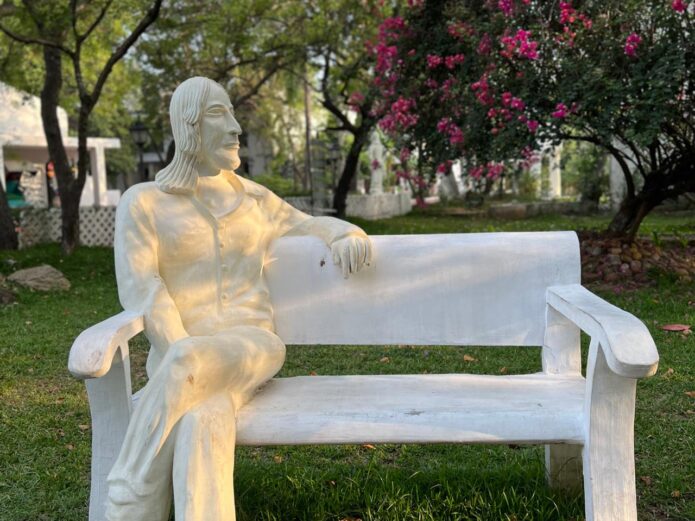
What they were describing, in plain English, was a man sitting on a bench looking at pigeons.

I have done this and will not pretend otherwise. I have sat on benches in Madurai, Mumbai, Melbourne, and a few places starting with other letters. And watched people cross roads, carry things, argue with autorickshaw drivers, and eat standing up. I have watched all of this with the focused attention of someone who is not quite sure what he is looking for but is confident it will appear.

This, apparently, is a philosophy.

The flâneur, has an artist’s eyes. He sees shape, colour and size. He freezes reality to step back and see the beauty in the bustle.

I read that sentence three times. The third time, I was fairly sure I had been doing something profound without knowing it. The first time, I thought it sounded like someone who had missed their bus and made the most of it.

Both can be true.

There is something to it, though. The bench is not wasted time. The watching is not idleness. If you sit still long enough in any city, the city starts performing for you. People forget you are there. A man on a motorcycle will argue with a traffic light. A woman will feed a crow with the precise movements of someone conducting a ceremony. A child will find a puddle that has no business being where it is and step into it with complete commitment.

None of this appears if you are walking with a purpose.

Perhaps being a flâneur is just having no plan and dressing it up in French.

I am fine with this.

Pay Attention

A teacher I had in Madurai had one instruction. Delivered daily. With the confidence of someone announcing a natural law.

Pay attention.

I paid. Mostly because she was terrifying.

It took forty years to notice the instruction was strange. You pay taxes. You pay rent. You pay for mistakes you didn’t entirely make. Attention, apparently, belongs in that list.

Seventeen browser tabs later

A few months ago, I was reading Steven Pinker. Something about language and how it shapes thought. A small question snagged. Why pay? I looked it up. Then something else. Then it was an hour later and I had seventeen browser tabs open and a strong opinion about German.

Here is what I found.

English is the only major language that treats attention as a transaction.

In German, you gift it. Freely. No invoice.

In Irish, you bring it somewhere, like a person arriving with something tucked under their arm.

In Japanese and Chinese, you pour your mind into something. Slow, deliberate.

In Arabic, the root of the word means to wake up. To attend to something is to be alive to it.

And then there is English. Where attention is currency, the mind is a wallet, and a classroom in Madurai is apparently a debt collection agency.

Lakoff and Johnson wrote a book called Metaphors We Live By. The argument, simplified badly, is that metaphors are not decoration. They are the architecture. The way you phrase something tells you what the thing actually is, in the mind of the person speaking.

Which is worth sitting with for a moment

The bill, and what it assumes

If attention is something you pay, it can be paid reluctantly. Dutifully. Resentfully. You can pay attention to a meeting you hate, a speech going nowhere, a relative explaining their knee surgery in considerable detail. Obligation discharged. Ledger balanced.

If attention is something you bring, that changes. You had to decide to carry it.

If attention is waking up, reluctant attention barely makes sense. Either you’re awake or you’re not.

In Tamil, the word is kavanam. From a root meaning to watch over something carefully. Almost protectively. Less a school instruction, more something you’d say to someone you trusted with something precious.

My teacher never said it that way. She had twenty three children and a chalk duster she was not afraid to use.

But I have been thinking about her instruction ever since. About what it asked for, and what it quietly assumed. That attention was a cost. That a child in a classroom in Madurai had a payment to make.

The metaphor you grow up with becomes the instruction you carry. It tells you what you owe, and to whom, before you are old enough to question it.

Decades later, I am still paying.

Though I’m no longer entirely sure to whom.