Personal Essay

Someone Called Me Names

Someone called me names last week.

Not in the way that requires an apology or a strongly worded reply. One name. Carefully chosen. Delivered with the quiet confidence of someone who has read more books than most people own.

The name was flâneur.

She is the kind of person who uses words like flâneur without checking if anyone is following. Well travelled, widely read, opinions that arrive fully formed and correctly spelled. When she says something, you nod first and look it up later.

She had just read two posts on this site. The one about paying attention. And the one where I photographed a feedback terminal in an airport washroom and asked who exactly goes to a washroom, takes out their phone, and clicks a picture of a smiley face survey.

I thanked her, because that seemed like the right thing to do. Then I went home and looked the word up.

A flâneur, it turns out, is someone who saunters through a city, watching the world pass by. The word is French, which is already suspicious. The French have a word for everything, and the word is always more dignified than the thing deserves.

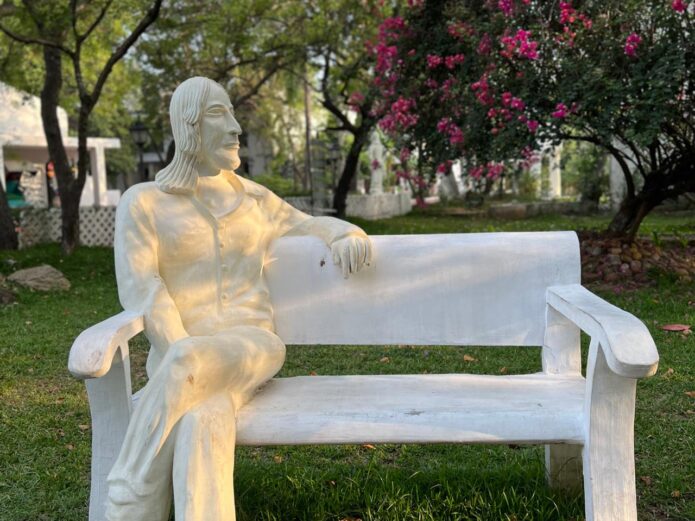
What they were describing, in plain English, was a man sitting on a bench looking at pigeons.

I have done this and will not pretend otherwise. I have sat on benches in Madurai, Mumbai, Melbourne, and a few places starting with other letters. And watched people cross roads, carry things, argue with autorickshaw drivers, and eat standing up. I have watched all of this with the focused attention of someone who is not quite sure what he is looking for but is confident it will appear.

This, apparently, is a philosophy.

The flâneur, has an artist’s eyes. He sees shape, colour and size. He freezes reality to step back and see the beauty in the bustle.

I read that sentence three times. The third time, I was fairly sure I had been doing something profound without knowing it. The first time, I thought it sounded like someone who had missed their bus and made the most of it.

Both can be true.

There is something to it, though. The bench is not wasted time. The watching is not idleness. If you sit still long enough in any city, the city starts performing for you. People forget you are there. A man on a motorcycle will argue with a traffic light. A woman will feed a crow with the precise movements of someone conducting a ceremony. A child will find a puddle that has no business being where it is and step into it with complete commitment.

None of this appears if you are walking with a purpose.

Perhaps being a flâneur is just having no plan and dressing it up in French.

I am fine with this.
This Moment That Is Slipping Away

Some lines stay. Some lines stir. A few quietly rearrange the furniture of the soul.

This one does not shake the house. It simply opens a window.

“The melody, a familiar current, pulled me instantly into the salt spray of a past self, revealing the sharp, inexplicable distance between who I was then and the present silence.” — Albert Camus

Songs from your wonder years always do this. They sneak up on you. No warning. One bar, and you are no longer here.

You are back in a room with an old 2-in-1 Panasonic tape recorder. Slightly temperamental. The eject button needed persuasion. The shelf above it carried a mélange of cassettes — handwritten labels, some spelling errors, all confidence. There was a particular smell in those rooms. Spices. Paper. A hint of ambition. Friends leaning in. Someone always claiming superior taste in music. Windows open to a world that felt large and somehow still manageable.

You remember the small-town ease of it. The presence.

And then you look around now. The devices are thinner. The music is cleaner. The storage is infinite. The shelf is gone. The room has changed. So have you. Scrolling, infinitely.

Nostalgia is a peculiar accountant. It tallies what was gained. It also, without fanfare, tallies what slipped away while you were busy refreshing screens.

A song does not merely remind you of who you were. It introduces you to the distance travelled.

The Thief in the Room and the Myth We Bought

There is, of course, a small device-shaped problem.

The phone. Eternally present. Faintly glowing. Always with something more urgent to offer than the room you are actually in. I have, on more than one occasion, reached for mine mid-conversation — not because anything important was arriving, but simply because the hand has developed its own ambitions.

It has successfully convinced an entire civilisation that the present moment is somehow insufficient. That whatever is happening here needs to be supplemented, checked, or at minimum photographed for later.

The other great lie, sold with equal confidence, is multitasking. The brain can hold one thing at a time — what we call multitasking is simply rapid switching between tasks, getting slightly worse at each of them, while feeling impressively busy throughout.

I have attended meetings in my head while being physically present in other meetings. The results were about what you would expect.

Neither of these revelations is new. What is mildly embarrassing is how consistently surprising they remain.

The Archivist Is Already at Work

Right now, something ordinary is happening around you. A voice in the next room. A cup placed on a table. A small irritation. A smaller delight. It feels entirely forgettable. It is not.

This, too, will one day be a melody. It will carry some future version of you back to a self you cannot yet imagine missing.

Bryson would probably note that memory is a slightly unreliable archivist with a fondness for soft lighting and selective omission. He would be right. But even unreliable archivists preserve something true. Something with weight.

So perhaps the only sensible response is to live this moment fully enough that it has something to give back later. Not as a performance. Not arranged for a photograph. Not in pursuit of the brief dopamine flicker of approval.

In the texture, instead. The awkwardness. The unfinished conversations. The imperfect furniture of today. The neighbour who burnt his bread and somehow let the whole floor know without making a sound.

You never know what the archivist will choose to keep. Or when a stray tune will pull it back out into the light.

Let it have something rich to retrieve.

A few days after these thoughts had been circling, Haresh Chawla wrote something on Founding Fuel that arrived like a companion piece. He approaches it from the other direction — not what memory retrieves, but what we keep deferring. The two ideas sit in quiet tension: anticipated memories pulling us forward, selective nostalgia pulling us back. Both, in their own way, are exits from the present. The destination, though, is the same.

_________________________________________________________________________________________

On a related thought — The Leisure We Forgot