philosophy

The Airport That Never Loses Your Bag

My life fits inside a suitcase. Literally.

My life, for better or worse, has been organised around a single suitcase. The suitcase and I have logged more miles together than I have with most people I know. It does not complain. It does not have opinions about the hotel. It simply arrives. Usually.

Sometimes, though, it waits in the wrong place. I have landed in San Francisco while my bag sat in Singapore. I have cleared immigration in Brisbane while my suitcase was still somewhere over the Indian Ocean, presumably enjoying the flight more than I did. Each time, there is that particular sinking feeling at the carousel. The belt moves. Other people’s bags appear. Yours does not.

It is harrowing in a way that is hard to explain to someone who hasn’t lived out of one bag for months at a time.

The rabbit hole

On one of those occasions, bag delayed, gate agent apologetic as the process warrants, scrolling through something on her device. A smile played at the corner of her lip. It was not about my suitcase. A lost bag offers very little to smile about. Although, who knows.

I found myself in the airport coffee shop with nothing to do but wait and drink. The coffee was doing its job. And then the data I was reading did something coffee rarely manages. It made me sit up straight.

Kansai International Airport opened in 1994 on an artificial island in Osaka Bay. Since that first day, it has not lost a single piece of luggage. Not one. It handles around 10 million bags a year. It has won the global award for best baggage delivery eight times.

In the United States, domestic flights lose 3 million bags every year.

I read that sitting at a gate, waiting for my bag to arrive on the next flight, and felt something between admiration and mild despair.

The man at the carousel

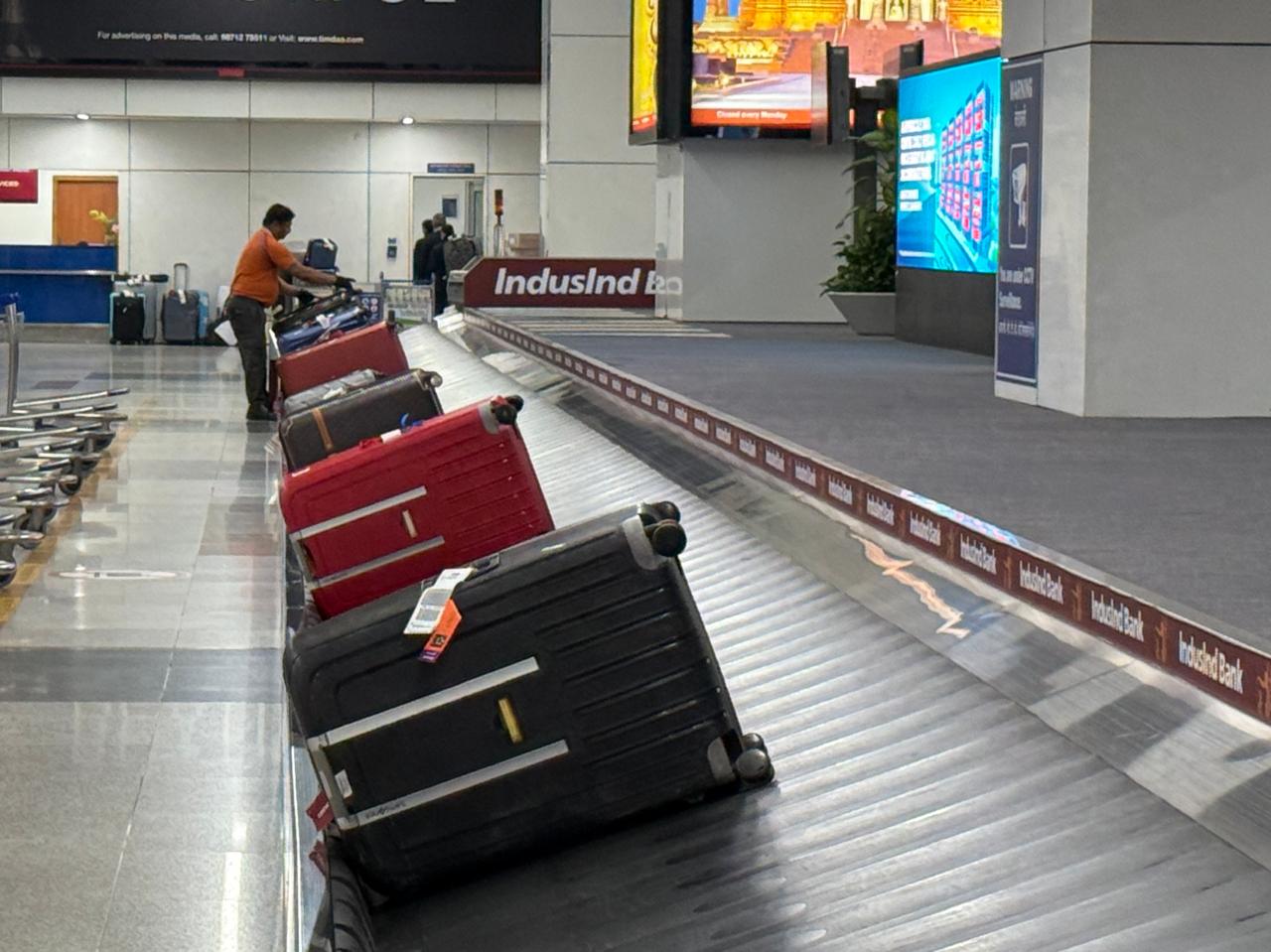
A few weeks ago, at Terminal 3 in Delhi, I watched a ground handler doing something I had never seen before. As bags landed on the carousel, he straightened them. Turned them. Arranged them so the handles faced outward.

Someone had clearly told him to do this. A new manager, perhaps. Or someone keen to get a good rating. Or both, which is usually how these things happen. My sceptical mind went there immediately. Because I had not seen this before at Delhi. Or maybe I had, and the carousel anxiety had made me look only at the bags.

Bangalore’s Terminal 2 has been doing something similar. The handles face outward there as well. The bags arrive with a certain quiet orderliness that feels deliberate.

Mumbai is a different story. At Mumbai, the correct posture is gratitude. If your bag appears at all, and within the same hour as you, the appropriate response is quiet thanksgiving. The handle direction is not the concern. Arrival is the miracle.

And yet, Delhi and Bangalore matter. The detail lands, regardless of what drove it. Someone, somewhere up the chain, looked at a carousel and thought: this could be better.

It stayed with me. And then Osaka made sense. Because Osaka had been doing the same thing, at every carousel, since 1994. Except nobody told them to. They just decided it mattered.

What they actually do

Kansai’s secret, when you finally prise it out of them, turns out to be deeply unsatisfying. Small teams. Manual counts. A rule that if the number of bags unloaded doesn’t match the number loaded, you stop everything and look. The bag reaches the carousel within 15 minutes. The handle faces outward.

That is it. No algorithm. No proprietary system. Just people who count bags twice and arrange handles and apparently find this entirely normal.

I went deeper into the rabbit hole looking for the dramatic reveal. An airport official told NPR that the record was “the result of the daily efforts and careful work of everyone involved.” Then added, with a courtesy that itself felt Japanese: “We apologise if this would be not a specific answer.”

It was not. It was also completely honest.

Another official, speaking to CNN, was even more deflating. “We don’t feel like we have been doing something special,” he said. “We have been working as we normally do.”

Thirty years. Zero bags lost. Business as usual.

What actually drives it

Tsuyoshi Habuta has run baggage operations at Kansai for 17 years. His explanation makes the spokesperson look verbose. Luggage is precious to passengers, he says. So it should not go missing.

That is the whole argument. Seventeen years. Ten million bags a year. Thirty years of an unbroken record. And the philosophy fits in one sentence.

He is not chasing a bonus. He is not hitting a KPI. He has decided, at some point that probably passed without ceremony, that a stranger’s suitcase deserves to arrive. That quiet decision, renewed every morning, is what the record is actually made of.

The Japanese have a word for this. Omotenashi. It translates as wholehearted hospitality, but the translation loses the edges. What it really means is that you attend to what the other person needs, whether they are watching or not. Especially when they are not watching.

The gap that cannot be downloaded

A process can be copied. A checklist can be shared. But the thing that makes Habuta count bags at 4am with the same attention as the first day, thirty years in, with nobody watching and no applause coming, that cannot be transferred in a training manual. It has to be believed.

Most airports move bags. Kansai returns them.

The difference is entirely in what the people there think they are doing when they show up.

Someone Called Me Names

Someone called me names last week.

Not in the way that requires an apology or a strongly worded reply. One name. Carefully chosen. Delivered with the quiet confidence of someone who has read more books than most people own.

The name was flâneur.

She is the kind of person who uses words like flâneur without checking if anyone is following. Well travelled, widely read, opinions that arrive fully formed and correctly spelled. When she says something, you nod first and look it up later.

She had just read two posts on this site. The one about paying attention. And the one where I photographed a feedback terminal in an airport washroom and asked who exactly goes to a washroom, takes out their phone, and clicks a picture of a smiley face survey.

I thanked her, because that seemed like the right thing to do. Then I went home and looked the word up.

A flâneur, it turns out, is someone who saunters through a city, watching the world pass by. The word is French, which is already suspicious. The French have a word for everything, and the word is always more dignified than the thing deserves.

What they were describing, in plain English, was a man sitting on a bench looking at pigeons.

I have done this and will not pretend otherwise. I have sat on benches in Madurai, Mumbai, Melbourne, and a few places starting with other letters. And watched people cross roads, carry things, argue with autorickshaw drivers, and eat standing up. I have watched all of this with the focused attention of someone who is not quite sure what he is looking for but is confident it will appear.

This, apparently, is a philosophy.

The flâneur, has an artist’s eyes. He sees shape, colour and size. He freezes reality to step back and see the beauty in the bustle.

I read that sentence three times. The third time, I was fairly sure I had been doing something profound without knowing it. The first time, I thought it sounded like someone who had missed their bus and made the most of it.

Both can be true.

There is something to it, though. The bench is not wasted time. The watching is not idleness. If you sit still long enough in any city, the city starts performing for you. People forget you are there. A man on a motorcycle will argue with a traffic light. A woman will feed a crow with the precise movements of someone conducting a ceremony. A child will find a puddle that has no business being where it is and step into it with complete commitment.

None of this appears if you are walking with a purpose.

Perhaps being a flâneur is just having no plan and dressing it up in French.

I am fine with this.

7 stones

Back then in school, oh yes, you remember when you were in school, don’t you? When the biggest possible worry was what the questions in mid term results could be.

When chief amongst the wonders of the world that you couldn’t figure out would be the acute deprivation in that human mind that caused him or her to think up of something as weird as Trigonometry. And then roll your eyes with even more wonder on the mind that thought of including as vile a subject as that in the syllabus!

These were brief interludes. At other times, you were free to do as you thought fit. Many times you just did and only then thought about if what you did ‘fit’ into acceptable scheme of things.

Ah. School days.

No this post is not about school days. Technically. No. this post is about a game called ‘Seven Stones’. That’s a game that caught attention much before games like basketball and volley ball emerged in the horizon.

It didn’t predate cricket, but then, cricket required equipment that was banned by the school. You had to be a Houdini to be able to smuggle in a bat and three stumps. Tall ask. But you could always find seven stones and on the field, and take aim with a smuggled rubber ball.

The rules were simple.

1. There were two teams. One that had to aim the rubber ball at those stacked up seven stones. As soon as the stack was broken, the same that broke it attempted to rebuild all of the seven stones again.

2. Oh yes, the other team weren’t twiddling their thumbs or picking their noses while this restacking happened.

3. They had to aim the ball and hit the members of this ‘rebuild’ team beneath the knees to get them ‘out’. If the ball ‘hits’ you, you are out.

4.Eventually there are fewer and fewer players around to rebuild.

5. The team that would build all of the seven stones before all its players are knocked down, or the team that knocks down all of the players before they can build up the tower of seven stones, is the winner.

Detailed rules are here

After this game ‘players’ would then go back to wondering whoever invented Trigonometry. Or why some crazy Midsummer Nights dream wasn’t as interesting as some of the other dreams that they would rather talk of.

Does this sound familiar ? Well, hold on. The world thinks that the Iraq war has no precedents. I beg to differ.

Examine it if you will. What were established cities, dams, roads , hospitals and the like were pulverised with remarkable accuracy. The news channels giving it a coating of pulchritude, as though it was some fireworks show! People died. Many were maimed. And many more left to fend for themselves.

Ofcourse, the rebuild effort started with greater speed by the same folks who pummeled the land. Like in the game of seven stones, the other team werent sitting there twiddling their fingers. They hit the re builders, usually, beneath the belt.

The other day in an animated discussion about the validity ( or the lack of it ) about the Iraq war, an animated participant said that this was the original idea of one Mr.Bush and another Mr.Blair.

Which is when the animated participant was calmly told that it was a ‘stolen’ idea. With an ever smart twitch of the corporate collar, a smirk and a slanted neck ( which is corporate speak for ‘ha ha you moron you shot yourself on the foot – I got you’) “so whats the evidence ? How can you prove this? “ the participant asked.

With an all pervasive calmness that would befit a zen master, the participant was told ‘go get me seven stones and a rubber ball’ !

Herd Wisdom !

One of those days, we drive. From Diveagar to Shriwardhan. It’s a nice drive. As is typical of me, I am unsure of the way ahead. We look around, alight from the car and walk a bit. The landscape is inviting. We aren’t keen on arriving at Shriwardhan ‘on time’. We are just headed in that direction.

We look around.


He walks by. He. His goats. His calfs, cows and buffalos. Bermuda shorts. T-Shirt. Baseball cap turned backwards, as a baseball player would. Umbrella. A huge stick that could almost excite an amateur pole vaulter. A tan on the skin and weary twinkle in the eye.

He squints at us enquiringly !

I ask him, ‘Shriwardhan ?’

Before I could complete, he says in what seems to be indifferent yet focused tone : ‘Go straight and stay on the right’. The speed and ease, combined with the seeming ease of getting there by just ‘going straight and staying on the right’, for 20 odd kilometers dont add up in my educated mind.

Truth be told, i dont know if he is telling me or this is a standard instruction for his cows and buffaloes !

I repeat, using my professed urban intelligence : ‘Shriwardhan’. Slowly. Like a teacher of a English pronunciation class working on a group of students who have studied through Tamil medium.

“ Shriii-Wardhan ????”…

He replies with a tinge of irritation and a twang of dismissal. Accompanied with a body language which lets me know that I asked the way to Shriwardhan and not to the South Pole. “Go straight. Stay on the right”

He speaks Marathi which the missus struggles to pick up, much evident from her furrowing eyebrows. A couple of staccato sentence exchanges. She translates. ‘The scenery is beautiful, he says, but he urges us to go straight and stay on the right’

He moves on. Tending to disobedient cow and the svelte buffalo with swagger. We drive on too. Driving by such splendid scenery as I can ever imagine.


Roads. Greens. Sea. Roads with a view. And a view with no roads. Of cattle. Of boats. Occasionally of people. And of course, of bobbing fishing boats in every fishing hamlet !

In some time, we reach Shriwardhan. A simple quaint and wonderful place.

That evening, I walk by the sea thinking of the day that’s been. The waves rush to shore, dissipating into nothingness, at the speed at which they arrive. A smile escapes my lips. Thinking of us, our lives, our strifes and such else, much like the waves in perpetual quest of the shore.

A dog runs by giving me a sympathetic look. Bubble crabs run all around the sand. A few kids are wading into to the water.

For some reason, the mind races to a svelte buffalo twitching its dirty tail. Just as a voice rings in the ear : ‘Go straight and stay on the right’ !

A pause and a full minute later, i realise that is sure something to keep in mind.

Sure !


Salted history

I used to hate him. Hate him with the bottom of my heart. For what he did to his father. For what he did to his brothers. For what he did to many many thousands of people who he killed and mowed and so on.

Yet today, i want to see him. Kind of go stand where he lies. Its ironical. For my friends don’t want to go anywhere close. Not because they hate him as much.

But today to go close to him, you have to go to a small nondescript place. A place nondescript enough that without direction and desire to get there, missing it would be normal ! He perhaps had all of India under his thumbs. Palaces were built and minor empires destroyed with a casual wave of a hand.

And all who talked thus far, about him, talked with a sense of borrowed spite and frown. The eternal bad chap image stayed fixed. Today, the simplicity of what i hear moves me to think.

Today, another man gives us another angle:

Imagine being born in a royal family. Imagine seeing your head of state dad, spend crane heaps of government money on a tomb for his wife. Imagine you having consternation about it. Imagine having the resolve to fight for simplicity yet scale. Fight anybody.

From an aggressive neighbour to your own father. Imagine ruling the land with great simplicity and methodical precision. Imagine living a simple frugal life when surrounded by royal splendour.

Imagine stitching caps and writing the holy scripture. The proceeds of which, you mandate, is all that would go to making of your own tomb ! I

Imagine, first of all, mandating that there wont be a significant tomb, despite being the emperor of India ! Imagine Aurangazeb.

As the shudder runs down the spine all the way to the left toe, he adds. “History is written by the victor. Its never factual”. The tourist guide moves me.

In some time we reach Khuldabad. In what appears to be another mosque in a predominantly muslim neighbourhood, Aurangazeb’s lies at the feet of his guru. No grand structure. Simple and quiet.

The Taj loses sheen in the mind. Think of it this way: Shah Jahan built the Taj out of government money and emptied the state coffers. His son threw him in jail ruled the land ably and died a simple man.

Well, i dont know what the truth is. None of us will never ever know. But then, i have resolved to read history with pitchers of salt by the side.

And as Dylan says, “All the truth in the world adds up to one big lie”

On the Wall : Ilusory Irony !

The mention of the word Maya, gets me philosophical !

All of the world is Maya. Thats what i knew. I thought of Maya in great awe, and uttered ‘MAYA’ with an air of respect, and a circle of awe. Until a couple of days back.

‘All of the world is Maya’, i have read in the epics. Everything is but an illusion and everything is taken from HIM, says the Gita.

Realisation that the world has moved on from there, caught me by surprise. Completely. That for sometime, i thought of myself as a lost soul getting off a ship that was moored in the middle of the Indian ocean for a million years !

Actually, this poster sent me scurrying for knowledge.

And i returned with understanding that Maya is the name of an animation software. Aha !

But think of the irony. The poster that advertises to make you an expert in animation, by studying Maya….is stuck on top of another that announces the death anniversary of a gentleman !

Maya ! Huh !

Javas transformation from coffee to software gave didnt excite me. One bit. I hope Maya stays illusory !