humour

Someone Called Me Names

Someone called me names last week.

Not in the way that requires an apology or a strongly worded reply. One name. Carefully chosen. Delivered with the quiet confidence of someone who has read more books than most people own.

The name was flâneur.

She is the kind of person who uses words like flâneur without checking if anyone is following. Well travelled, widely read, opinions that arrive fully formed and correctly spelled. When she says something, you nod first and look it up later.

She had just read two posts on this site. The one about paying attention. And the one where I photographed a feedback terminal in an airport washroom and asked who exactly goes to a washroom, takes out their phone, and clicks a picture of a smiley face survey.

I thanked her, because that seemed like the right thing to do. Then I went home and looked the word up.

A flâneur, it turns out, is someone who saunters through a city, watching the world pass by. The word is French, which is already suspicious. The French have a word for everything, and the word is always more dignified than the thing deserves.

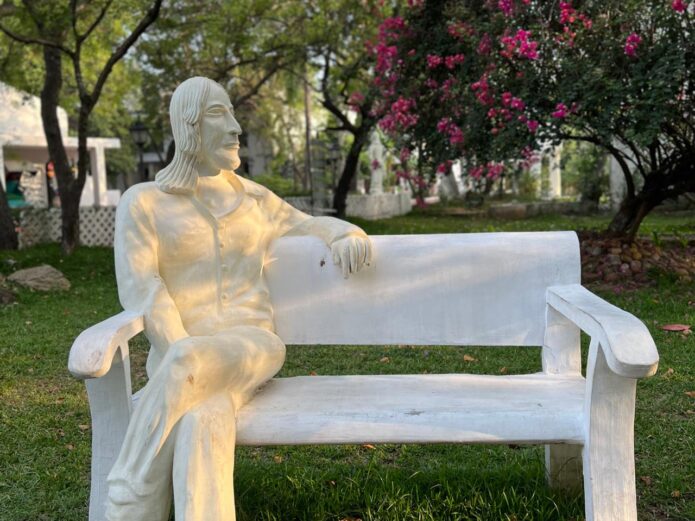
What they were describing, in plain English, was a man sitting on a bench looking at pigeons.

I have done this and will not pretend otherwise. I have sat on benches in Madurai, Mumbai, Melbourne, and a few places starting with other letters. And watched people cross roads, carry things, argue with autorickshaw drivers, and eat standing up. I have watched all of this with the focused attention of someone who is not quite sure what he is looking for but is confident it will appear.

This, apparently, is a philosophy.

The flâneur, has an artist’s eyes. He sees shape, colour and size. He freezes reality to step back and see the beauty in the bustle.

I read that sentence three times. The third time, I was fairly sure I had been doing something profound without knowing it. The first time, I thought it sounded like someone who had missed their bus and made the most of it.

Both can be true.

There is something to it, though. The bench is not wasted time. The watching is not idleness. If you sit still long enough in any city, the city starts performing for you. People forget you are there. A man on a motorcycle will argue with a traffic light. A woman will feed a crow with the precise movements of someone conducting a ceremony. A child will find a puddle that has no business being where it is and step into it with complete commitment.

None of this appears if you are walking with a purpose.

Perhaps being a flâneur is just having no plan and dressing it up in French.

I am fine with this.
Spilled Water, Sharp Wit, and a Lesson in Leadership

It was a long oak table. The kind around which serious men in serious suits talked serious strategy.

The Managing Director was about to make a big presentation. Papers needed to be passed around.
Years ago, as a junior manager, I’d been entrusted with setting it all up. I grabbed the opportunity with both hands. Possibly legs too.

I had worked closely with the CEO. Learnt a ton. And put it all together like my life depended on it. Because, frankly, it felt like it did.

People filed in. The room filled up. And just as the meeting was about to begin, Murphy showed up. My elbow hit a glass of water. It emptied itself on the neat sheaf of the CEO’s printed presentation. Numbers, projections, strategy, all now soaking in regret.

Right then, the CEO walked in. I froze. So did time.

He looked at the mess, smiled, picked up the damp stack, and said:Well, here’s a watered-down version of next year’s strategy.”

The room erupted. The tension vanished. The meeting was sharp, alive, and unexpectedly joyful.

And I learnt something I’ve never forgotten: The best leaders don’t just stay calm in a crisis. They know when to crack a joke.

These days, humour has become something else. It’s often loud. Crass. Sharp-edged. Reduced to personal attacks, one-upmanship, and clever jabs. It’s lampooning more than laughing. And it leaves no room for dignity. Only applause or offence.

Which is a pity. Because true humour of the quiet kind, the kind with timing and taste, adds a certain sophistication to everyday life.

It disarms. It connects. It shows perspective. It’s not about who can say the most outrageous thing as much as it about holding the moment lightly, without letting it slip.

Stanford thinks so too

At Stanford’s Graduate School of Business, Professors Jennifer Aaker and Naomi Bagdonas teach a popular course called Humour: Serious Business. Their research is clear: humour is an underrated superpower in leadership.

Used well, it boosts trust, increases engagement, and makes communication stick. More interestingly, humour makes leaders appear more competent, not less.

Because being able to laugh — and more importantly, to make others laugh, signals something powerful: you’re comfortable. You’re present. You’re not afraid of the room.

And the very best leaders? They don’t just use humour. They can take a joke too. Without flinching. Without getting defensive. Often, with a smile and a comeback that lifts the moment rather than hijacks it.

Humour is the glue

There’s a Japanese art form called kintsugi. It involves repairing broken pottery using gold. The cracks are not hidden. They’re highlighted. Because the break is part of the story. And the gold, quite literally, holds it all together.

I think humour plays a similar role in leadership. When things crack, as they often do, humour is the gold we can pour into the situation.

It doesn’t erase the problem. But it holds the room together, highlights resilience, and reminds everyone that we can move forward. With perspective.

The best part? Once you’ve laughed with someone, it’s much harder to stay divided.

So how do you cultivate this?

Start by observing. Noticing moments of lightness or the ones begging for it. I once worked with a manager who was famous for his campus presentations. He would rehearse meticulously, plan every slide and then grin and say,

“In the fifth minute, I’ll crack a spontaneous joke.”

Yes. Spontaneous, by appointment. And strangely, it worked. The room laughed. Every time. For some people, humour is a performance. 

But for the truly great ones, it’s a practice. It comes from noticing. From being present. From taking small risks. And yes, from being open to taking it on the chin when it doesn’t land.

The next time you’re in a heavy meeting, watch what lifts the room. It’s rarely slide 47. It’s often a well-timed comment. A look. A line. Something small but true.

Read people who write with wit. Hang around people who laugh easily, not just loudly. And most importantly, practise on yourself. Learn to take a joke. Especially about yourself. That’s the real test. And the best training ground.

The Closing Line

This is not a call to turn every meeting into a stand-up set. At best, It’s a quiet reminder that in ‘serious’ rooms , a well-timed laugh can change everything.

It humanises the moment.

Because humour, when done right, doesn’t just break the ice. It becomes the gold that mends the cracks. The pause that helps the room breathe. The tiny spark that reminds us: we’re all in this together. Elbow, water spills and all.

And maybe, just maybe, the best way to hold the room, is to let it laugh.

Who moved my lottery ?!?

So, I have won the lottery. The UK Online lottery! Well, at least, that’s what this mail states. “After this automated computer ballot, your e-mail address emerged as one of ten winners in the FIRST category for the THIRD prize”. And at thousands of pounds for no work and my mail id bringing me luck, well, what can I ask for.

This is what the mail said :

The National Lottery is pleased to inform you that you emerged a winner of £3.000.000 GBP in the last concluded National Lottery online draws on 17 th Oct ‘07. However, no tickets were sold butall email addresses were assigned to different ticket numbers for representation and privacy.

After this automated computer ballot, your e-mail address emerged as one of ten winners in the FIRST category for the THIRD prize.Your prize award has been insured with your e-mail address and will be transferred to you upon meeting the requirements, statutory obligations, verifications, validations and satisfactory report. .

So, they said. And interesting it did seem !

There are two factors that drive all of the world, I read somewhere : “ Fear & Greed” ! Over the past so many months there have been ever so many lottery ‘winners’ who were supposed to send in ‘some’ money to a foreign account to ‘meet requirements, statutory obligations, verifications, validations and satisfactory report’.

Well, the money that these ‘winners’ were sending was booty for somebody else. People kept sending in money. Week after week. Some demand was made on a inventive pretext. “Transfer Fee’. “Currency Tax’ ! And the booty was just around, in the minds of people. They could almost reach it if they paid the ‘tax’. And finally, they did pay some ‘tax’. For money that stayed in their minds.

No way was i going to give my address, telephone number and bank account details. Well, maybe I am missing the thousands of pounds. Maybe I am driven by Fear ! what say ? Maybe I have actually won the lottery!

But what perhaps almost gives me a conniption fit is this: I emerged as one of the ten winners for the third prize ! This is a fictitious prize given by some gangster holed up in front of some computer in some land. He must realise that he is sending this to an Indian. Where 3,00,000 people fight to get admitted into colleges which do not have more than 7000 seats. The first prize matters dude !!!!

Oh boy ! The First Prize & me seem destined not to meet! Even in the concocted imagination of a creative criminal !!