The man arrived at ten in the morning with a helper, a trolley, and a face that had seen too many dining tables to feel anything about this one.
He walked around it once. Tapped a leg. Looked at the surface with the practiced detachment of someone assessing timber, not history. Then he named his price. It was not the price you pay to take something away. It was the price you pay someone to do you a favour.
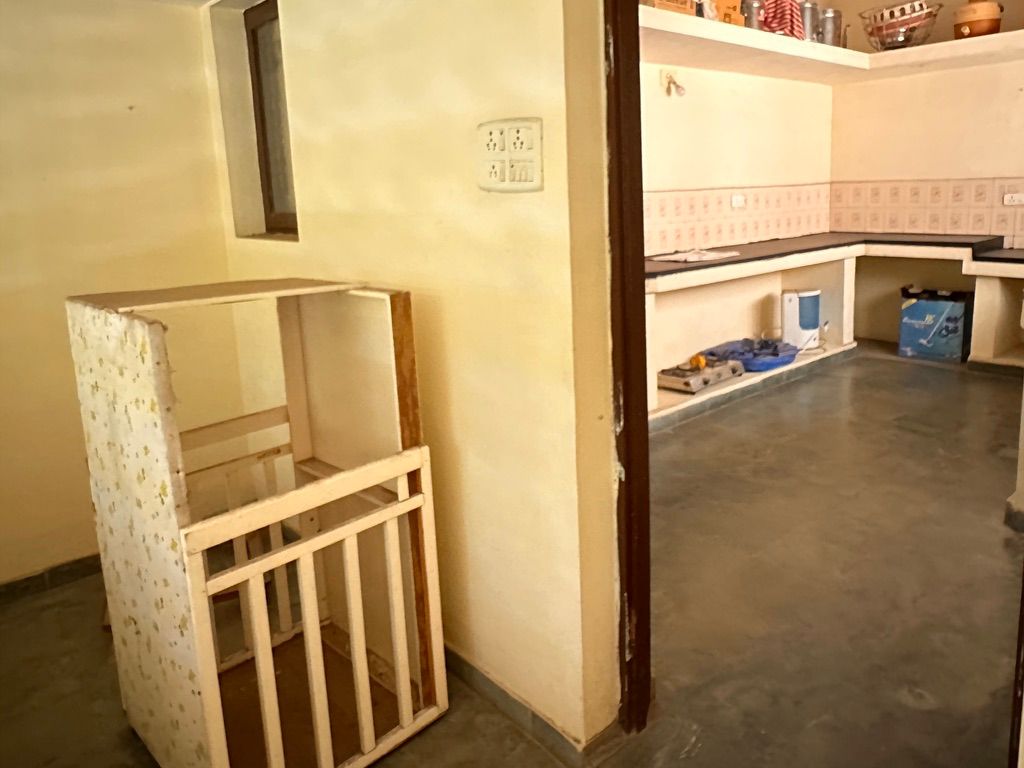
I looked at the table. Twelve years of breakfast. The dent where my daughter, age two, introduced her head to a hard surface and delivered her first proper howl. The chair she stood on, aged four, reaching for something she absolutely should not have reached for. The evening she ate her first real meal there, small fork, enormous concentration. The man with the trolley saw none of this. He saw four legs and a surface. I paid him to take it away. The room looked larger and felt considerably emptier than its dimensions suggested.
This is the problem I cannot solve. Acquiring is effortless. Disposal is grief dressed up as logistics.
The Ticket from Vegas
I have, somewhere in a box that has moved with me across three cities, a paper ticket from a trip to Vegas in 2012. Every time I reach for it to throw it away, something stops my hand. The ticket is not a ticket. It is a sealed jar containing whatever I was feeling on the day I stuffed it into my pocket. I do not know what that feeling was. I am apparently not willing to find out.
This is the part nobody warns you about when they talk about letting go of things. It is not disorganisation. It is attachment, distributed across a thousand objects, each one a small protest against the fact that time moves in one direction only. The New Yorker ran a piece on the heroic misery of trying to offload things. Its sharpest line: people prefer cheap to free. Meaning a price tag, however small, signals that something has been assessed and found worthy. Free signals the opposite. You cannot even donate your way out of the problem.
The Boxes
I have been thinking about the boxes. Not the contents. The boxes things come packed in. There is one on a shelf right now. Bright red. A perfume box, foam insert intact, carrying a faint trace of what it once held. The perfume ran out some time ago. The box did not. Too well made to throw away. Next to it, the moisturiser container with the elegant pump, long empty. And the iPhone box from two upgrades ago, because the cardboard was so clean.
If you cannot bring yourself to throw away the container, you were never going to throw away the thing inside it.
The Invisible Kind
A twenty-eight-year-old in that same piece offered a thought that stung: we have moved our accumulation online, he said. Digital purchases give the illusion of minimalism. The clutter is still there. It is simply invisible. Clay Shirky said in 2008 that the problem was never information overload. It was filter failure.
Free storage means no friction at acquisition, and no friction means no moment at which you pause and decide. The screenshots accumulate. The downloads folder fills. The brain does not distinguish between a drawer of cables for devices you no longer own and a folder of PDFs you will never read.
The Warehouse Economy
The United States has more than 50,000 self-storage facilities: warehouses you rent by the month for things you cannot fit at home and cannot bring yourself to discard. More of them than McDonald’s, Starbucks, and Subway combined. One in ten Americans rents a unit. The monthly rent, paid quietly over years, often exceeds the value of what sits inside.
India is building the same economy now, and faster. What we are storing, in the end, is not furniture. It is a mental state: unresolved pasts, uncertain futures, and abundance without clarity.
Learning to Let Go
Clutter is expensive. It costs the mind more than we admit: the low hum of unfinished decisions, the guilt of things unused, the weight of objects that demand nothing and take everything quietly. In a city like Mumbai, where every square foot has a price, it costs the home too. Space given to things you no longer need is space you are paying for twice.
I am trying to change this. Genuinely trying, not aspirationally trying. Filtering at source, before things arrive rather than after. Keeping the memory and releasing the object. The dining table is gone. What I was trying to keep was not the table. It was my daughter at two, howling. That is still here. It requires nothing except the occasional willingness to let it surface on its own.
I do not have this solved. What I have is the intention to work on it seriously, and the humbling recognition that intention is not the same as action. If you have found a way through this, I am genuinely interested. Tell me what worked. Tell me what you have not been able to let go of, and why.
The dining table is gone. The Vegas ticket is still here.
We are both works in progress.
12 responses
You touched a raw nerve on this one, Kavi. It is timely and much required. But it is true. I am hopeless at letting go. I cling onto objects, memorabilia, fancied packaging, letters, old note pads with notes I was proud of a long time ago… In short, a quintessential hoarder. The better half picks many a bone with me on this trait. Till, with a heavy reluctance and a heavy heart I succumb to the pressures of spring cleaning. Inevitably, with growing years, and reducing memory that prevents me from accessing what I look for, the household is poised to downsize to only what’s currently essential. The nostalgia lives on virtually in the mind, without the prop of substance, where it now gets summoned as many happy returns. Just saying.
The note pads with things you were proud of a long time ago — that one is so much of what I do too. There is something particularly difficult about the evidence of a former self, the version of you that wrote that note, attended that meeting, felt that proud. Throwing it away feels like a small betrayal of who you once were 🙂
And yet you have landed on something important: the nostalgia lives in the mind, not in the prop. The household downsizing will be hard. But it sounds like you already know where the memories actually live.
That’s a really a tough one . I am classic hoarder from books to stamps to all the empty boxes to travel tickets and souvenirs. Separating the object from the memory requires some effort. Sometimes we have to give permission to keep a symbol .. letting go of 2000 odd books to a library – comic books bought from saved pocket money was painful, it took time . Sometimes you wait if the body resist and then act on it, sometimes I think you are tired to resist . Still struggling around this .. have seen my friends who practise minimalism , give away a piece of cloth to buy a new one ( I still have those conference t shirts I sleep in from a sales conference 20 years ago )
Two thousand books to a library. Comic books bought with saved pocket money. That is not decluttering. That is surgery!!
Btw, the conference t-shirt you still sleep in twenty years later is perfect, by the way — it has found its function. I sleep in some too. Though not of the same vintage! 🙂
Perhaps that is the test: not whether something sparks joy in the Marie Kondo sense, but whether it has quietly found a use, however unexpected. The ones that have neither use nor clear memory attached are perhaps the ones to start with.
There is a hook the wall bracketing the narrow passage to the bedroom. On the hook, once, were the lanyards of various conferences I attended, a few I spoke at. One has the address of the IMO London and another the IIT Madras. I would pass them by every day.
One day it was gone. It was in fact gone for many days and I hadn’t noticed. The gangster ruthlessness and the surgical precision of the act can only be appreciated in hindsight. I have someone at home who sees a larger picture. Reading this post, I also see the kindness that underlies the ruthless precision.
Thank you. The gangster ruthlessness and surgical precision of someone at home who sees the larger picture. That is one of the finest descriptions of a spouse’s relationship with a partner’s clutter that I have read. 🙂
The lanyards from IMO London and IIT Madras, gone for days before you noticed. That is the real data point. Not that they were removed. That you did not miss them. Worth thinking about. I have a few of them too.
Beautiful!!
We all are I guess somewhere in the middle ..can let go few stuff as we know otherwise more cannot come ..and not let go some because of our memories with them..
Somewhere in the middle is exactly right Chaula.
The binary — keep everything or release everything — is a false choice. Most of us live in that corridor, letting go of a few things, holding on to others, and making our peace with the fact that the line shifts with time.
I tell myself that it is not weakness. That is just being human about it.
Kavi! this is awesome! I loved the above article – simply because I resonate so much with it! similar to your Vegas ticket, I have been holding our Singapore ticket, where we travelled to, more than a decade ago. And about the disposal of items! this is my top issue today. so many things and I am struggling to let go. My house is in a mess, (though not fully,) mainly because of my things! this is a timely article.
The Singapore ticket. Of course there is a Singapore ticket. There is always a ticket. The specific city changes, the decade changes, and the ticket stays exactly where it was, in a drawer, in a box, in a pocket of a bag you no longer carry. I think we keep them because throwing them away feels like admitting the trip is truly over. Which it is. But still. You are not alone in this. Not even slightly. 😀
I suspect this has to do with long years of neural wiring. Our societies were used to both famine and drought. Floods in some places. That deep insecurity shows up in everyday objects. The number of pairs of shoes, slippers, for example. Conserving for hard times is the forerunner. All modern day attributions are to be understood more fully. What does the brain predict? How does it feel restored?
Thank you Joseph. This is a genuinely interesting frame and I think you are right. The neural wiring runs deep, and societies that have known scarcity do not unlearn it in one generation of abundance.
The shoes, the slippers, the extra everything — it is not irrationality. It is memory encoded in behaviour. The brain predicts hard times because hard times have happened, and objects feel like insurance. The question of what makes it feel restored is the harder one. I am not sure I have an answer.
But I suspect it begins with the recognition you just described: that the holding on is not random. It has a history.