

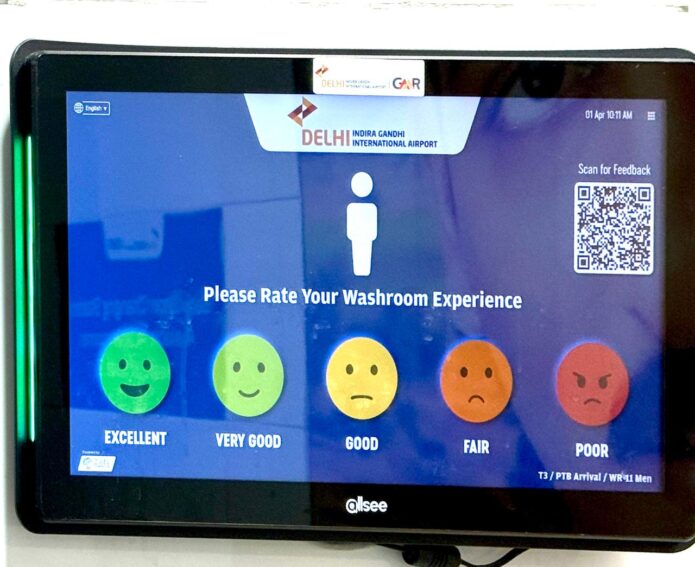
The Uber driver had barely pulled up before I was out the door. He was a pleasant enough man. No sudden swerves, no unsolicited opinions on the economy. A perfectly decent journey by any reasonable measure. And then his phone dinged.
“Please,” he said, holding it out like a collection plate, “if you could rate the ride.”
I gave him a four. Felt guilty immediately. Still not sure why.
That was nine in the morning. By lunchtime I had been surveyed by a coffee shop, a car park, my doctor’s receptionist, and a sandwich chain that wanted to know, on a scale of one to five, how the bread had made me feel. Not the sandwich. The bread. Specifically.
The Problem with Three
You know the drill. A question appears on your screen, or on a clipboard, or on the little touchpad by the exit. How satisfied were you? Strongly agree. Agree. Neither agree nor disagree. Disagree. Strongly disagree. Or sometimes just numbers. One to five. One to seven, if the researcher is feeling ambitious.
It is everywhere. Clinic waiting rooms, parking apps, hotel pillows, highway petrol station toilets. No experience, however brief or involuntary, is apparently complete without a structured response.
The honest answer to most of these is three. Three is not satisfied. Three is not disappointed. Three is “I have already moved on and cannot believe you are asking me this.” But three, on a satisfaction survey, is treated as a catastrophe. Someone in an office will look at the three and wonder where it all went wrong.
It went wrong when you asked.
The Numbers Go Up, the Meaning Goes Down
Somewhere along the way, five points stopped being enough. The Uber driver now hands you a quiet instruction as you step out: please give me a five. The “please” is doing a lot of work there. It is not really a please. It is a five with good manners.
The car service centre called back after I gave them a four. The mechanic himself, not a bot. “What did I do wrong, sir? I have kids to feed.” A pause long enough to be intentional. Then the manager. “We have people here with home loans,” he said. “Please choose your rating carefully.”
He had, somewhere in his desk drawer, a full load of guilt arrows. He knew exactly where to aim them.
I did not change my four. But I thought about it. Which is, I suspect, the point.
The system has a name, as it happens. The psychologist Rensis Likert invented this style of rating scale in 1932, as a precise research tool for measuring human attitudes. It is, in its original form, a perfectly sensible idea. What Rensis did not foresee is that ninety years later his invention would be repurposed to measure how one feels about a cancelled clinic appointment, a self-service checkout, and, apparently, bread.
Even the Feelings Have a Score
It has crept into places you would not expect. Leadership coaching, strategy facilitation and the like. I have sat in rooms where a facilitator asks, with complete sincerity, “On a scale of one to five, how effectively did you lead that conversation?” The leader thinks. Nods. Says “three point five.” Everyone writes it down. It is the same impulse I wrote about in The Checklist Trap — complexity reduced to something that fits on a form.
There is a fantastic organisation I work with that opens every meeting with a check-in. Each person announces their mood on a scale of one to five, and explains why. It is, genuinely, a good practice. You learn things. A quiet two from someone who is usually a four tells you more than ten minutes of status updates. I am part of it. I have given my twos and my fours. I have meant them.
But something nags. A mood is not a number. It is a weather system. It has history and pressure fronts and the memory of last Tuesday. Squeezing it to a five-point scale makes it legible. It also makes it smaller than it is.
That is the thing about the scale. It is useful the way a map is useful. Accurate enough to navigate. Not quite the same as being there.
So Much for a Number
A number is a pointer. It gestures at something. It says: roughly here, roughly this much, roughly this warm. The moment the number becomes the goal, something quietly breaks. The car service centre is no longer trying to fix cars well. It is trying to harvest fives. The coffee shop is not trying to make good coffee. It is managing its rating. The mechanic with the kids and the manager with the home loans are not asking how they did. They are negotiating a score.
Goodhart’s Law, if you want the formal version: when a measure becomes a target, it ceases to be a good measure. The number stops pointing at the thing. It becomes the thing. And the thing, quietly, disappears. I have written about this tendency before, in a different context, in Benchmark Against What, Exactly?
I got home that evening having logged opinions on no fewer than eleven separate experiences. The dry cleaner. The parking app. The supermarket billing counter, which had the audacity to ask whether I would recommend it to a friend.
I was still processing this when my daughter appeared in the doorway.
“Appa,” she said, with the casual cruelty available only to children, “on a scale of one to five, how was your day?”
I stared at her for a long moment.
“Two,” I said.
She nodded and walked away. Unsurprised. In this house, two is practically optimistic.
Somewhere out there, a dashboard updated. A bar shifted. And in the morning, I will receive a follow-up email asking if there is anything they could have done better.
I will give it a three. Seems about right.
Inspired by Deborah Thompson’s essay on the Likert scale, published in The Offing, July 2024.
Career begins when you join an organization and are given an employee number! Since that point, numbers haunt you.
The biggest damage done by the rating scales is that you learn accept (grudgingly and blindly) evaluation done by others.
And we fail to realize that growing up means relying on self evaluation, and yet giving up being evaluative.
Insightful piece. Thanks for sharing.
That is a beautiful observation Sir. The employee number is where it starts. And you are right, the real cost is not the number itself. It is the habit of waiting for someone else to tell you where you stand.
The shift from external evaluation to self awareness, and then beyond that, to simply being present without scoring yourself either, that is the quiet work of growing up. Most of us are still somewhere in the middle.
Thank you for adding this. It belongs in the post itself.