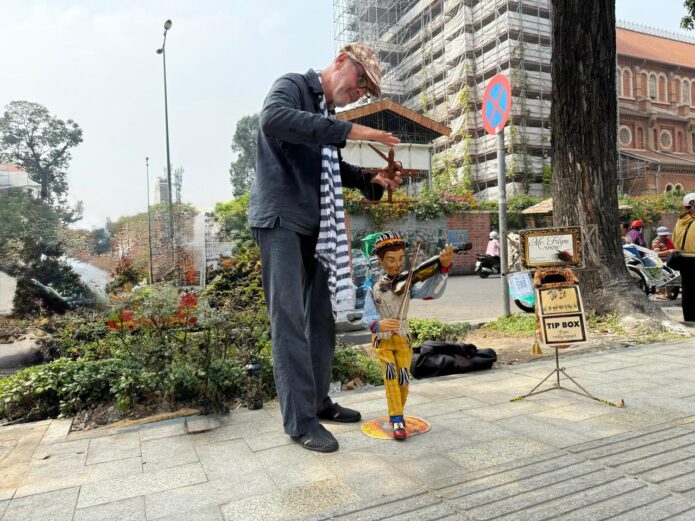
I stopped because something caught my eye. A small crowd. A man in a flat cap. And what appeared to be a very well-dressed child playing the violin on a Saigon pavement.
It was not a child. It was a marionette, a puppet controlled from above by strings attached to its limbs, its head, its bow arm. The puppeteer holds a wooden bar and works the strings to create movement. The word comes from French, apparently. Another French word. This one, a diminutive of Marie. Originally used for small religious figures, now used for this: a fellow in yellow trousers and zebra-print socks, playing violin outside the Saigon central Post Office ( aka the French Post Office) in Ho Chi Minh City, drawing a crowd on a regular morning.
I did not know any of this before I stopped. Travel is an education. Sometimes it arrives in a textbook. Sometimes it arrives in yellow trousers.
Mr. Filipo, Violin Virtuoso (Sort Of)
The marionette’s name is Mr. Filipo. His puppeteer is Filip, a Polish man with a flat cap and a striped scarf, working the strings with the ease of someone who has made his peace with the world, or at least with this particular corner of it.
What struck me first was the smoothness. No visible effort. No performance of performance. Filip moved with the unhurried confidence of a man entirely at home in what he was doing, which is rarer than it sounds. Mr. Filipo responded in kind. The fingers moved. The arm swung. He leaned into a phrase with his whole body, the way serious musicians do, as if the music was pulling him forward and he was happy to go.
A crowd gathered. Nobody checked their phone.
In Ho Chi Minh City traffic. There was joy in it. Genuine, uncomplicated joy. The kind that makes you wonder when you last felt that easy inside something you were doing.
I don’t know what Mr. Filipo is paid. But he earns it.
The Conversation That Came Free
After the show, I went over. Filip was packing up the strings with the careful attention you give to things that are irreplaceable, or expensive, or both.
The ease was still there in his hands. But not in what he said.
He is warm, direct, personable and quietly upset about the state of world. Europe especially, he said. Peace, he said, is becoming harder to find. He said it the way you say something you’ve been carrying for a while. Not to alarm, just to put it somewhere outside yourself for a moment.
He loves Asia because people here still stop. They still look up. A puppet plays violin on a street corner and they actually watch. Elsewhere, he told me, people are moving faster every year, as if standing still has become something to apologise for.
The man who had been all lightness and fluency a few minutes earlier was now speaking about a world running out of both. Same hands. Same flat cap. Completely different weather inside.
No ticket required for any of this. No QR code. Just a man, a marionette, and a taxi honking somewhere behind us.
No strings attached, you might say. Though Filip would probably find that funny.
One Thought Before We Go
Mr. Filipo is beautiful to watch because he holds nothing back. No hedging. No half-commitment. He is entirely inside the moment, and the moment gives back accordingly.
We mostly perform with conditions attached. I’ll be present once this is done. I’ll enjoy this after that is sorted. The strings that tie us to outcomes and ambitions are not wrong. Without any strings, Mr. Filipo is just painted wood. The question is simply which strings you’re holding, and which ones are holding you.
Filip was already packing when he said it. Folding the gilded frame. Coiling the strings. I work on my terms, he said, not breaking his rhythm. Somewhere behind us, two children were crying about something. He kept going.
He wished me well. Then he packed Mr. Filipo carefully into his box, picked up his bag, and walked.
The street outside the old French Post Office carried on as streets do. Taxis. Motorbikes. People with somewhere to be and tourists with something to see.
But something had left with him. The joy and the grief together, packed into the same box. A point of view, perhaps. The kind that arrives unannounced on a pavement, plays violin for a while, doesn’t ask permission. And walks away.
My life, for better or worse, has been organised around a single suitcase. The suitcase and I have logged more miles together than I have with most people I know. It does not complain. It does not have opinions about the hotel. It simply arrives. Usually.
Sometimes, though, it waits in the wrong place. I have landed in San Francisco while my bag sat in Singapore. I have cleared immigration in Brisbane while my suitcase was still somewhere over the Indian Ocean, presumably enjoying the flight more than I did. Each time, there is that particular sinking feeling at the carousel. The belt moves. Other people’s bags appear. Yours does not.
It is harrowing in a way that is hard to explain to someone who hasn’t lived out of one bag for months at a time.
The rabbit hole
On one of those occasions, bag delayed, gate agent apologetic as the process warrants, scrolling through something on her device. A smile played at the corner of her lip. It was not about my suitcase. A lost bag offers very little to smile about. Although, who knows.
I found myself in the airport coffee shop with nothing to do but wait and drink. The coffee was doing its job. And then the data I was reading did something coffee rarely manages. It made me sit up straight.
Kansai International Airport opened in 1994 on an artificial island in Osaka Bay. Since that first day, it has not lost a single piece of luggage. Not one. It handles around 10 million bags a year. It has won the global award for best baggage delivery eight times.
In the United States, domestic flights lose 3 million bags every year.
I read that sitting at a gate, waiting for my bag to arrive on the next flight, and felt something between admiration and mild despair.
The man at the carousel
A few weeks ago, at Terminal 3 in Delhi, I watched a ground handler doing something I had never seen before. As bags landed on the carousel, he straightened them. Turned them. Arranged them so the handles faced outward.
Someone had clearly told him to do this. A new manager, perhaps. Or someone keen to get a good rating. Or both, which is usually how these things happen. My sceptical mind went there immediately. Because I had not seen this before at Delhi. Or maybe I had, and the carousel anxiety had made me look only at the bags.
Bangalore’s Terminal 2 has been doing something similar. The handles face outward there as well. The bags arrive with a certain quiet orderliness that feels deliberate.
Mumbai is a different story. At Mumbai, the correct posture is gratitude. If your bag appears at all, and within the same hour as you, the appropriate response is quiet thanksgiving. The handle direction is not the concern. Arrival is the miracle.
And yet, Delhi and Bangalore matter. The detail lands, regardless of what drove it. Someone, somewhere up the chain, looked at a carousel and thought: this could be better.
It stayed with me. And then Osaka made sense. Because Osaka had been doing the same thing, at every carousel, since 1994. Except nobody told them to. They just decided it mattered.
What they actually do
Kansai’s secret, when you finally prise it out of them, turns out to be deeply unsatisfying. Small teams. Manual counts. A rule that if the number of bags unloaded doesn’t match the number loaded, you stop everything and look. The bag reaches the carousel within 15 minutes. The handle faces outward.
That is it. No algorithm. No proprietary system. Just people who count bags twice and arrange handles and apparently find this entirely normal.
I went deeper into the rabbit hole looking for the dramatic reveal. An airport official told NPR that the record was “the result of the daily efforts and careful work of everyone involved.” Then added, with a courtesy that itself felt Japanese: “We apologise if this would be not a specific answer.”
It was not. It was also completely honest.
Another official, speaking to CNN, was even more deflating. “We don’t feel like we have been doing something special,” he said. “We have been working as we normally do.”
Thirty years. Zero bags lost. Business as usual.
What actually drives it
Tsuyoshi Habuta has run baggage operations at Kansai for 17 years. His explanation makes the spokesperson look verbose. Luggage is precious to passengers, he says. So it should not go missing.
That is the whole argument. Seventeen years. Ten million bags a year. Thirty years of an unbroken record. And the philosophy fits in one sentence.
He is not chasing a bonus. He is not hitting a KPI. He has decided, at some point that probably passed without ceremony, that a stranger’s suitcase deserves to arrive. That quiet decision, renewed every morning, is what the record is actually made of.
The Japanese have a word for this. Omotenashi. It translates as wholehearted hospitality, but the translation loses the edges. What it really means is that you attend to what the other person needs, whether they are watching or not. Especially when they are not watching.
The gap that cannot be downloaded
A process can be copied. A checklist can be shared. But the thing that makes Habuta count bags at 4am with the same attention as the first day, thirty years in, with nobody watching and no applause coming, that cannot be transferred in a training manual. It has to be believed.
Most airports move bags. Kansai returns them.
The difference is entirely in what the people there think they are doing when they show up.
I grew up believing coffee came in precisely one legitimate form.
It arrived in a steel tumbler. Poured with mild theatrical flourish from one vessel to another. It possessed the authority of habit and the fragrance of morning. It was called filter kaapi. My mother makes it. There is, and remains, no higher benchmark.
Then, decades ago, a young man at a Café Coffee Day counter in Bangalore looked at me with professional patience and said, “Cappuccino?”
I had grown up in Madurai. Outside my mother’s kitchen, the only other coffee I had considered was at a small roadside coffee place called Visalam in Goripalayam. My mother gave hers in a tumbler and davara. Visalam served it in a glass tumbler. That, I had assumed, was the full range of possibility. Cappuccino was not a category I had prepared for.
What Avvaiyar Knew About Coffee (And Everything Else)
What you have learned is a handful of sand. What you have not yet learned is the size of the world.
I had known this line for years. I had also attributed it, confidently and wrongly, to Thiruvalluvar. The irony of misattributing a quote about the limits of one’s knowledge is, I think, what philosophers call “a bit much.”
In popular Tamil online folklore, the line hangs on a wall at NASA. I cannot verify this. But for rocket scientists to keep this in mind, however remote, is comforting anyway.
Going Down the Coffee Rabbit Hole
I came to coffee late. But when I did, I came properly. I ground my own beans. Chose them carefully. Waded in. And at each stage arrived confident I had figured it out, only to be shown, cheerfully, the next wall of ignorance waiting just ahead.
The world is not content with “coffee.” It insists on thirty-odd variations before you reach the door: espresso, ristretto, lungo, flat white, cortado, affogato, cold brew, nitro. And that is just the front end. Behind the counter lurk Arabica and Robusta, spoken of as rival football teams. There are tasting notes. Chocolate. Citrus. Stone fruit. Hints of regret.
And just when you think you have grasped the situation, someone whispers: there are beans that have passed through a cat.
Kopi Luwak. The Asian palm civet eats the coffee cherries, digests the fruit, and passes the beans. They are then collected, washed, roasted, and served to people like me. I first had it in Bali, sceptical and mildly horrified. It was extraordinary. Smooth, almost syrupy, with none of the bitterness I deserved. I have sourced it wherever possible since. Make of that what you will.
Kopi Langit Bali. The beans were extraordinary. The education was free.
My first purchase was from a couple in Bali. They sold me the beans and threw in an education I had not budgeted for. They explained processing methods, drying times, and the difference between wild-harvested and farmed civet with the patience of people who genuinely loved what they were doing. I left with more coffee than I could carry and significantly less confidence than I had arrived with.
Then I wandered into a specialty café. It was not merely a place that served coffee. It was a temple. Baristas moved with the quiet assurance of neurosurgeons. There were championships. Yes, championships. People compete at making coffee. There are judges, points awarded for crema, and somewhere, I suspect, slow-motion replay.
Coffee, I discovered, is not a beverage. It is a civilisation.
The Dunning-Kruger Effect in a Tumbler
The less you know about something, the more qualified you feel. Beginners are condemned to confidence. I had consumed coffee daily for decades before I understood I knew nothing about it. The peak of Mount Stupid, as psychologists call it, has a magnificent view.
Coffee crossed continents before it reached your cup — from an Ethiopian goat herder through Yemen and the Ottoman Empire to the coffee houses of London, where one cup bought you a chair and the right to argue with strangers about everything.
Today, for the exorbitant price of an Americano in Mumbai, you get poor coffee, the Wi-Fi password, and access to the toilet.
The people who know coffee best are uniformly humble. Coffee taught me why. Every door you open reveals three more. The domain you think you have mastered is merely the room you are standing in. I once watched a man at a roadside kaapi kadai in Tamil Nadu who had clearly stopped thinking about coffee altogether. That is what mastery looks like from the outside.
Back to the Tumbler
My mother still pours her kaapi from height, cooling it with a practised hand. Smooth arc. No tasting notes. No championship ambitions.
I still think it is unbeatable.
But now, when a barista reels off a menu of ristretto, lungo, flat white, cortado, cold brew, and something called a nitro coffee, I do not panic. I nod gravely, as though I have always known.
Then I look it up, quietly, before anyone notices.
Avvaiyar would understand. I suspect she would also help herself to the coffee.
The Seine is the river that runs through the heart of Paris. It is wide, unhurried, and has been flowing through this city for longer than the city has existed. Poets have written about it. Painters have stood on its banks. Napoleon built bridges across it. And on one of those bridges, more than a decade ago, I stopped walking and simply stared. I had not expected the locks.
Across the river sits the Pont des Arts, a pedestrian bridge connecting two of Paris’s most celebrated institutions — the Louvre museum on one bank, and the Institut de France on the other. No traffic. No noise. Just people walking, and the river moving quietly below. Wooden slats underfoot, iron railings on either side, and on a clear day, the whole of Paris seems to arrange itself around you — domes, rooftops, water, light.
I slowed down. Then I stopped.
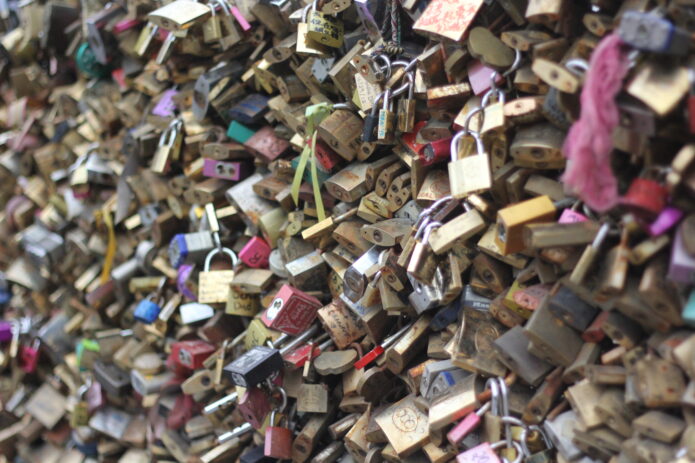
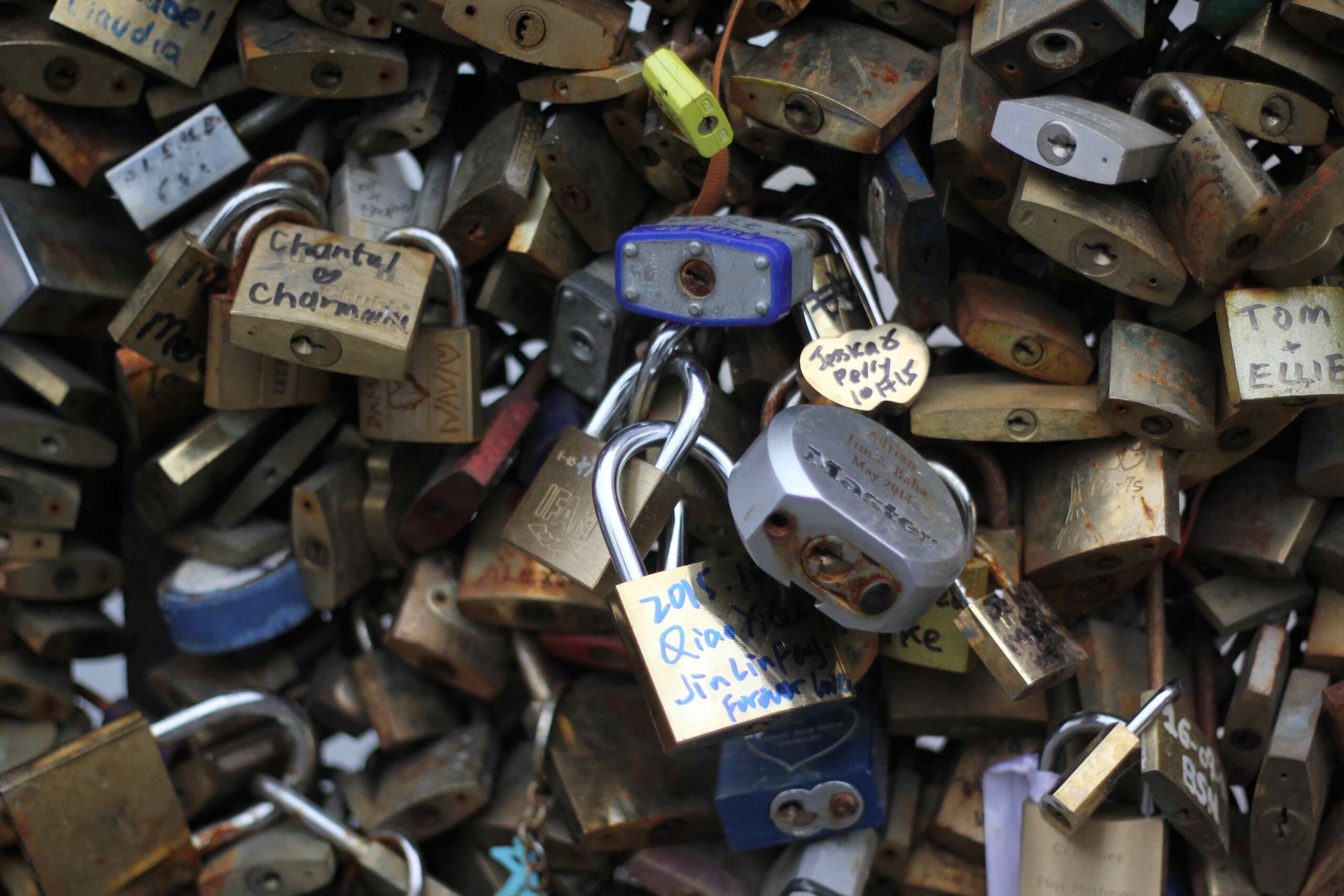
Because of the locks. Hundreds of thousands of locks, covering every inch of railing. Every size. Every colour. Brass ones, painted ones, heart-shaped ones, cheap ones from the hardware shop around the corner. Each carrying two names and one enormous hope.
That this would last. That nothing would change.
Locks of love
Look closely and you could read them. “Chantal et Charmaine.” “Tom + Ellie.” “2015, Qian, Jinlin — Forever.” Names in marker, names scratched in metal, names engraved by people who had planned ahead and brought the right tools. All of them saying the same thing, in every language, in every handwriting. Please. Not yet. Stay.
A Wish As Old As Worry
The story behind the locks begins, as the best stories do, with heartbreak. Mani Ratnam would have approved.
In a small Serbian town called Vrnjačka Banja, just before the First World War, a schoolmistress named Nada fell in love with an officer named Relja. He went to war in Greece. He fell in love with someone else. And did not come back to Nada. She never recovered, and eventually died of it. Which is the kind of ending that leaves a town looking for something to do with its grief.
The women of Vrnjačka Banja found an answer. They began writing their names, and the names of their loves, on locks, and fixing them to the bridge where Nada and Relja used to meet. Not a grand gesture. Not a ceremony. Just a small, stubborn wish dressed up as ironmongery. Protection, they hoped, against the same fate.
The gesture wandered. Across Europe, across decades, picking up believers everywhere it went. It found a 2006 Italian novel, in which two lovers attach a lock to a bridge in Rome and throw the key into the river. Young Europeans read it, recognised something in it, and began to act on it. Within two years, it had reached Paris.
Paris was not the end of it. The tradition has since spread to over 500 locations across 65 countries. Cologne, Moscow, Seoul, New York, Melbourne. Wherever there is a bridge and a railing, someone has arrived with a lock and a feeling.
Here is what you actually did. You brought a lock — or bought one from a vendor who had appeared on the bridge with the particular efficiency of someone who had read the situation correctly — wrote your names on it, snapped it onto the railing, and threw the key into the Seine. The lock said this is permanent. The key going into the river said I accept I cannot undo this.
It was, depending on how you look at it, either the most romantic gesture in the world or a considerable administrative problem in the making.
As it turned out, it was both.
By 2014 there were nearly a million locks on the Pont des Arts, weighing 45 tonnes. The equivalent of twenty elephants, standing very still on a wire fence, all of them believing in forever. A section of the railing collapsed under the weight. The city launched a campaign called Love Without Locks, which nobody paid the slightest attention to. Eventually the city stepped in, removed every single lock, and began the work of replacing the railings entirely.
We have always done this. Fear of losing a good thing at one end. A deep desire for more at the other. These are not weaknesses. They are the most human feelings there can be. The lock just happens to be what we had in our hands at the time.
A thread tied around the wrist. A ring slipped onto a finger. A coin tossed into a fountain. A name carved into a tree that will keep growing long after the feeling has moved on. And then a lock on a bridge and a key in a river — and the small, magnificent delusion that this time, finally, something might actually stay.
It never does. But the trying is very human, and it is very hard to argue with.
So What Did Paris Do?
It did what Paris does. It made a practical decision and somehow made it look elegant.
The old railings were pulled down and replaced with glass panels. Clean, clear, completely smooth. Nothing to attach to. No hook, no bar, no gap. A lock pressed against it would simply slide off, which is not the effect anyone was going for.
But here is what you can do now, standing on the Pont des Arts. You can look straight through. Through the glass, past the railing, all the way down to the Seine moving steadily below. The same river that was flowing when Napoleon built the bridge in 1804. Still going. Still not stopping for anyone.
There is something in that worth sitting with. We spend so much energy trying to fix things in place. Lock them down. Make them stay. And the river just keeps moving, completely unbothered, as if it knows something we have spent centuries refusing to accept.
Maybe the glass is the better lesson. Not a lock. Not a wish thrown into the water. Just clarity. See through it. Stay open. Keep moving.
The Seine keeps moving. And somehow, despite everything, so do we.
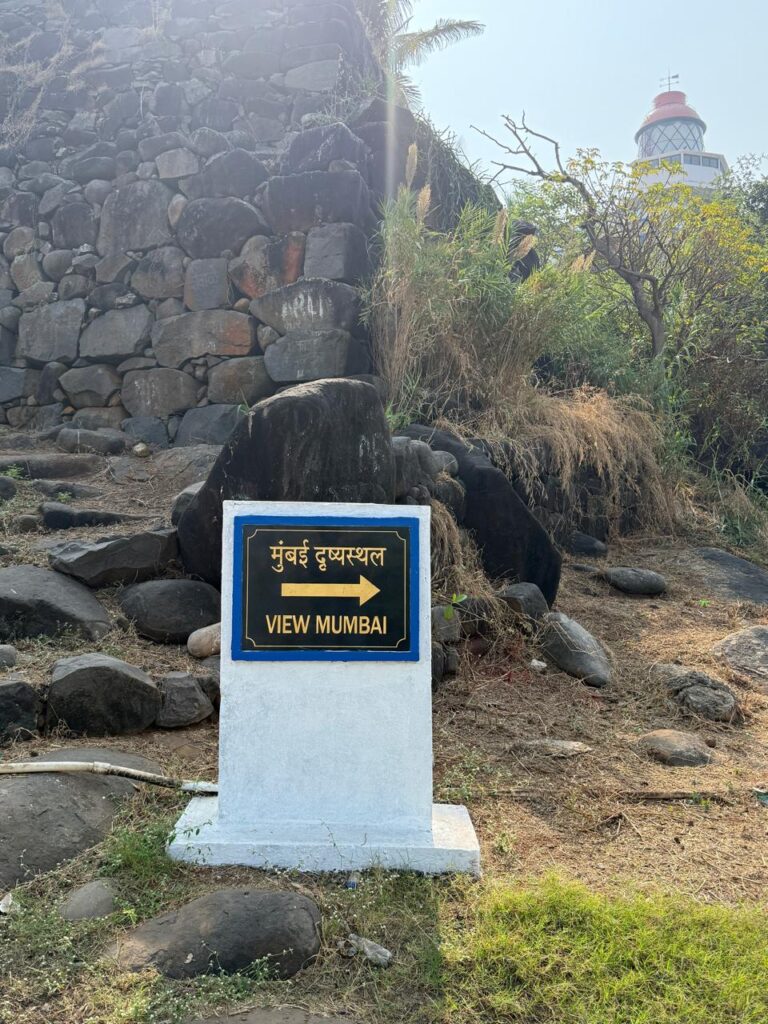
There is a sign on Kanhoji Angre Island that says, simply, “View Mumbai.” An arrow points right. My eyes strained hard in the direction it pointed, and sure enough, Mumbai was there, spread across the horizon like a rumour that got out of hand. Behind me, the lighthouse stood quiet in the morning sun. It only flashes at night.
This small island, five kilometres off the coast of Alibaug, holds more history per square metre than most places manage in an entire country. It was called Khanderi until 1998, when it was renamed after a man the British spent decades trying to catch and never did.
The Admiral They Called a Pirate
Kanhoji Angre was born in 1669 and died undefeated in 1729. In between, he ran the Maratha Navy with a brisk efficiency that made European admirals uncomfortable. He controlled the entire Maharashtra coastline from Sawantwadi to Mumbai. Every ship that sailed through Maratha waters paid a levy called jakat. Those that refused often lost the ship.
His navy was a coalition. Koli, Bhandari, and Kharvi seafarers formed its backbone. He employed Dutch commanders for his best vessels, a Jamaican pirate as chief gunner, and a Portuguese defector from the very East India Company trying to bring him down.
The British called him a pirate. In 1712, his navy captured the armed yacht Algerine, which belonged to the Governor of Bombay himself. They returned it fourteen months later, along with the Governor’s representative’s widow, for 30,000 rupees. The British East India Company, an organisation not known for taking things graciously, took this very badly indeed.
He also found time to found the town of Alibaug and issue his own silver currency, the Alibagi rupaiya. The ferry you take to reach his island leaves from the town he built.
Despite repeated attempts by the British, Portuguese, and Dutch to defeat him at sea, Kanhoji Angre died in bed in 1729. The lighthouse that now carries his name was built by the very people he spent his life outmanoeuvring.
There is something satisfying about that.
A Lamp from Paris
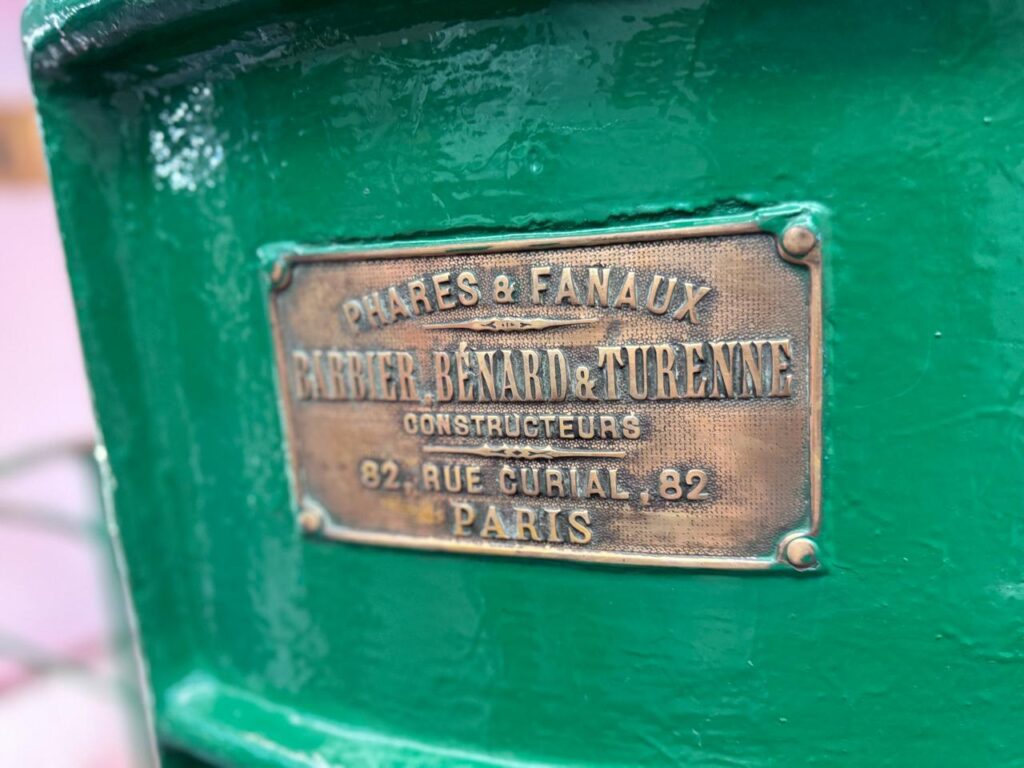
The British laid the cornerstone in January 1867. The Governor of Bombay did the honours. A Parisian firm, Barbier, Bénard & Turenne, supplied the lamp equipment. Their brass maker’s plate is still there, bolted to the green-painted housing, looking alarmingly cheerful. A small bronze plaque on a machine built for the age of sail, now guiding container ships tracked on phones. History has a sense of humour.
On a clear night, it flashes twice every ten seconds, in red and white, visible 25 nautical miles out. It has done this, with minor interruptions, since June 1867.
Empress Of India. The ship’s bell clang well.
Mumbai at a distance
Climb up to the lighthouse
The stariwary to the very top
Viewing deck at the lighthouse
Made in Paris
Entrance Of The Lighthouse
Delegates ahoy!
What You Find When You Get There
The island is small enough to take in quickly. The fort walls, built by Chhatrapati Shivaji Maharaj in 1679, still mostly stand. Old cannons sit along the parapets. There is a musical stone that makes a metallic ring when struck with a pebble, which fishermen once used to warn of approaching ships. Two freshwater wells have been supplying the lighthouse keepers for over a century.
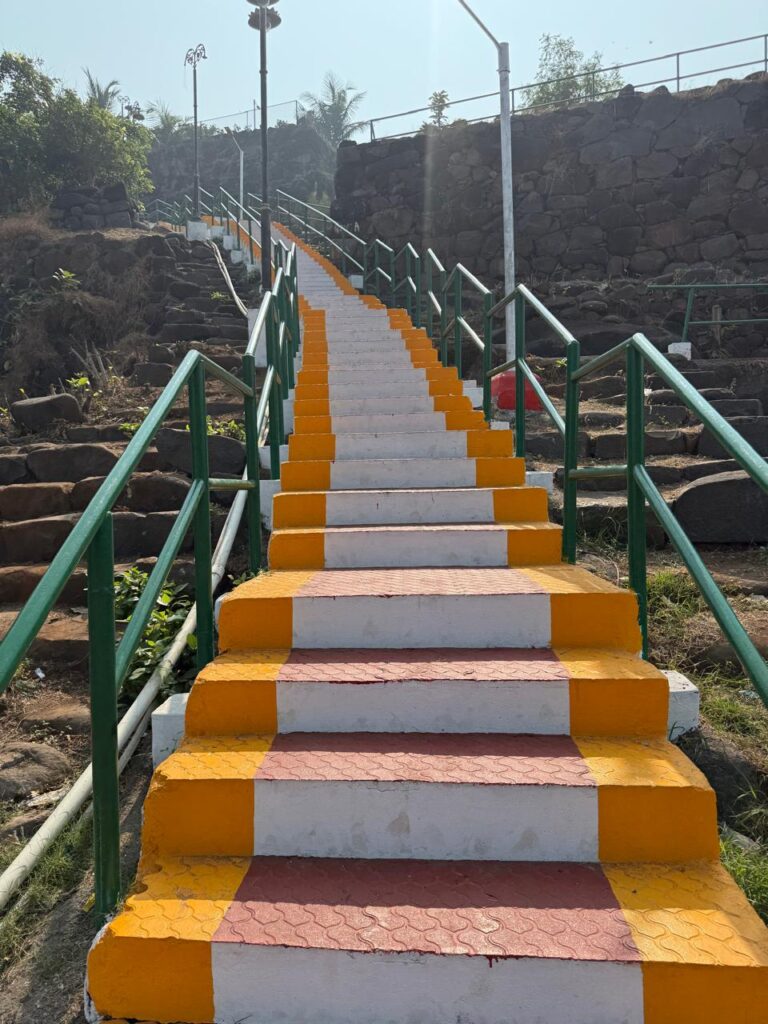
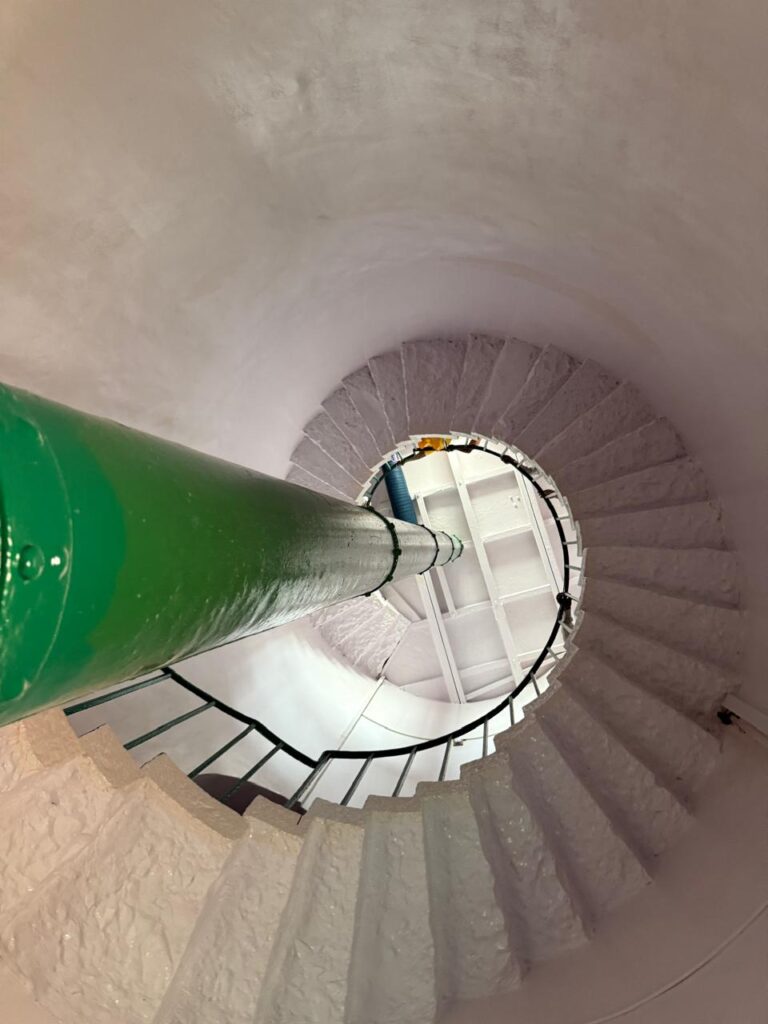
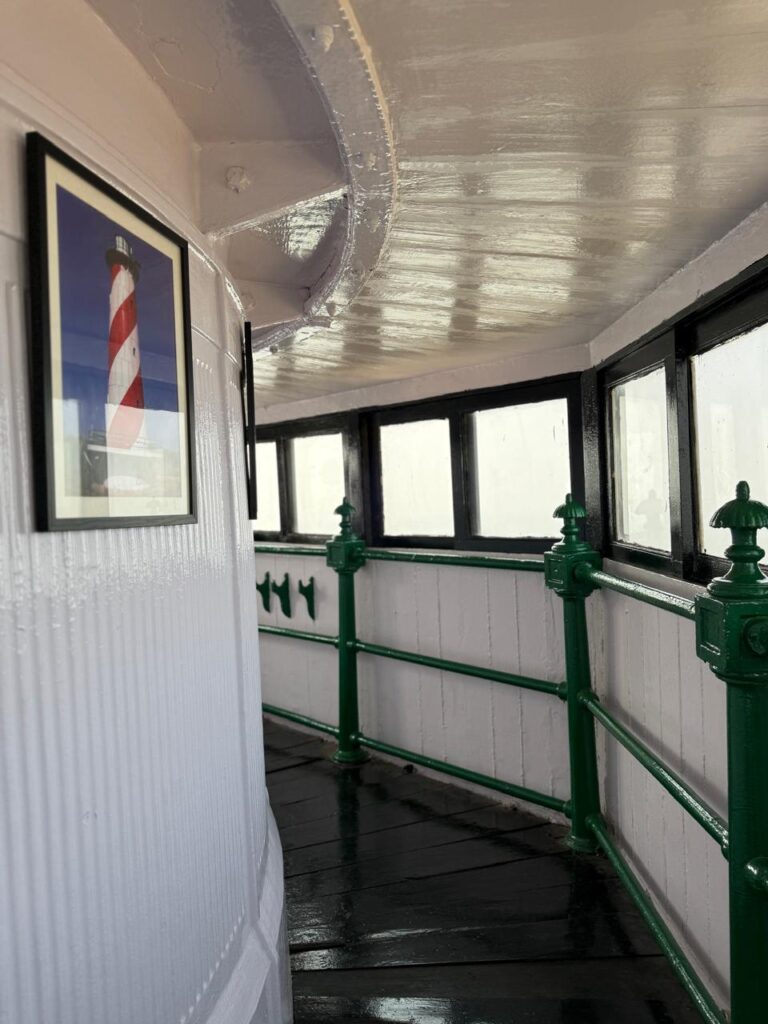
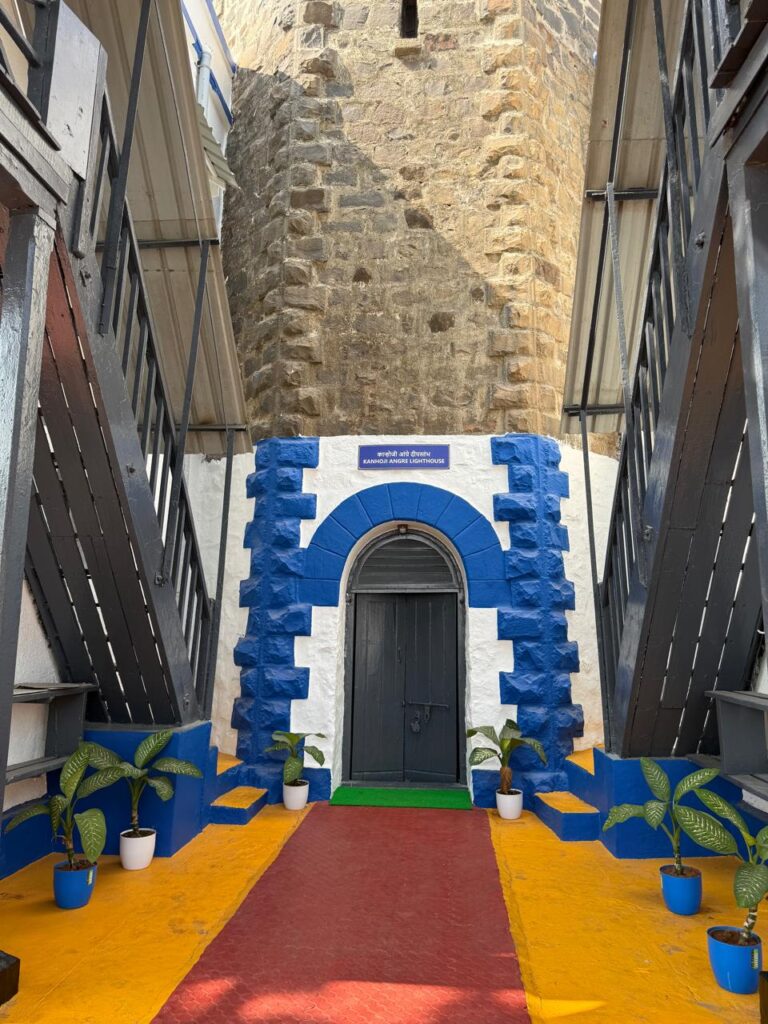
The lighthouse entrance is painted in blue and white, with small potted plants arranged outside. The interior is something else. The spiral staircase winds up through 160 years of iron and stone, the steps worn smooth in the middle, the green handrail the same shade as the lamp housing at the top. You climb toward a circle of light that keeps getting slightly closer and never quite arrives, until suddenly it does.
From the top, Mumbai sits in one direction and the open Arabian Sea in the other.
What the Island Keeps
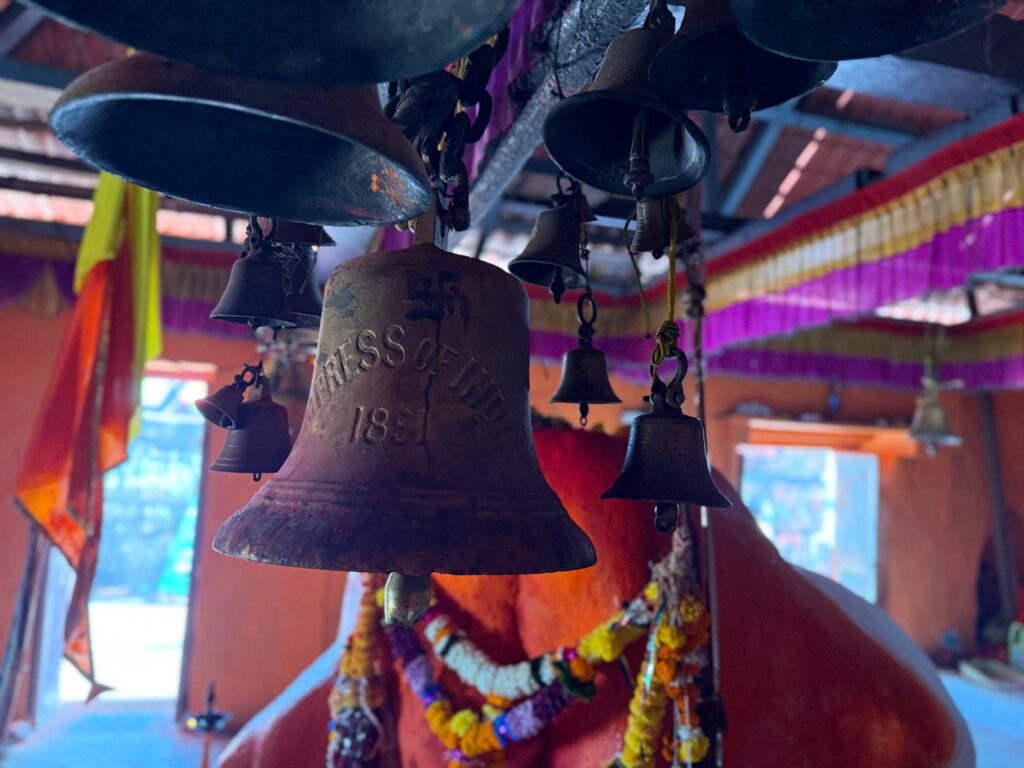
Near the water’s edge, a small orange temple sits wedged between ancient rocks, saffron flags flying. It is very much still in use. Inside, among the garlands and incense, hangs a large bronze bell. Cast into the metal, in raised letters: EMPRESS OF INDIA. 1891. A ship’s bell, over a hundred and thirty years old, now rung daily as an offering at the Vetoba temple. The Konkan Kolis worship Vetal, the god of ghosts. On an island named after the man who spent his life raiding British ships. Nobody planned that particular detail, and it is all the better for it.
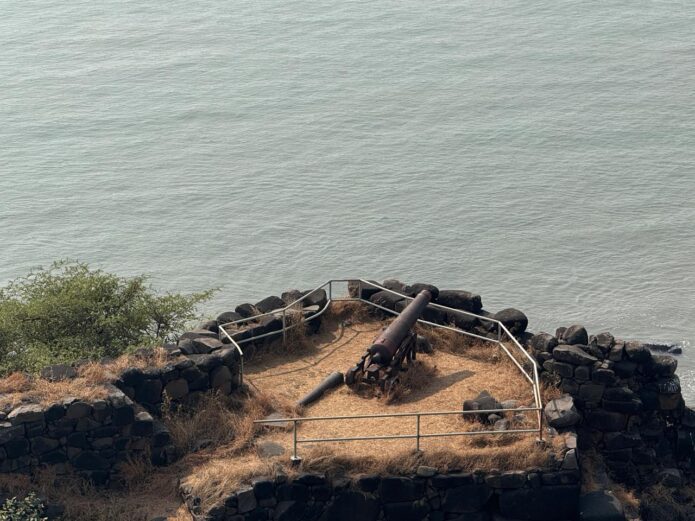
Along the way, delinquent cannons lay on their side on a rusted cart, exactly where someone had left it. Around it, water bottles and plastic bags. Three centuries of history and a morning’s worth of rubbish, sharing the same patch of ground.
Still Making an Impression
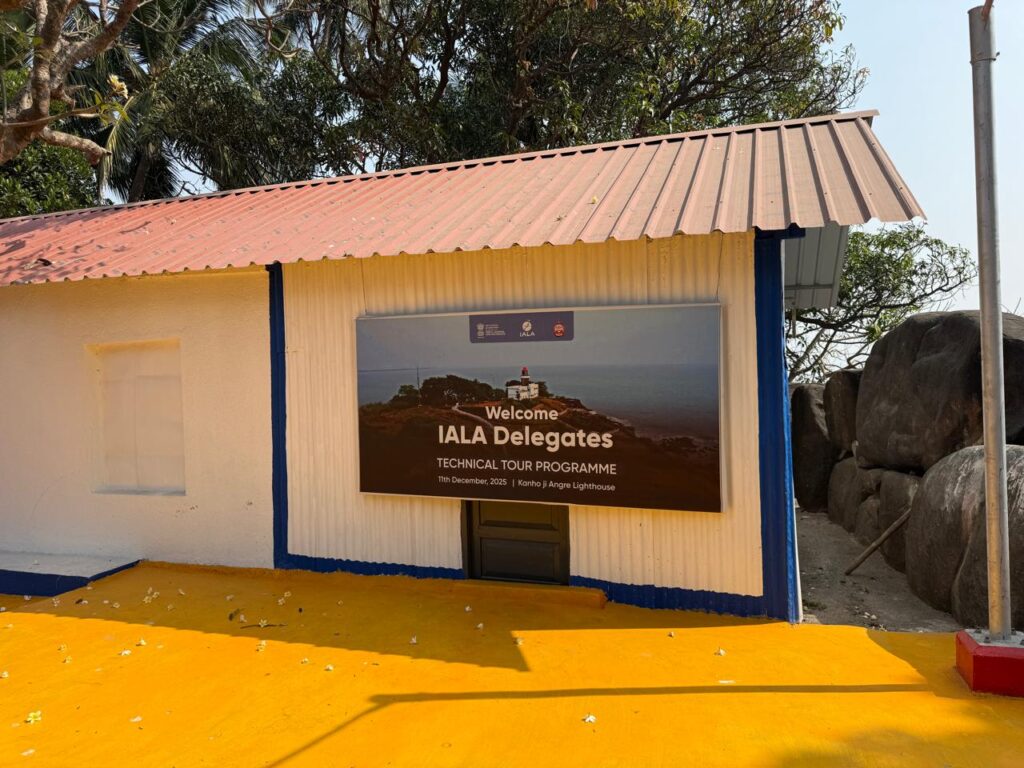
A faded banner on the wall announced that sixty maritime officials from thirty countries had visited a few weeks earlier. IALA, the body that sets lighthouse standards for the entire world, had chosen this island for its technical tour. They flew in from Europe, Asia, and the Americas, checked into Mumbai hotels, and then took a boat to a five-kilometre rock to look at a Victorian lamp made in Paris.
Kanhoji Angre spent his life ensuring that Europeans paid close attention to this coastline. Some habits, apparently, persist.
The ferry back to Alibaug takes twenty minutes. At night, the lighthouse flashes twice, pauses, and flashes again. It has been saying something out there, to anyone paying attention, for over a hundred and fifty years.
As a young boy, every temple visit meant one thing before anything else. My great grandmother’s hand, and the soft clink of coins.
She would stop at the entrance, find the men sitting outside, and without ceremony drop a few coins into the black bowl in front of them. The sound was unmistakable. Metal on something hard and hollow. A clean, round clang that rang out and then faded into the temple noise. I heard that sound at every temple, in every town, across every visit. It became, without my knowing it, the sound of arrival.
I came to know the bowl’s name much later. Thiruvodu. In Tamil, thiru means sacred or holy. Odu means vessel. The sacred vessel. The bowl that holds what is given and asks for nothing more. Mendicants of Lord Shiva have carried it for centuries, painted black, hollowed from the hard shell of a fruit that, of all things, originates in the jungles of Mexico. It travelled oceans before anyone thought to name it sacred. Then it settled quietly into Tamil temple life, as if it had always been there.
I did not know any of this as a boy. I just knew the sound.
Well into adulthood, I picked up the courage to do more than drop coins and walk on. In a small town somewhere in rural Tamil Nadu, where life is placid and unhurried, a man sat on the ancient stone floor of a temple, sacred ash on his skin, a thiruvodu in front of him, its rim bedecked with bright flowers. We got talking. Within minutes he said something I have not managed to forget: “Whatever they give, my bowl must be worthy and ready to receive.”
I have turned that line over in boardrooms. In bad conversations. On mornings when the day arrived with more than I had asked for.
A decade and a half or so passed. Another thiruvodu brought alive an ordinary moment. This time I was in Konerirajapuram, a small village in the Chola heartland, off Kumbakonam. Its Uma Maheswarar temple has stood since the tenth century and houses what is said to be the world’s largest bronze Nataraja. A thousand years of devotion, with routines and a shrug. The village is now a shadow of its former self, though the temple stands unmoved.
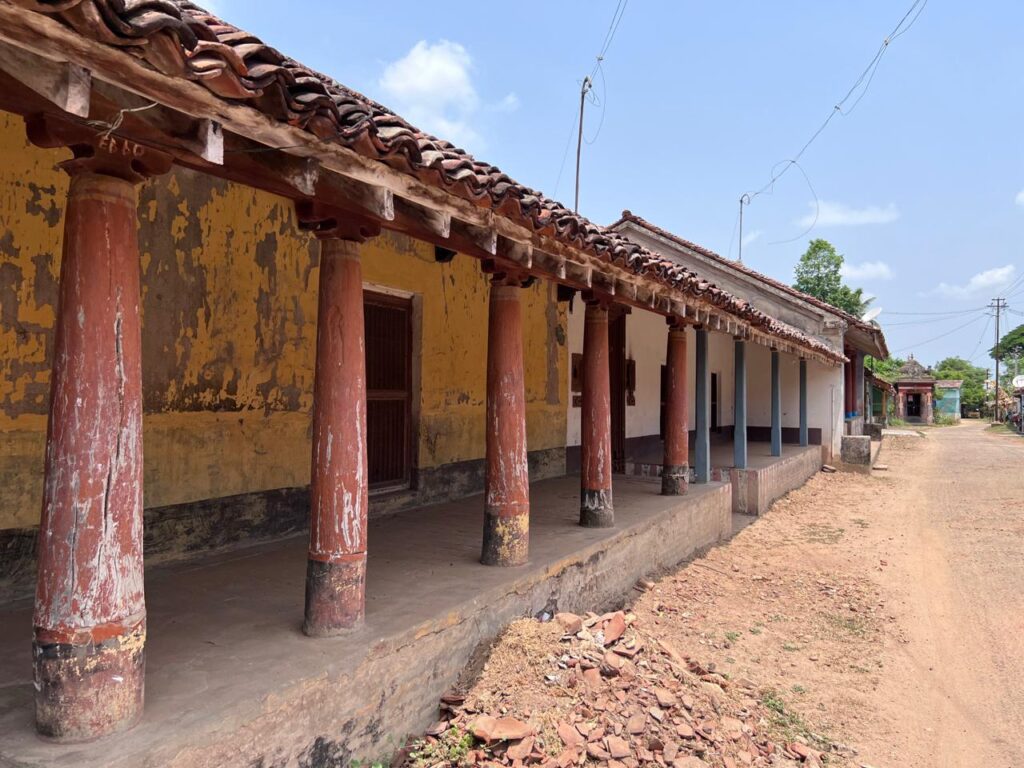
We passed through a deserted Agraharam to get there. Long colonnaded houses, ochre walls peeling in slow strips, red pillars standing at attention for a life that had quietly packed up and left. Somewhere in those corridors, families had cooked and argued and celebrated for generations. Now, just footsteps and a silence that wasn’t empty. The kind that remembers.
The temple was shortly after. And there he was, sitting outside, holding a thiruvodu worn smooth with years. No flowers this time. Just the bowl, the man, and his smile.
I asked him how he was.
He said, in Tamil, whatever has happened has happened for the good. Whatever will happen will all be for the good.
The words are from the Bhagavad Gita. But he spoke them with no performance attached. No invitation to discuss. He said what he said, smiled, and returned to sitting. The bowl sat on the ancient stone floor, looking at the sky.
He hadn’t overthought his afternoon. He wasn’t rehearsing the next thought or relitigating the previous regret. He had simply arrived at the present and settled there. The bowl open. The mind open. That was enough.
What the Sea Confirmed
Seneca, the Roman Stoic who wrote more wisely about happiness than he perhaps lived it, said something similar two thousand years ago. Happiness, he wrote, asks one thing: set down the memory of a bad past and the fear of a bad future. Two bags. Both heavy. Most of us carry them everywhere.
A few months later I drove to Sayalgudi without a plan. Just a sense the road went somewhere worth going. It did. The road ran out and the sea filled the gap. Waves arriving, crashing, dissolving without complaint, each one complete in itself.
I sat on that beach with a phone full of unread messages, a conversation I had handled badly three weeks earlier, and a meeting I was already dreading on Tuesday. I had carried all of it from Mumbai, through Madurai, down to the edge of the land. Good luggage management.
Each wave came in full, spent itself completely, and pulled back without holding on to anything. No wave has ever refused to break because the last one didn’t go well.
With one of those waves came back the image of the thiruvodu. It arrives open. It receives what comes. It does not clutch what has gone. The bowl doesn’t mourn its last contents or worry about the next. It simply stays ready.
The man in Konerirajapuram already knew this. He had known it long enough that he no longer needed to think about it.
Two bowls. Two men. One with flowers on the rim, one worn plain. Both open to whatever arrived. Between them, across a decade and a half of travel through Tamil Nadu temples, they had said everything Seneca spent letters trying to say.
Be ready to receive. Let go of the rest.
The bowl doesn’t ask what it deserves. It doesn’t mourn what it missed. It simply stays open, in whatever temple or crumbling Agraharam or quiet coastline you happen to find yourself in.
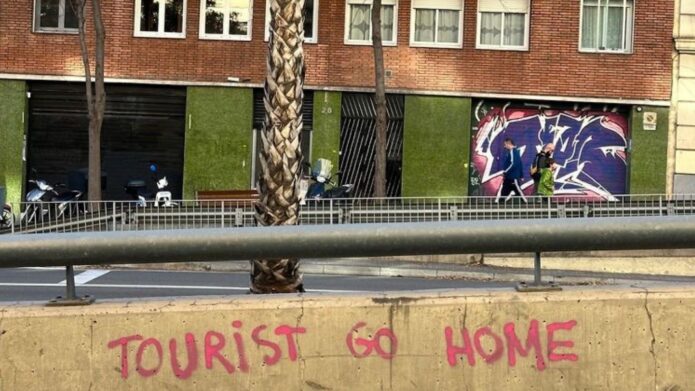
I was in Barcelona, wandering through a neighbourhood that smelled of olive oil and laundry, when I saw it. Painted in large, unapologetic letters on a wall: Tourist Go Home.
Not a suggestion. A verdict.
I stood there for a moment, passport metaphorically in hand, and felt the particular shame of someone who has just been told, with remarkable economy of language, that their presence is the problem. I took a photo, of course. Which, in retrospect, did nothing to help my case.
The Bus That Disappeared
Barcelona had been dealing with this for years. In the La Salut neighbourhood, a small 20-seat minibus called the 116 served locals going about their daily lives. Then Park Güell appeared on Google Maps, tourists discovered the route, and the bus stopped being useful to anyone who actually needed it. Luz López, 75, told a Spanish newspaper that people with walking sticks could no longer board.
“At first we laughed,” said a local activist. “It seemed absurd, like putting gates on the countryside.”
It worked. Cities are now erasing themselves from the internet, piece by piece, to get a moment’s peace.
Cherry Blossoms and the Limits of Instagram
In Fujiyoshida, a small Japanese city of under 50,000 people at the foot of Mount Fuji, the Arakurayama Sengen Park cherry blossom festival had run happily for ten years. Then social media found it. By last year, 10,000 people were arriving on a single peak day. Tourists trespassed on private property, dropped litter, opened doors to private homes to use the bathroom. Some defecated in residents’ gardens and, when challenged, became aggressive. Children walking to school were pushed off pavements by crowds that had no particular awareness that school existed.
In February this year, the mayor cancelled the festival. “Behind this beautiful scenery,” he said, “the quiet lives of our citizens are being threatened.”
The cherry blossoms will still bloom. The tourists will still come. Because the problem was never the festival. The problem is the assumption that beauty is a public resource, available to whoever can afford the flight.
We see the photograph. They live in the frame.
Documentarian and photographer Sej Saraiya, writing in the Hindustan Times on 22 February 2026, names this precisely: movement without humility, she argues, “trains us to confuse access with understanding, presence with permission, and visibility with care.” She goes further, suggesting that in an era of speed and viral exposure, humility may be the only thing that keeps travel honest at all.
The Thirty-Second Reminder
Before meetings, conferences, and school assemblies across Australia, someone will stand and say: I would like to acknowledge the Traditional Owners of the land on which we gather, and pay my respects to their Elders, past, present, and emerging.
Thirty seconds. It costs nothing. And it does something quietly radical: it reminds everyone in the room that the ground beneath them has a history, and that history belongs to someone who was here long before the meeting was scheduled.
Every time I have heard it said properly, by someone who means it, I have felt the same gentle, necessary deflation of my own self-importance.
You are a visitor here. You have been welcomed. Act accordingly.
Not a tourism lesson. A human one.
Somebody Lives Here
The simplest reframe is also the hardest to hold when you are three hours into a queue with your camera.
The place you are visiting is somebody’s home. The street you are photographing is where someone’s grandmother walks to the shop. The view that appeared on your feed at 2am last Tuesday has been somebody’s ordinary Tuesday for their entire life.
When I stood in front of that wall in Barcelona, I did not feel attacked. I felt corrected. The city was telling me something accurate: your presence has a weight, and you may not have thought about that weight until now.
Barcelona had to paint it on a wall. Fujiyoshida had to cancel a festival it had spent ten years building. Luz López had to wait for a bus she had been riding for decades.
Travel remains one of the more reliable ways to discover that your assumptions are parochial. But done well requires arriving as a guest rather than a consumer. To leave a place at least as good as you found it. Which is, when you think about it, the oldest rule of hospitality, applied in reverse.
The cherry blossoms near Mount Fuji will bloom again this April. They are indifferent to us, which is part of what makes them beautiful.
The question is whether we will be worthy of them.
On the other side of tourism, there is travel done with presence. I found a small example of it on a river ferry in Brisbane. That story is here.
Have you had a moment that made you feel like an unwelcome guest? Or one that reminded you what good travel looks like? I’d love to hear it in the comments.
Ask anyone in Ho Chi Minh City what you must see. You will not finish the sentence before someone says Cu Chi tunnels. I heard about the Cu Chi tunnels Vietnam before I even landed. It has that kind of reputation.
And it earns it.
If you want to see death, destruction, and human resilience in one place, Vietnam is a good address. The Cu Chi tunnels carry all three. Quietly. Without making a fuss about it.
First, Some History
It started in the late 1940s. Vietnam was fighting to end French colonial rule. Small holes were dug into the red soil around Cu Chi, a rural district about seventy kilometres northwest of what was then Saigon. Nothing grand. Just enough to vanish into when you needed to.
Then the Americans arrived.
By the early 1960s, the United States had committed troops to South Vietnam, supporting its government against the communist North and the Viet Cong guerrillas fighting in the South. Cu Chi sat squarely in contested territory. The Americans eventually built one of their largest bases in Vietnam right on top of the tunnel network. They did not know it was there.
The farmers dug deeper. If you want the full picture of the war, Ken Burns’ documentary is the place to start.
The Tunnels
Tunnel hatches in the floor
Two hundred and fifty kilometres of tunnels. Dug by hand. Mostly at night. By farmers who had never lived underground and had no intention of starting.
That number takes a moment to land.
Stretch those tunnels out and they run from Mumbai to Pune and back. Think New York to Philadelphia, Or Sydney to Canberra. Pick your geography. The number does not get smaller.
All of it beneath an ordinary-looking forest. All of it invisible from above.
The soil here is red and firm. Good for digging. Better for hiding. Simple shelters became something else entirely. Kitchens with chimneys angled sideways so the smoke rose thin and invisible through the trees. Field hospitals. Weapons stores. Command rooms lit by oil lamps. People were born down there. Some died there. The tunnel did not ask anyone if they were ready. It just asked them to keep going.
My Turn
I tried getting into the tunnels. There is a section open to tourists, widened slightly from the original, lit at intervals. Helpful, in theory.
Within two metres I was bent double. Shoulders on both walls. Knees filing urgent complaints. For someone of my particular level of fitness, this was not exploration. This was negotiation. I shuffled forward, gasping quietly, looking desperately for where it ended. It did not seem to end.
I emerged. Wincing. Suddenly very aware of muscles I had not thought about since the last time I climbed stairs too quickly.
Around me, other tourists were doing the same. Appearing from holes in the ground like bemused meerkats. Some triumphant. Some clutching their knees. One man stood very still with the expression of someone reconsidering several life choices.
To think that for decades, an entire generation lived and worked from down there. Slept there. Ate there. Planned there. Climbed out to fight. Climbed back in.
The Tank
Built for open ground and a visible enemy. It found neither. The M48 Patton sits where the forest stopped it. The gun still points. The war moved on without it.
Then there is the tank.
An American M48 Patton. Built for open ground, clear sightlines, and a visible enemy. It found none of those things here. It stands alone in the heat, rust-stained and enormous, with the quiet dignity of something that was once very powerful and is now very still.
It is an accidental monument to a simple idea. Alter the ground of combat and the strength built for another ground becomes useless. The tunnels did not match American firepower. They made it irrelevant. The war moved beneath the reach of the tank, beneath the bombs, beneath everything that should have ended it quickly.
Watch your ground, the tank seems to say. I did not.
The path back to the entrance takes you past the firing range. You hear it before you see it. A crack, then another, then a continuous percussion that fills the trees. Tourists queue to fire AK-47s and other guns. The sound is enormous. It bounces off everything and asks no permission.
The irony is thicker than a bulletproof vest. The guns were supposed to have fallen silent when the tunnels emptied out. Decades later, the bullets are still flying. Just with better queuing and a gift receipt.
When you get older, you develop an aversion to loud sound. My father used to say that. The thought arrived just as I turned away and noticed a small polite sign on the path ahead. B-52 bomb crater. Not an ordinary crater. One left by a bomber that flew so high you never saw it coming. Marked now like a feature on a nature trail. The ground around it still looks unsettled. Like it remembers and has not quite forgiven it.
You look ahead and keep walking. The gunfire slowly recedes behind you.
What They Left Behind
Mines and grenades on wooden racks, amber light, neat and domestic. Arranged carefully. The tidiness is the unsettling part.
Inside a low covered shelter, the weapons are on display. Mines, grenades, and small explosive devices laid out on wooden slats. Yellow casings. Black fittings. Organised like a market stall. Each one made largely from scrap, from whatever the war left behind. Spent shell casings were cut and reformed. Unexploded American bombs were carefully taken apart and rebuilt into something else. Nothing was wasted. Everything had another use. So says the tall guide with authority and a badge.
He explains the use cases of each of the bombs without drama. This for the legs. This one slower. The calm voice makes it worse for me.
The pyramid of artillery shells, tourists browsing casually in the background)Hundreds of shells, stacked neatly. Tourists drift past. The contrast does not resolve easily.
In the exhibition room, artillery shells are stacked in a broad pyramid. Hundreds of them, arranged by size, smallest at the base, largest reaching upward. A gift shop is visible just behind. People browse both with roughly the same expression.
Rockets. Casings. Each one labelled. None of them need to be.
The labels tell you what each one is. 105mm artillery shell. 150mm shell. Cluster bomb. The numbers are precise. The effect is not clinical. You stand there and do the arithmetic quietly, and then you stop doing it.
The Ground Remembers
You walk among quiet tourists towards the exit. Most are solemn. Turning something over. The forest thins. The entrance comes into view.
By the time you reach it, the firing range is distinct yet distant.
Though I suspect some of the silence around me had less to do with reflection and more to do with the sudden discovery, deep in a Vietnamese forest, that knees and thigh muscles exist. And have opinions.
Two hundred and fifty kilometres. Dug by hand. By farmers. Against the world’s most powerful army.
The ground remembers. Even if the rest of us needed reminding.
If travel and human behaviour interest you, this queue on Wall Street taught me something entirely different about optimism.
Some travel experiences stop you mid-stride, send you into the nearest café, and make you look things up immediately. This was one of those. It has stayed with me ever since.
New York City has a presence that is hard to miss. Busy. Proud. Tall. When its mayoral elections attract international attention, it tells you something. The city also has a remarkable talent for organising queues. Queues for bagels. Queues for museums. Queues for coffee that costs more than lunch and tastes like it knows it.
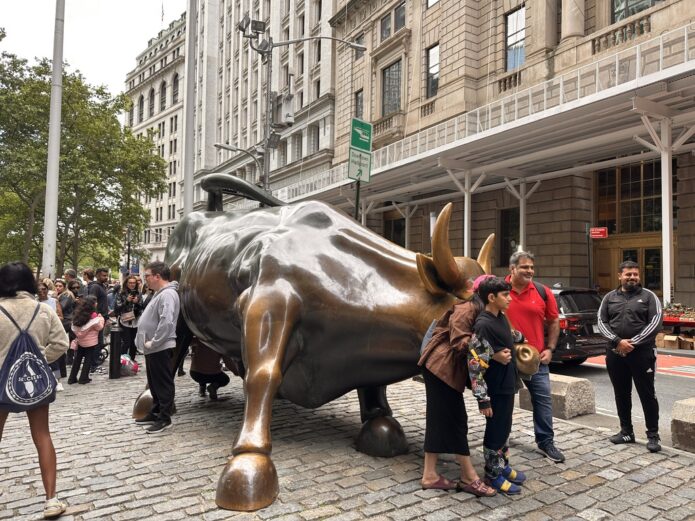
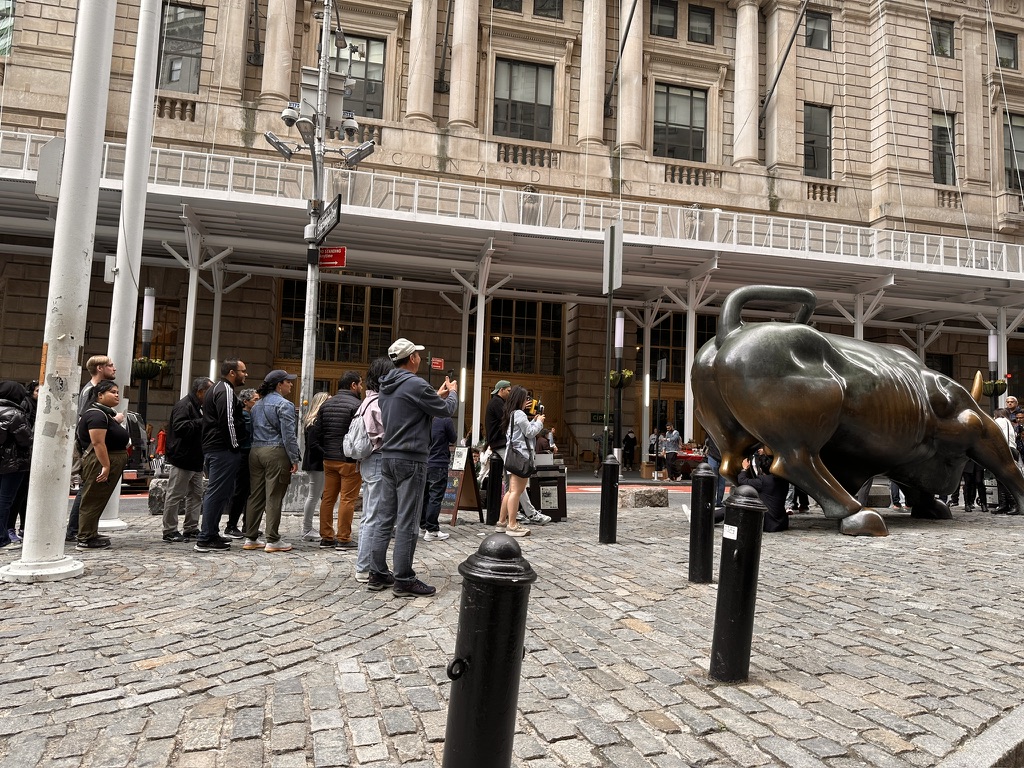
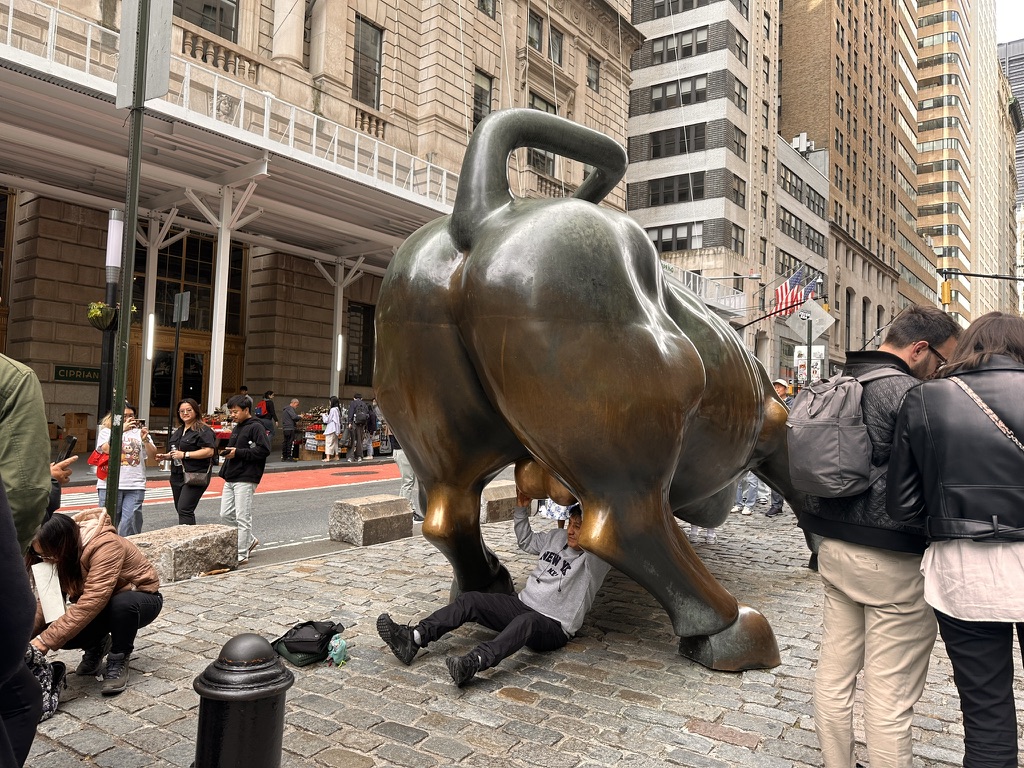
Near Wall Street, there are two queues around a bronze bull. Yes. The Charging Bull of Wall Street.
One forms in front. People pose, touch the horns, take photographs. It is literal, performative, and reassuringly obvious. Taking the bull by the horns, as it were.
The other queue is different. It gathers behind the bull.
This one does not announce itself. It does not move quickly. People shuffle forward with the seriousness usually reserved for immigration counters or new Apple launches. When their turn comes, they disappear briefly behind the animal and re-emerge wearing the faintly satisfied look of someone who has completed a small but meaningful civic duty.
That queue stopped me. I stood there for a while, trying to work out what exactly was being achieved.
A Ritual Revealed
It did not take long to find out.
The queue exists so that people can touch the bull’s testicles. Yes. You read that right. For luck, apparently.
The Queue FormsHappiness at the end of the queue
Not metaphorical luck. Actual luck. The sort associated with money, markets, careers, or at the very least, a good day. There was no embarrassment about it. No nervous laughter. People waited their turn, did what was required, and stepped aside for the next person.
Some things, I learned, are best understood by watching quietly.
How the Bull Got There
Absurd rituals deserve good origin stories, and this one has a particularly strong one.
The sculpture, officially called Charging Bull, was never commissioned. In 1989, after the stock market crash, an Italian sculptor named Arturo Di Modica was furious at what he saw as a collapse of courage and confidence.
So he did what any reasonable person might do.
He spent months working in his cellar, used his own money, cast a bronze bull weighing over three tonnes, and one night deposited it outside the New York Stock Exchange. No permission. No permits. No committee meetings. Then he vanished.
The city wanted it removed. The public loved it. The bull stayed.
The queue came later.
Bulls and bears, of course, existed long before bronze statues. The language of bull and bear markets has been around for centuries. Bulls charge forward. Bears retreat, swipe, and hibernate. One stands for confidence and momentum. The other for caution and decline.
After the Charging Bull appeared, optimism acquired a body. Confidence suddenly had muscle, shine, and something you could stand behind in a queue. Financial districts around the world followed the impulse, if not always the sculpture itself. Bulls appeared in good times, never bad ones. Built to be photographed, touched, and briefly believed in.
The bear, meanwhile, remained abstract. A chart. A warning. Something you were expected to read about later.
Understanding, it turns out, is much harder to rub for luck.
Touching Optimism
What fascinated me wasn’t the sculpture so much as the behaviour around it.
Touching the bull felt like experiential optimism. You don’t need to understand markets. You don’t need to read history. You just show up, queue, touch, and move on feeling marginally better. The bull promises movement. Momentum. Forward motion.
The bear, by contrast, asks for reading. Possibly thinking. It asks for a pause, for reconsideration, for the uncomfortable act of standing still. And pauses do not photograph well. People don’t fly halfway across the world to rethink their decisions. They come for symbols that look like they’re going somewhere.
Coffee, Naturally
I didn’t learn most of this from a plaque.
There is very little explanatory material near the bull. New York prefers you to work things out for yourself. I learned the story in a nearby coffee shop, sitting by the window, reading while watching the queue replenish itself with impressive reliability.
People arrived. People waited. People left slightly happier.
It felt appropriate that coffee was involved. Most observations worth keeping seem to require caffeine and a place to sit.
What Stayed With Me
Long after I left Wall Street, what stayed with me was not the bull’s size or shine, but the seriousness of the queue. The lack of irony. The shared understanding that this was a harmless thing to want.
Travel often sells spectacle. This offered behaviour.
A line of people from all over the world, waiting patiently behind a bull, hoping for a little extra fortune. It was absurd. It was oddly touching. And it made perfect sense.
Some queues, it turns out, are worth standing in.
I asked a café regular if anyone ever took issue with it. “This is New York,” he said. “As long as it doesn’t block traffic, it’s fine.”
Which, I realised, is probably the operating principle in most parts of the world now.
Google knows me a little too well. Somewhere between scanning my photos of weathered temples and long-abandoned wells, it popped up a notification. “You might be interested in Kamuthi Fort.” Oh sweet thing, of course I was.
Kamuthi Fort sits in one of those small Tamil towns that lived in my mind as a nameboard on buses leaving Mattuthavani bus stand years ago. You see the sign, nod at its existence, and move on to the next one. But as with all such towns, there are stories waiting if you only pause.
So, pause I did.
A sixteenth century fort, said Google. Nine ramparts, said the web. I was sold.
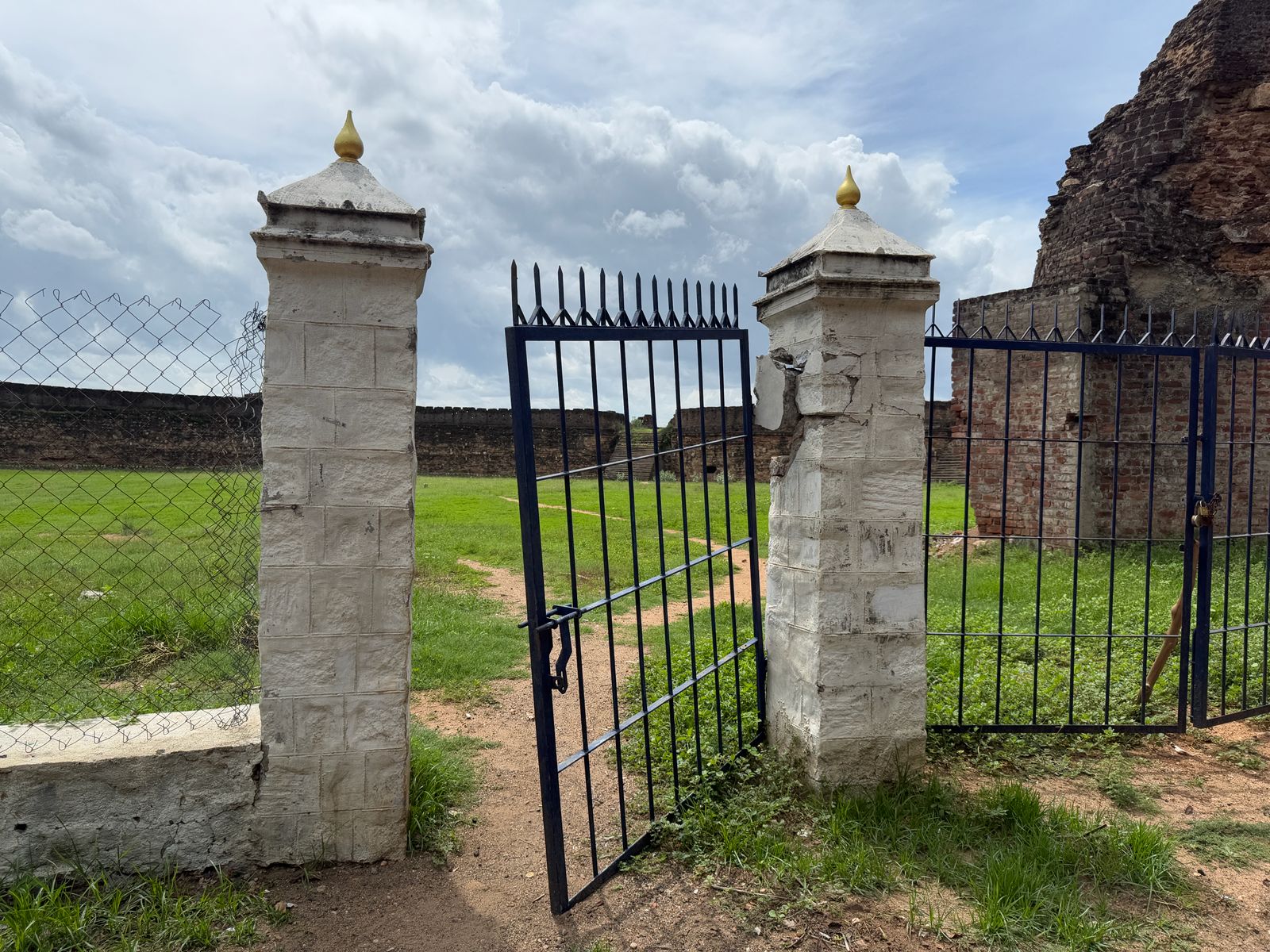
A half-open steel gate squeaked in the wind. Silence did the welcoming.
The drive from Sayalgudi was short and easy. The kind of road where fields stretch to the horizon and herons perform slow-motion flypasts. When the map finally announced, “You have arrived”, I looked around for a dramatic gateway, maybe a guard with a spear. Instead, a half-open steel gate squeaked in the wind. Silence did the welcoming.
My daughter and I stepped out to find a way to enter. A half-open steel gate guarding a three hundred year old fort was unmissable irony.
Inside, the Archaeological Survey of India had left a plaque, Tamil on one side and English on the other, as if to say, “You wanted history, here, have some.” It read:
“This stone fort was constructed 300 years ago by Sethupathy King Udayathevar alias Vijaya Raghunatha Sethupathy. It is believed that this was built with the assistance of a French Engineer. After the downfall of Panchalankurichi, this fort fell into the hands of the East India Company. It was also under the control of the Marudhu brothers for some time. It is reported that Veerapandya Kattabomman stayed at this fort on his way to Ramanathapuram.”
Department of Archaeology, Government of Tamil Nadu.
A Large Swathe Of Time
Three hundred years ago. Or maybe three fifty. Hard to say. The plaque offered no date, and the stone looked as if it had been sunbathing there for at least fifty years itself. Perhaps that was the idea, a quiet puzzle for every visitor to solve, century after century. A lump of cold data with no life, sitting there like an exam answer from a student who had memorised the facts but forgotten the story.
Large swathes of time like “three hundred years” hide more than they reveal. We revisited our memories and tried patching together a timeline of world events back then.
We bantered about how it might have been built when the Mughals were beginning to wobble.
Before the United States became a country, when it was still mostly wild land and brave people trying to survive winter. Before the French Revolution, when Marie Antoinette was still years away from allegedly offering people cake. Before Beethoven wrote a single note, before railways linked cities, before the first vaccine, and even before coffee became a global habit that half the world now depends on just to get through the morning.
The sun shone through the clouds. It was a splendid conversation to have in that setting. To talk about a quiet, crumbling place by stitching it into the larger story of the world. To look at these stones in desolate isolation, and then suddenly see them in full, noisy context.
The other line on the plaque that caught our attention was about the French engineer. What was a Frenchman doing in the sweltering plains of Ramanathapuram, drawing blueprints for a Tamil king? I pictured him, moustache damp, measuring walls under a merciless sun, wondering which Parisian sin had earned him this posting.
And then there were the Marudhu brothers, Kattabomman, the Sethupathis, all names that echoed rebellion and royalty. I could almost imagine them striding through this space with pride, purpose and possibly a few swords.
All these conversations were possible only because of past dalliances with history, and my occasional attempts to teach her some. In front of us, though, was an NCERT style summary carved into granite, looking surprised to get as much attention as we were to see it.
When you have too much history, you sometimes stop tending to it. It felt like a reasonable hypothesis to accept, nod at, and move on.
Steps, Stories, and Silence at Kamuthi Fort
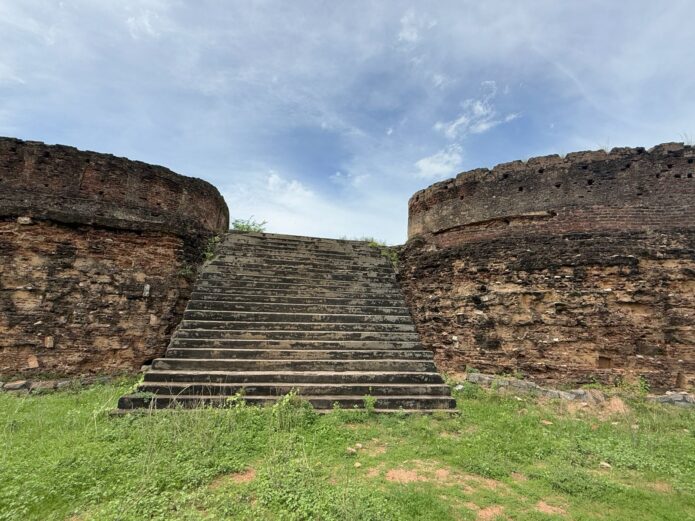
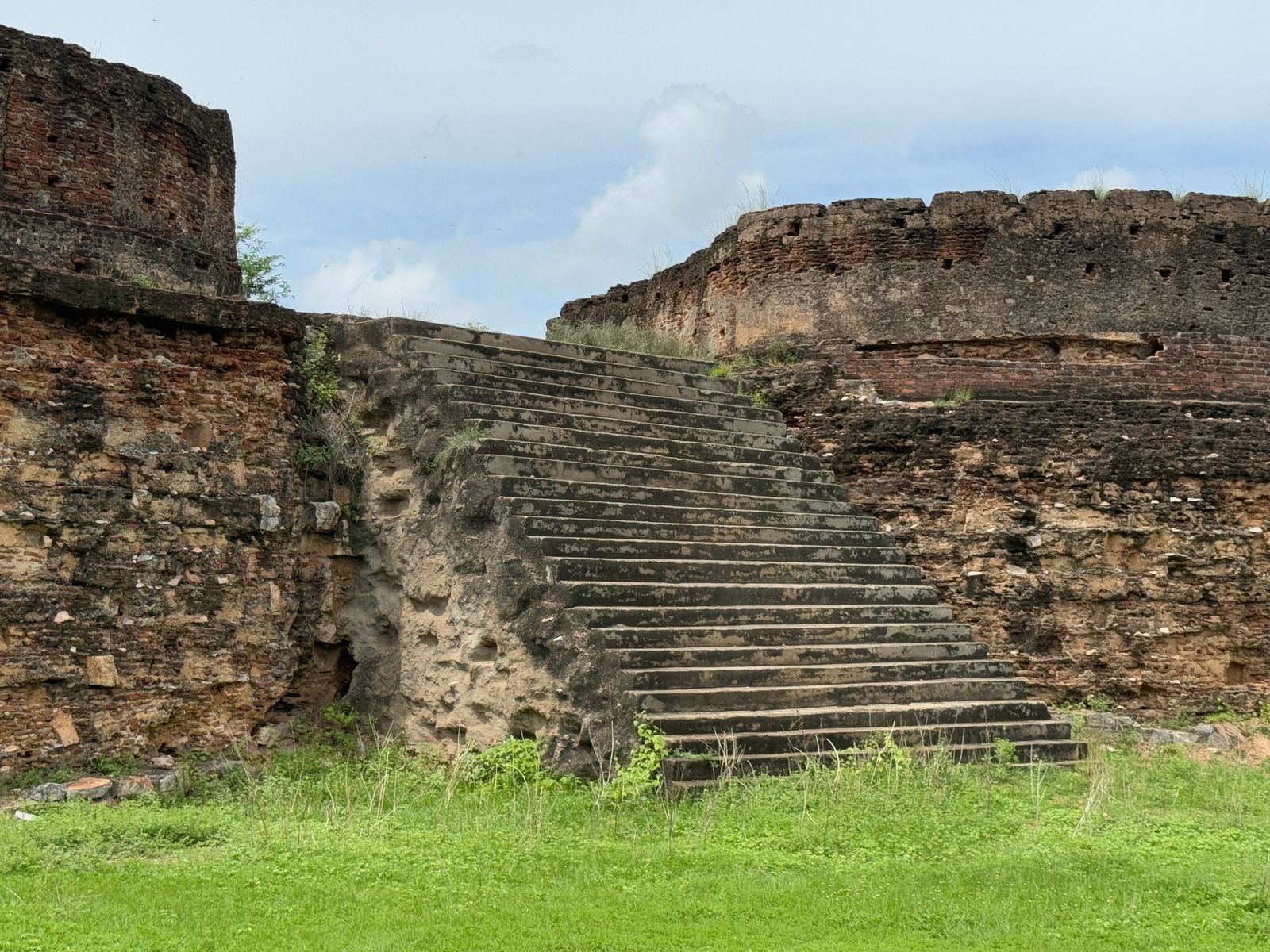
The fort is circular, its thick walls still stoic even though time and rain have bitten chunks out of them. Wide stone steps climb up the ramparts. Strong. Straight. Stubborn. The kind you do not see in modern buildings.
Storied steps of Kamuthi fort
I climbed one and reached the top, expecting a grand view. Instead, I found empty beer bottles glinting in the sunlight. Every era has its warriors, I suppose. Then I climbed another flight of steps, and another view waited. Each staircase led to a different story.
From up there, the view stretched across contradictions. A colourful temple tower rose from one side, loud with freshly painted gods. On the other side, the Armed Reserve Ground stood silent.
I later found a YouTube video claiming that the cops once used the fort for target practice, until residents protested. Not out of love for history, but because of the noise. Small mercies, I thought. I have no idea how true that story is, but the fort clearly has had many lives. And its latest round of survival did not seem to be due to grand conservation plans, but to something far more ordinary, everyday irritation.
At the centre of the fort, a wide green patch stretched like an empty parade ground. Perhaps soldiers once trained there. Perhaps kings reviewed troops. Now, weeds stood in quiet attendance.
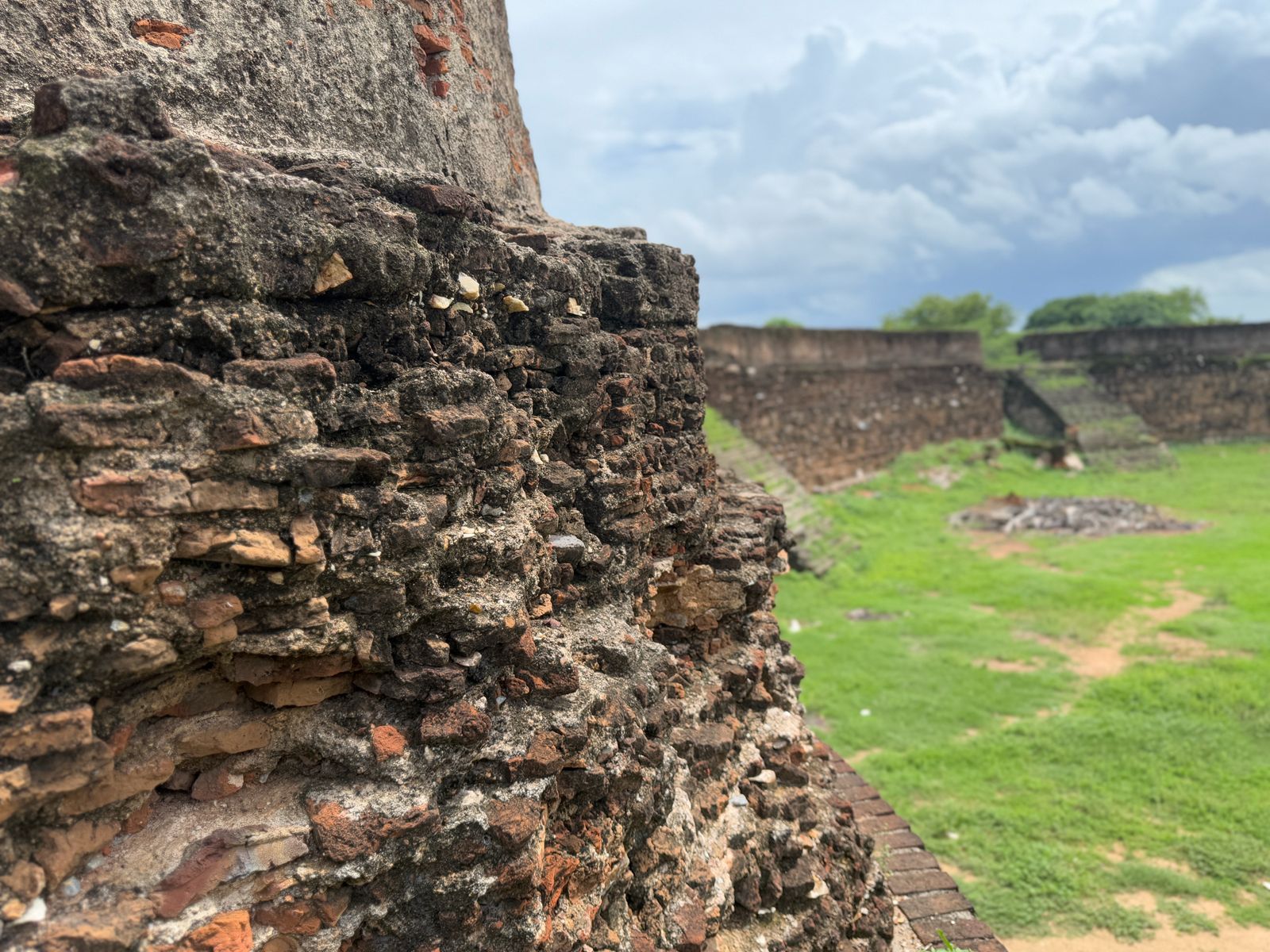
The walls of Kamuthi Fort are astonishingly thick, the kind that were built not just to stop enemies but to outlast them and ten generations that followed. Up close, you can see layers of old brick, lime mortar, sand, crushed shell, and the occasional glint of stone all holding together like a long, patient handshake.
Thick walls of Kamuthi Fort
Later that evening we pored over the internet, trying to understand what gave the construction its strength. We found that builders in those days mixed the mortar with whatever helped it endure, including jaggery water, powdered limestone, and kadukkai, a small wrinkled fruit whose natural tannins helped the walls resist cracking and moisture.
Some recipes even mention raw eggs for a smoother set. Whatever they used, it clearly worked. Three centuries later, these walls still stand in stubborn defiance, quietly proving that things built with care and a few eccentric ingredients tend to last.
On my way out, I noticed a bold red 1993 painted on the wall of the temple wedding hall. Its proud year of inception. It stood directly opposite the steel gate, a mere thirty two years old. The contrast was almost comic. Like a fresher showing off a car he mostly owes the bank, before a billionaire who has lost his fortune.
What Kamuthi Fort Teaches Without Trying
Kamuthi Fort may never make it to glossy travel brochures. It does not charge tickets, sell souvenirs, or feature in drone videos with cinematic background music. But it has something many others do not. Presence. A stubbornness to remain. You walk through the broken walls and feel centuries of sun and storm still trapped in the bricks. You hear whispers of battles and see echoes of neglect.
If this were in Europe, there would have been tour guides with microphones, an entry ticket priced just right to fix half the state budget, and a tidy little museum shop selling magnets of the fort looking ten times grander than real life. There would have been plaques with footnotes, audio guides in eight languages, and a cheerful volunteer reminding you to stay on the marked path.
And if this were in the United States, the place would have been turned into “Fort Kamuthi National Heritage Park.” There would have been a café called “Kattabomman’s Brew”, a massive fort shaped bouncy castle for children, actors from Colonial Williamsburg doing hourly re-enactments, a twelve dollar bottle of water, burgers the size of dinner plates, and a forty nine dollar premium early access pass. Of course, the small town of Kamuthi would have been flattened to make way for a giant colour coded parking lot.
All this for a place that, in Kamuthi, lives perfectly happily with a steel gate and the afternoon sun.
It struck me then how wildly the world varies in the way it wraps itself around history. Some places polish their past to make it look like something else. Others leave it lying around like old furniture. Kamuthi Fort simply sits and waits, holding on with quiet strength while we hurry past. It deserves far more care than it gets. The slow drift into disrepair feels like a small discourtesy to everything it has survived.
Perhaps it will get more attention if someone like Lokesh Kanagaraj decides to shoot a fight sequence or a moody montage here. But we do not have to wait for that. We can start with something simpler, attention and respect.
We owe these places that. A few moments of silence. A pause to think of the countless hands that built, fought, prayed, or repaired these stones.
If you are ever near Kamuthi, please go. Not only for your children to climb its steps, but for yourself, to stand still for a while. To feel how time stretches, how pride turns to dust, and yet how beauty lingers in silence. You will come back lighter, and oddly grateful.
Because even in its decay, Kamuthi Fort is doing something quietly spectacular. It is enduring.