

As a young boy, every temple visit meant one thing before anything else. My great grandmother’s hand, and the soft clink of coins.
She would stop at the entrance, find the men sitting outside, and without ceremony drop a few coins into the black bowl in front of them. The sound was unmistakable. Metal on something hard and hollow. A clean, round clang that rang out and then faded into the temple noise. I heard that sound at every temple, in every town, across every visit. It became, without my knowing it, the sound of arrival.
I came to know the bowl’s name much later. Thiruvodu. In Tamil, thiru means sacred or holy. Odu means vessel. The sacred vessel. The bowl that holds what is given and asks for nothing more. Mendicants of Lord Shiva have carried it for centuries, painted black, hollowed from the hard shell of a fruit that, of all things, originates in the jungles of Mexico. It travelled oceans before anyone thought to name it sacred. Then it settled quietly into Tamil temple life, as if it had always been there.
I did not know any of this as a boy. I just knew the sound.
Well into adulthood, I picked up the courage to do more than drop coins and walk on. In a small town somewhere in rural Tamil Nadu, where life is placid and unhurried, a man sat on the ancient stone floor of a temple, sacred ash on his skin, a thiruvodu in front of him, its rim bedecked with bright flowers. We got talking. Within minutes he said something I have not managed to forget: “Whatever they give, my bowl must be worthy and ready to receive.”
I have turned that line over in boardrooms. In bad conversations. On mornings when the day arrived with more than I had asked for.
A decade and a half or so passed. Another thiruvodu brought alive an ordinary moment. This time I was in Konerirajapuram, a small village in the Chola heartland, off Kumbakonam. Its Uma Maheswarar temple has stood since the tenth century and houses what is said to be the world’s largest bronze Nataraja. A thousand years of devotion, with routines and a shrug. The village is now a shadow of its former self, though the temple stands unmoved.
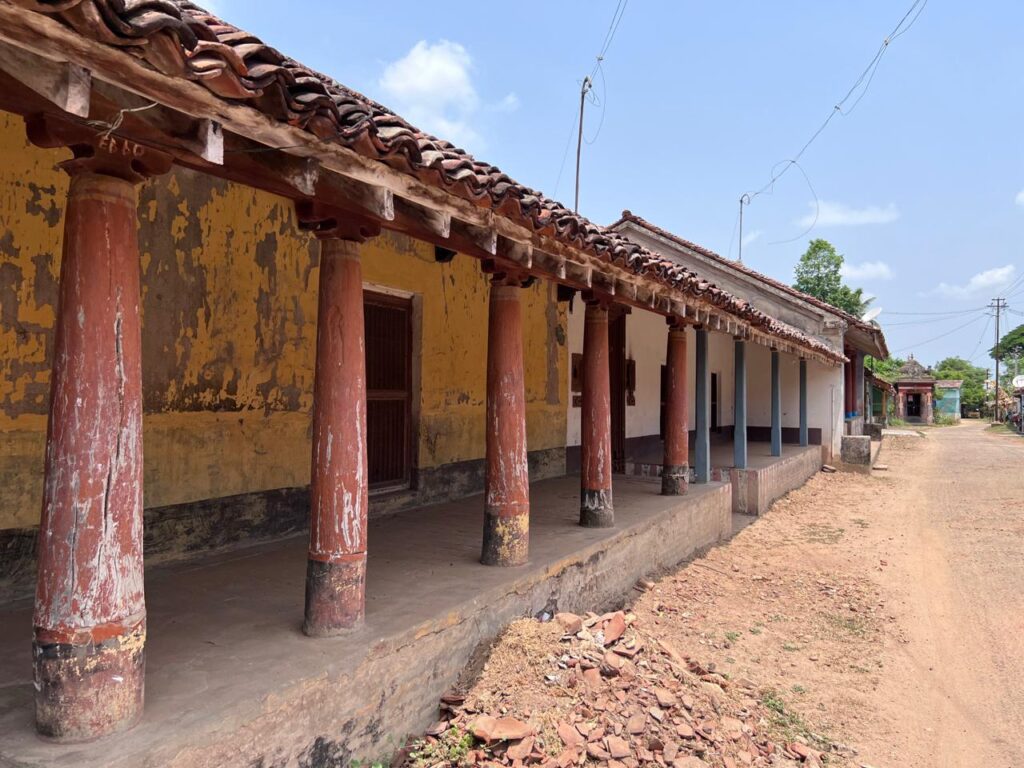
We passed through a deserted Agraharam to get there. Long colonnaded houses, ochre walls peeling in slow strips, red pillars standing at attention for a life that had quietly packed up and left. Somewhere in those corridors, families had cooked and argued and celebrated for generations. Now, just footsteps and a silence that wasn’t empty. The kind that remembers.
The temple was shortly after. And there he was, sitting outside, holding a thiruvodu worn smooth with years. No flowers this time. Just the bowl, the man, and his smile.
I asked him how he was.
He said, in Tamil, whatever has happened has happened for the good. Whatever will happen will all be for the good.
The words are from the Bhagavad Gita. But he spoke them with no performance attached. No invitation to discuss. He said what he said, smiled, and returned to sitting. The bowl sat on the ancient stone floor, looking at the sky.
He hadn’t overthought his afternoon. He wasn’t rehearsing the next thought or relitigating the previous regret. He had simply arrived at the present and settled there. The bowl open. The mind open. That was enough.
What the Sea Confirmed
Seneca, the Roman Stoic who wrote more wisely about happiness than he perhaps lived it, said something similar two thousand years ago. Happiness, he wrote, asks one thing: set down the memory of a bad past and the fear of a bad future. Two bags. Both heavy. Most of us carry them everywhere.
A few months later I drove to Sayalgudi without a plan. Just a sense the road went somewhere worth going. It did. The road ran out and the sea filled the gap. Waves arriving, crashing, dissolving without complaint, each one complete in itself.
I sat on that beach with a phone full of unread messages, a conversation I had handled badly three weeks earlier, and a meeting I was already dreading on Tuesday. I had carried all of it from Mumbai, through Madurai, down to the edge of the land. Good luggage management.
Each wave came in full, spent itself completely, and pulled back without holding on to anything. No wave has ever refused to break because the last one didn’t go well.
With one of those waves came back the image of the thiruvodu. It arrives open. It receives what comes. It does not clutch what has gone. The bowl doesn’t mourn its last contents or worry about the next. It simply stays ready.
The man in Konerirajapuram already knew this. He had known it long enough that he no longer needed to think about it.
Two bowls. Two men. One with flowers on the rim, one worn plain. Both open to whatever arrived. Between them, across a decade and a half of travel through Tamil Nadu temples, they had said everything Seneca spent letters trying to say.
Be ready to receive. Let go of the rest.
The bowl doesn’t ask what it deserves. It doesn’t mourn what it missed. It simply stays open, in whatever temple or crumbling Agraharam or quiet coastline you happen to find yourself in.
That, it turns out, is the whole practice.
18 responses
Dear Kavi ,
Wonderful!!!
I love the use of sound i& silence n this essay .
Some sentences that I read,took a deep breath and read again..
“Red pillars
standing at attention for a life that had quietly packed up and left”
“The bowl doesn’t ask what it deserves. It doesn’t mourn what it missed”.
“Good luggage management”!
As always poignant,quiet & leaves a footprint in the mind.
Thanks so much Sonali. Grateful. “Good luggage management” made me smile when I wrote it too. Glad it landed. The red pillars were just there, asking to be noticed. That’s all I did.
Sir you write simple thats easy to understand, and digest too.
That is exactly what I aim for, Ajay. Simple enough to sit with. Thank you for saying so.
I love you, Kavi. As always, well thought and well written article
So deep and so open like the Thiruvodu.
And what is deep and open?
“Deep love holds closely, yet never holds captive. It cares deeply, yet leaves the sky open for the other to fly.”
Your writing does that. More pronounced like the Thiruvodu.
That image of deep love leaving the sky open, that is beautiful, Sir. The thiruvodu would approve. Thank you for bringing that here.
Thanks Kavi Sir, ‘Be ready to receive. Let go of the rest. The bowl doesn’t ask what it deserves. It doesn’t mourn what it missed. It simply stays open,”
In my openion, it is very important to practice for being better human, however as a human i keep moving with new thoughts every second it will be difficult to be aware and practice. Irruku aana illai
Irruku aana illai. That is the whole essay in three words, Murali. The practice is the practice, even when we keep losing it.
Good stuff kavi
Thank you, Rama. Glad it reached you.
Acceptance is, according to Osho, the “revolutionary challenge of transformation,” allowing one to experience life as a blessing. He suggests “floating with the river” of life rather than pushing it, leading to a state of peace and deep silence.
Osho and the thiruvodu would have got along well, Sir. Floating with the river, open to the sky. The bowl already knew this. We are just catching up.
Lovely piece Kavi – not surprised at all – you write so well. I wonder if the thiruvodu does not have a lid so that one cannot hide or hoard. What stays stays – what does not is not yours to keep! You get only that which you need – no greed is pandered to. My 2 cents.
Your two cents are worth considerably more, Shubha. No lid. No hoarding. You get only what you need. That is a beautiful addition to the essay. Thank you for it. Grateful.
Dear Sir,
This article, in many unexplainable ways, reminds me of my reflections from our conversation a few years ago over a casual drive in Chennai. Thanks for sharing.
Thanks and regards,
Venkattesh
The past, the present, and the future form a seamless continuum—an unbroken stream of time flowing quietly through our lives. To linger too long in what has been, or to wander too far into what may come, is perhaps to diminish the richness of the moment we inhabit now, for the present asks only for our attention and presence.
Your narration, in that sense, feels like poetry gently woven into prose—words that move with rhythm, thought, and grace.
And so, the Sunday feels quietly blessed…
Always love reading your thoughtful pieces couple of times. They speak to me and love the way you create a lyrical prose with your words bringing so much of the unseen. Sitting with it this Sunday
loved the flow. Distilled essence of life often missed and messed. Tx Kavi