
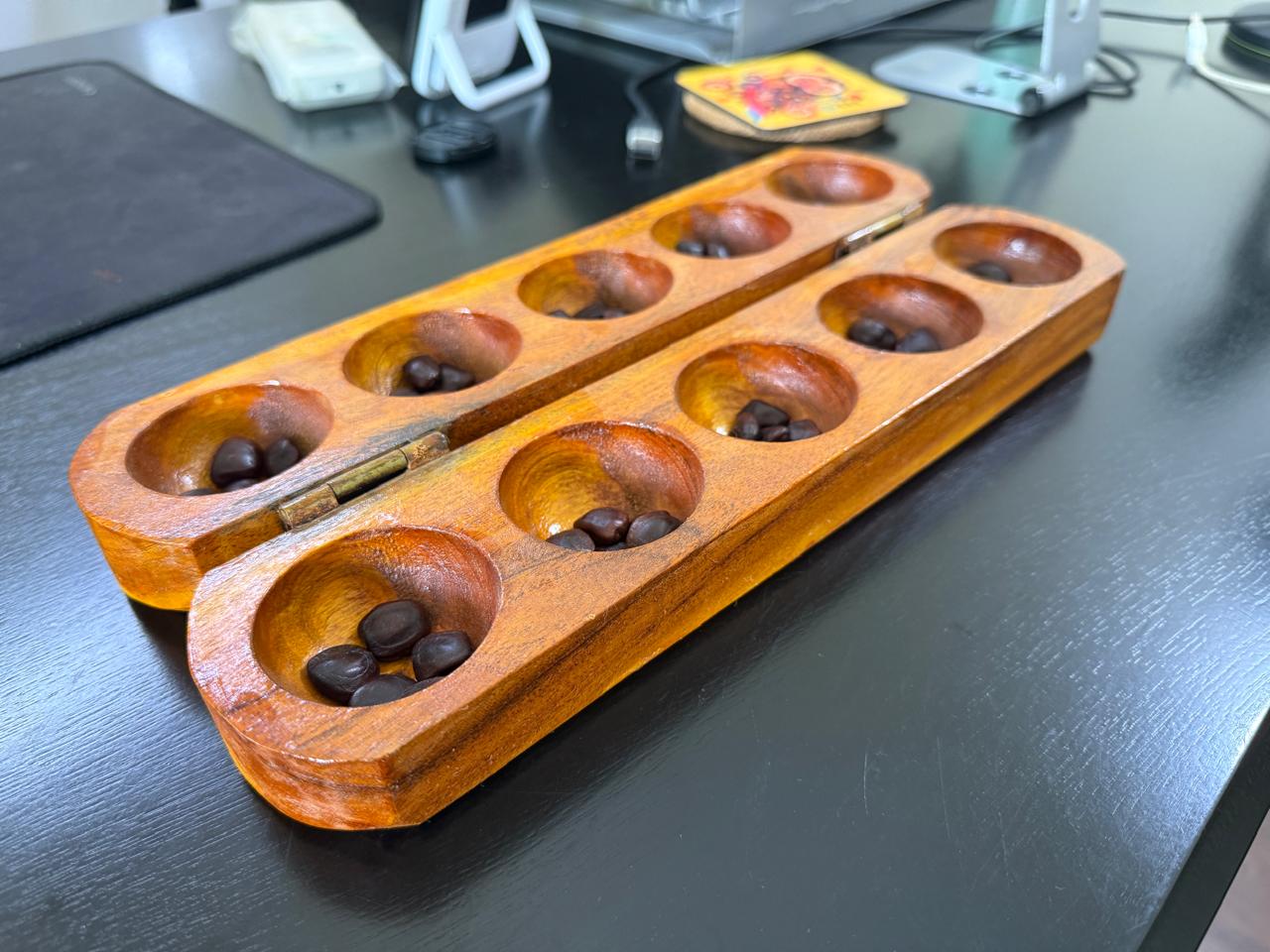
A friend keeps a pallanguli board on her desk. Not as a decoration. As a reset button.
Between calls and deadlines, she scoops tamarind seeds from pit to pit. Two rows of small hollows carved into wood. It takes three minutes. It costs nothing. It works every time.
I watched her do this a few weeks ago. I did not say anything right away. Because something from decades ago walked in and sat down.
My great grandmother played pallanguli the way she did most things. Without fuss and without losing. She moved the seeds around the board as if the board had already agreed with her plan. I was six, maybe seven. I sat across from her, lost every round, and picked up arithmetic, strategy, and patience without knowing I was picking up anything at all.
My hands got it long before my head did.
The same tamarind seeds, by the way, could be rubbed hard on the ground and pressed onto someone’s arm. The result was a fine, sharp burn. I know this from years of personal research.
The Unsponsored League
The games we played in Madurai were never meant to be lessons. None of us thought of it that way. We had open ground, a big sun, no money, and nothing to do. The learning just showed up on its own.
Kitti
Kitti, or kitti-pullu (gilli danda in Hindi). A long stick, a short stick, and a bit of empty road. You flicked the short one into the air and whacked it before it landed. The other side tried to catch it. If they missed, you measured how far it went. The unit of measurement was the stick itself. There was no other.
Nobody said the word geometry. Nobody said judgment. We just played, and played, until somebody caught a stick to the head. The game stopped for a minute while the injured party made a decision. Cry, or hit back. Both were fair.
(I found out recently that in Galicia, Spain, there is a Liga Galega de Billarda. A proper league with fixtures, for a game that works on the same principle. . I watched a video of them playing on YouTube. Men in a field, flicking a short stick into the air, striking it mid-flight. I had tears in my eyes before I understood why. They gave it a federation. We gave it a bleeding forehead and were home for dinner as though nothing had happened. Of course. )
Goli
Goli. Marbles.
You crouched in the dust, curled your thumb behind the marble, and let it go. The thumb knew things the brain had not yet heard of. That a big marble is not always a heavy one. That angle matters more than power. That things travel in curves on rough ground.
Years later, we met all of this in a physics class and recognised it at once. Like running into someone from your old street.
Under the Madurai sun, with no cap, no sunscreen, and no worry about either, all that mattered was landing it on the right spot. The physics came free.
Pambaram. The spinning top.
You wound the string tight, threw it, and it landed spinning. Most boys could manage that. The jalli, if I remember the word right, was something else. The jalli meant scooping the spinning top off the ground onto your open palm while it was still going. The iron nail turning fast against your skin. Your hand learning not to flinch. It took weeks. It took nerve. The boys who could do it well were not just good. They were artists. Champions, and champions of champions, long before Ravi Shastri earned that title at Melbourne in 1985 and drove home in an Audi.
That was about the time cricket, proper cricket with television and trophies, walked into every Indian home and showed the street games the door. The street games were not lesser. They were just unsponsored.
When It Was Dark Enough
We played without watches. The sun told us when to stop. When it got dark, we went home. No clock. No notification. No battery running low. Just the sky, doing what the sky does.
These games lived in texture and sound. The weight of a marble in a curled thumb. A pambaram string pulled tight. Tamarind seeds dropping into wood with a soft click. The sharp sting of those same seeds, rubbed on the ground and pressed to skin. They left a memory in the hands, not the head. That kind of knowing lasts longer than most things taught in a room with a blackboard.
No cap. No sunscreen. No money. Just open ground, a big sun, and the whole afternoon ahead.
We were, it turns out, in a different league entirely.
2 responses
I have played all these games so your post brought a flood of memories. Thanks for the post, we relived some experiences.
My father was against my playing Goli, or Gotya as it si called in Marathi. That is because marbles got traded based on one’s play which he did not like – he likened it to a kind of gambling. It is great how children invent games with least material on hand.
And we also played (probably you too played) ‘Dabba Aispais’ which is a corrupted version of “the Bird’s Eye Spy.” There is a Marathi movie Dabba Aispais.
Thanks again for the wonderful blog post.
Thank you very much!
I had played all Bambaram, Gilli, Golli, Kabadi, Jumping trees, Mudugu Puncture and some more with all my friends. Best part is we are all still great friends. All these physical games kept us absolutely tied entire day and we never think of food except the pipe water on the road side.
Wnen we bargin to any of our friend house, his mother will quickly prepare food for all os us (10 to 12). Great Fun!