Metaphor

Pay Attention

A teacher I had in Madurai had one instruction. Delivered daily. With the confidence of someone announcing a natural law.

Pay attention.

I paid. Mostly because she was terrifying.

It took forty years to notice the instruction was strange. You pay taxes. You pay rent. You pay for mistakes you didn’t entirely make. Attention, apparently, belongs in that list.

Seventeen browser tabs later

A few months ago, I was reading Steven Pinker. Something about language and how it shapes thought. A small question snagged. Why pay? I looked it up. Then something else. Then it was an hour later and I had seventeen browser tabs open and a strong opinion about German.

Here is what I found.

English is the only major language that treats attention as a transaction.

In German, you gift it. Freely. No invoice.

In Irish, you bring it somewhere, like a person arriving with something tucked under their arm.

In Japanese and Chinese, you pour your mind into something. Slow, deliberate.

In Arabic, the root of the word means to wake up. To attend to something is to be alive to it.

And then there is English. Where attention is currency, the mind is a wallet, and a classroom in Madurai is apparently a debt collection agency.

Lakoff and Johnson wrote a book called Metaphors We Live By. The argument, simplified badly, is that metaphors are not decoration. They are the architecture. The way you phrase something tells you what the thing actually is, in the mind of the person speaking.

Which is worth sitting with for a moment

The bill, and what it assumes

If attention is something you pay, it can be paid reluctantly. Dutifully. Resentfully. You can pay attention to a meeting you hate, a speech going nowhere, a relative explaining their knee surgery in considerable detail. Obligation discharged. Ledger balanced.

If attention is something you bring, that changes. You had to decide to carry it.

If attention is waking up, reluctant attention barely makes sense. Either you’re awake or you’re not.

In Tamil, the word is kavanam. From a root meaning to watch over something carefully. Almost protectively. Less a school instruction, more something you’d say to someone you trusted with something precious.

My teacher never said it that way. She had twenty three children and a chalk duster she was not afraid to use.

But I have been thinking about her instruction ever since. About what it asked for, and what it quietly assumed. That attention was a cost. That a child in a classroom in Madurai had a payment to make.

The metaphor you grow up with becomes the instruction you carry. It tells you what you owe, and to whom, before you are old enough to question it.

Decades later, I am still paying.

Though I’m no longer entirely sure to whom.

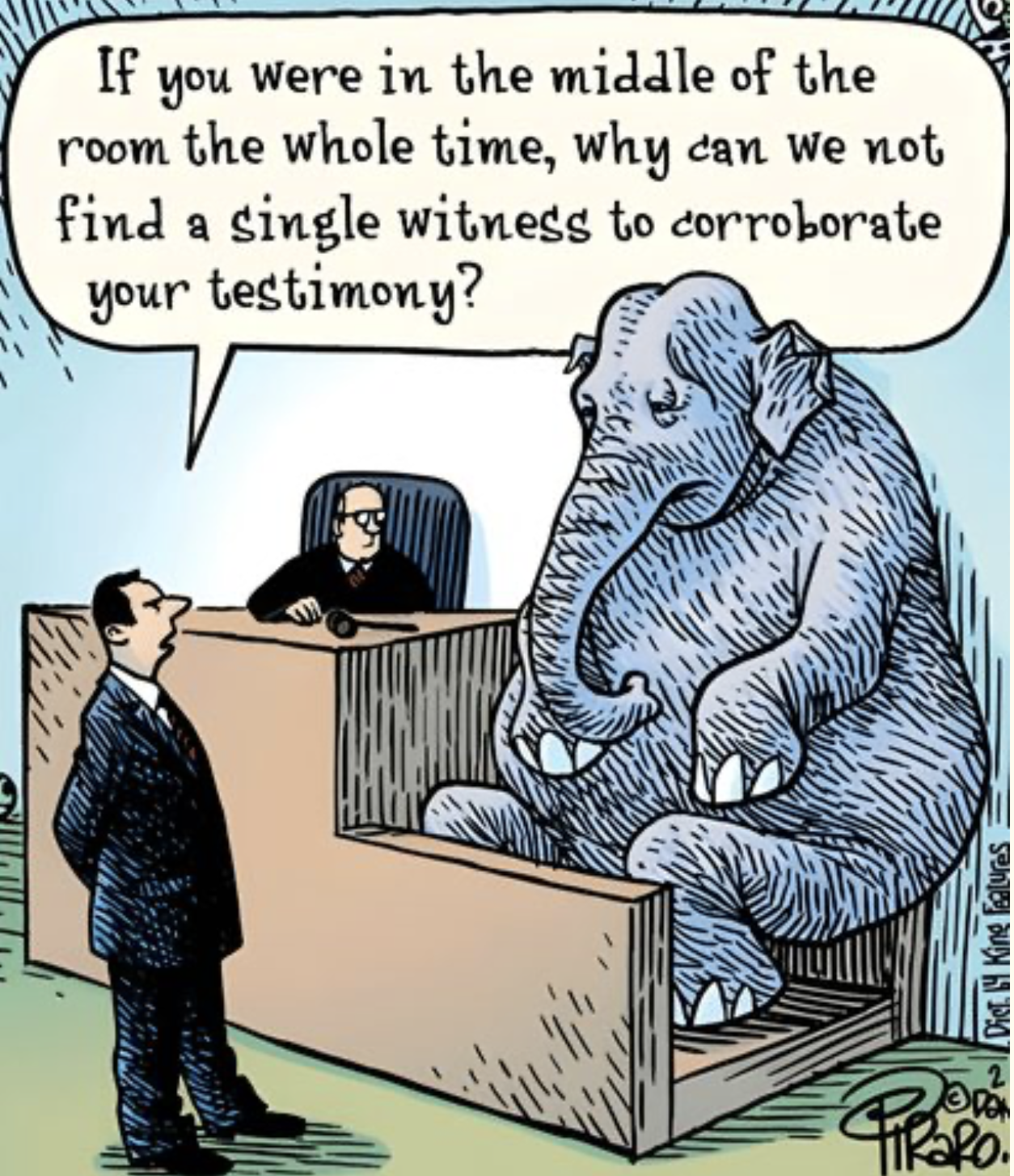
The Elephant in the Room – Not as Invisible as You Think

My work revolves around making change happen and stick—at all kinds of levels. And if there’s one universal truth, it’s this: there’s always something unsaid, something avoided. Sometimes, it’s just a small discomfort. An Elephant in the room! Sometimes, there’s a full herdThe other day, I wrapped up a conversation where everyone expertly avoided making eye contact with the massive, wrinkled reality in the room.


I’ve been thinking about these elephants in the room. Unspoken realities. They have a tough job. And honestly, so do I. Because the more I work with organisations and teams, the more I see how much avoidance of this elephant in the room stands in the way of progress. It can be incredibly frustrating to watch brilliant people, well-resourced teams, and ambitious strategies get stalled because no one wants to name the obvious.

Interestingly, the phrase “elephant in the room” has its roots in an old fable by Russian poet Ivan Krylov, titled The Inquisitive Man (1814). The story follows a man who visits a museum and marvels at all the tiny, insignificant details but somehow fails to notice the elephant right in front of him. If that isn’t the perfect metaphor for how most organisations and families deal with uncomfortable truths, I don’t know what is. We focus on minor distractions, but the massive, inconvenient reality remains untouched.

Wild thought. What would it be like to hire an elephant in the room? I mean, how would the job description look? What would be its responsibilities? How would you review its performance? What would the elephant say? Where would they go to cry? And what else could they do?

Some days of intense frustration make me think like this. Creative licence to deal with day-to-day difficulties, if you will.

Now Hiring: Elephant in the Room

Position: Elephant in the Room
Location: Every office, family gathering, and awkward social situation.
Reports To: No one, because no one acknowledges its existence.

Job Responsibilities:

  • Stand silently in meetings, absorbing tension like an unpaid intern.
  • Ensure everyone pretends everything is fine when it clearly isn’t.
  • Occasionally wave a trunk in frustration, only to be ignored.
  • Be the invisible force behind passive-aggressive emails that start with “As discussed earlier…”

Performance Review:

“Exceptional ability to be avoided. Maintains presence without making a sound. 10/10 at making people glance at their phones instead of addressing the real issue. Keep up the great work!”

A Word from the Elephant Itself

“Look, I didn’t apply for this job. But here I am. Stuck in boardrooms where people discuss alignment instead of accountability. Hovering over family dinners where everyone tiptoes around Cousin Ramesh’s mysterious ‘business venture.’ Sitting in post-crisis town halls where leadership promises ‘synergy’ while employees quietly update their LinkedIn profiles.

I’ve tried everything. Waving my trunk. Wearing a hat. Bringing snacks. (Nothing gets humans talking like free food, right?) But nope. Silence.

At this point, I just sigh and sit down. If you won’t acknowledge me, I might as well be comfortable.”

Support Group for Elephants in the Room

  • “I’ve been in an office for five years, and they still pretend I don’t exist!”
  • “Try being the elephant at a wedding where everyone knows the bride’s ex is in the audience.”
  • “At this point, I’m considering a career switch. Maybe become the ‘Monkey on Someone’s Back’ instead.”

Ways Forward: Working with the Elephant in the Room

Addressing the unspoken isn’t about charging headfirst into confrontation. It requires a mix of awareness, strategy, and patience. Leaders who handle these situations well focus on a few key things.

First, recognising discomfort is essential. What are the conversations being avoided? What patterns keep repeating? Naming the issue doesn’t always mean calling it out immediately but being aware of its impact.

Creating an environment where people feel safe to speak up makes a difference. If raising concerns is met with silence or punishment, people will simply stop trying. Timing also matters—some truths need gentle nudges, others require direct conversations.

Finally, not every situation can be resolved. Some rooms thrive on avoidance. And in those cases, knowing when to step away is just as important. Progress happens when people choose to see what’s right in front of them.

The Next Career Move

“With all the rooms filled with ignored elephants, I’m considering a career change. Maybe I’ll become the ‘Skeleton in the Closet’ instead. Seems like a better gig!”

What’s the biggest elephant you’ve seen in the room?
Let’s talk. No peanuts required.

Traveller Or Tourist?

“when all is said and done, much more remains to be said and done”.

At the end of the Chicago leg of this travel, @flyohare ’s elevators say goodbye in a shiny memorable way!
“The traveler sees what he sees, the tourist sees what he has come to see”. Thats G.K.Chesterton. Now that I dint come to see the elevators, I guess I am a traveller! 🙂 

Flying Over the North Pole: Big Engines, Tiny Thoughts

Flying over the North Pole is magical. White stretches everywhere. Then a flash of sparkling blue. The Airbus A380 hums along, powerful yet tiny against the vast sky.

It makes you think.

Big and small are just ideas.

Up here, the plane feels like a dot. Down below, it’s a giant. Perspective changes everything. It’s humbling. It’s beautiful. It’s a moment to pause and wonder.

Coffee and Conversations: Wisdom in Every Sip

My dad always said, “Coffee drinkers are better thinkers.” He was a wise man. I’ve never had a reason to doubt him.

These days, “Coffee?” is the answer to everything.

Questions, answers, problems—it doesn’t matter. Coffee solves it all. Especially in Mumbai. The city hums with its energy, fuelled by endless cups.

Maybe it’s the caffeine. Or maybe coffee is just a great excuse to pause, talk, and think.

Either way, I’m not arguing. Coffee?

Stories a Brass Kettle

Objects have character. Don’t they? This brass kettle from another era sat quietly, serving filter coffee and cardamom tea for generations. Imagine what it has seen!

Families growing, stories flowing, and lives unfolding—all while it stayed still.

Sometimes, I wish it could talk, spilling tales of the people and the times. But its dents and marks do the talking. They hint at the lives it touched.

So, I let my imagination take over and weave my own stories.

After all, isn’t that what character is—a silent storyteller of time?

The Weight We Carry: Mind Over Matter

It’s not always about the weight. It’s about how we carry it. A heavy object isn’t just physics. The mind plays its part, adding or easing the load. What’s weighing you down today? A worry, a regret, or just a bad day?

Sometimes, the trick isn’t to put it down but to carry it differently. Shift your perspective. Find a new balance. After all, the mind can make even the heaviest burden feel lighter—or unbearable. So, how will you carry your weight today? Lighten up.

You might just surprise yourself.

The Potter’s Quiet Emotion

A mound of clay transforms into pots in hours. Each pot looks identical. But I wonder—does the potter feel the same shaping every one? Is there joy in the rhythm, or is it just routine?

Each curve of the clay carries a trace of his hand, maybe even his mood. A fleeting emotion, frozen in form. What stories would he share if asked about the pots?

Or perhaps, like the clay, he’s shaped by the act of creating—silent, steady, and a little mysterious.

A potter’s world is one of quiet emotion, moulded into shape.

The Ocean’s Eternal Charm

There’s something magical about the ocean. She kisses the shore endlessly, even when sent away. Her waves are calm one moment, terrifying the next. Yet, she never fails to soothe a restless soul.

Add to this the South China Sea at sunset—hues so breathtaking they need no filter. The sky and sea meet in a silent embrace, as if sharing secrets. It’s a moment that captures the ocean’s timeless charm: her power, her grace, and her quiet promise to amaze, always. Sometimes, all it takes is a glance at her to find peace.

(at Kota Kinabalu)

Travel: More Than Just Seeing

Travel does more than take you places—it puts you face to face with your biases. It forces you to notice what you usually ignore. And suddenly, new possibilities appear.

It’s not about ‘just seeing.’ It’s about feeling, learning, and understanding. When you travel with intent, the world becomes richer. You notice details, connect with people, and see life from another angle.

That’s when travel truly keeps you alive—by opening your mind and reshaping the way you see the world.