History

The Brown Snake and I

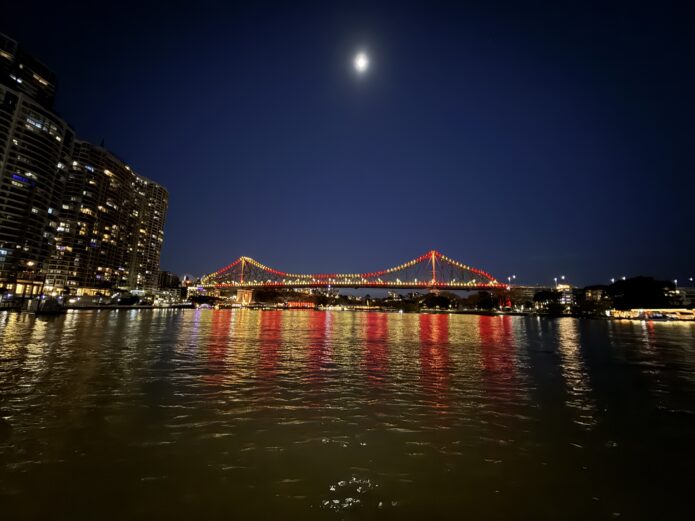
It was one of those Brisbane evenings that felt neatly put together. The moon hung above the Story Bridge, the bridge glowed in red and gold, and the river below reflected it all as if it knew its role.

This is the Brisbane River. But long before it became a postcard, it was Maiwar. The river of the Turrbal people, the first caretakers of this land. They lived along its bends for thousands of years before Europeans arrived in the 1820s. For them, the river was everything. Food, road, temple, and teacher.

The Meeting Place and a Cricket Fortress

The Turrbal people had names for every turn of the river. Woolloongabba meant “meeting place.” It still lives up to that name. It is now home to the famous cricket ground, The Gabba, where every few years India meets Australia to settle who really runs cricket.

In 2003, Sourav Ganguly’s brave century on a green, bouncy pitch showed that India had grown tired of being called timid. Then in 2021, a young, injury-hit team came back to do the impossible. Breaking Australia’s 32-year unbeaten record at the Gabba with courage, calm, and a touch of cheek.

It wasn’t just a win; it was a story of belief and joy. Many said the fortress had fallen. I thought otherwise. In fact, the Gabba stood taller for it. It proved again why sport matters: to host rivalries, to test effort, to stretch courage, and to honour that often-abused but still-revered phrase, the spirit of the game.

Funny how I started writing about the river and ended up at the cricket ground. But then again, the river has seen it all. Floods, bridges, and the odd boundary.

The River That Refused to Straighten

People call the river, ‘Brown Snake’. And the name fits. It winds through the city, calm and sure of itself. People jog along it, sail on it, build towers beside it and sometimes, when it floods, remember who’s really in charge.

Along its banks, the city gathers quietly.

Queensland’s Parliament House sits near one of the curves, looking calm and serious as if the river is ready with the next question. The kind that would embarrass a minister and still ask the opposition what they were doing all this while. A little further down, government offices line the shore, their glass windows catching the light. Across the water, old timber homes in Teneriffe stand beside tall new apartments, both pretending they belong together.
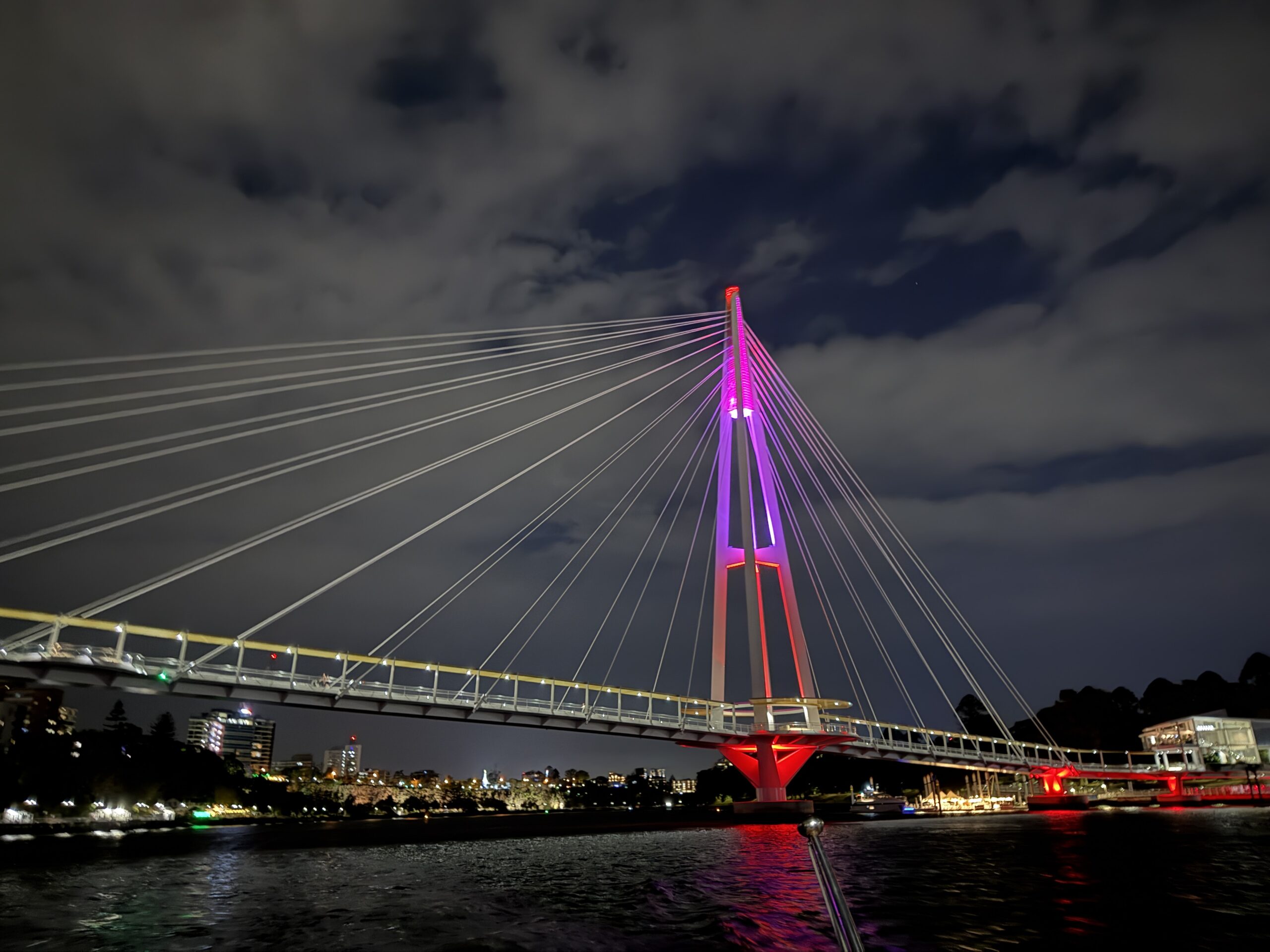
Kurilpa Bridge — a web of light and steel across the Brisbane River. It carries walkers, cyclists, and late-night wanderers
Kurilpa Bridge — where steel meets stillness, and the Brown Snake plays along.
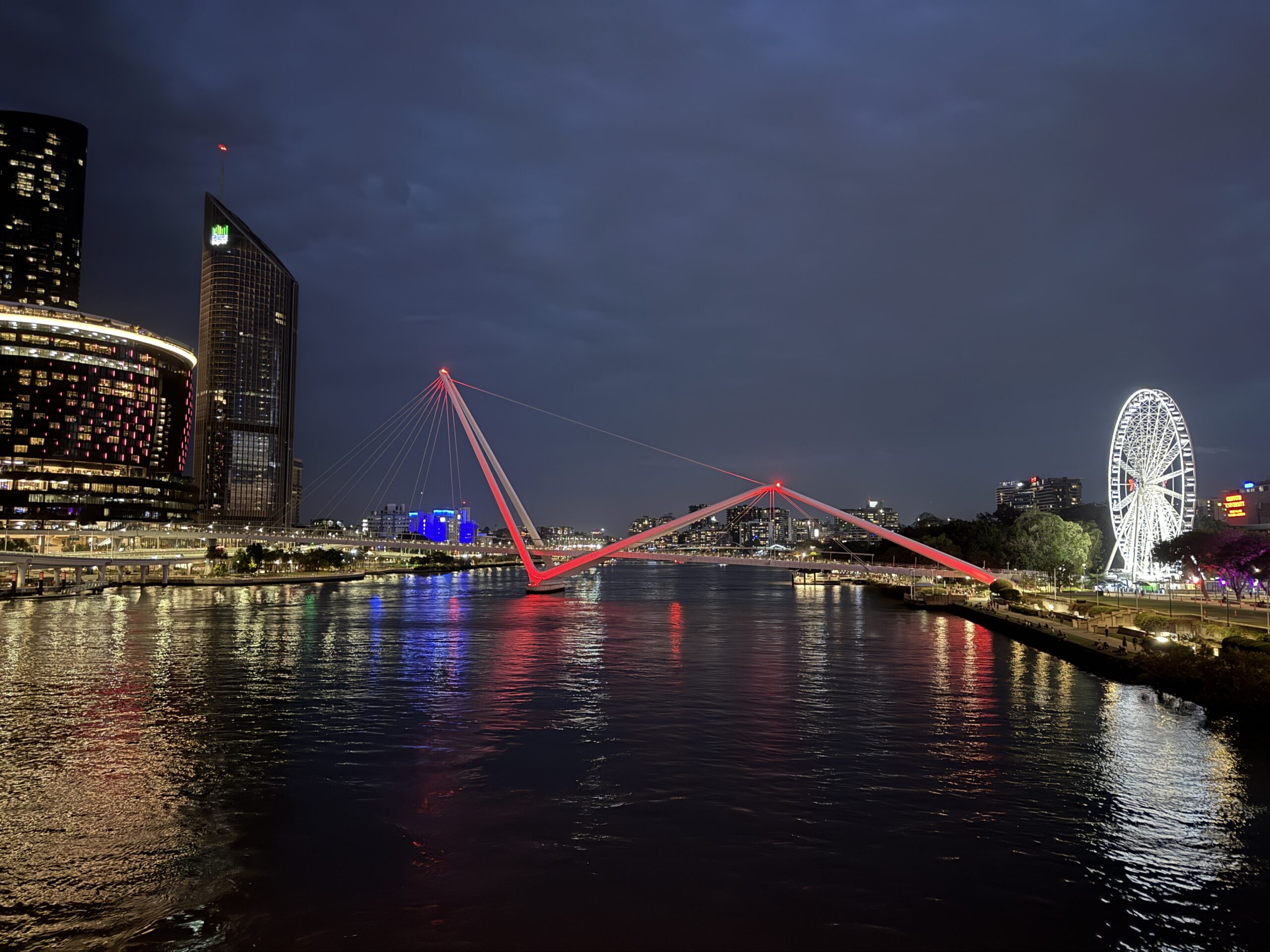
The Neville Bonner Bridge — Brisbane’s newest way to cross the Brown Snake, or to stop halfway and take another photo of it.

At South Bank, the Wheel of Brisbane turns slowly over the river. It’s a giant Ferris wheel that looks like it’s keeping an eye on the city. At night, its lights shimmer on the water, mixing with reflections from cafés and bridges. Downstream, near the University of Queensland, students walk and talk by the water, thinking of exams, futures, and maybe nothing at all. The Brown Snake watches them all, moving quietly past.
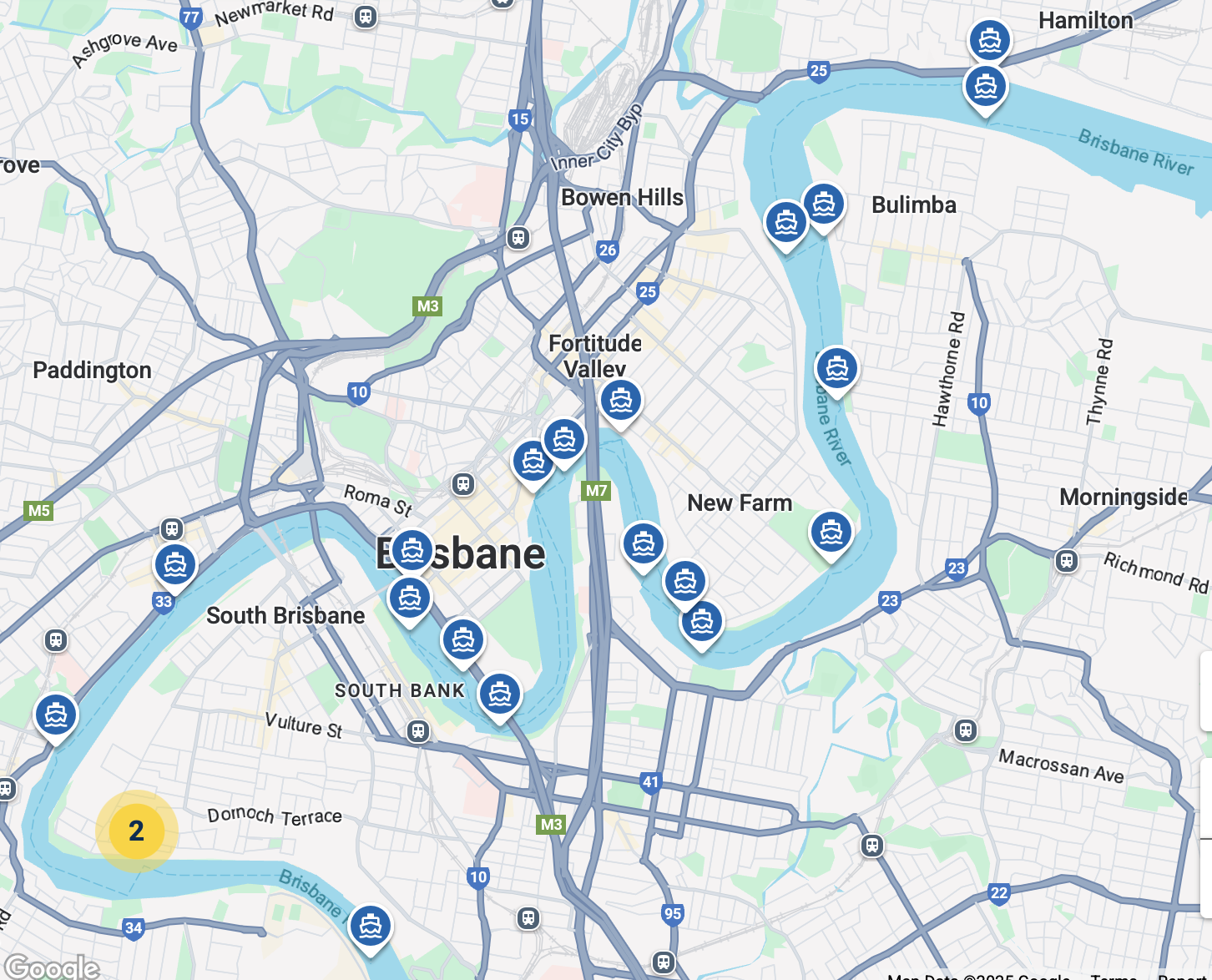
The Brisbane River tracing the city’s heart . A ribbon of water, movement, and memory.

Later that night I read how early European settlers once tried to make this river straight. They brought dredges and plans, confident they could tidy nature’s design. The Brown Snake was fiercely Australian. It refused and kept curving and silting as it pleased, reminding everyone that some things are meant to meander.

Bridges, Lights, and the CityCat

Sixteen bridges now cross this river. The old Victoria Bridge has been rebuilt more than once. The Story Bridge, born in the Depression years, is Brisbane’s favourite landmark. Every night it glows like a festival — blue, gold, purple — changing colour depending on what the city is celebrating or mourning.

I took the CityCat a few evenings. Long, sleek, and painted in cheerful blues and whites, it glides along the river like a quiet promise. Office workers scroll on their phones. Tourists seem to take the same photo over and over. An extended hand holding a phone and clicking a picture is a standard feature! Somewhere, a child points at the moon.
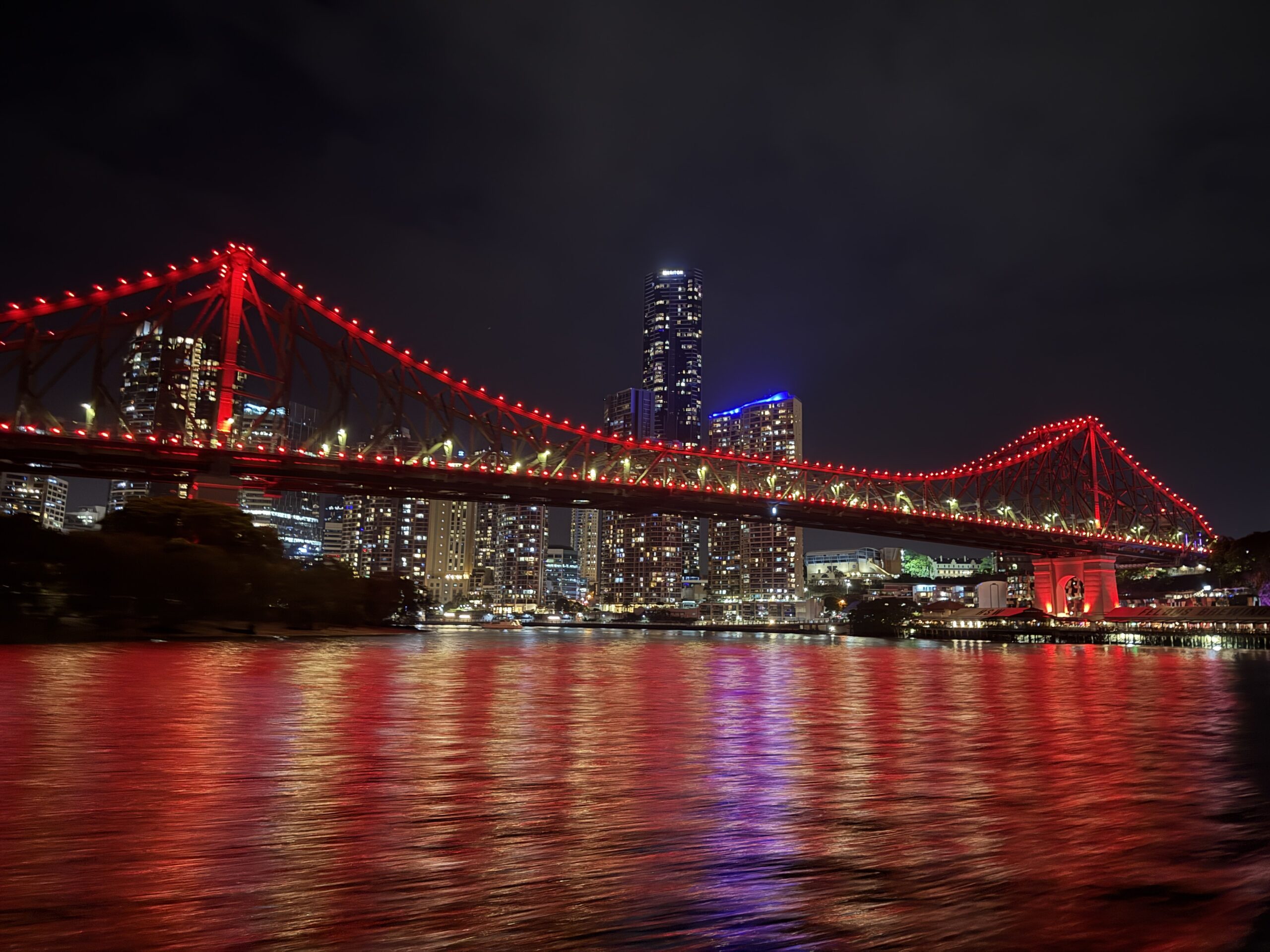
The Story Bridge. Proof that even steel can smile when the lights come on.
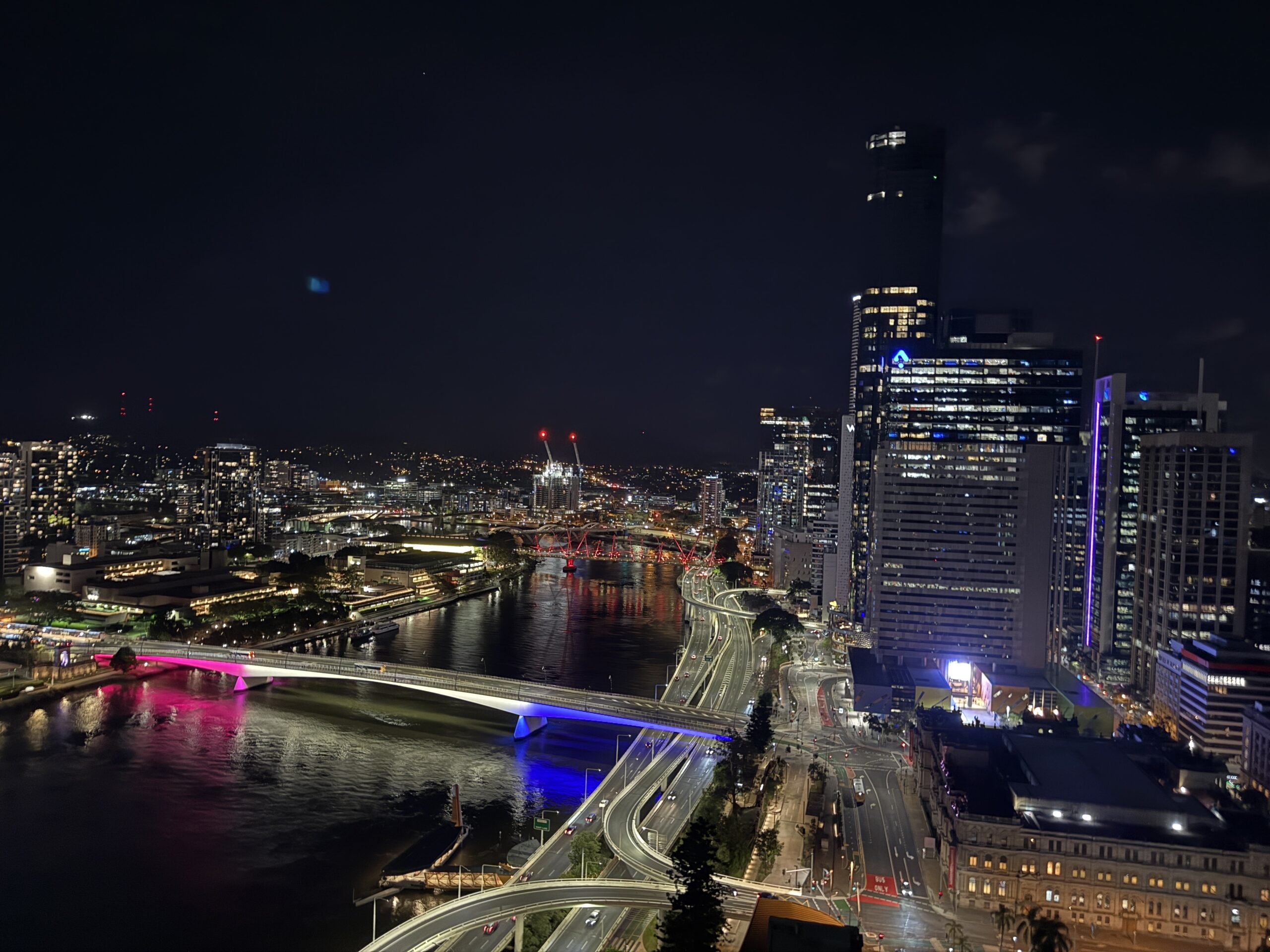
The Brown Snake seen from above. Calm, luminous, and endlessly patient, holding Brisbane in its curve.

On one side, picture-perfect apartments lean over the water, all glass and balconies. On the other, green parks and old timber wharves stand calmly, pretending not to notice. The air smells faintly of salt and weekend plans.

The Rivers That Made Me

Somewhere between two stops, my mind wandered home. To Madurai. To the Vaigai. The river I grew up by. Once the pride of the city, now mostly a trickle between bridges that are newer than the water beneath them. Still, people cross, live, and hope. That’s what bridges are for.

And then I thought about space and wondered how many people live per square kilometer relative to spaces that I am used to.

Brisbane breathes at around 176 people per square kilometre.

Madurai hums at 8,800.

Mumbai roars at 33,000.

For ordinary people, that’s not density. That’s destiny.

Here, everyone seems to move. Running, rowing, cycling, sailing. But try getting a doctor’s appointment, and you’ll learn what patience truly means. The Brown Snake has its own pace, and so does the city.

Vaigai trickles. Maiwar flows. Mumbai surges. Each carries its own rhythm and lesson.

What Rivers Teach Us

As the CityCat slipped under the Story Bridge, the moon brightened above, and the Brisbane River — the Brown Snake — shimmered gold. The ferry hummed softly, carrying people home, and I felt the city exhale.

My mind darted back to the waters I’ve known: the restless sea in Mumbai, the fading Vaigai in Madurai, and this calm, brown river in Brisbane. Each carries its own rhythm . The sea crashes, the Vaigai sighs, the Brown Snake flows and forgives.

Mumbai teaches me motion. Madurai teaches me memory. Brisbane, perhaps, teaches me stillness and flow. Together, they remind me that home is not fixed to a pin on a map. It is a current that carries you forward, again and again, asking you to move, to meander, and to remember.

Rivers don’t just flow; they hold time. They carry stories we’ve forgotten how to tell. Stories of people, floods, bridges, and beginnings. The Brown Snake has watched Brisbane rise, falter, and rise again. It asks for nothing, but it seems to remembers everything.

Maybe that’s what rivers teach us in the end . That strength isn’t about speed or noise, but about keeping on, quietly, towards the sea.
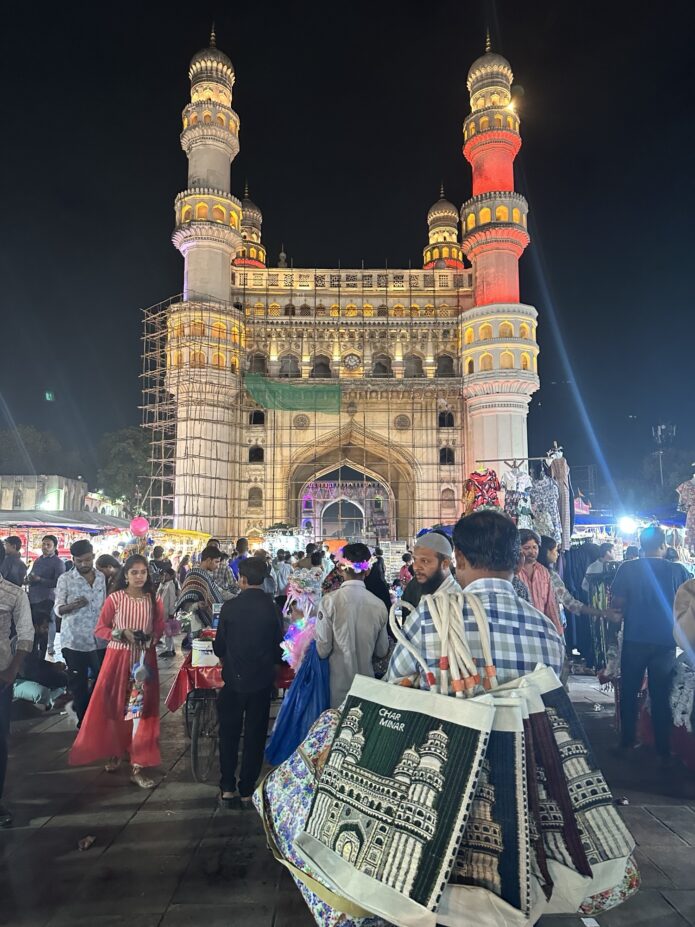
Hyderabad: More Than Just a City

Hyderabad doesn’t try too hard. Old and new exist without fuss. Charminar and Cyber Towers. Bazaars and glass buildings.

People are warm, witty, and fluent in many worlds. A chai can spark an hour-long debate—about the past, the present, the US, or Tirupati.

The food? Yes, the biryani is legendary. But also kebabs, the softest osmania biscuits, and some delightfully spicy vegetarian preparations.

The city stays clean. Surprises with green spaces. KBR Park for morning walks. Durgam Cheruvu for sunsets.

There is history in its bones and tech in its DNA.

Hyderabad is where opposites don’t just coexist—they complete each other. It doesn’t force harmony. It just moves, breathes, and thrives. A quiet example for the rest. Not just as a city to live in, but as a way to live.

Eclipse

Friends and family have watched the eclipse and sent pictures. All of them have squares atop their noses and face the sky. For the world that is so much into perpetually peering down into phones, this is quite a change.

Ever since I saw Alaska airlines’ interest in eclipses, I have been intrigued enough to consider travelling to catch an eclipse. The next big eclipse that I am excited about is happening on August 2027, over the Pyramids. That is perhaps something to be present for. That’s some time away.

When I think of how it all started, my awe of eclipses did not happen in a classroom. By the time I got to understand what it really was, it got a hazier tint. And no geography teacher could have done what Tintin did!

It was in Prisoners of the Sun, that Tintin gets to Peru. When on track to be executed, he commands the Sun to disappear much to the bewilderment of the locals. Of course, the knowledge of the eclipse coming in was masterfully used.

Much later, I learnt that this technique was not something that is something that Tintin came up with!

Krishna used it in the Mahabharata war. (And then, Chanced upon this paper recently).

Christopher Columbus & the Spanish used the knowledge of an eclipse in their conquest of America.

The battle of Halys resulted in a negotiated treaty after the eclipse.

Here’s a list of 6 eclipses that have influenced history.

With each additional story that I came to soak up, there came more interest in eclipses. The whole drill of wearing some fancy glass and peering into the Sun as it disappears and reappears was, and continues to be magical.

As kids, we were not allowed to watch eclipses! There were all kinds of reasons. And so, we ended up watching eclipses, half in protest!

Eclipsed? 🙂

Back to Tintin and Prisoners of the sun. It continues to be a favourite. And that status did not dim because I learnt later that it had an error in it. A kid pointed out to Herge that his depiction of the Eclipse in the Prisoners of War was not quite accurate!

“Hergé borrowed various elements from Gaston Leroux’s book Wife of the Sun, for the crucial eclipse scene, in the same way that La Fontaine borrowed from Aesop. He was equally inspired by the text from the book Christopher Columbus by C. Giardini, published by Dragaud, Paris, in 1970, in which the author describes how the Spanish succeeded in forcing the natives to submit completely thanks to a lunar eclipse which had been announced in a calendar.

© Hergé / Tintinimaginatio – 2024

It is also interesting to point out a mistake regarding the eclipse. In the book the eclipse moves from right to left, whereas in reality it should travel from left to right because Peru is in the southern hemisphere. This mistake was pointed out to Hergé by a child who wrote a long letter expressing his dissatisfaction.”

You could be the smartest of people in a room. All it takes is a child or a childlike curiosity to eclipse you.

Secret Destinations

Secret destinations are not so secret if you are not solely focused on the destination you came after. Martin Buber stitched travel to my heart with this immortal line.

“All journeys have secret destinations of which the traveller is unaware”.

Martin Buber

We all go on our journeys. There is a said destination that a contented traveller gets to. But a real traveller goes far beyond. Because the destination is not the end point. Several story(ies) start after you arrive!

There are elements like what else you discover in a journey. Like the lay of the land and markers in its evolution. Like this glorious temple of a 1000 years. It’s historical undulations. Some scripted in stone and other new tales that are spun to suit today’s skies. The internet tells you about this land’s past glory, the minerals beneath it and the flow of the water across the hills and much else. You can drink all of it in like a voyeur with no skin in the game or like a lover who is immersed in her love.

The rich air tells you a few stories, only if you are ready to stop and take in a breath without necessarily being coveted by the dull lure of THE destination you came after. Sometimes, I infer my lessons by looking at the people and their ways. Their quick stride, the simple ways, easy smiles, the quite common afternoon snooze under the neem tree and the collective bath by the lakeside.

At night when I peruse my random notes to realise, secret destinations are not so secret if the focus is on curiosity and possibility beyond what is apparent.

Today, I make my notes sitting in the shade that the Sun and a 1000 year old wall come together to offer.

There are two others men there. Animated in conversation.

One tells another a story from history about the king and his valour. He speaks as though he has seen it first hand. Passionate. Lyrical. And filled with energy. I am hooked. The story meanders.

And suddenly, he looks into his watch and remembers that they have to be somewhere else by this time. The other agrees. Their destination interferes with a story that was building up well. Both of them get up, dust themselves up and move.

Leaving me with their incomplete story. I let the king stay within me whilst shuffling my feet and wondering what new secret destination awaits the king. And me.

Reacting to change

On December 31st, 2018 an interesting article appeared in the New York Times. It was titled “Wielding Rocks and Knives, Arizonans Attack Self-Driving Cars“.  It wasn’t a lazy review of some crazy future book. The fourth industrial revolution is here and our tools seem to be testing us. And some of us are running out of patience. The world is reacting to change. Like in Arizona, people were pelting stones at driverless cars! Including one man who jumped in front of one driverless car and waved a gun at it saying, ‘he despises it’!

Energy Revolutions

Every revolution is about a shift in energy. From physical to mechanical. From mechanical to digital.

The first industrial revolution (sometime between 1760 – 1840 or so) had the power of ‘steam’ as its thrust area.  Steam. Steel. Machine tools. Industrial looms. And the like. 

The second industrial revolution a.k.a “The technological revolution”, is about scale. Electricity. Petroleum. Iron & Steel. Railroads. Turbines. Engines. Etc. And the like. Perhaps a mention of Fredrick Taylor and his management principles is due. The second industrial revolution happened between 1870-1914. 

The third industrial revolution is the giant shift from mechanical to digital. Commencing sometime from the late 50s when computers began to make their first appearance. An important marker on the ground was the movement of music from vinyl records to CDs in the 80s!

Some argue that the fourth is primarily a continuation of the the 3rd. Obviously, it’s not that simple. Wearable devices. Implants. Networked devices. Data. Robotics. Internet of things. All point to a fusing of the physical, biological and digital. 

Reacting to change

Example after example from history points to non linear change leading to a forceful response .  Every significant change that disrupted an existing status quo provoked people of that time. Be that a wave of dismissal, royal proclamation or violent protests! 

Is it different this time?

If change is natural, so must our reactions to it. Isn’t it? Only this time, the scale of change isnt quite the same. Changes that are reaching us are more intense, simultaneous, interconnected like never before.  Klaus Schwab, who wrote “The Fourth Industrial Revolution” speaks of the difference in terms of Scale, Scope and complexity. The fusion of physical, digital and biological worlds will break boundaries of a number of disciplines. From economics to research. From biology to technology. 

Artificial Intelligence is changing professions. Lawyers. Doctors. Construction engineers. Construction engineers. Armed Forces. You name a domain and a passing lark will point to how AI and related stuff is sitting outside the door. 

The ramifications of such sweeping change presents dilemmas at scale. Most of it dished out simulataneously. Complex and interwoven, mankind’s sense of preservation is being tested. The scenario of mankind not cherishing all the progress made by its own is real. Worse, it is already happening every day. 

There is something more 

The fourth industrial revolution has in it an innate ability to amplify and showcase the inequalities that are omni present in the world. These inequalities have been a result of a thinking that gave ‘Capital’ a lot more heft. Perhaps this time it will be a tad different with ‘talent’ getting more attention than before.  

The amplification of inequalities and the new opportunity to amplify independent voice is a different deal. This change is not the usual change! 

In search of new frameworks and new mental models

Ways of thinking and working that aided us all these years are coming apart now. Not because they are wrong but because, they were designed for a different era. The new age citizen needs a new assortment of skills and mind maps. Needless to say that holds true for leaders and leadership as well. 

Klaus Schwab notes, “We need leaders who are emotionally intelligent, and able to model and champion co-operative working. They’ll coach, rather than command; they’ll be driven by empathy, not ego. The digital revolution needs a different, more human kind of leadership”.

We need to keep thinking and talking about this. It is only in our interest to do the same.

Handcrafted

When effort surpasses reality, the picture isn’t one of suffering—it’s one of progress.

Look closely, and life isn’t just about enduring; it’s about adapting, creating, pushing forward. The human spirit isn’t wired for defeat—it is built to survive and overcome.

Seen this way, suffering takes a backseat to resilience, and struggle reveals itself as transformation.

In markets, “handcrafted” is a premium label, reserved for the unique and the carefully made. But for millions, handcrafting life is not a choice—it’s everyday survival.

Effort, persistence, and the refusal to give in—that’s the real handmade story.

Stories a Brass Kettle

Objects have character. Don’t they? This brass kettle from another era sat quietly, serving filter coffee and cardamom tea for generations. Imagine what it has seen!

Families growing, stories flowing, and lives unfolding—all while it stayed still.

Sometimes, I wish it could talk, spilling tales of the people and the times. But its dents and marks do the talking. They hint at the lives it touched.

So, I let my imagination take over and weave my own stories.

After all, isn’t that what character is—a silent storyteller of time?

Orchestrated Moments: When Connection Breaks Through

Another morning. Another airport.

What seemed like a car was just an assortment of lights, choreographed to perfection. Orchestration rules the world now. Every movement, every detail, neatly arranged.

Amidst the glitz and precision, an old friend appears, catching me by surprise. “You haven’t changed one bit,” they say.

“I’m glad you looked,” I reply.

A moment. A hug. A smile.

Orchestration may dominate our world, but moments like these remind us there’s something it can’t choreograph—genuine connections.

And for that, I’m grateful.

(at Chatrapati Shivaji International Airport)

The Tread Within: How Character Shapes Our Marks

The treads on tyres leave their distinct marks on the ground, telling a story of grip, direction, and purpose.

It’s the same with us. What’s inside shapes how we behave, speak, and leave our mark on the world. When the tread is strong, it shows in our character and actions.

But when the tread wears out—when we let life grind us down—the marks we leave lose their distinctiveness. A bald tyre leaves no meaningful trace.

The tread within matters. Nurture it, renew it, and ensure it’s ready for the road ahead. That’s how you leave a lasting mark.

The Rajabai Tower: When Timekeeping Became a Monument to Love

Some build monuments to power. Others, to love. Premchand Roychand, a wealthy businessman, built the Rajabai Tower for something both grand and simple—to help his blind mother keep time.

Modelled after Big Ben, its chimes once echoed across Mumbai, guiding her through the day. A full-fledged clock tower just so a mother could tell time—now that’s devotion on another level.

He must have been some man. And she, some mother.

Centuries later, the tower still stands. A reminder that love, like time, leaves its mark.