games

The School of the Open Street

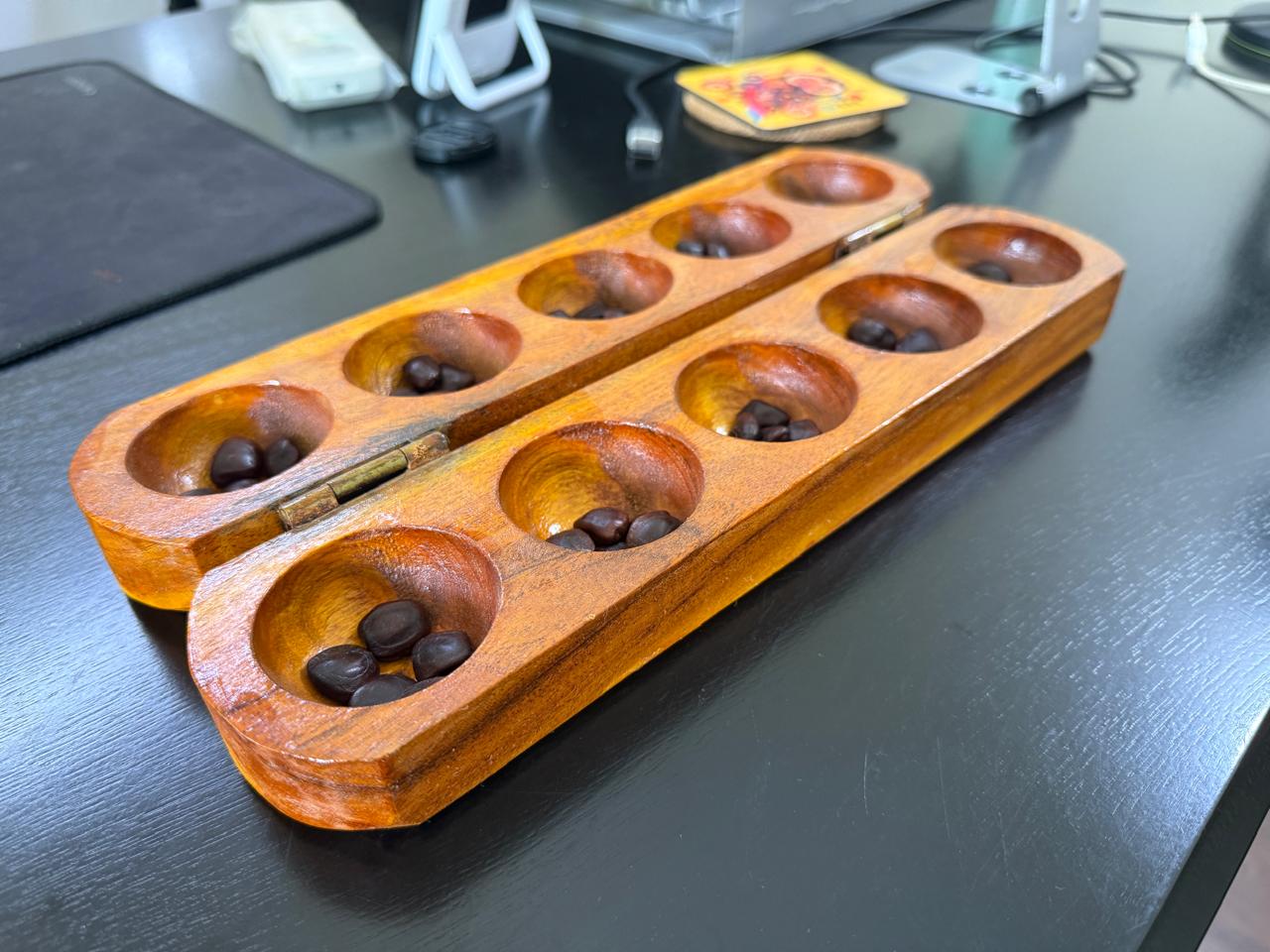
A friend keeps a pallanguli board on her desk. Not as a decoration. As a reset button.

Between calls and deadlines, she scoops tamarind seeds from pit to pit. Two rows of small hollows carved into wood. It takes three minutes. It costs nothing. It works every time.

I watched her do this a few weeks ago. I did not say anything right away. Because something from decades ago walked in and sat down.

My great grandmother played pallanguli the way she did most things. Without fuss and without losing. She moved the seeds around the board as if the board had already agreed with her plan. I was six, maybe seven. I sat across from her, lost every round, and picked up arithmetic, strategy, and patience without knowing I was picking up anything at all.

My hands got it long before my head did.

The same tamarind seeds, by the way, could be rubbed hard on the ground and pressed onto someone’s arm. The result was a fine, sharp burn. I know this from years of personal research.

The Unsponsored League

The games we played in Madurai were never meant to be lessons. None of us thought of it that way. We had open ground, a big sun, no money, and nothing to do. The learning just showed up on its own.

Kitti

Kitti, or kitti-pullu (gilli danda in Hindi). A long stick, a short stick, and a bit of empty road. You flicked the short one into the air and whacked it before it landed. The other side tried to catch it. If they missed, you measured how far it went. The unit of measurement was the stick itself. There was no other.

Nobody said the word geometry. Nobody said judgment. We just played, and played, until somebody caught a stick to the head. The game stopped for a minute while the injured party made a decision. Cry, or hit back. Both were fair.

(I found out recently that in Galicia, Spain, there is a Liga Galega de Billarda. A proper league with fixtures, for a game that works on the same principle. . I watched a video of them playing on YouTube. Men in a field, flicking a short stick into the air, striking it mid-flight. I had tears in my eyes before I understood why. They gave it a federation. We gave it a bleeding forehead and were home for dinner as though nothing had happened. Of course. )

Goli

Goli. Marbles.

You crouched in the dust, curled your thumb behind the marble, and let it go. The thumb knew things the brain had not yet heard of. That a big marble is not always a heavy one. That angle matters more than power. That things travel in curves on rough ground.

Years later, we met all of this in a physics class and recognised it at once. Like running into someone from your old street.

Under the Madurai sun, with no cap, no sunscreen, and no worry about either, all that mattered was landing it on the right spot. The physics came free.

Pambaram. The spinning top.

You wound the string tight, threw it, and it landed spinning. Most boys could manage that. The jalli, if I remember the word right, was something else. The jalli meant scooping the spinning top off the ground onto your open palm while it was still going. The iron nail turning fast against your skin. Your hand learning not to flinch. It took weeks. It took nerve. The boys who could do it well were not just good. They were artists. Champions, and champions of champions, long before Ravi Shastri earned that title at Melbourne in 1985 and drove home in an Audi.

That was about the time cricket, proper cricket with television and trophies, walked into every Indian home and showed the street games the door. The street games were not lesser. They were just unsponsored.

When It Was Dark Enough

We played without watches. The sun told us when to stop. When it got dark, we went home. No clock. No notification. No battery running low. Just the sky, doing what the sky does.

These games lived in texture and sound. The weight of a marble in a curled thumb. A pambaram string pulled tight. Tamarind seeds dropping into wood with a soft click. The sharp sting of those same seeds, rubbed on the ground and pressed to skin. They left a memory in the hands, not the head. That kind of knowing lasts longer than most things taught in a room with a blackboard.

No cap. No sunscreen. No money. Just open ground, a big sun, and the whole afternoon ahead.

We were, it turns out, in a different league entirely.

Watch : Liga Galega de Billarda. Kitti with a passport.

The girls played well!
We were at the garden. The daughter and her friends. And me. Tasked with minding the girls.
Every such task I lap up with energy. For it teaches me the journeys that I have gone through and an opportunity to gawk at the magic of creation.
Amidst the games we played, the most enjoyed one was called “Yellow Flowers”. It had no rules and no boundaries. Other than running about and picking yellow flowers.

The morning reminded me that it takes very little to be happy. A child like imagination and curiosity will get us all there.
#kids #garden #Sunday #travel #travelblogging #travelblogger
#parenting #daughter #daughters #daughterdiaries #flowers #games #simpleliving #sharing #love #joy #journeys #children (at Mumbai, India)

7 stones

Back then in school, oh yes, you remember when you were in school, don’t you? When the biggest possible worry was what the questions in mid term results could be.

When chief amongst the wonders of the world that you couldn’t figure out would be the acute deprivation in that human mind that caused him or her to think up of something as weird as Trigonometry. And then roll your eyes with even more wonder on the mind that thought of including as vile a subject as that in the syllabus!

These were brief interludes. At other times, you were free to do as you thought fit. Many times you just did and only then thought about if what you did ‘fit’ into acceptable scheme of things.

Ah. School days.

No this post is not about school days. Technically. No. this post is about a game called ‘Seven Stones’. That’s a game that caught attention much before games like basketball and volley ball emerged in the horizon.

It didn’t predate cricket, but then, cricket required equipment that was banned by the school. You had to be a Houdini to be able to smuggle in a bat and three stumps. Tall ask. But you could always find seven stones and on the field, and take aim with a smuggled rubber ball.

The rules were simple.

1. There were two teams. One that had to aim the rubber ball at those stacked up seven stones. As soon as the stack was broken, the same that broke it attempted to rebuild all of the seven stones again.

2. Oh yes, the other team weren’t twiddling their thumbs or picking their noses while this restacking happened.

3. They had to aim the ball and hit the members of this ‘rebuild’ team beneath the knees to get them ‘out’. If the ball ‘hits’ you, you are out.

4.Eventually there are fewer and fewer players around to rebuild.

5. The team that would build all of the seven stones before all its players are knocked down, or the team that knocks down all of the players before they can build up the tower of seven stones, is the winner.

Detailed rules are here

After this game ‘players’ would then go back to wondering whoever invented Trigonometry. Or why some crazy Midsummer Nights dream wasn’t as interesting as some of the other dreams that they would rather talk of.

Does this sound familiar ? Well, hold on. The world thinks that the Iraq war has no precedents. I beg to differ.

Examine it if you will. What were established cities, dams, roads , hospitals and the like were pulverised with remarkable accuracy. The news channels giving it a coating of pulchritude, as though it was some fireworks show! People died. Many were maimed. And many more left to fend for themselves.

Ofcourse, the rebuild effort started with greater speed by the same folks who pummeled the land. Like in the game of seven stones, the other team werent sitting there twiddling their fingers. They hit the re builders, usually, beneath the belt.

The other day in an animated discussion about the validity ( or the lack of it ) about the Iraq war, an animated participant said that this was the original idea of one Mr.Bush and another Mr.Blair.

Which is when the animated participant was calmly told that it was a ‘stolen’ idea. With an ever smart twitch of the corporate collar, a smirk and a slanted neck ( which is corporate speak for ‘ha ha you moron you shot yourself on the foot – I got you’) “so whats the evidence ? How can you prove this? “ the participant asked.

With an all pervasive calmness that would befit a zen master, the participant was told ‘go get me seven stones and a rubber ball’ !