Bits and Bytes

The Stuff No One Claps For

“I work physically very hard every day of my life. It’s got nothing to do with cricket anymore. It’s the way I live. So as long as my fitness levels are up and my mental enjoyment and sharpness is there, when you can visualise the game and see yourself running as hard, reacting fast on the ball, you know it’s fine.”

That is Virat Kohli. And thank God he scored runs before saying that.

Because if he had nicked one to slip for a duck, this philosophy would not have been printed anywhere. It would have been dismissed as a post-match consolation line. Success brings applause. Failure brings silence.

But the message matters, because it points to the stuff no one claps for.

The hours before the match.
The recovery routines.
The quiet mornings.
The invisible discipline.
None of it is dramatic, yet all of it is essential.

James Clear speaks the same language. Systems. Habits. Tiny steps.
MS Dhoni did the same thing without saying anything. One process at a time.
The Bhagavad Gita said it centuries ago. Act without attachment. Let the fruit take its time.

Outcomes get the spotlight.
Process sits backstage and holds up the ceiling.

Virat Kohli’s words are not a motivational poster. They are a reminder of how performance is built. Not on inspiration, but on daily structure. Not on hype, but on small habits. The world celebrates the big shot. The body remembers the small drills.

Sport keeps offering examples. Look at Roger Federer.

Roger made tennis look like silk.
People saw the elegance, not the repetition.
They admired the one-handed backhand, not the endless balance and footwork drills that came before it. They talked about grace, not the maintenance that kept him injury-free for two decades.

Federer’s genius was simple. He took care of the stuff no one claps for. Strength work. Recovery. Rehearsal. The glamorous “effortlessness” was built on ordinary routines repeated thousands of times.

This is the part we often forget.
Outcomes depend on timing, luck, conditions, moods, even the bounce of a ball.
Process depends only on you.

People imagine confidence comes from results.
But most confidence comes from doing the work when no one is watching.
You trust yourself because yesterday’s effort is still in your bones.

That is why the stuff no one claps for ends up shaping the very things people cheer for.
The unseen half carries the seen half.
The quiet routines make the loud moments possible.

So here is the simple truth in all this.
Stop staring at the scoreboard. Stop refreshing the result. Build the routines you can control.

Do the boring work. Do it when it is raining. Do it when you are not in the mood. Do it because it steadies you.

The applause will find its own time.
The work must find yours.

A Hill, a Haze, and All of Pune Trying to Say Hello

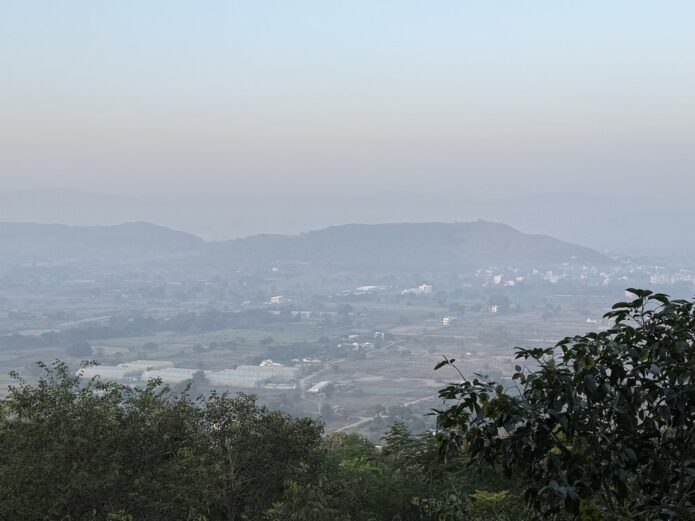
From the top of Lavale, the world below looks like it is trying to multitask. Part village. Part expanding city. And part construction brochure. The morning haze does its best to hide the confusion, but even through the soft grey, the jumble is obvious.

A set of apartment blocks stands proudly in the foreground, as if posing for an ad that has not been written yet. Behind them is a sudden burst of buildings that look like they belong in a different country. Blue domes, tall towers, arches, the whole theatre. It is the sort of campus that makes you blink twice, then check if someone is filming a period drama nearby.

Beyond all this, Pune stretches out in every direction. Tall buildings fade into the mist. Others stand out sharply. A crane leans casually into the frame, hinting that more construction is on the way. The land, however, stays unbothered. Patches of fields, open brown earth, scattered trees. All of them seem perfectly content to ignore the city’s ambition.

But the hill itself is calm. The trees in front rustle lightly. Birds chirp as if the valley is their personal auditorium. Every now and then, a dog barks somewhere below, reminding you the world is awake even if it looks half-asleep.

And then there is the sound of distance. A tractor starting up. A pressure cooker whistle floating up from a home you cannot see. An early-morning folk tune travelling up the slope. All of it carried through the crisp, cold air as if the hill enjoys delivering messages.

At 7.00 am a factory’s siren goes off. Loud. Firm. Reliable. It slices through the mist like a very punctual rooster. The view does not change, but your sense of morning resets instantly. Even the haze seems to shift slightly out of respect.

Once the sun rises higher, the landscape begins to reveal itself. The valley sharpens. Buildings gain edges. Roads emerge. The hills behind appear clearer, like someone increased the brightness. Even the castle-like campus settles comfortably into the scenery instead of surprising you.

By then your coffee has made its way into your system. The warmth spreads. Your thoughts soften. Whatever you were worried about before you stepped out feels a little foolish in front of this strange mix of serenity and cityhood.

Nothing dramatic happens. Nothing needs to.

You look out again. At the haze, the hills, the buildings trying to touch both village and city. And something inside you settles.

For a small, perfect moment, all is well with the world.

All is well with the world.

Lightly, Child, Lightly

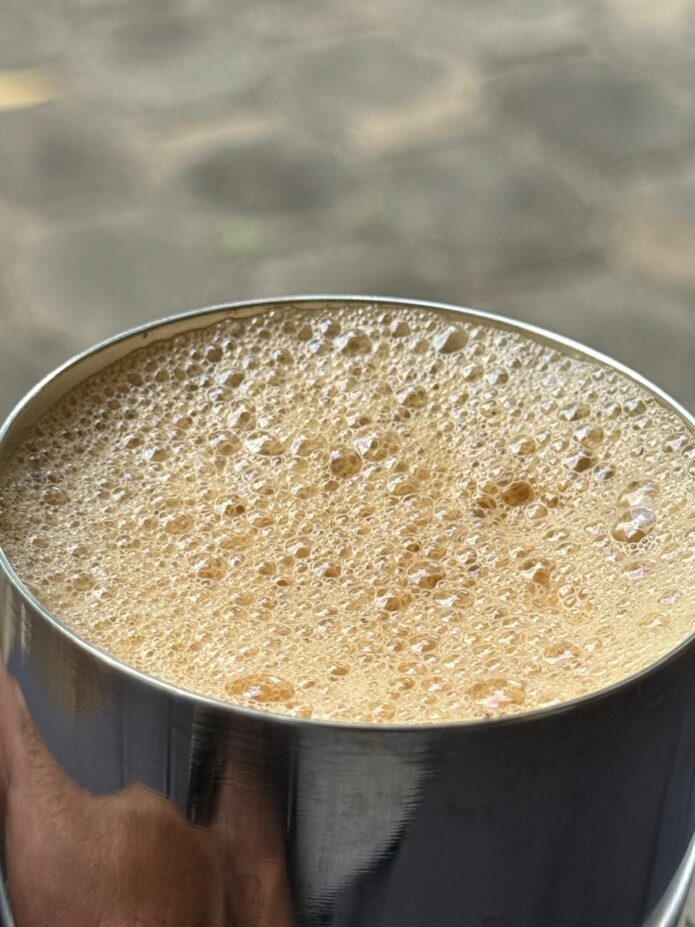
The other day, I was looking at a roadside coffee shop in rural Tamil Nadu. It was a pit stop. More to sip on nostalgia. Coffee was the excuse. I got both. Nostalgia. Coffee. And a line from Huxley that appeared on cue.

The man behind the counter was working his magic with a giant kettle that hissed and sang like an old friend. The smell of fresh decoction drifted through the morning air. Somewhere in the background, Ilayaraja’s 80s melody played faintly from a radio that had seen better days. There was a very faint nip in the air, and the newspaper hanging by a rusted clip on the stall was still crisp. Proof that the day was just beginning.

The man himself was spotless and alert. A splash of thiruneer, three bright grey lines, shone on his forehead. He moved with a rhythm shaped by years of practice. Pouring, mixing, serving, taking money, returning change. All in one smooth motion. It felt as if time had slowed down to watch him.

There was no tension in his face. No wasted effort. He did not rush, yet he was never still. The kettle tilted at the perfect angle. The coffee arced through the air in a golden stream. The froth landed obediently in its glass. Every act was precise and calm. Ease that comes when you stop fighting your work.

That is when it struck me. Lightness comes from intimacy. When you have done something long enough, you stop proving yourself to it. The dancer stops counting beats. The cricketer stops calculating angles. This man has stopped thinking about coffee.

Aldous Huxley said it perfectly. “It’s dark because you are trying too hard. Lightly, child, lightly. Learn to do everything lightly.” Perhaps he had watched this man.

He looked up once, smiled, and went back to his art. The world around him kept moving. Buses honked. Cows crossed. A customer called for an extra spoon of sugar. Yet he was steady, like a monk in the middle of a festival.

It was not grand. Or dramatic. It was simply beautiful. And light.
Ease, brewed fresh.

The Comfort of the Known

“If the path before you is clear, you’re probably on someone else’s.” – Carl Jung

There is comfort in a clear road. The turns are marked, the benches well placed, and even the café at the corner feels familiar. Most of us like that kind of certainty. It is safe and easy to explain.

But people who build new things rarely have that luxury. Their roads begin in fog, full of wrong turns and quiet doubt. Only later, looking back, does it seem straight.

There is nothing wrong with the tried and tested. The world needs people who keep the lights on. But for the builders and founders, clarity comes late. Sometimes very late.

New things rarely start with blueprints and spotlights. They start with someone walking through the unknown, one steady step at a time.

The Beauty of Not Knowing

Doubt is often a good sign. It means you are not on autopilot. It means you are creating something that does not yet have a name. Many mistake this fog for failure, when it is how good work begins.

Someone once said, “Trust the work, not the noise.” There is always noise. Advice, trends, confident predictions. But the work is what moves things forward. Keep your head down. Do the next small thing well. The rest sorts itself out.

Clarity is lovely, but it can also be a cage. When you know exactly where you are going, you stop noticing what else could be possible.

If the path ahead feels dim or uneven, do not panic. Keep moving. The map gets drawn by walking.

And one day, when you look back, you may see a trail that others have started to follow, one that existed only because you began before it was clear.

What Does Success Mean?

The other day I chanced upon Kipling’s If. The kind of find that comes when you are lazily flipping through an old journal. My younger self had copied the poem there, in a steadier hand.
That poem has travelled with me across the years.

It made me pause. Again. As it always does. It made me wonder: what are my own markers for success?
Now.
How have they shifted as new conversations arrive at my shore, every day? As new books, ideas, and lived moments at work reshape me? Or have they?
I reached for a pad and pencil.

So, what is success?

Three things.

Success is to reinvent. To see the changes around us and not be afraid. To bend, to stretch, to become.
Not to chase every trend. But to stay alive, awake, in touch with the times. To move with them, yet remain yourself.

Success is to believe that better is possible. Better is not more. Not louder. Not heavier.
Better is lighter.
Cleaner.
Full of meaning. It asks for courage.
It is nourished by curiosity. And thrives on humility. Every day offers the chance to try again. To make one corner of life, work, family, self a little better than before.

Success is to give. And then give again. Not because you have plenty left over. But because giving itself makes you full. It is the circle of life made visible. To give is to know you are alive. To give is to know you are enough.

That to me, is success. Now.
Reinvention.
Belief in better.
The grace of giving.

Yours?

Not a Travelogue. A Checklist.

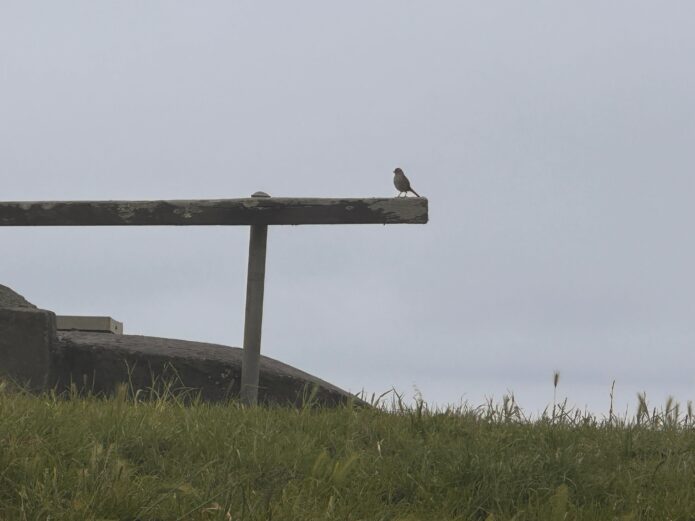
The bird sits alone on a weathered post. San Francisco breathes behind it. Fog rehearses its entrance. The Bay keeps secrets and receipts. Waves clap lightly, like polite applause. The bird doesn’t bow. It just is.

We chase bigger stages. The bird chooses a better stance. Small can be vast when attention is full. Presence is the original zoom.

What’s the moral? None, if you need a twist. Plenty, if you need a nudge. Simplicity survives weather. Patience outflies drama. Focus is free and expensive.

If you must take a selfie, include the horizon. If you must take a call, keep it short. If you must take advice, take it from the wind. Lean, then let go.

One bird. One post. One city that never agrees with itself and somehow works.

And that is enough for today.

The real poor

What does it mean to be poor?

It is easy to describe poverty through the lens of money. Somehow that is the one definition that seems to stick across the spectrum. There are programs for alieviation of this wretched state. Governments are made and unmade on this topic.

But what does it mean to be poor?

On a summer morning, from a construction site that was fast making realty a reality, I saw a lady pass by. A hop now, a skip otherwise and a jump now and then.. In tow was her daughter. Playing with an empty water bottle and struggling to keep pace. On her hips, her little son cackling with laughter and undoing her hair.

She spoke in a language I didn’t recognise. But her tone was enough to tell me a bit about her love for her children and the richness of her heart. Atop her head were building material in a red basket with a yellow safety helmet sitting pretty. Like a crowning diamond on Her Majesty’s crown.

The bright red flowers on her saree sat easy with the glass bangles and matched her happy step. Her work shift was all set to start. The anklets on her feet seemed to announce that with every step she took. It was going to be some time before family time in their temporary dwelling that they lived in. The builder had given them one until the high rise that they were part of constructing, got done.

There was genuine happiness in them. All three of them. The daughter often stopping to pluck flowers and throw them at the wind and then scampering to catch up with her mother. They went about reaching out to the morning with a joyous spirit and a gentle sprint. So full of life and yet with tenderness and care. Oblivious to the stranger in me watching them walk by.

Are they ‘poor’?, I remember asking myself. A monetary lens will affirm. But look at it this way.

To walk by with a happy stride.

To carry a weight but not seem bothered by it.

To provide life in real terms to your children by exchanging your living moments for it.

To embrace each morning with  smile and all the possibilities that it brings in.

That is not ‘poverty’! Ask any rich man. Or the office goer. Observe faces on a Monday morning as they come out of trains, buses and cars. It often is a weary lost look and an impossible to miss sadness. Not in all, but in many. And even as you wonder why, remember to look into the mirror as well.

What are we chasing? What do we have to give up in order to be ‘rich’? Poverty, as they say, is a state of mind. So is ‘Richness’. To be truly ‘rich’ is to be mindful of ourselves and our choices being fully present to how we think of our state of the mind. The lady with the red flowers and the eloquent yellow diamond atop her dirty crown showed that to me. She is long gone but the happiness in her voice and the cheer in her children remain in my memory.

The high rise she helped build now is lit by big swanky cars, sophisticated scents and solemn looks. Especially so, on Monday morning. Often it takes me back to the laughter of the lady with the bright red flowers on her saree. We have choices

We have choices! Lets remember to choose a rich life.

Happy Holi

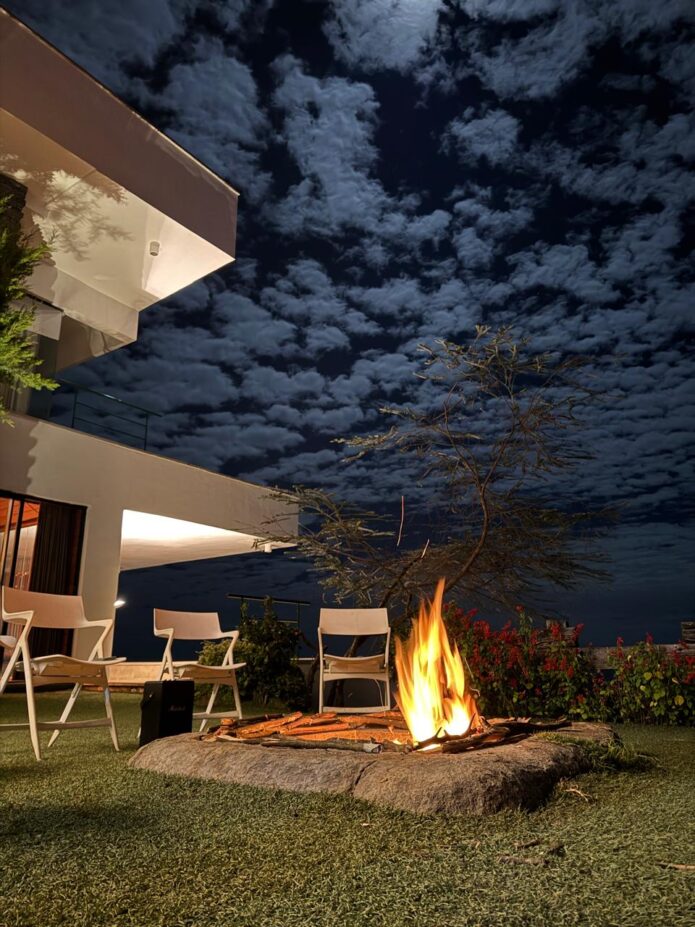
When the giant bonfire lights up the night sky there are a few things that it does.

It tells you that the bright days of summer are here. It tells you tomorrow is Holi. A day of colour and gaiety.

It tells you that winter is over. And as the fire leaps to the sky and people bow in its honour, it seems to wink at me and say, the seasons are changing. And in its fleeting wink, seems to ask me, if am ready. As the crackle of the firewood changes the contours of the night sky, the fire doesn’t wait for answers.

It is warm. Actually, it is hot.We step back a few feet as it devours all the wood and everything else that was there to light it up. In a continuous go like a runner gasping and soaking in lungfuls of air on the home stretch.

Well, the fire is brilliant. It consumes you and even as it consumes you, it lights something in you. And from its flame, I await new colours that will emerge in the morning.

Happy Holi!

Pathways

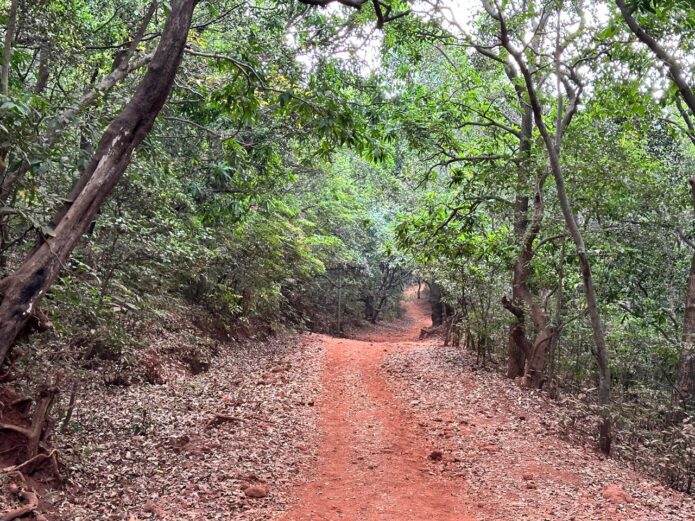
The pathways aren’t often straight lines. Sometimes they are not clear. Many other times, they need to be created.  The undergrowth to be cleared. Concrete and stone coming together to make a permanent path. At other times, what’s required is walking through the undergrowth. A few more walks for a few more days and the pathways emerge.

Have you noticed that people look for pathways that have been created and simultaneously yearn for the rush of creating new pathways? It is often the case.

‘Creation of new grand pathways is not for everyone’, someone told me a few weeks http://healthsavy.com/product/propecia/ ago.  I argued that creating new pathways in the brain is so important to keep things alive. To keep the mind young and fresh. It is the basis for curiosity. It is something that each one of us can do. Pick up a new task. Go by a different route. Talk to a new person. Listen like never before. Whatever. New neural pathway a keeps us moving forward.

These constantly add flourish to who we are even as new discoveries emerge.  That is the true story of several entrepreneurs who set up path-breaking ventures 🙂

Heres to a good day

Heres to a good day.

I spotted this in London on a wet and rainy day. It reminded me that the choice to have a good day or otherwise remains with us.

Viktor Frankl in his famous book “Man’s search for meaning” said, “Between stimulus and response there is a space. In that space is our power to choose our response. In our response lies our growth and our freedom.”

Today is a good day indeed to have a good day. Lets make those choices for making it a good day. No matter what the day offers.

Is that a deal? 🙂

Heres to a good day