Tamil Nadu

The Fort That Forgot Its Kingdom

Google knows me a little too well. Somewhere between scanning my photos of weathered temples and long-abandoned wells, it popped up a notification. “You might be interested in Kamuthi Fort.” Oh sweet thing, of course I was.

Kamuthi Fort sits in one of those small Tamil towns that lived in my mind as a nameboard on buses leaving Mattuthavani bus stand years ago. You see the sign, nod at its existence, and move on to the next one. But as with all such towns, there are stories waiting if you only pause. 

So, pause I did.

A sixteenth century fort, said Google. Nine ramparts, said the web. I was sold.

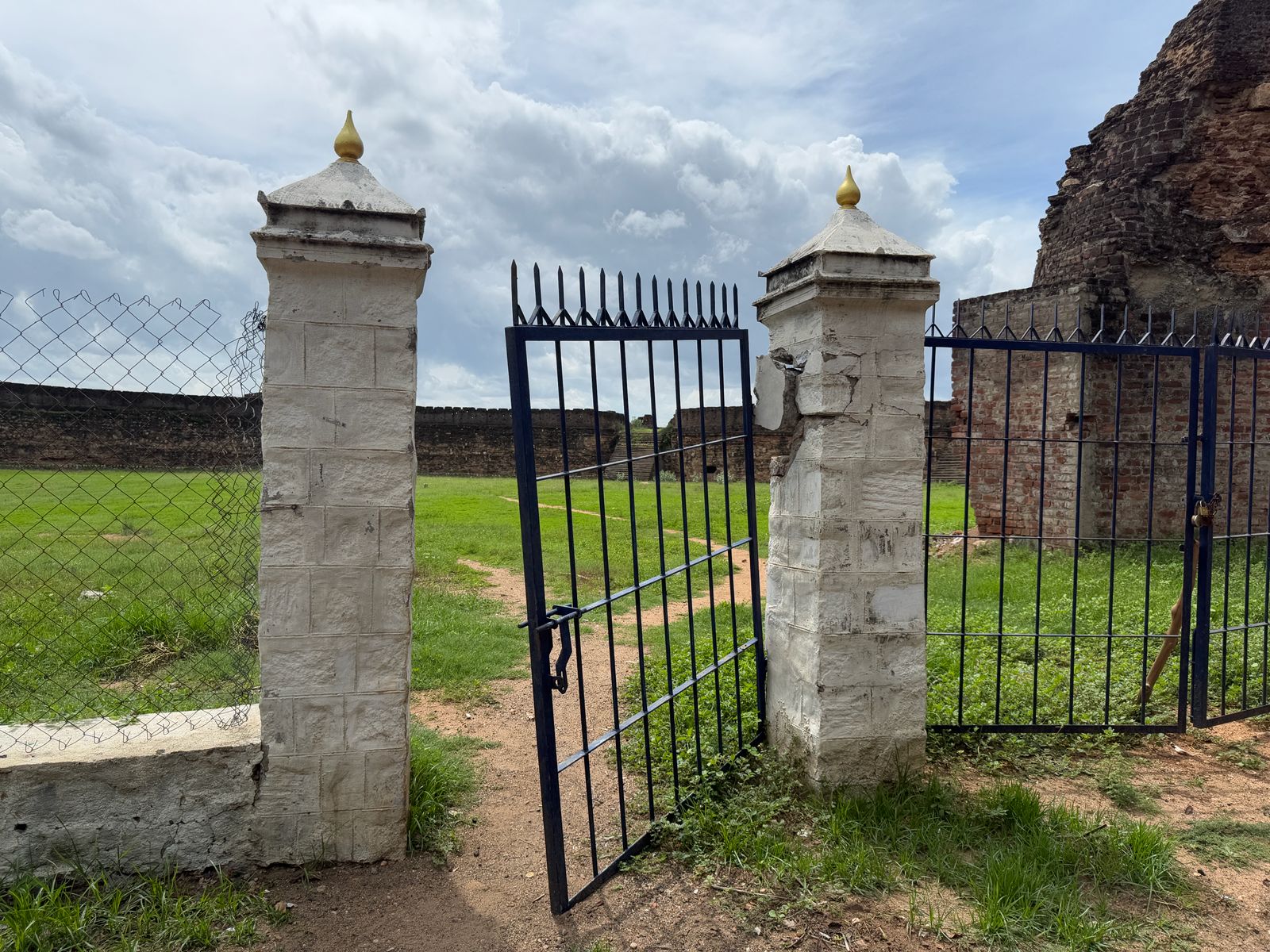
A half-open steel gate squeaked in the wind. Silence did the welcoming.

The drive from Sayalgudi was short and easy. The kind of road where fields stretch to the horizon and herons perform slow-motion flypasts. When the map finally announced, “You have arrived”, I looked around for a dramatic gateway, maybe a guard with a spear. Instead, a half-open steel gate squeaked in the wind. Silence did the welcoming.

My daughter and I stepped out to find a way to enter. A half-open steel gate guarding a three hundred year old fort was unmissable irony.

Inside, the Archaeological Survey of India had left a plaque, Tamil on one side and English on the other, as if to say, “You wanted history, here, have some.” It read:

“This stone fort was constructed 300 years ago by Sethupathy King Udayathevar alias Vijaya Raghunatha Sethupathy. It is believed that this was built with the assistance of a French Engineer. After the downfall of Panchalankurichi, this fort fell into the hands of the East India Company. It was also under the control of the Marudhu brothers for some time. It is reported that Veerapandya Kattabomman stayed at this fort on his way to Ramanathapuram.”

Department of Archaeology, Government of Tamil Nadu.

A Large Swathe Of Time

Three hundred years ago. Or maybe three fifty. Hard to say. The plaque offered no date, and the stone looked as if it had been sunbathing there for at least fifty years itself. Perhaps that was the idea, a quiet puzzle for every visitor to solve, century after century. A lump of cold data with no life, sitting there like an exam answer from a student who had memorised the facts but forgotten the story.

Large swathes of time like “three hundred years” hide more than they reveal. We revisited our memories and tried patching together a timeline of world events back then. 

We bantered about how it might have been built when the Mughals were beginning to wobble.

Before the United States became a country, when it was still mostly wild land and brave people trying to survive winter. Before the French Revolution, when Marie Antoinette was still years away from allegedly offering people cake. Before Beethoven wrote a single note, before railways linked cities, before the first vaccine, and even before coffee became a global habit that half the world now depends on just to get through the morning.

The sun shone through the clouds. It was a splendid conversation to have in that setting. To talk about a quiet, crumbling place by stitching it into the larger story of the world. To look at these stones in desolate isolation, and then suddenly see them in full, noisy context.

The other line on the plaque that caught our attention was about the French engineer. What was a Frenchman doing in the sweltering plains of Ramanathapuram, drawing blueprints for a Tamil king? I pictured him, moustache damp, measuring walls under a merciless sun, wondering which Parisian sin had earned him this posting.

And then there were the Marudhu brothers, Kattabomman, the Sethupathis, all names that echoed rebellion and royalty. I could almost imagine them striding through this space with pride, purpose and possibly a few swords.

All these conversations were possible only because of past dalliances with history, and my occasional attempts to teach her some. In front of us, though, was an NCERT style summary carved into granite, looking surprised to get as much attention as we were to see it.

When you have too much history, you sometimes stop tending to it. It felt like a reasonable hypothesis to accept, nod at, and move on.

Steps, Stories, and Silence at Kamuthi Fort

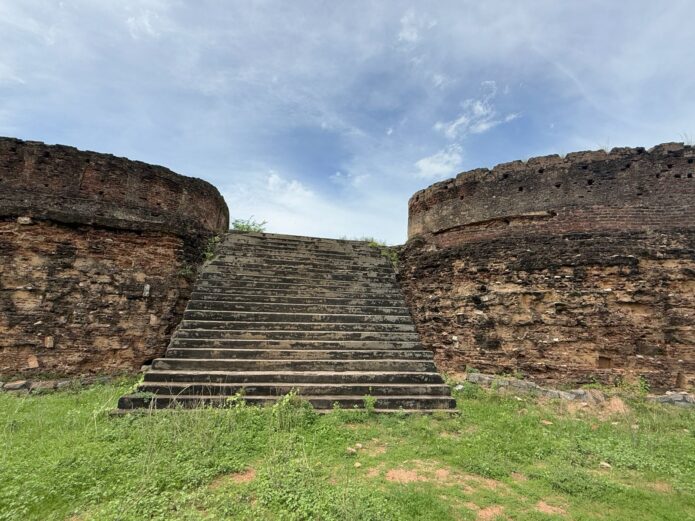
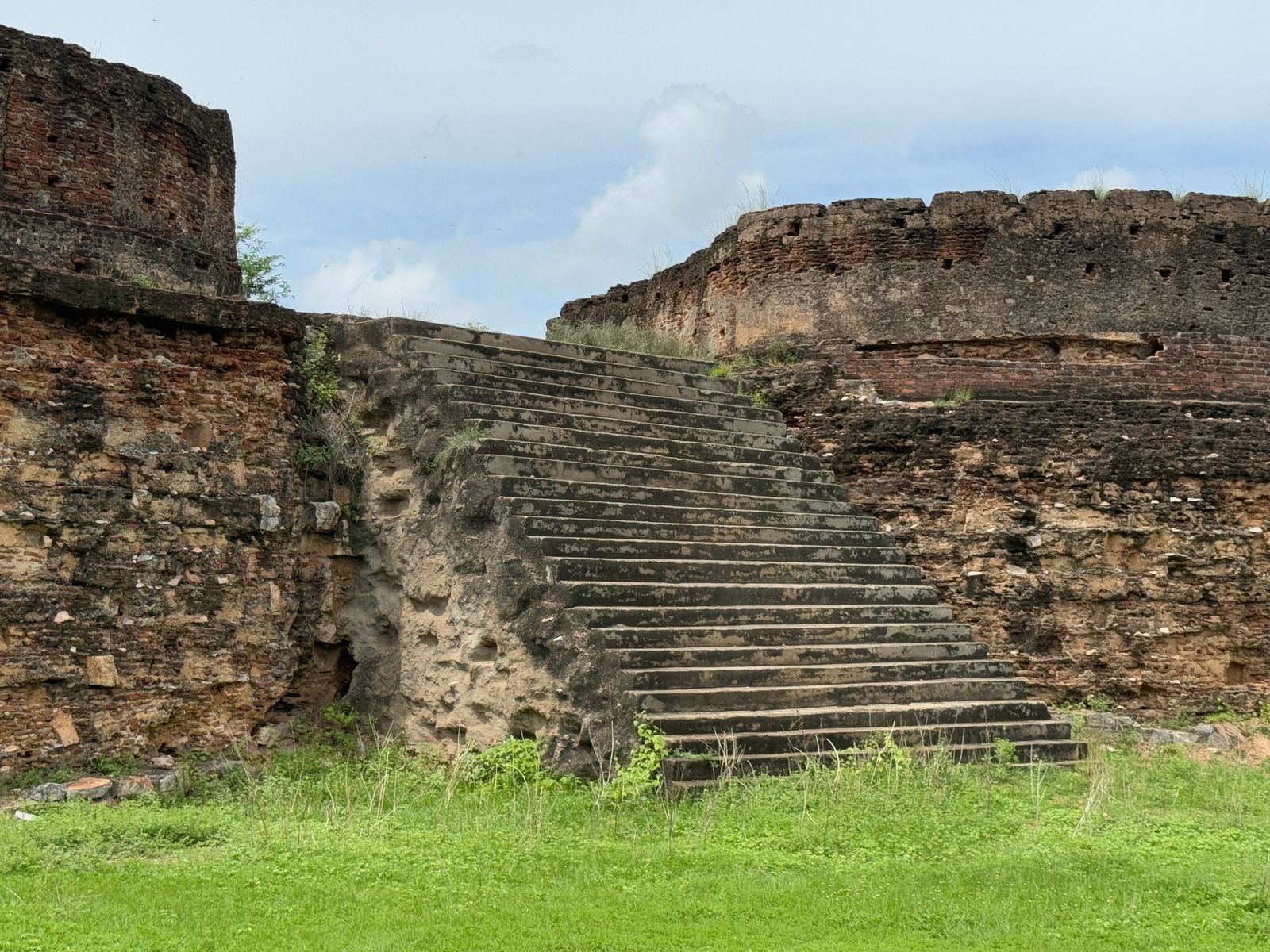
The fort is circular, its thick walls still stoic even though time and rain have bitten chunks out of them. Wide stone steps climb up the ramparts. Strong. Straight. Stubborn. The kind you do not see in modern buildings.

Storied steps of Kamuthi fort

I climbed one and reached the top, expecting a grand view. Instead, I found empty beer bottles glinting in the sunlight. Every era has its warriors, I suppose. Then I climbed another flight of steps, and another view waited. Each staircase led to a different story.

From up there, the view stretched across contradictions. A colourful temple tower rose from one side, loud with freshly painted gods. On the other side, the Armed Reserve Ground stood silent.

I later found a YouTube video claiming that the cops once used the fort for target practice, until residents protested. Not out of love for history, but because of the noise. Small mercies, I thought. I have no idea how true that story is, but the fort clearly has had many lives. And its latest round of survival did not seem to be due to grand conservation plans, but to something far more ordinary, everyday irritation.

At the centre of the fort, a wide green patch stretched like an empty parade ground. Perhaps soldiers once trained there. Perhaps kings reviewed troops. Now, weeds stood in quiet attendance.

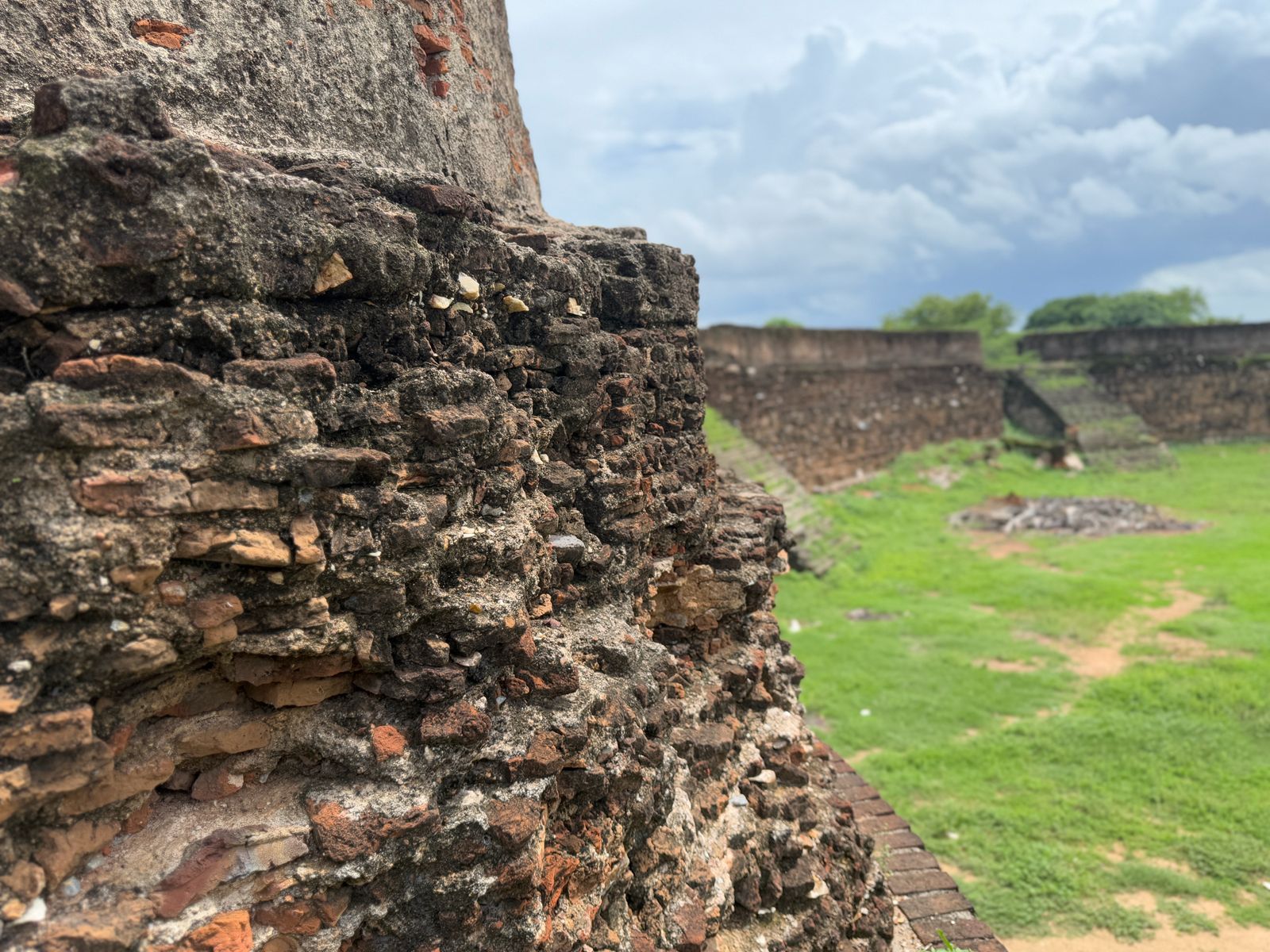
The walls of Kamuthi Fort are astonishingly thick, the kind that were built not just to stop enemies but to outlast them and ten generations that followed. Up close, you can see layers of old brick, lime mortar, sand, crushed shell, and the occasional glint of stone all holding together like a long, patient handshake.

Thick walls, stubborn stones, and a silence that carries the weight of centuries.
Thick walls of Kamuthi Fort

Later that evening we pored over the internet, trying to understand what gave the construction its strength. We found that builders in those days mixed the mortar with whatever helped it endure, including jaggery water, powdered limestone, and kadukkai, a small wrinkled fruit whose natural tannins helped the walls resist cracking and moisture.

Some recipes even mention raw eggs for a smoother set. Whatever they used, it clearly worked. Three centuries later, these walls still stand in stubborn defiance, quietly proving that things built with care and a few eccentric ingredients tend to last.

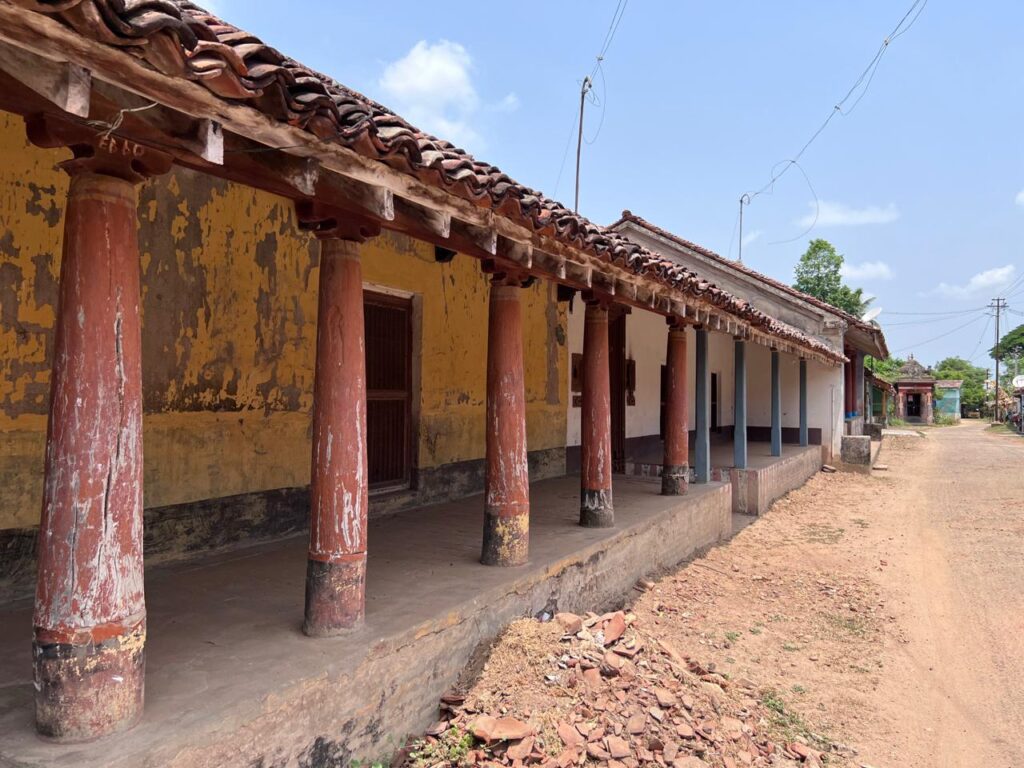
On my way out, I noticed a bold red 1993 painted on the wall of the temple wedding hall. Its proud year of inception. It stood directly opposite the steel gate, a mere thirty two years old. The contrast was almost comic. Like a fresher showing off a car he mostly owes the bank, before a billionaire who has lost his fortune.

What Kamuthi Fort Teaches Without Trying

Kamuthi Fort may never make it to glossy travel brochures. It does not charge tickets, sell souvenirs, or feature in drone videos with cinematic background music. But it has something many others do not. Presence. A stubbornness to remain. You walk through the broken walls and feel centuries of sun and storm still trapped in the bricks. You hear whispers of battles and see echoes of neglect.

If this were in Europe, there would have been tour guides with microphones, an entry ticket priced just right to fix half the state budget, and a tidy little museum shop selling magnets of the fort looking ten times grander than real life. There would have been plaques with footnotes, audio guides in eight languages, and a cheerful volunteer reminding you to stay on the marked path.

And if this were in the United States, the place would have been turned into “Fort Kamuthi National Heritage Park.” There would have been a café called “Kattabomman’s Brew”, a massive fort shaped bouncy castle for children, actors from Colonial Williamsburg doing hourly re-enactments, a twelve dollar bottle of water, burgers the size of dinner plates, and a forty nine dollar premium early access pass. Of course, the small town of Kamuthi would have been flattened to make way for a giant colour coded parking lot.

All this for a place that, in Kamuthi, lives perfectly happily with a steel gate and the afternoon sun.

It struck me then how wildly the world varies in the way it wraps itself around history. Some places polish their past to make it look like something else. Others leave it lying around like old furniture. Kamuthi Fort simply sits and waits, holding on with quiet strength while we hurry past. It deserves far more care than it gets. The slow drift into disrepair feels like a small discourtesy to everything it has survived.

Perhaps it will get more attention if someone like Lokesh Kanagaraj decides to shoot a fight sequence or a moody montage here. But we do not have to wait for that. We can start with something simpler, attention and respect.

We owe these places that. A few moments of silence. A pause to think of the countless hands that built, fought, prayed, or repaired these stones.

If you are ever near Kamuthi, please go. Not only for your children to climb its steps, but for yourself, to stand still for a while. To feel how time stretches, how pride turns to dust, and yet how beauty lingers in silence. You will come back lighter, and oddly grateful.

Because even in its decay, Kamuthi Fort is doing something quietly spectacular.
It is enduring.

Other blogposts from this trip
1. Kaapi Kadai wisdom
2. Notes from Sayalgudi

The Road Ends, the Sea Begins: Notes from Sayalgudi

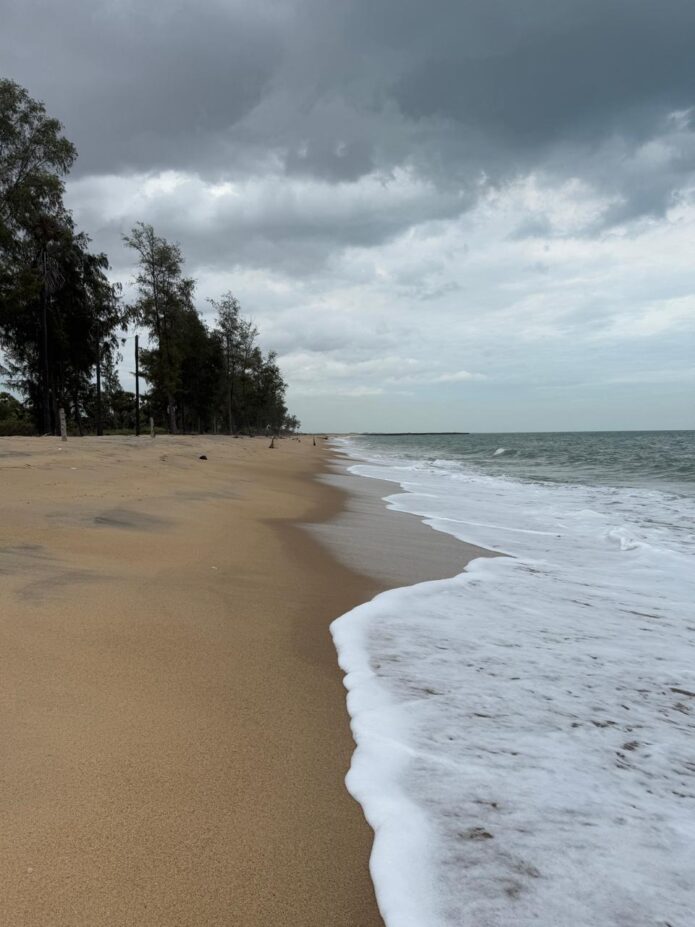
The beach at Sayalgudi doesn’t announce itself. It appears, almost shyly. No signboard declares “Welcome to Paradise.” No resort gate opens grandly with a poor, uninterested labrador that is forced to sniff the car’s trunk. There’s just the soft hiss of waves, a ribbon of clean sand, and the faint scent of salt that tells you you’ve arrived somewhere that doesn’t know it’s special.

The sea stretches endlessly, its rhythm unhurried, uncurated. There are no shacks, no deck chairs facing the sea, no soft-serve ice-cream vendors. Just a moon already at work, waves rehearsing their eternal script, and one solitary visitor thanking his stars that, such beauty escaped some social media influencer’s attention!

I sat there for a long while, watching the sea nibble at the shore and retreat, as if testing the flavour of land. It was hard to believe that this was two hours from Madurai. Tamil Nadu’s coastline is vast and beautiful, and extends beyond the fame of the Marina, Pondicherry, and Kanyakumari.

The Road That Curves Away from Fame

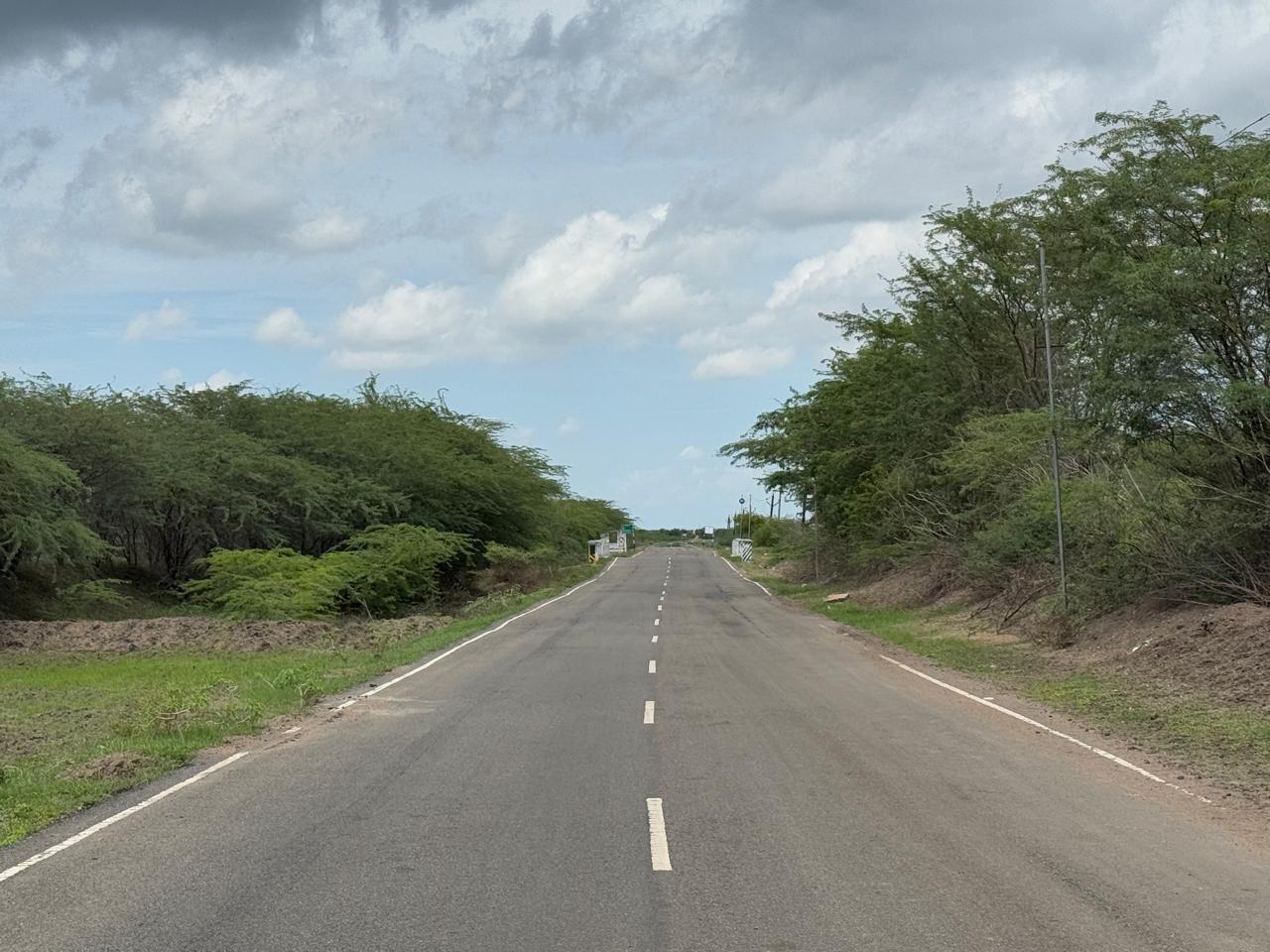
Getting here is a breeze. You start from Madurai, drive towards Rameswaram, and somewhere after Manamadurai you slip off the highway. The road begins to twist, as if embarrassed by how small it has become.

Seemakaruveli bushes for company

On both sides stand seemakaruveli bushes — Prosopis juliflora, the invasive guest the British brought in the 19th century to tame wastelands. Now it rules the countryside like a green despot, spreading faster than gossip and just as hard to uproot.

Villages appear and vanish like punctuation marks. Abhiramapuram, Karisakulam, Athikulam, Allikulam and many more whose names blur in the rear-view mirror. Their kaapi kadais linger longer in memory: tin kettles boiling away gossip, glass tumblers with a skin of sugar on top.

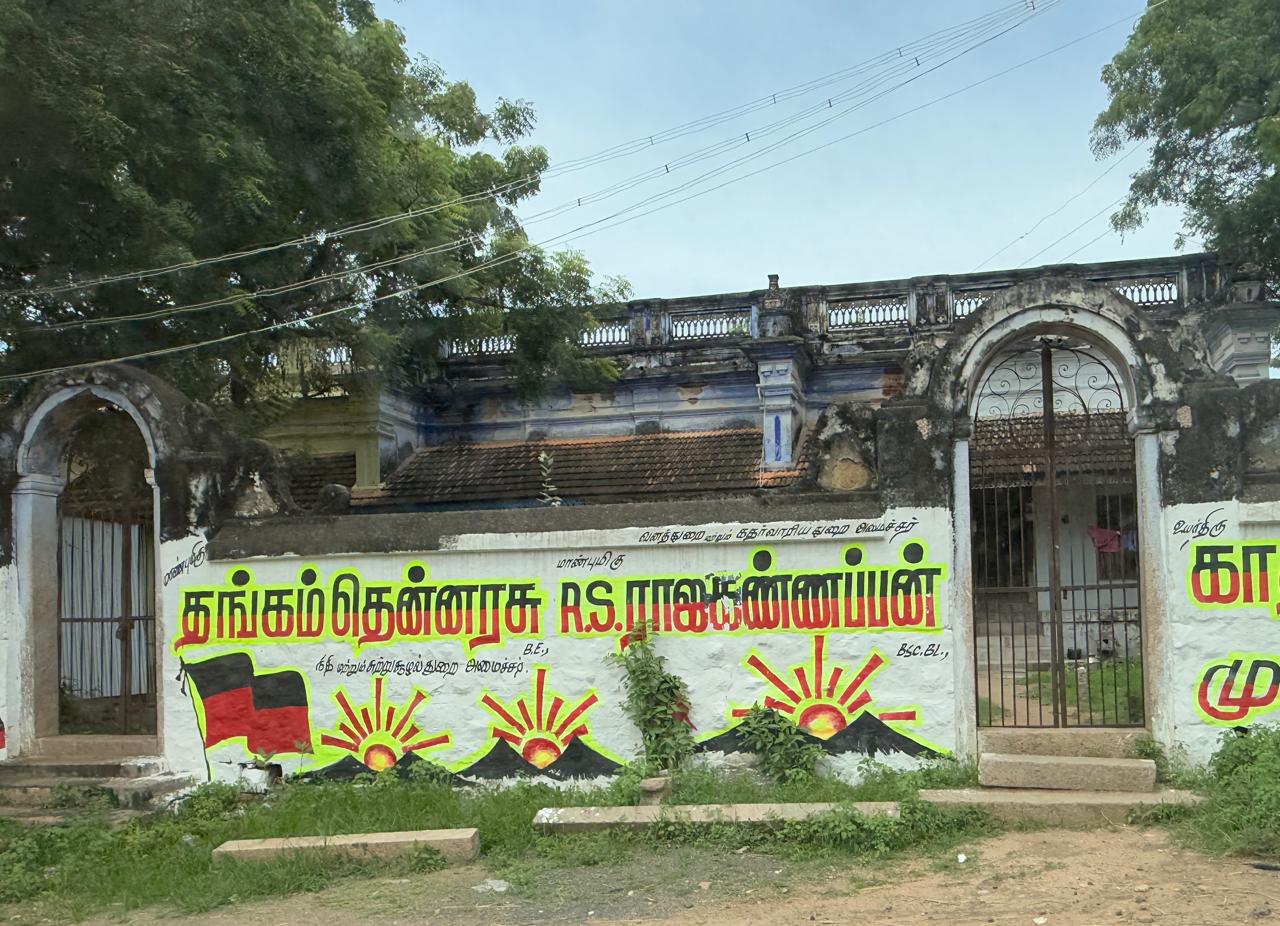
Politics rendered on plaster

The walls along the way shout in red, black, yellow, white, and blue. Politics rendered in thick Tamil letters. In this part of the world, even plaster has opinions. A painted bull here, a rising sun there, two leaves somewhere else; campaign promises merging gracefully into art. Between two walls, a goat herd ambles across the road, his flock spilling into the highway with serene entitlement. He crouches by his TVS 50, adjusting something in the chain. They used to walk once, I think. Now even goats wait for engines.

Sugar and Spice. Ah! Memories

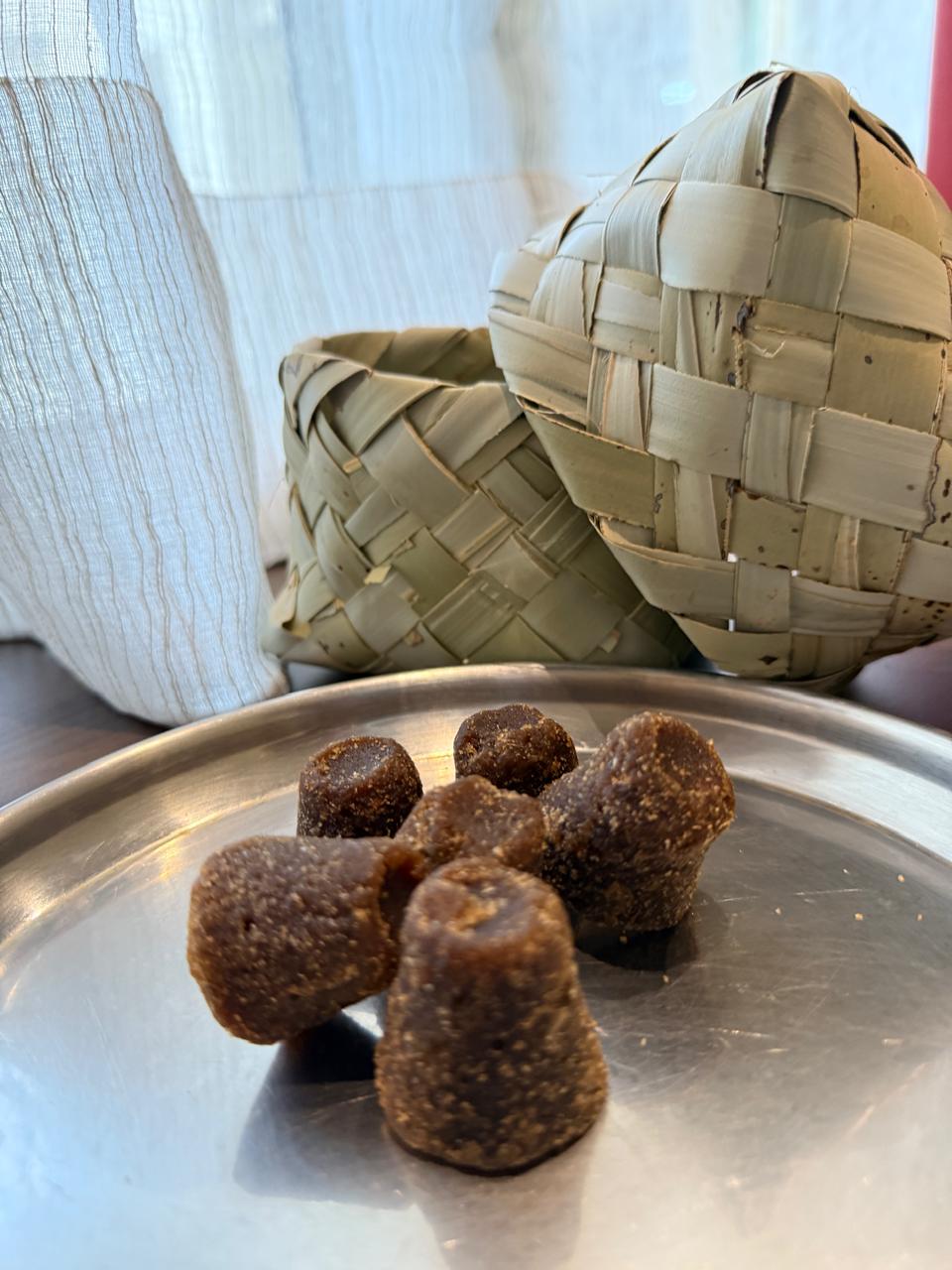
A little further on, a man sells inji karuppatti. Ginger and palm jaggery. Packed neatly in olai kottans (palm-leaf baskets). I buy some. They’re sweet, fiery, and nostalgic all at once. Childhood condensed into sugar and spice.

A Trust in the Road

I often drive through rural Tamil Nadu with a quiet confidence that if anything were to go wrong, someone would appear. Not with a “How may I help you, sir?” but with a curious “Are you okay? Water?” People here don’t outsource kindness. It’s part of the day’s work, somewhere between lunch and the evening bus.

Over the years, I’ve been stranded by punctures, wrong turns, and delusionary optimism. Each time, a passer-by has stepped in, not only to do the needful — that tidy phrase from corporate emails — but to actually see what was needed. A word, a jug of water, a direction, sometimes just company until help arrived. Rural rhythms seem to cock a polite snook at the urban question of “What’s in it for me?” Here, the answer is often, “Nothing”. And that’s fine. Every time signing off with a “paathu poituvaanga.” Loosely translated to “stay safe and come back soon.”

A Town That Prefers Modesty

Sayalgudi itself sits quietly on the southeastern edge of Tamil Nadu, a town of about twelve thousand people and exactly zero pretensions. There are shops selling coconuts, rubber slippers, and recharge coupons. The fish market smells of honesty and ocean. It’s the sort of place where everyone seems busy but no one seems in a hurry.

You follow a narrow lane until the houses give up, and the sea fills the gap. The transition is so sudden it feels like the land has run out of sentences and switched to poetry.

People Who Stay Real

The “resort” I stayed at was more functional than fancy. A bed, an air-conditioner and a fan that coughed with commitment, and a window that framed the horizon. Hot running water. Clean sheets. A television that didn’t need to be turned on, because the best show in town was hosted by the sea. And luxury came from the sound of the waves.

Gopal, the manager, was a stocky man with a weathered Hero Honda and an even more reliable smile. Ajit, the chef, tall and thoughtful, made fish curries that could start conversations. And Jaya, the attentive housekeeping staff, had returned to the resort after dallying with other employers in the vicinity. All wonderful people. “It’s good to help people here,” she said softly, folding towels with care. “Only wish others are considerate too.” Who those “others” were, we left hanging in that polite ambiguity that some conversations excel at. Like a scene from a Mani Ratnam movie where silence does the explaining. And you fill in the gap in your own way.

They didn’t greet you with a scripted “Good morning.” They simply nodded, smiled, and said “Enna saar?” — “What, sir?” — half greeting, half check-in on your wellbeing. It was infinitely warmer than the mechanical, well-practised flow of a five-star resort employee. These folks were simple and authentic. Just like the sea. That’s all that mattered.

Stillness, the Unadvertised Luxury

By night, Sayalgudi changes tone. Fishing boats light up the horizon like a shy constellation. The lighthouse sweeps its beam with the discipline of a monk ringing a bell. The air fills with the sound of insects tuning up, and occasionally, a bird that hasn’t yet signed off.

It’s the kind of stillness Pico Iyer writes about: “The more ways there are to connect, the more we seem desperate to unplug.”

Here, you don’t disconnect as rebellion. You simply forget to connect in the first place. The signal flickers; the mind steadies.

I walk along the shore, barefoot, the sand cool and damp. Something sharp presses against my foot. For a moment I think it’s a broken beer bottle. A memory from a trip to Bali. But it’s a seashell, luminous under the moon. I slip it into my pocket, a small souvenir of an unadvertised paradise.

Abundance in the Unfamous

The next morning, Ajit serves dosai so crisp it competes with the waves. Gopal checks if the Wi-Fi has decided to exist. Jaya hums an old Ilaiyaraaja song as she sweeps the courtyard. Life goes on, entirely unbranded.

I think of all the famous beaches I’ve visited. Where the soundtrack is a mix of EDM, immaculate hotel staff and unbridled commerce. Corn. Coffee. Ice-cream. Beer. Horse riding. Whatever. Sayalgudi reminds me what a coastline really is: a conversation between sea and sand that doesn’t need an audience.

Paul Theroux once said, “Tourists don’t know where they’ve been; travellers don’t know where they’re going.” In Sayalgudi, both are forgiven. You just sit, let the waves do the talking, and measure time in tides.

A Small Philosophy Between Two Waves

The sea teaches quietly. Each wave arrives certain, crashes spectacularly, and dissolves without complaint. Watching them, I begin to think of work emails and deadlines that once felt as urgent as surf, until they receded. Maybe that’s what travel to places like this really does: it returns scale to things.

My phone vibrates — a reminder of a meeting, a plan, a project. I look at the screen, then at the moon tracing its silver loop above the water. Another wave rises, crashes, and fades.

“Tomorrow,” I tell the caller. Then add, “Actually, day after.” I hear the silence on the other side.

I add, “Please.” One more wave roars.

The wind approves. The sea keeps its counsel. Somewhere far away, a boat hums its way home.

I switch my phone to airplane mode. This time, I don’t want to buckle up like I otherwise would when I do that. Because, this time, I am not in a plane. I seem to have wings.

Other blogposts from this trip
1. Kaapi Kadai wisdom
2. The Fort That Forgot Its Kingdom

Lightly, Child, Lightly

The other day, I was looking at a roadside coffee shop in rural Tamil Nadu. It was a pit stop. More to sip on nostalgia. Coffee was the excuse. I got both. Nostalgia. Coffee. And a line from Huxley that appeared on cue.

The man behind the counter was working his magic with a giant kettle that hissed and sang like an old friend. The smell of fresh decoction drifted through the morning air. Somewhere in the background, Ilayaraja’s 80s melody played faintly from a radio that had seen better days. There was a very faint nip in the air, and the newspaper hanging by a rusted clip on the stall was still crisp. Proof that the day was just beginning.

The man himself was spotless and alert. A splash of thiruneer, three bright grey lines, shone on his forehead. He moved with a rhythm shaped by years of practice. Pouring, mixing, serving, taking money, returning change. All in one smooth motion. It felt as if time had slowed down to watch him.

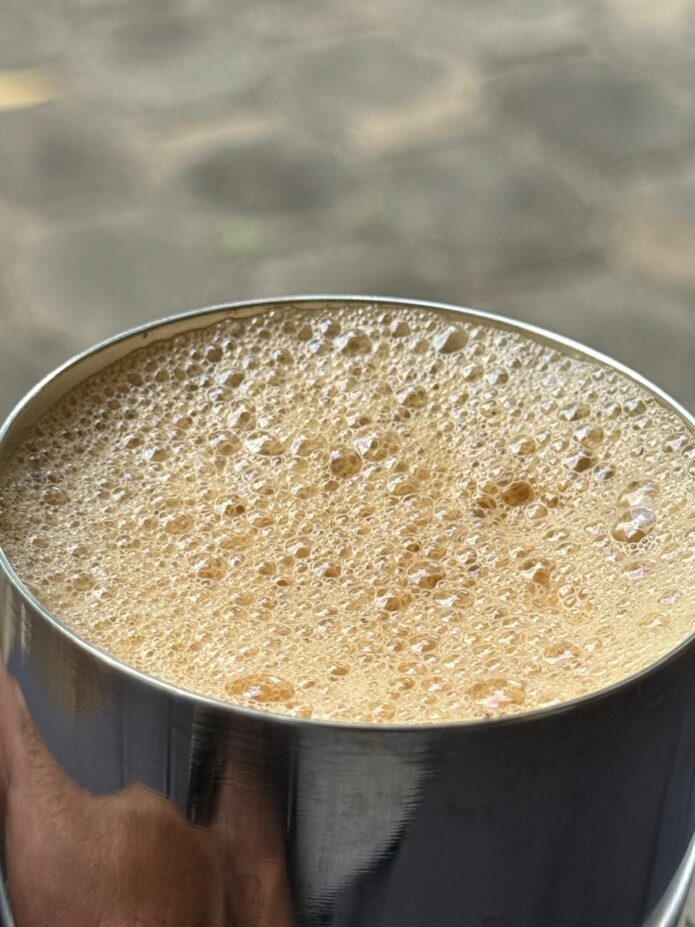
There was no tension in his face. No wasted effort. He did not rush, yet he was never still. The kettle tilted at the perfect angle. The coffee arced through the air in a golden stream. The froth landed obediently in its glass. Every act was precise and calm. Ease that comes when you stop fighting your work.

That is when it struck me. Lightness comes from intimacy. When you have done something long enough, you stop proving yourself to it. The dancer stops counting beats. The cricketer stops calculating angles. This man has stopped thinking about coffee.

Aldous Huxley said it perfectly. “It’s dark because you are trying too hard. Lightly, child, lightly. Learn to do everything lightly.” Perhaps he had watched this man.

He looked up once, smiled, and went back to his art. The world around him kept moving. Buses honked. Cows crossed. A customer called for an extra spoon of sugar. Yet he was steady, like a monk in the middle of a festival.

It was not grand. Or dramatic. It was simply beautiful. And light.
Ease, brewed fresh.

Insurance !


There could be a corolla parked in the drive way or maybe its just a ramshackle of a Jugaad butting the head out of the front gate. But if the eyes that look at a place someplace in the deep south, the chances for a chap like this on the exterior wall of the house, is more than likely !

For ages, this chap has guarded the household against ‘Evil Eye’ ! So has it been told in the household that feeds this blog.

The Evil Eye. Yeah yeah ! The negative energy that is generated by ‘neighbours envy’ (not necessarily restricted to the neighbour) of seeing another do well !

The potency of the negative energy that the ‘evil eye’ of the neighbour, runs thick and deep !


Big eyes. Think eye lashes. Eyebrows as large as a forehead. A handlebar moustache that would make any Harley or its owner shift feet in awe. Canine teeth that drive fear into a tiger. Sharp white horns that can excite a matador in Spain. A scorpion in the tongue http://premier-pharmacy.com/product-category/antiviral/ that a tattoo artist would be proud of !

Well laid out sparkling array of colours. Blue neck. Red face. Yellow forehead. Green ear lobes !

These chaps are supposed to be absorbers of the mall effects of bad thought. They sure look that part. And for sure look pretty impressive too.

So, the next time you are in the South or at a Southerner’s place and you see this man on the wall, you would do well to remember the following.

a. This is not a representative image of the man of the house . Atleast not physically. Though you may have reasons to imagine him so.

b. You can let those big gasps of jealousy into the air. Looking at the chap’s ramshackle Jugaad or his designer underpants.

He for sure thinks he is insured. By a big man with big eyes. Think eye lashes. Eyebrows as large as a forehead. And a handlebar moustache that would make any Harley or the owner shift feet in awe.

Anyone for coffee ?

We are brewing. Really. New brew ! We have officially established South Indian rule in our home ! Yes. We We too drink Filter Coffee !! I mean, we too make it at home. Right here! And yes. We too have arrived ! (Wikipedia has all the details for you here !)

Amongst the many that i talk to, any discussions around my origins invariably lead to a discussion around Filter Coffee. The sharp eyed would have spotted my squirm and a shuffle of feet. Or atleast a shuffle of fingers of the feet, inside the shoe.

For in the family, ‘filter coffee’ was confined to the borders of Tamil territory. In our family tree. But we broke it all.


During this trip back home, coffee powder was picked up. ” ‘PB’ standing for ‘Peaberry’ ” we were told. The coffee filter was picked up, right here in Mumbai. And voila there is a decoction and the strong aroma of coffee that waffles through the morning air are now common place.

To the uninitiated, this may not be big deal. Neither was Filter coffee a big deal to us, until we moved here. North of the deep south !! Here, good old Filter Coffee is seen as an integral part of a Tamil existence. That connection seems to rule common mind space. Like a cross to Christ !!! Very rightly so !

Sample this. We would have guests at home. The best of good food would be served, nay, attempted. And promptly showered with wonderful critical acclaim that’s generous. And then a few thinly veiled questions would surface about filter coffee. You know, something like, ” the food was tastier than the ones that we get in Matunga, but over there you get filter coffee also’ !

And we would grin and mouth our ‘thank yous’. Pretending that their statements didn’t go beyond the comma. Now, the guests who did comment were a small minority. But you know, we feared the worst. Even when nothing was said !!!

But now, hey, we too have filter coffee !

And as the coffee sinks in, leaving a strong aftertaste in the mouth and in the air around too, we glance at slogans like “coffee drinkers are better thinkers” with a new slant !

But you know something, the coffee is something. Really something. Today, i wondered why there is so much of connection to the drink. I wonder if its because it helps me connect with home, with every sip? I haven’t been a great fan of coffee. Until now.

I don’t know.

But that’s not whats important. Whats important is this : The guest list is being refurbished. With some confidence ! Aha !

Now, anyone for coffee ?

Tamil Times !

This ad launched The Times Of India’s Chennai edition. A brilliant portrayal. With a ‘background beat’ that typifies Tamil Nadu, and a catchy ‘dance tune’ ( they said), i kept getting questions about the ‘meaning’ of the song from non-Tamil colleagues and friends !

Many of my friends and colleagues were impressed with the portrayal & capturing of life in Chennai as they could see ! Upon their goading, here is my attempt at translation !

Nakku Mukka is a ‘mascot‘ to whom the song is sung to. ( I think so). However, the song itself is about Cinema ( & its heroes’) hold out Tamil Nadu !

This is how it goes. Vaguely !!

“In Choolaimedu, Teynampet, Royapettah, T.Nagar etc ( all indelible parts of Chennai ) and across all roads of Chennai, cinema lives and rocks too !!

And here is a hero who has grown, donning many a ‘heroic’ role, asking people to have massive cut-outs for himself, and offerings of milk, dance, drums, garlands in his name !!

He aspired for power, started a casteist political party, called it ‘Rice Party’, contested the elections, and won it too !!

Only to become a minister and switch allegiance to the ruling party ! Dissolving the ‘Rice Party’ that he started.

And when this news spread to the country, his hometown turned violent !

After that he lost his reputation and was shamed.

Now he stands as a scare-crow, after losing it all !!”

Subtle sarcastic undertones to the story, creative portrayal of the state of affairs, leave me impressed ! So, does the filming. I particularly like the way in which our film hero segues from film star to minister !

So does calling the party ‘Rice Party’ the dissolution of which leads him to become a ‘scare crow’. Poetic justice, so to speak !!

The ad is but a realistic & sad commentary on the daily life of Tamil Nadu. Living a celluloid life, Tamil politics has filmdom woven into it. Face paint, stunts, dialogues, music and comedy rule the film world. So does it rule the politics there.

The ad though, has a polyannish ending. With the film star being reduced to a scare crow. In Tamil politics, such stars, shine ! And new ones continue to emerge !

A good friend told me, ‘Forget all of this ! Just enjoy the music’. Yeah right. I said. And forced an apathetic smile reside within.

Sure. Enjoy the music ! But catch the meaning too.