Already warm. Already bright. My daughter and I were sitting in the small garden behind the house, doing nothing in particular. The kind of nothing that usually lasts only until someone reaches for a phone.
She spotted it first.
A still insect clinging to a blade of grass. Perfectly formed. Perfectly unmoving.
Dead, we assumed. And declared so. Quickly.
We still leaned in. Looked closer. It did not have the careless look of something crushed or abandoned. It seemed intact. Intentional. As if it had chosen that exact spot.
We began guessing. Beetle? Grasshopper? Something more interesting? We debated seriously, the way children do, and adults quietly enjoy. We turned it gently. Examined the legs. The head. The odd lightness of it.
Then the realisation arrived. With some help.
It was not an insect at all.
It was a shell.
A cicada had grown inside it and, at some point, calmly stepped out. Growth completed. Old skin left behind. No drama. No hurry. Just a quiet exit under the Texas sun.
What surprised me later was not the discovery itself, but how I felt afterwards. I was strangely energised. Light. Refreshed. We had not rested. We had not done anything useful. And yet something had shifted.
I noticed that I had been fully present. Not half-there. Not thinking ahead. Just there, crouched in the heat, absorbed in a small mystery. And I found myself wondering why that felt so restorative. It felt like leisure, though nothing about it resembled how leisure is usually described.
Wonder at Cruising Altitude
Two days later, I was flying from Dallas to the East Coast. Seatbelt light on. Coffee barely drinkable. Clouds stretched endlessly beneath the wing, like a slow, patient design lesson. Somewhere between cruising altitude and mild jet lag, I was reading David Steindl-Rast.
Steindl-Rast is a Benedictine monk best known for his writing on gratefulness and everyday spirituality. Not the dramatic kind. The attentive kind. And there it was, tucked into the page as if it did not need emphasis.
He wrote that leisure is not the absence of activity but the presence of wonder.
The line landed differently at 35,000 feet. The Dallas garden returned instantly. The shell. The crouching. The strange lift I had felt afterwards. That moment finally had a name.
Around that time, the idea of leisure had been circling me anyway. Conversations with friends. Reading and writing essays to clarify what leisure meant to me. Many of my friends seemed drawn to the same question. How to make time for leisure. How to protect it. And, how to schedule it before it slipped away.
Steindl-Rast’s line quietly undid all of that.
Leisure had not arrived because time had opened up that morning in Dallas. Time had not changed at all. Attention had. Wonder had been allowed in. Leisure and wonder, I realised, have less to do with calendars and far more to do with how awake we are to the moment in front of us.
Children seem to understand this without effort. They do not ask whether something is useful before being fascinated by it. A shell on a blade of grass is enough. Adults tend to wait for permission. Or purpose. Or a clear outcome.
That cicada shell offered none of those.
Not even an invitation to look closer. It sat there in casual indifference, until attention and curiosity cast their quiet spell. Something ordinary came alive. The mind loosened. And, without effort, it relaxed.
And that, it turns out, was plenty.
Leisure came not from creating space, but from entering the moment more fully.
It is December now. Many people are looking ahead to leisure. Calendars are being cleared. Time is being protected.
On that bright June morning, we discovered that the cicada shell has a small crack along its back. Nothing dramatic. Just enough for something larger to leave. I like to think wonder works in much the same way. It does not wait for empty days or perfect conditions. It slips in through small openings, through moments when attention loosens and something ordinary is allowed to surprise us. And it refreshes the soul in a remarkable way.
Yes. We could stop sealing every moment shut and not wait for free time to soak into leisure!
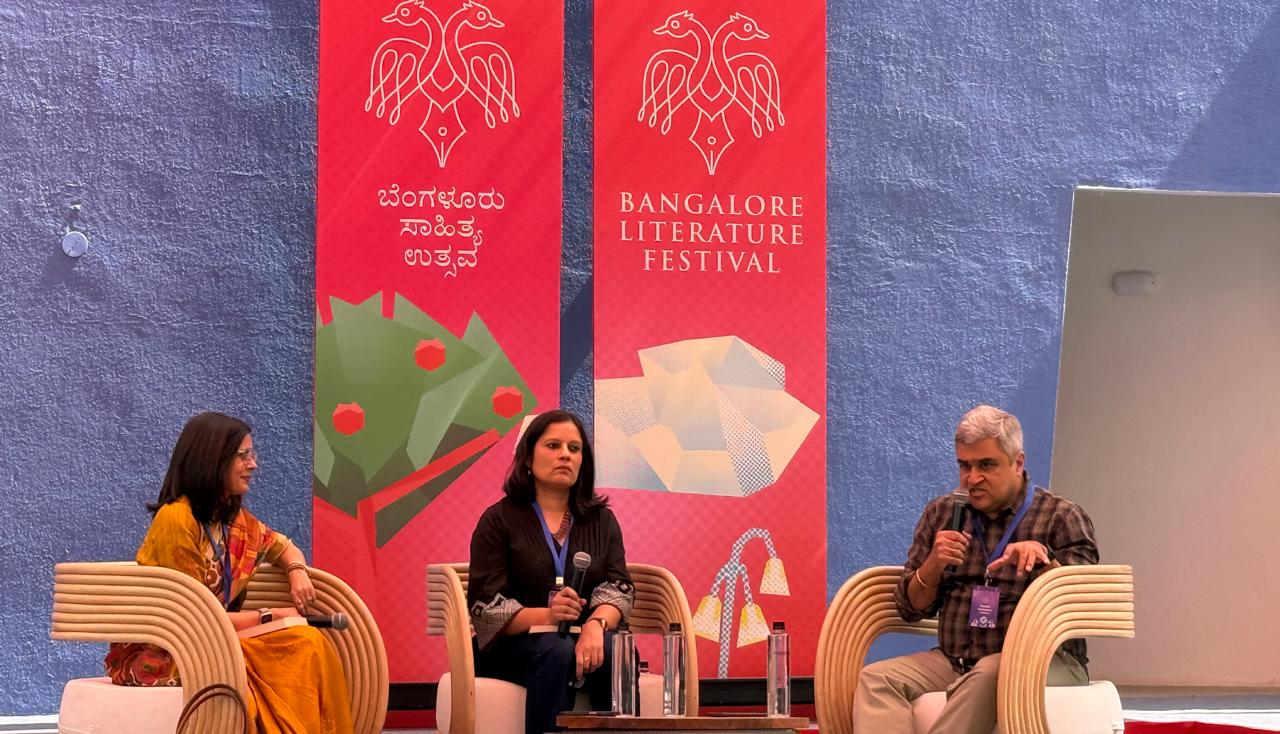
The Bangalore Literature Festival has been around since 2012, but I always managed to miss it. My first glimpse of it was through friends and colleagues at Founding Fuel, Charles Assisi and NS Ramnath, authors of The Aadhaar Effect, when they spoke at the festival years ago. Since then I have been meaning to attend. Something or the other kept coming in the way. Then I read the founder’s comment on Founding Fuel about moving the festival from the five-star comfort of The Lalit Ashok to the wide open public grounds of Freedom Park. I remember thinking, Freedom Park? Interesting. The irony and the possibilities jumped out at once.
And so I finally went. The first thing that greeted me was a tall mosaic figure holding a bright red surfboard-like object with the word Freedom splashed across it. Not exactly what the British officers had in mind when they built the place, but a cheerful indication of what the day held. A few steps further was the bright @blrlitfest sign in pinks and blues. If you ever needed proof that literature can trend, this was it.
If you want to experience the full irony of modern life, go to a place once built to keep people in and watch thousands walk in voluntarily, some even jogging, to attend a literature festival. Freedom Park, the former Central Jail of Bangalore, is now a pleasant expanse of trees, sunlight, ideas, and, for a day at least, more book-loving humans than you could shake a bookmark at.
The symbolism was impossible to miss. Once, Freedom Park held prisoners in barracks with concrete beds and narrow passageways where freedom was a rumour. Now those same spaces hosted sessions on Sanskrit, parenting, news, men’s rights, and All India Radio. Chairs and yoga mats were laid out neatly across old prison beds, and people sat on them happily, notebooks open, as if taking notes in jail was the most normal thing in the world.
Bayonets and Books!
The watchtower stood tall and white in the centre, looking gently puzzled by its new job of overseeing conversations instead of convicts. A sepoy cast in stone held his rifle and stared ahead, while festival banners fluttered around him. If he ever imagined he would spend eternity watching people queue for author signings and filter coffee, he revealed nothing.
Entry was through two long parallel walls once built to contain bodies. In the evening they glowed red and seemed delighted to welcome minds instead. I could almost hear Bill Bryson remarking how human beings are the only species that would turn a former prison into a venue for people who willingly sit for hours listening to strangers discuss how to live better, write better, and occasionally argue better.
Inside the Festival: Ideas, People, and a Whiff of Possibility
The crowd was a marvellous pot-pourri. Teenagers with tote bags. Elderly couples who looked like they had stepped straight out of a Sunday crossword. Children trotting towards the #CLF area, drawn to colourful cloth canopies and cheerful storytellers. And of course a smattering of stars from Day One. Banu Mushtaq. Vir Das. Santosh Desai. Vivek Shanbag. And Shashi Tharoor, freshly returned from shaking hands with Vladimir Putin, which is not a sentence I ever expected to write. Yet there he was, surrounded by admirers, looking as though world diplomacy was merely a warm-up act for a weekend lit fest in Bangalore.
What I enjoyed most was how many remarkable authors simply wandered about. No entourage. No velvet ropes. You could walk up, say hello, and they would smile like old friends. In a world where even mid-tier influencers travel with ring lights, this felt wonderfully human. A free world, at least on that patch of reclaimed earth.
The children’s section was buzzing. Under a rainbow of cloth shades, kids sat on red chairs and listened wide-eyed to storytellers and wildlife experts. A far cry from my childhood, when literary glamour meant reading an author interview in The Hindu framed stiffly against a bookshelf. These children had open skies, soft grass, and sessions under trees. My younger self would not have known where to look.
There was also the small matter of the prison of devices. Everywhere I looked, people had put their phones away. Not in silent mode. Not in airplane mode. Properly away. Buried in bags. Forgotten. Occasionally taken out to check programme changes, especially after the Indigo fiasco caused some authors to miss their slots. It was as though the old walls had agreed to keep the devices inside and let the humans escape.
The fashion added its own subplot to the day. There were the formal types in suits. The linen types whose clothes took a moment to arrive after they did. The tight-fit types who seemed to have been sentenced to mild compression. Prints with camels, checks, stripes, feathers, hats, turbans. Greens, blues, greys, and salt-pepper combinations that could have been a paint chart. A riot, and a joyful one, united by a love for books.
I also met a few old friends, people I had worked with years ago. Some were authors now. We talked about books we were reading and books we were pretending to read. We shared recommendations. We spoke of manuscripts in progress and our quiet ambitions to one day contribute something that would sit on a table like the ones before us. These small reunions made the day feel less like an event and more like a homecoming.
Book buying was brisk. I picked up a few myself. At the end of it all, the young lady announced proudly that they accepted no credit cards. Instant debits from bank accounts are perhaps the truest measure of commitment. People paid anyway. I did too.
The organisers deserve every bit of credit. They created something warm, open, and quietly defiant at a time when reading is supposedly declining and AI, we are told, is sharpening its knives for books.
But at Freedom Park, of all places, there was a whiff of possibility. Under the watchtower that once surveyed prisoners, I watched hundreds of people sit under an open sky, listening, questioning, dreaming, and shaping answers they would take away.
Reading keeps us human. Writing keeps us honest. And festivals like these remind us that imagination is still, thankfully, unjailable.
“I work physically very hard every day of my life. It’s got nothing to do with cricket anymore. It’s the way I live. So as long as my fitness levels are up and my mental enjoyment and sharpness is there, when you can visualise the game and see yourself running as hard, reacting fast on the ball, you know it’s fine.”
That is Virat Kohli. And thank God he scored runs before saying that.
Because if he had nicked one to slip for a duck, this philosophy would not have been printed anywhere. It would have been dismissed as a post-match consolation line. Success brings applause. Failure brings silence.
But the message matters, because it points to the stuff no one claps for.
The hours before the match. The recovery routines. The quiet mornings. The invisible discipline. None of it is dramatic, yet all of it is essential.
James Clear speaks the same language. Systems. Habits. Tiny steps. MS Dhoni did the same thing without saying anything. One process at a time. The Bhagavad Gita said it centuries ago. Act without attachment. Let the fruit take its time.
Outcomes get the spotlight. Process sits backstage and holds up the ceiling.
Virat Kohli’s words are not a motivational poster. They are a reminder of how performance is built. Not on inspiration, but on daily structure. Not on hype, but on small habits. The world celebrates the big shot. The body remembers the small drills.
Sport keeps offering examples. Look at Roger Federer.
Roger made tennis look like silk. People saw the elegance, not the repetition. They admired the one-handed backhand, not the endless balance and footwork drills that came before it. They talked about grace, not the maintenance that kept him injury-free for two decades.
Federer’s genius was simple. He took care of the stuff no one claps for. Strength work. Recovery. Rehearsal. The glamorous “effortlessness” was built on ordinary routines repeated thousands of times.
This is the part we often forget. Outcomes depend on timing, luck, conditions, moods, even the bounce of a ball. Process depends only on you.
People imagine confidence comes from results. But most confidence comes from doing the work when no one is watching. You trust yourself because yesterday’s effort is still in your bones.
That is why the stuff no one claps for ends up shaping the very things people cheer for. The unseen half carries the seen half. The quiet routines make the loud moments possible.
So here is the simple truth in all this. Stop staring at the scoreboard. Stop refreshing the result. Build the routines you can control.
Do the boring work. Do it when it is raining. Do it when you are not in the mood. Do it because it steadies you.
The applause will find its own time. The work must find yours.
A Night of Theatre, Memory, and the Scripts That Refuse to Leave
Some theatre evenings feel like performances. Others feel like mirrors. This was the latter.
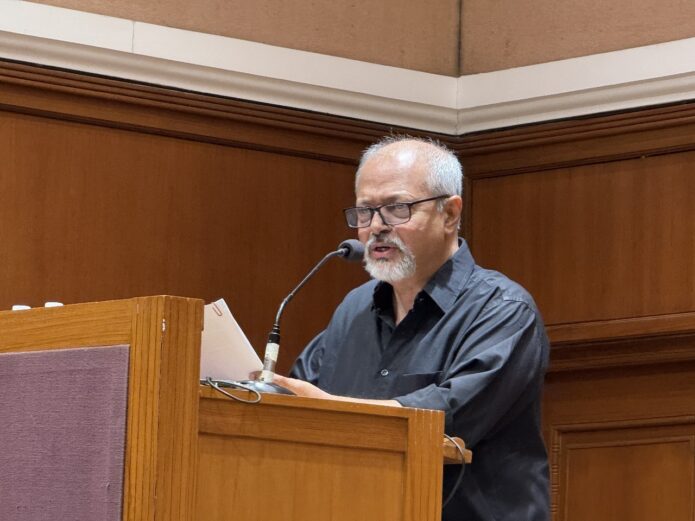
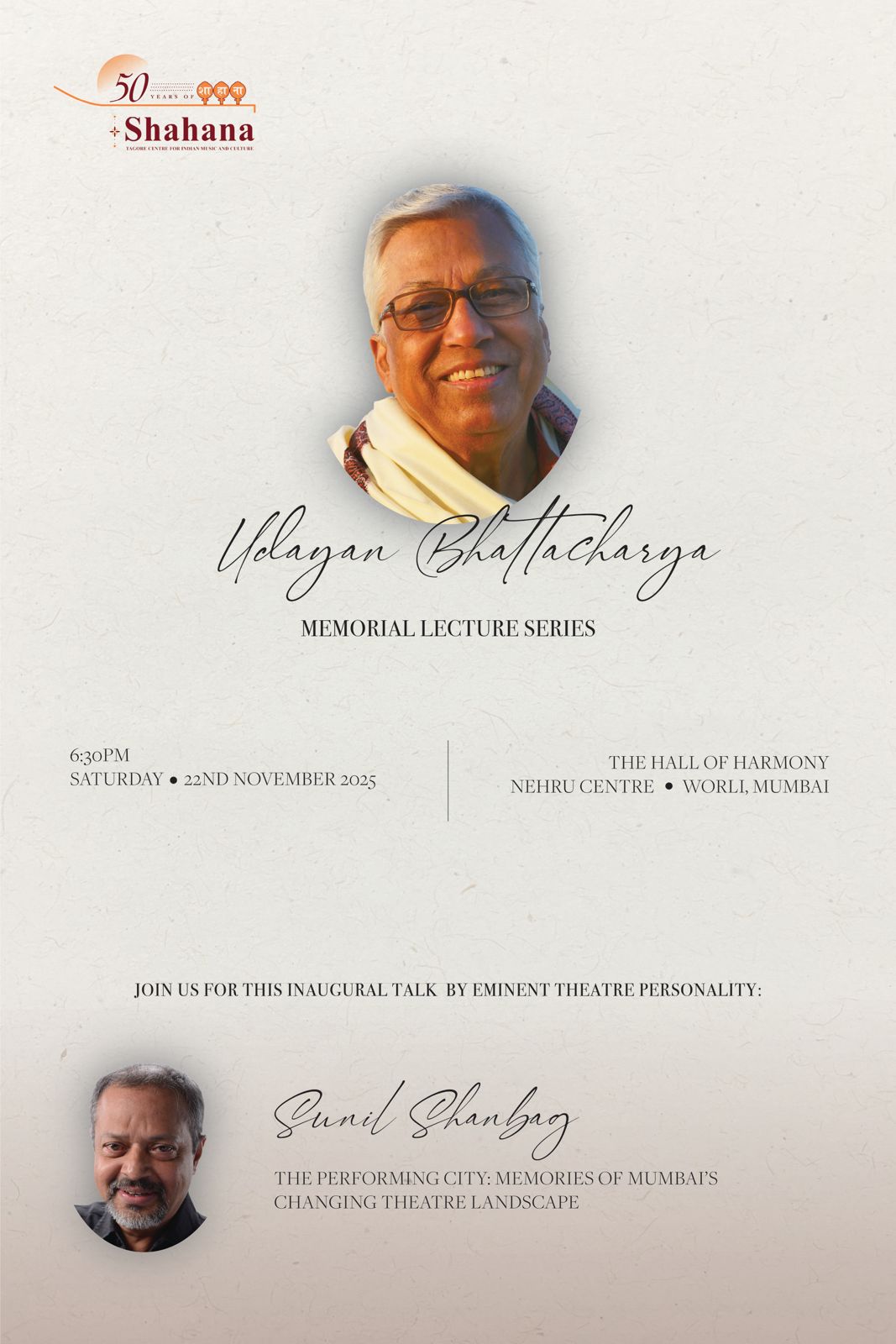
I expected the inaugural Udayan Bhattacharya Memorial Lecture at Nehru Centre to be solemn. Instead, it turned out warm, thoughtful and quietly humorous. The evening opened and closed with Tagore songs sung softly, as if reminding us that culture breathes best at its own pace. It was also the evening I was properly introduced to Sahana, Mumbai, a remarkable collective that has spent decades nurturing performing arts in the city with quiet resolve.
An Evening To Remember
At the centre of it all was Sunil Shanbag, one of Mumbai’s most respected theatre-makers and a protégé of the legendary Satyadev Dubey. He had the ease of someone shaped by decades of rehearsal rooms, difficult scripts and stubborn hope. Shanbag spoke calmly, stroking his goatee now and then, and made the history of Mumbai theatre feel less like a lesson and more like a stroll through a familiar neighbourhood. He offered hope simply by holding history in one hand and possibility in the other.
Somewhere along the way, a small door opened in me too, a familiar pathway to my own dalliances with theatre from years ago.
The Plays That Found Me
My introduction to theatre did not come with spotlights or pedigree. I was discovered by Prof Elango at Fourthwall, at The American College, who plucked me out of wayward obscurity and gave me a role in a play titled In the Name of God. One moment I was minding my own business, the next I was on stage wondering which limb was meant to move first. Theatre does not wait for you to be ready. It simply says, “Your turn.”
What followed was a fast, compressed and surprisingly thorough education. A little Shakespeare, a little Chekhov, and then The Zoo Story, the two-person pressure cooker that offers no escape and no excuses. Those early plays left an imprint, the way a river leaves its mark on stone. They shaped how I listened, how I observed, and how I carried myself long before I understood what they were doing.
Plays do not end when the curtain falls. They end when they are done with you. They return in airport queues and quiet mornings, tapping you on the shoulder when you least expect it. A play you performed at nineteen can return at forty with a completely different meaning. Theatre builds an internal archive without asking for permission, and it keeps adding to it long after the stage has gone dark.
For that imprint I owe a lifelong debt to Prof Elango and everyone at Fourthwall. Their passion ran on a different voltage and it sweepingly carried me along. Without them I would have remained exactly where I was, minding my business instead of discovering a new way of seeing and being.
And it was that way of seeing and being that sat upright that evening, listening to Sunil Shanbag narrate how Tagore’s play Dak Ghar had travelled all the way into Nazi Germany, slipping quietly into the shadows of the Warsaw Ghetto. It felt less like a history lesson and more like a reminder that stories often go further than their writers ever imagine.
Tagore, Korczak and a Lesson I Was Not Expecting
To understand the story, it helps to picture the Warsaw Ghetto in the early 1940s. A sealed district created by Nazi Germany. Starvation, cold and constant deportations. Entire childhoods cut short before they had begun.
In the middle of this was Janusz Korczak, whom I have been reading about ever since that evening. He was a paediatrician and educator who ran an orphanage with fierce tenderness. He believed children deserved clarity and dignity even when adults around them had lost both. His compassion was stubborn in the best possible way.
Shanbag described how Korczak used Tagore’s Dak Ghar to prepare the orphaned children for the idea of death. Amal, the sick child in the play who dreams of the world beyond his window, became a mirror for children whose own world was closing in. For many of us, this was the first time the Warsaw Ghetto was introduced not through numbers but through a play, through frightened children performing a gentle story, and through one man’s determination to give them a last taste of imagination.
The part that stayed with me came after the play. A few days later the children were marched away with hundreds of others towards the trains that would take them to a concentration camp. Adults around them wailed and collapsed. The children walked in silence, steady and composed. One of them held a violin and played as they moved. They were as ready as children can ever be for a fate they did not choose.
It struck me that the evening was as much an education about Korczak as it was about Tagore. Sometimes we learn about literature through the lives it touches. And sometimes we learn about history through the plays it chooses.
That night Korczak became the teacher and Dak Ghar became his chalk. Shanbag kept weaving that story through Mumbai’s own theatre tales, stories that were no less fascinating in their own way.
The Spaces That Built Mumbai’s Theatre
Shanbag’s stories reminded me that theatres do not just host plays. They build cities. They shape how a place thinks and imagines, held together not by budgets but by conviction.
Much of that conviction came from people like Dubey, who kept appearing in Shanbag’s telling. Dubey could spot actors who did not know they were actors, push them into difficult roles, and treat theatre as oxygen rather than entertainment. That energy seeped into the rooms where Mumbai’s theatre first found its voice.
Chhabildas: A School Hall That Sparked a Movement
The way Shanbag described Chhabildas, you could see it. A modest school hall in Dadar. A high tiled roof. A storeroom pretending to be a backstage. A toilet that worked on its own mood. Almost no equipment. And yet it became the beating heart of experimental theatre. For nearly two decades, dozens of groups performed there across languages, on diwans and rattling steel chairs, with traffic, vendors and radios leaking in from the street. On one night, even a murder downstairs.
In Shanbag’s telling, Chhabildas thrived not despite its flaws but because of them. The room taught theatre makers to be inventive, honest and fully awake to life.
Prithvi and NCPA: Spaces That Grew a City’s Confidence
Prithvi and NCPA, as Shanbag described them, were Mumbai’s two strictest teachers. Prithvi demanded intimacy, its thrust stage leaving no place to hide. NCPA offered the opposite lesson, insisting on scale and discipline. Together they taught artists to stretch, adapt and rise to whatever room held them. They were not just venues. They were training grounds.
Why Money Cannot Be the Only Question
Shanbag also traced how things shifted after 1992. As the country opened its markets, theatre was nudged into the logic of “an evening out.” Plays became shorter, lighter and more “dinner-friendly,” trimmed to suit appetites rather than ideas.
But Chhabildas reminded me of something else. Art does not need money to live. It needs people who care enough to rehearse after work, to perform in hot rooms, to sit on diwans and steel chairs and still feel something. Chhabildas did not decorate Mumbai. It animated it. It kept the city honest and awake.
Somewhere between the pollution outside and the conversation inside, something shifted. The air in the hall felt lighter, as if talking about plays and playwrights could momentarily clean a city’s lungs. It left me with nostalgia, a hint of melancholy, and most unexpectedly, hope.
Art that depends only on money cannot build a city. It can only decorate it. But art that depends on love and belief gives a city a soul.
Why Theatre Matters Even More Today
In a digital age we have traded presence for convenience. There is more to watch than ever, yet far less to truly feel. Our attention has become a marketplace and everything wants a piece of it.
Which is why theatre feels almost radical now. People in one room. Shared breathing. Shared laughter. And shared silence. No pause button. No algorithm.
Culture is not luxury. It is how a society remembers to stay human. And theatre remains one of the few places where India’s astonishing diversity gathers, listens to itself and recognises its own depth.
Google knows me a little too well. Somewhere between scanning my photos of weathered temples and long-abandoned wells, it popped up a notification. “You might be interested in Kamuthi Fort.” Oh sweet thing, of course I was.
Kamuthi Fort sits in one of those small Tamil towns that lived in my mind as a nameboard on buses leaving Mattuthavani bus stand years ago. You see the sign, nod at its existence, and move on to the next one. But as with all such towns, there are stories waiting if you only pause.
So, pause I did.
A sixteenth century fort, said Google. Nine ramparts, said the web. I was sold.
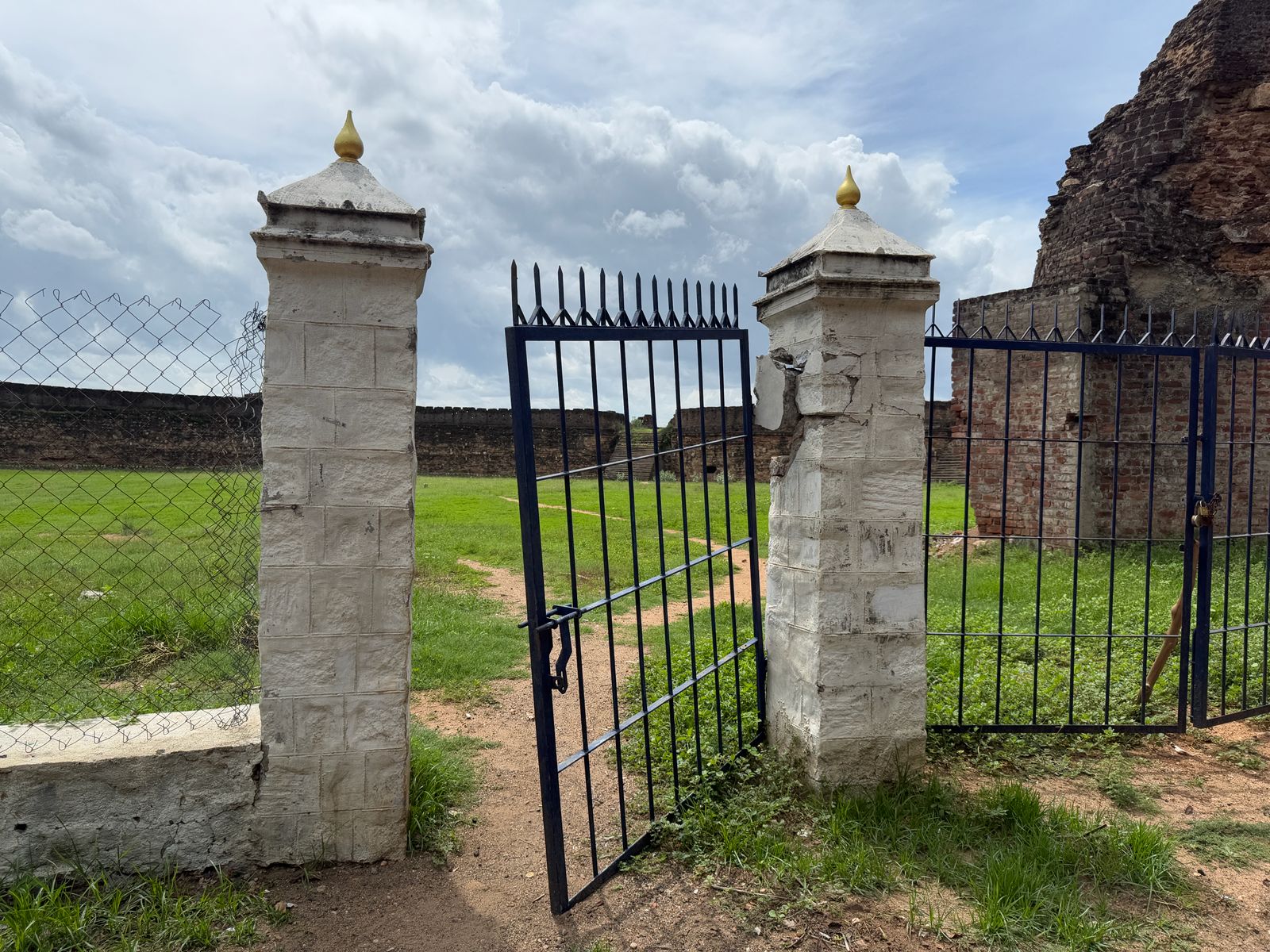
A half-open steel gate squeaked in the wind. Silence did the welcoming.
The drive from Sayalgudi was short and easy. The kind of road where fields stretch to the horizon and herons perform slow-motion flypasts. When the map finally announced, “You have arrived”, I looked around for a dramatic gateway, maybe a guard with a spear. Instead, a half-open steel gate squeaked in the wind. Silence did the welcoming.
My daughter and I stepped out to find a way to enter. A half-open steel gate guarding a three hundred year old fort was unmissable irony.
Inside, the Archaeological Survey of India had left a plaque, Tamil on one side and English on the other, as if to say, “You wanted history, here, have some.” It read:
“This stone fort was constructed 300 years ago by Sethupathy King Udayathevar alias Vijaya Raghunatha Sethupathy. It is believed that this was built with the assistance of a French Engineer. After the downfall of Panchalankurichi, this fort fell into the hands of the East India Company. It was also under the control of the Marudhu brothers for some time. It is reported that Veerapandya Kattabomman stayed at this fort on his way to Ramanathapuram.”
Department of Archaeology, Government of Tamil Nadu.
A Large Swathe Of Time
Three hundred years ago. Or maybe three fifty. Hard to say. The plaque offered no date, and the stone looked as if it had been sunbathing there for at least fifty years itself. Perhaps that was the idea, a quiet puzzle for every visitor to solve, century after century. A lump of cold data with no life, sitting there like an exam answer from a student who had memorised the facts but forgotten the story.
Large swathes of time like “three hundred years” hide more than they reveal. We revisited our memories and tried patching together a timeline of world events back then.
We bantered about how it might have been built when the Mughals were beginning to wobble.
Before the United States became a country, when it was still mostly wild land and brave people trying to survive winter. Before the French Revolution, when Marie Antoinette was still years away from allegedly offering people cake. Before Beethoven wrote a single note, before railways linked cities, before the first vaccine, and even before coffee became a global habit that half the world now depends on just to get through the morning.
The sun shone through the clouds. It was a splendid conversation to have in that setting. To talk about a quiet, crumbling place by stitching it into the larger story of the world. To look at these stones in desolate isolation, and then suddenly see them in full, noisy context.
The other line on the plaque that caught our attention was about the French engineer. What was a Frenchman doing in the sweltering plains of Ramanathapuram, drawing blueprints for a Tamil king? I pictured him, moustache damp, measuring walls under a merciless sun, wondering which Parisian sin had earned him this posting.
And then there were the Marudhu brothers, Kattabomman, the Sethupathis, all names that echoed rebellion and royalty. I could almost imagine them striding through this space with pride, purpose and possibly a few swords.
All these conversations were possible only because of past dalliances with history, and my occasional attempts to teach her some. In front of us, though, was an NCERT style summary carved into granite, looking surprised to get as much attention as we were to see it.
When you have too much history, you sometimes stop tending to it. It felt like a reasonable hypothesis to accept, nod at, and move on.
Steps, Stories, and Silence at Kamuthi Fort
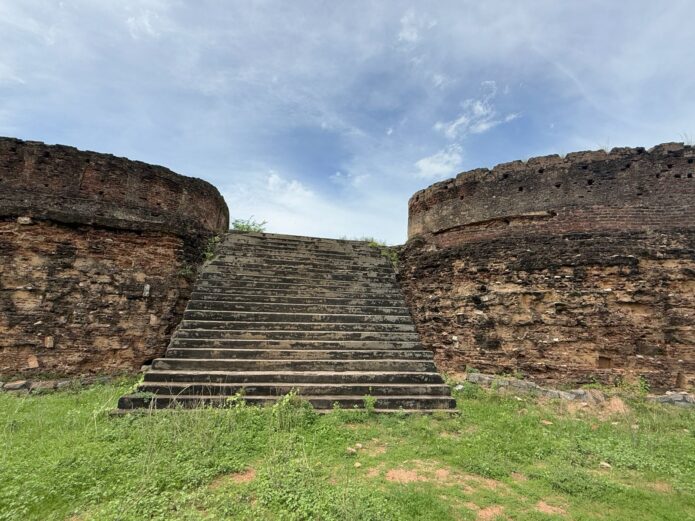
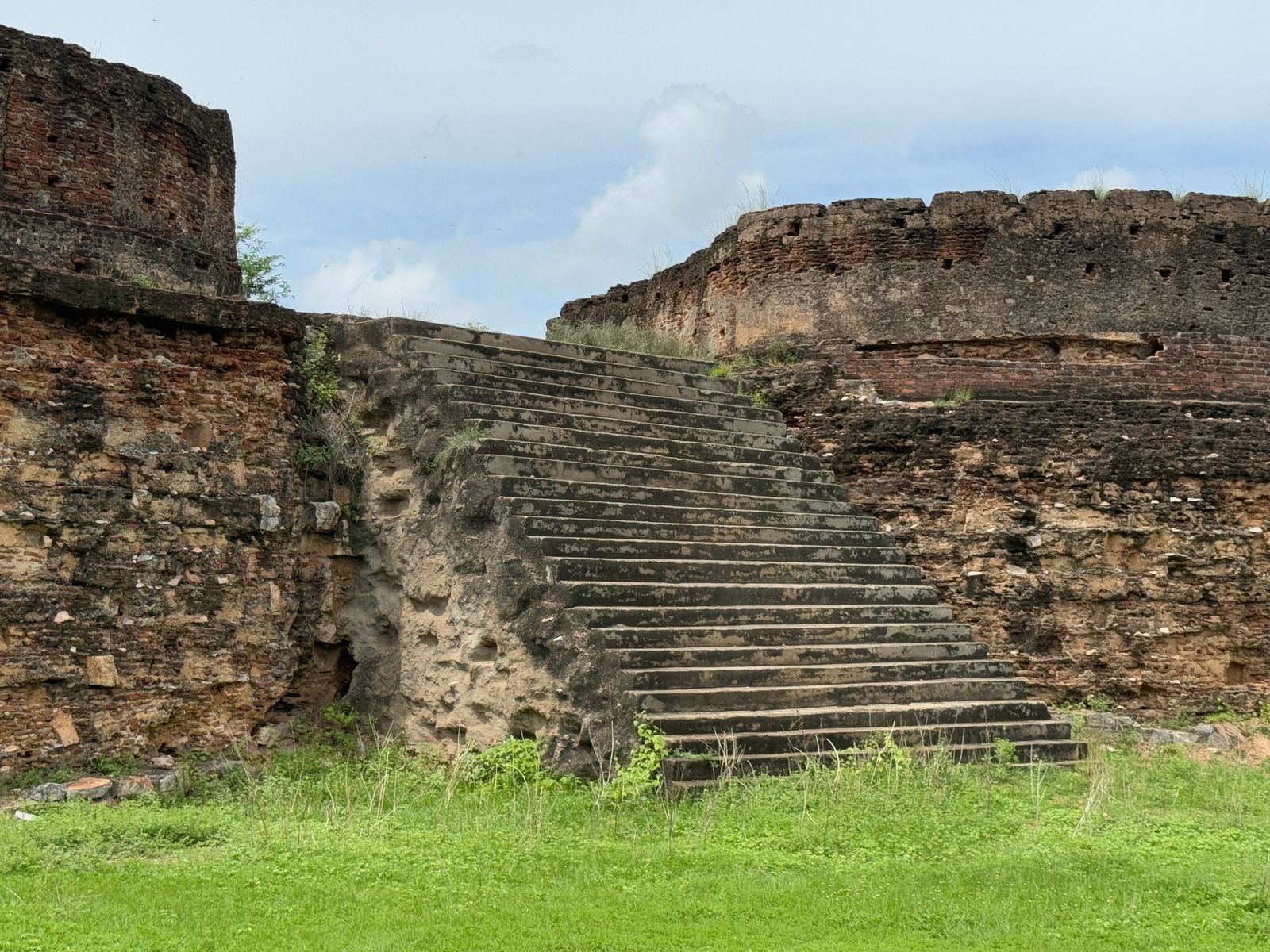
The fort is circular, its thick walls still stoic even though time and rain have bitten chunks out of them. Wide stone steps climb up the ramparts. Strong. Straight. Stubborn. The kind you do not see in modern buildings.
Storied steps of Kamuthi fort
I climbed one and reached the top, expecting a grand view. Instead, I found empty beer bottles glinting in the sunlight. Every era has its warriors, I suppose. Then I climbed another flight of steps, and another view waited. Each staircase led to a different story.
From up there, the view stretched across contradictions. A colourful temple tower rose from one side, loud with freshly painted gods. On the other side, the Armed Reserve Ground stood silent.
I later found a YouTube video claiming that the cops once used the fort for target practice, until residents protested. Not out of love for history, but because of the noise. Small mercies, I thought. I have no idea how true that story is, but the fort clearly has had many lives. And its latest round of survival did not seem to be due to grand conservation plans, but to something far more ordinary, everyday irritation.
At the centre of the fort, a wide green patch stretched like an empty parade ground. Perhaps soldiers once trained there. Perhaps kings reviewed troops. Now, weeds stood in quiet attendance.
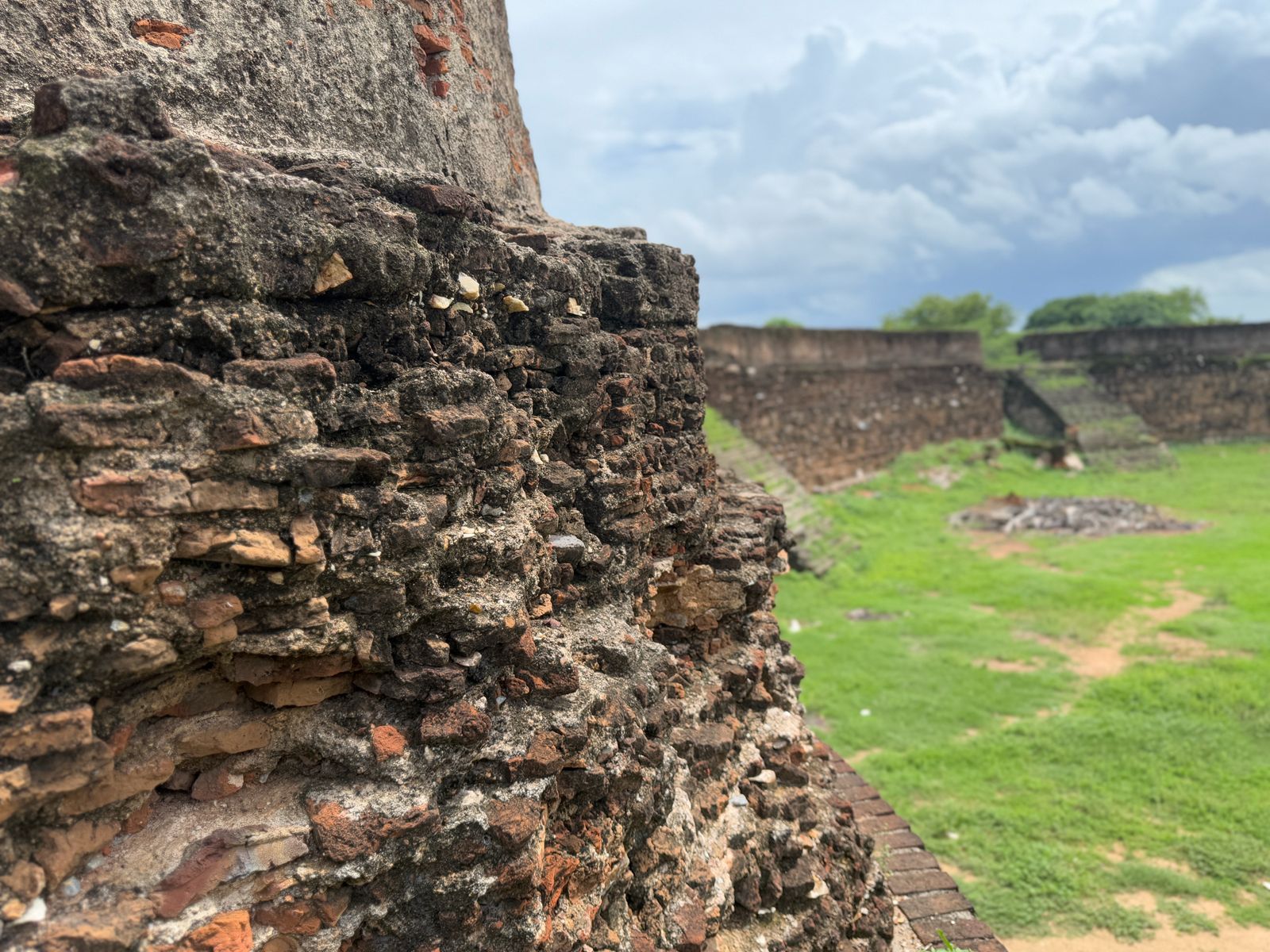
The walls of Kamuthi Fort are astonishingly thick, the kind that were built not just to stop enemies but to outlast them and ten generations that followed. Up close, you can see layers of old brick, lime mortar, sand, crushed shell, and the occasional glint of stone all holding together like a long, patient handshake.
Thick walls of Kamuthi Fort
Later that evening we pored over the internet, trying to understand what gave the construction its strength. We found that builders in those days mixed the mortar with whatever helped it endure, including jaggery water, powdered limestone, and kadukkai, a small wrinkled fruit whose natural tannins helped the walls resist cracking and moisture.
Some recipes even mention raw eggs for a smoother set. Whatever they used, it clearly worked. Three centuries later, these walls still stand in stubborn defiance, quietly proving that things built with care and a few eccentric ingredients tend to last.
On my way out, I noticed a bold red 1993 painted on the wall of the temple wedding hall. Its proud year of inception. It stood directly opposite the steel gate, a mere thirty two years old. The contrast was almost comic. Like a fresher showing off a car he mostly owes the bank, before a billionaire who has lost his fortune.
What Kamuthi Fort Teaches Without Trying
Kamuthi Fort may never make it to glossy travel brochures. It does not charge tickets, sell souvenirs, or feature in drone videos with cinematic background music. But it has something many others do not. Presence. A stubbornness to remain. You walk through the broken walls and feel centuries of sun and storm still trapped in the bricks. You hear whispers of battles and see echoes of neglect.
If this were in Europe, there would have been tour guides with microphones, an entry ticket priced just right to fix half the state budget, and a tidy little museum shop selling magnets of the fort looking ten times grander than real life. There would have been plaques with footnotes, audio guides in eight languages, and a cheerful volunteer reminding you to stay on the marked path.
And if this were in the United States, the place would have been turned into “Fort Kamuthi National Heritage Park.” There would have been a café called “Kattabomman’s Brew”, a massive fort shaped bouncy castle for children, actors from Colonial Williamsburg doing hourly re-enactments, a twelve dollar bottle of water, burgers the size of dinner plates, and a forty nine dollar premium early access pass. Of course, the small town of Kamuthi would have been flattened to make way for a giant colour coded parking lot.
All this for a place that, in Kamuthi, lives perfectly happily with a steel gate and the afternoon sun.
It struck me then how wildly the world varies in the way it wraps itself around history. Some places polish their past to make it look like something else. Others leave it lying around like old furniture. Kamuthi Fort simply sits and waits, holding on with quiet strength while we hurry past. It deserves far more care than it gets. The slow drift into disrepair feels like a small discourtesy to everything it has survived.
Perhaps it will get more attention if someone like Lokesh Kanagaraj decides to shoot a fight sequence or a moody montage here. But we do not have to wait for that. We can start with something simpler, attention and respect.
We owe these places that. A few moments of silence. A pause to think of the countless hands that built, fought, prayed, or repaired these stones.
If you are ever near Kamuthi, please go. Not only for your children to climb its steps, but for yourself, to stand still for a while. To feel how time stretches, how pride turns to dust, and yet how beauty lingers in silence. You will come back lighter, and oddly grateful.
Because even in its decay, Kamuthi Fort is doing something quietly spectacular. It is enduring.
There are mornings when coffee wakes you up. And there are mornings when the coffee seems sluggish compared to the news.
On my LinkedIn feed popped an interesting post by Intellectual Property thought leader Latha Nair: “India just got its first smell mark, that too smelling of roses! 🙂 And it must be a sweet feeling for any trademark enthusiast from India!“
That was the moment my coffee stopped being a beverage and became a witness to history.
The details were even better. Sumitomo has “apparently been infusing the floral fragrance of roses into its products as an integral component of its business strategy and product development since 1995.” And a 13-page order from the Controller General now trailblazes India’s journey into the world of non-conventional marks.
The coffee sputtered and screeched down my alimentary canal as I checked again if it was Sumitomo the tyre company.
Yes. It was.
A tyre company applying for — and getting — a smell trademark. That too, of a rose. To be infused into its products?
But here is where the fun truly begins. To register a smell, you must represent it graphically. So Sumitomo submitted a graphic of a “rose-like smell”, with the assistance of IIIT, Allahabad.
A picture of perfume? A drawing of aroma? Some sort of curvy line that looks like a rose caught in a Wi-Fi signal?
Which makes me wonder: What would the official graphic be for the smell of coffee? And when do we get an emoji for “wake up and smell the coffee,” because modern civilisation is clearly running behind schedule?
Her post also quotes the order, in impeccable judicial calm, that “the scent of roses bears no direct relationship with the nature, characteristics, or use of tyres.”
I think that translates to: “This makes no earthly sense, and that is exactly why it qualifies.”
Honestly, understanding why a tyre smells like roses is about as clear as solving this week’s crossword with last week’s clues. You know something is happening. You just cannot explain what and why.
It is one of those “fact is stranger than fiction” moments. Science fiction predicted teleportation and aliens. Reality gave us perfumed tyres.
I am still trying to imagine that “rose-like smell” graphic. My nose says yes. My brain says absolutely not. And my coffee says, “Please leave me out of this.”
I never met Ramki Sreenivasan. Yet I’ve heard his name often enough from friends and colleagues for him to feel familiar in the background. Like someone whose work you recognise before you recognise the face. I’ve read his writing, followed his work from a distance, and mourned his passing quietly.
Reading NS Ramnath’s piece on Founding Fuel, and seeing the images from the award instituted in his name, made me pause. Not as much in sorrow as much in meaning and celebration. A life like his leaves a long trail. For people, for places, and for everything that flies, swims, crawls, or blooms.
The Founding Fuel link below gives greater context to this piece.
The award created in his name is not just a reminder of his work. It is a quiet act of love from his family and friends, who continue to keep his spirit alive in the field he cared about.
Ramki treated conservation as serious work. It needed persuasion, evidence, and courage. He didn’t photograph wild places as a hobby. He helped protect them. The tools were cameras and lenses, but the work was closer to activism.
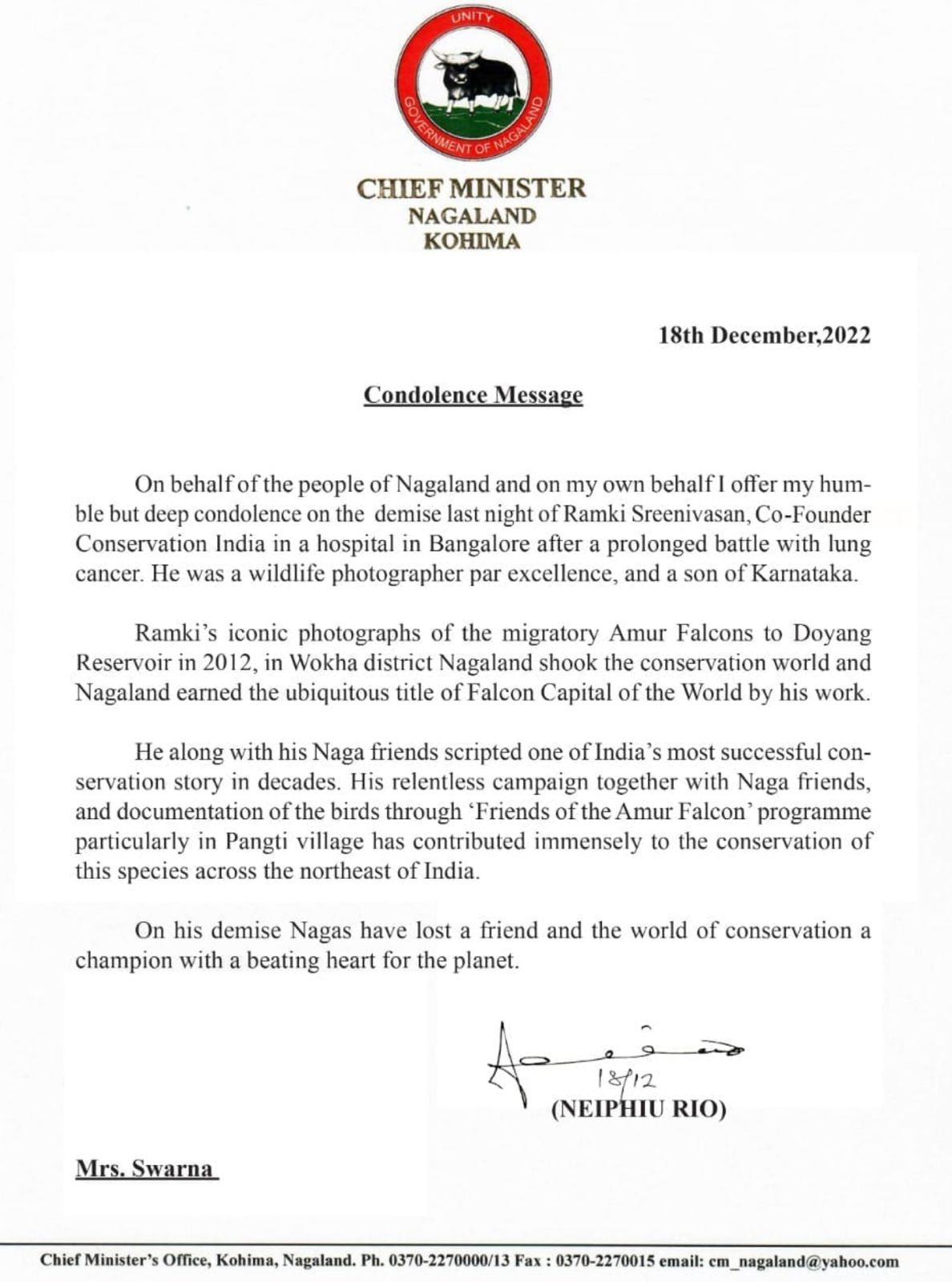
A reminder of that impact came from an unexpected place: a tribute from Neiphiu Rio, the Chief Minister of Nagaland.
Condolence letter from Nagaland’s Chief Minister
Political leaders rarely stop their day to acknowledge conservationists. Nature seldom makes it to the official list of people politics thanks. So when a state leader publicly honours a man who helped protect migratory birds, it says something about the work. And the scale of it.
The Cost We Forgot to Count
The damage we do to the environment is often invisible to us. We track inflation, GDP, stock indices, petrol prices. We complain about shrinkflation in our biscuit packets. But we don’t notice the shrinkflation of habitats. Forests thinning. Rivers narrowing. Skies losing their travellers. There is no mainstream index that measures the cost of losing forests, wetlands, or birds. It is a bill we are already paying. We have just settled for not seeing the invoice.
We don’t see ecological loss because it rarely comes as one dramatic event. It shows up quietly: fewer bird calls in the morning, a river that smells different, a fruit that no longer grows where it once did. These changes arrive disguised as “development” or “progress.” And because they don’t show up in quarterly earnings or political slogans, we treat them as background noise. By the time we notice, the damage is already permanent.
That’s where lives like Ramki’s shift perspective. They remind us that conservation is not fringe activism. It’s maintenance. It keeps the world in working order so that both people and wildlife can live with dignity. If the forests fall silent, we lose an entire vocabulary of life.
Small choices matter too. The plastic bag we refuse. The holiday we plan differently. A school project about migratory birds instead of zoo favourites. Culture changes through small, repeated acts of responsibility. And through teaching our children to relate to the planet as a neighbour they share life with.
Ramki’s life and work set a benchmark. This is a call to match his stance, not his scale. Most of us will not save a neighbourhood, let alone a species. But we can choose not to help erase one. That is a modest place to start, and perhaps the most honest one.
Some lives add noise. Some add followers. A few quietly make the world better.
The beach at Sayalgudi doesn’t announce itself. It appears, almost shyly. No signboard declares “Welcome to Paradise.” No resort gate opens grandly with a poor, uninterested labrador that is forced to sniff the car’s trunk. There’s just the soft hiss of waves, a ribbon of clean sand, and the faint scent of salt that tells you you’ve arrived somewhere that doesn’t know it’s special.
The sea stretches endlessly, its rhythm unhurried, uncurated. There are no shacks, no deck chairs facing the sea, no soft-serve ice-cream vendors. Just a moon already at work, waves rehearsing their eternal script, and one solitary visitor thanking his stars that, such beauty escaped some social media influencer’s attention!
I sat there for a long while, watching the sea nibble at the shore and retreat, as if testing the flavour of land. It was hard to believe that this was two hours from Madurai. Tamil Nadu’s coastline is vast and beautiful, and extends beyond the fame of the Marina, Pondicherry, and Kanyakumari.
The Road That Curves Away from Fame
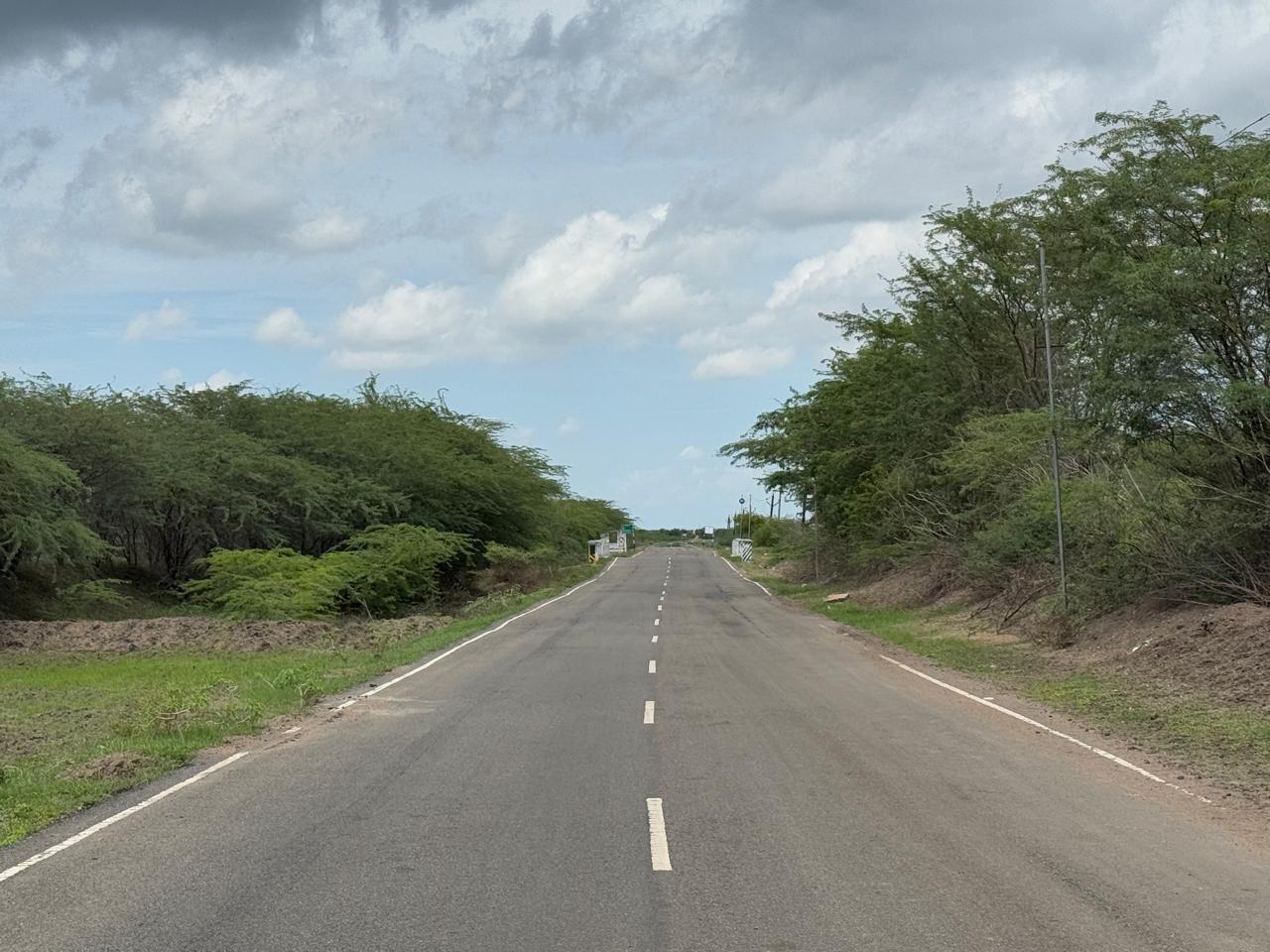
Getting here is a breeze. You start from Madurai, drive towards Rameswaram, and somewhere after Manamadurai you slip off the highway. The road begins to twist, as if embarrassed by how small it has become.
Seemakaruveli bushes for company
On both sides stand seemakaruveli bushes — Prosopis juliflora, the invasive guest the British brought in the 19th century to tame wastelands. Now it rules the countryside like a green despot, spreading faster than gossip and just as hard to uproot.
Villages appear and vanish like punctuation marks. Abhiramapuram, Karisakulam, Athikulam, Allikulam and many more whose names blur in the rear-view mirror. Their kaapi kadais linger longer in memory: tin kettles boiling away gossip, glass tumblers with a skin of sugar on top.
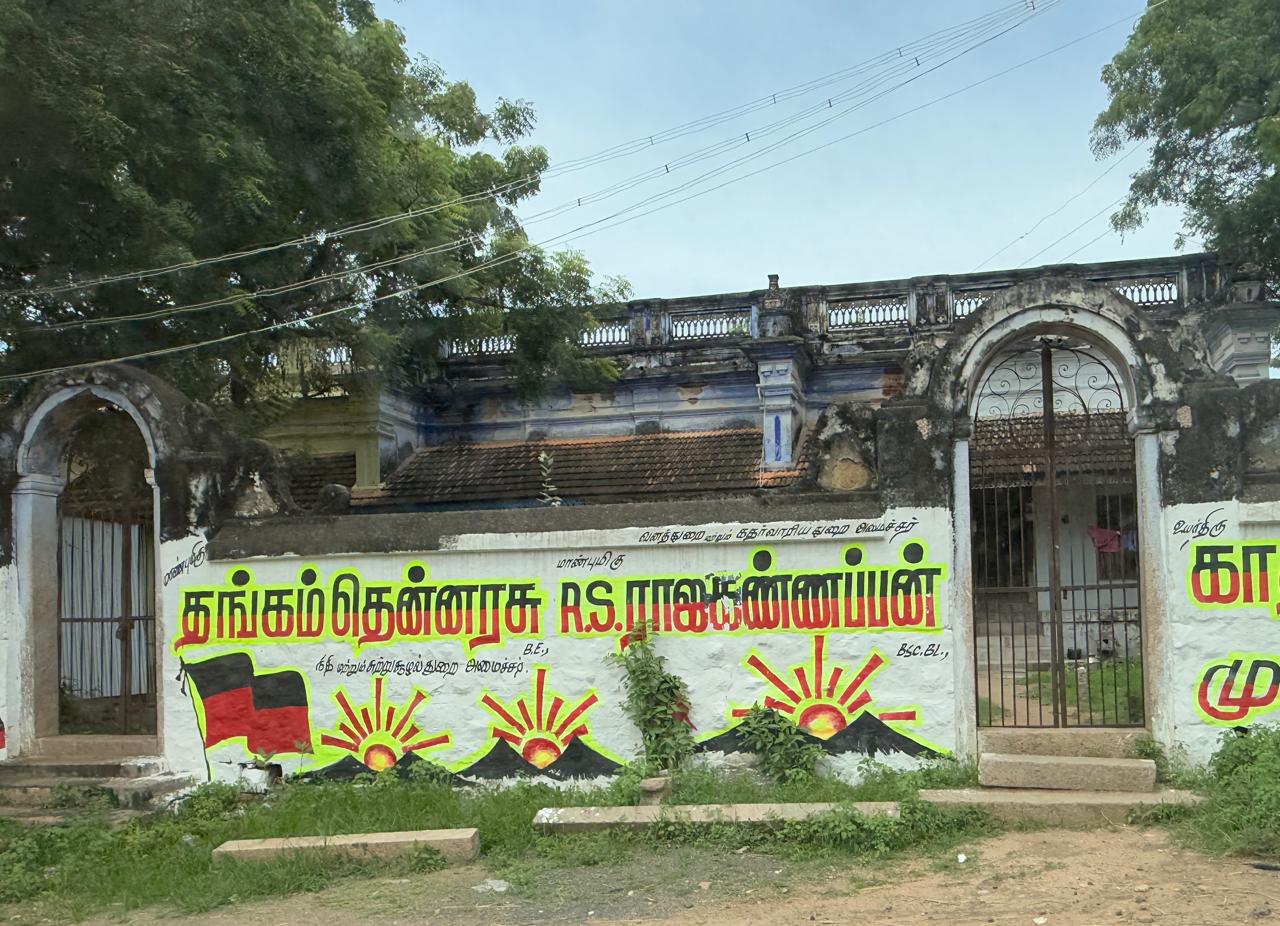
Politics rendered on plaster
The walls along the way shout in red, black, yellow, white, and blue. Politics rendered in thick Tamil letters. In this part of the world, even plaster has opinions. A painted bull here, a rising sun there, two leaves somewhere else; campaign promises merging gracefully into art. Between two walls, a goat herd ambles across the road, his flock spilling into the highway with serene entitlement. He crouches by his TVS 50, adjusting something in the chain. They used to walk once, I think. Now even goats wait for engines.
Sugar and Spice. Ah! Memories
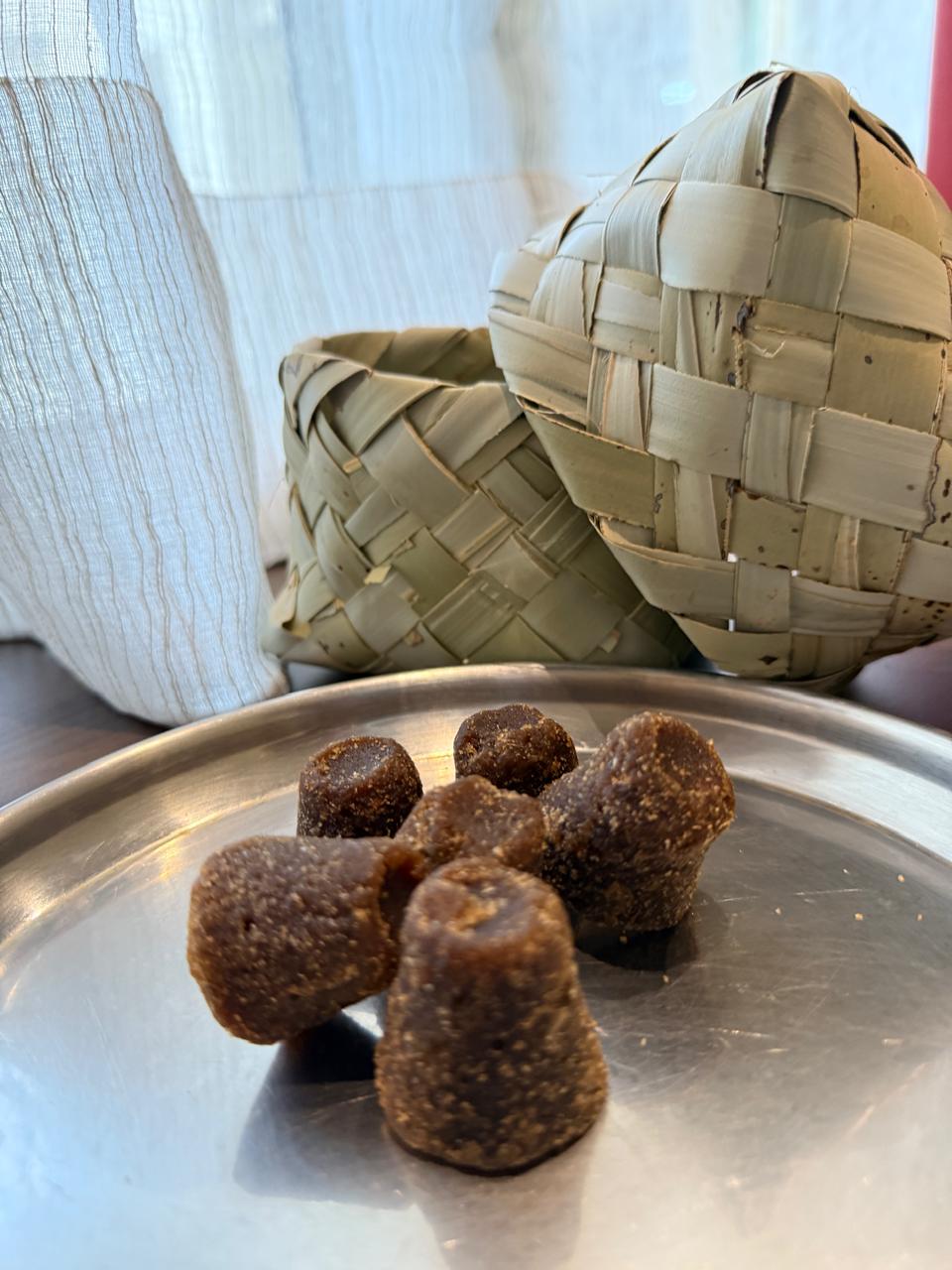
A little further on, a man sells inji karuppatti. Ginger and palm jaggery. Packed neatly in olai kottans (palm-leaf baskets). I buy some. They’re sweet, fiery, and nostalgic all at once. Childhood condensed into sugar and spice.
A Trust in the Road
I often drive through rural Tamil Nadu with a quiet confidence that if anything were to go wrong, someone would appear. Not with a “How may I help you, sir?” but with a curious “Are you okay? Water?” People here don’t outsource kindness. It’s part of the day’s work, somewhere between lunch and the evening bus.
Over the years, I’ve been stranded by punctures, wrong turns, and delusionary optimism. Each time, a passer-by has stepped in, not only to do the needful — that tidy phrase from corporate emails — but to actually see what was needed. A word, a jug of water, a direction, sometimes just company until help arrived. Rural rhythms seem to cock a polite snook at the urban question of “What’s in it for me?” Here, the answer is often, “Nothing”. And that’s fine. Every time signing off with a “paathu poituvaanga.” Loosely translated to “stay safe and come back soon.”
A Town That Prefers Modesty
Sayalgudi itself sits quietly on the southeastern edge of Tamil Nadu, a town of about twelve thousand people and exactly zero pretensions. There are shops selling coconuts, rubber slippers, and recharge coupons. The fish market smells of honesty and ocean. It’s the sort of place where everyone seems busy but no one seems in a hurry.
You follow a narrow lane until the houses give up, and the sea fills the gap. The transition is so sudden it feels like the land has run out of sentences and switched to poetry.
People Who Stay Real
The “resort” I stayed at was more functional than fancy. A bed, an air-conditioner and a fan that coughed with commitment, and a window that framed the horizon. Hot running water. Clean sheets. A television that didn’t need to be turned on, because the best show in town was hosted by the sea. And luxury came from the sound of the waves.
Gopal, the manager, was a stocky man with a weathered Hero Honda and an even more reliable smile. Ajit, the chef, tall and thoughtful, made fish curries that could start conversations. And Jaya, the attentive housekeeping staff, had returned to the resort after dallying with other employers in the vicinity. All wonderful people. “It’s good to help people here,” she said softly, folding towels with care. “Only wish others are considerate too.” Who those “others” were, we left hanging in that polite ambiguity that some conversations excel at. Like a scene from a Mani Ratnam movie where silence does the explaining. And you fill in the gap in your own way.
They didn’t greet you with a scripted “Good morning.” They simply nodded, smiled, and said “Enna saar?” — “What, sir?” — half greeting, half check-in on your wellbeing. It was infinitely warmer than the mechanical, well-practised flow of a five-star resort employee. These folks were simple and authentic. Just like the sea. That’s all that mattered.
Stillness, the Unadvertised Luxury
By night, Sayalgudi changes tone. Fishing boats light up the horizon like a shy constellation. The lighthouse sweeps its beam with the discipline of a monk ringing a bell. The air fills with the sound of insects tuning up, and occasionally, a bird that hasn’t yet signed off.
It’s the kind of stillness Pico Iyer writes about: “The more ways there are to connect, the more we seem desperate to unplug.”
Here, you don’t disconnect as rebellion. You simply forget to connect in the first place. The signal flickers; the mind steadies.
I walk along the shore, barefoot, the sand cool and damp. Something sharp presses against my foot. For a moment I think it’s a broken beer bottle. A memory from a trip to Bali. But it’s a seashell, luminous under the moon. I slip it into my pocket, a small souvenir of an unadvertised paradise.
Abundance in the Unfamous
The next morning, Ajit serves dosai so crisp it competes with the waves. Gopal checks if the Wi-Fi has decided to exist. Jaya hums an old Ilaiyaraaja song as she sweeps the courtyard. Life goes on, entirely unbranded.
I think of all the famous beaches I’ve visited. Where the soundtrack is a mix of EDM, immaculate hotel staff and unbridled commerce. Corn. Coffee. Ice-cream. Beer. Horse riding. Whatever. Sayalgudi reminds me what a coastline really is: a conversation between sea and sand that doesn’t need an audience.
Paul Theroux once said, “Tourists don’t know where they’ve been; travellers don’t know where they’re going.” In Sayalgudi, both are forgiven. You just sit, let the waves do the talking, and measure time in tides.
A Small Philosophy Between Two Waves
The sea teaches quietly. Each wave arrives certain, crashes spectacularly, and dissolves without complaint. Watching them, I begin to think of work emails and deadlines that once felt as urgent as surf, until they receded. Maybe that’s what travel to places like this really does: it returns scale to things.
My phone vibrates — a reminder of a meeting, a plan, a project. I look at the screen, then at the moon tracing its silver loop above the water. Another wave rises, crashes, and fades.
“Tomorrow,” I tell the caller. Then add, “Actually, day after.” I hear the silence on the other side.
I add, “Please.” One more wave roars.
The wind approves. The sea keeps its counsel. Somewhere far away, a boat hums its way home.
I switch my phone to airplane mode. This time, I don’t want to buckle up like I otherwise would when I do that. Because, this time, I am not in a plane. I seem to have wings.
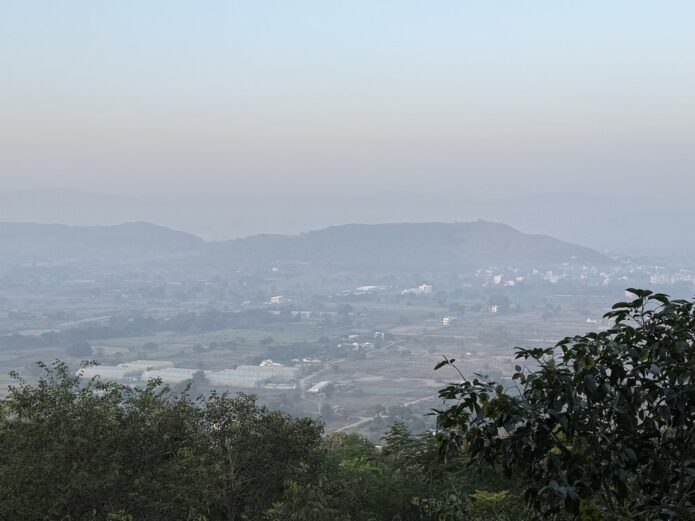
From the top of Lavale, the world below looks like it is trying to multitask. Part village. Part expanding city. And part construction brochure. The morning haze does its best to hide the confusion, but even through the soft grey, the jumble is obvious.
A set of apartment blocks stands proudly in the foreground, as if posing for an ad that has not been written yet. Behind them is a sudden burst of buildings that look like they belong in a different country. Blue domes, tall towers, arches, the whole theatre. It is the sort of campus that makes you blink twice, then check if someone is filming a period drama nearby.
Beyond all this, Pune stretches out in every direction. Tall buildings fade into the mist. Others stand out sharply. A crane leans casually into the frame, hinting that more construction is on the way. The land, however, stays unbothered. Patches of fields, open brown earth, scattered trees. All of them seem perfectly content to ignore the city’s ambition.
But the hill itself is calm. The trees in front rustle lightly. Birds chirp as if the valley is their personal auditorium. Every now and then, a dog barks somewhere below, reminding you the world is awake even if it looks half-asleep.
And then there is the sound of distance. A tractor starting up. A pressure cooker whistle floating up from a home you cannot see. An early-morning folk tune travelling up the slope. All of it carried through the crisp, cold air as if the hill enjoys delivering messages.
At 7.00 am a factory’s siren goes off. Loud. Firm. Reliable. It slices through the mist like a very punctual rooster. The view does not change, but your sense of morning resets instantly. Even the haze seems to shift slightly out of respect.
Once the sun rises higher, the landscape begins to reveal itself. The valley sharpens. Buildings gain edges. Roads emerge. The hills behind appear clearer, like someone increased the brightness. Even the castle-like campus settles comfortably into the scenery instead of surprising you.
By then your coffee has made its way into your system. The warmth spreads. Your thoughts soften. Whatever you were worried about before you stepped out feels a little foolish in front of this strange mix of serenity and cityhood.
Nothing dramatic happens. Nothing needs to.
You look out again. At the haze, the hills, the buildings trying to touch both village and city. And something inside you settles.
For a small, perfect moment, all is well with the world.
The other day, I was looking at a roadside coffee shop in rural Tamil Nadu. It was a pit stop. More to sip on nostalgia. Coffee was the excuse. I got both. Nostalgia. Coffee. And a line from Huxley that appeared on cue.
The man behind the counter was working his magic with a giant kettle that hissed and sang like an old friend. The smell of fresh decoction drifted through the morning air. Somewhere in the background, Ilayaraja’s 80s melody played faintly from a radio that had seen better days. There was a very faint nip in the air, and the newspaper hanging by a rusted clip on the stall was still crisp. Proof that the day was just beginning.
The man himself was spotless and alert. A splash of thiruneer, three bright grey lines, shone on his forehead. He moved with a rhythm shaped by years of practice. Pouring, mixing, serving, taking money, returning change. All in one smooth motion. It felt as if time had slowed down to watch him.
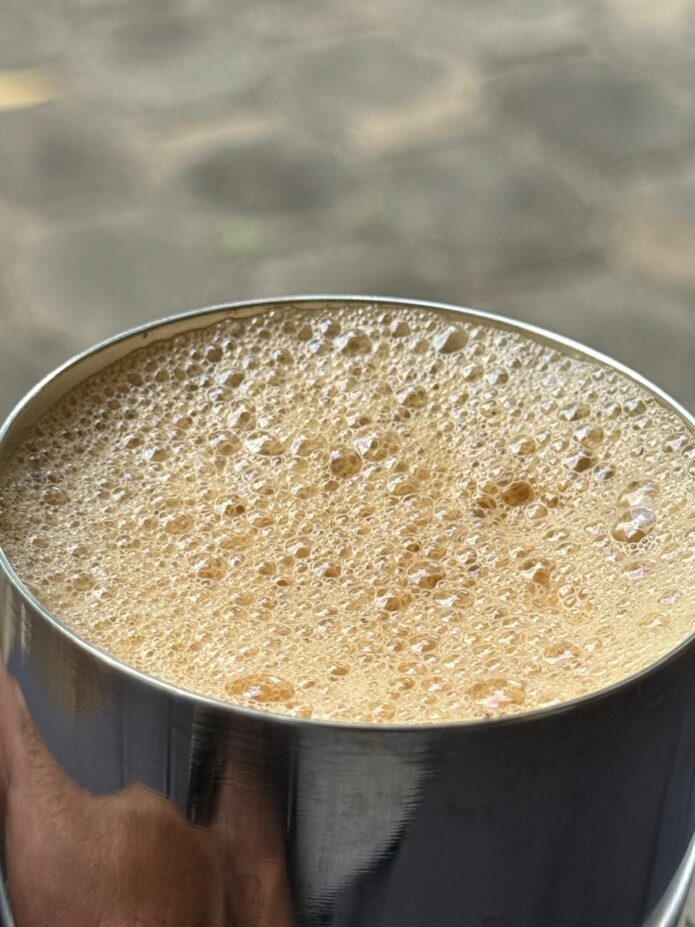
There was no tension in his face. No wasted effort. He did not rush, yet he was never still. The kettle tilted at the perfect angle. The coffee arced through the air in a golden stream. The froth landed obediently in its glass. Every act was precise and calm. Ease that comes when you stop fighting your work.
That is when it struck me. Lightness comes from intimacy. When you have done something long enough, you stop proving yourself to it. The dancer stops counting beats. The cricketer stops calculating angles. This man has stopped thinking about coffee.
Aldous Huxley said it perfectly. “It’s dark because you are trying too hard. Lightly, child, lightly. Learn to do everything lightly.” Perhaps he had watched this man.
He looked up once, smiled, and went back to his art. The world around him kept moving. Buses honked. Cows crossed. A customer called for an extra spoon of sugar. Yet he was steady, like a monk in the middle of a festival.
It was not grand. Or dramatic. It was simply beautiful. And light. Ease, brewed fresh.