research

Tattoos, Then and Now

I once turned down a tattoo at a party.
It was temporary, would fade in a week, and involved no pain. Still, I said no.

My daughter was horrified. Her face said, “Who in the world would miss such an opportunity?” As if I had refused free chocolate.

I shrugged and reached for a fried snack destined to sit on my hips forever.

I didn’t realise that moment would sit in my memory for years, waiting to be triggered by something I read last week.

An Inked Lady in Ice

A research report took me to Siberia. Archaeologists had found a woman from 500–200 BC, preserved in the ice. She was about 50 when she died — and she had tattoos everywhere.

Using near-infrared imaging, scientists created a 3D model of her skin. Mythical beasts curled around her shoulders. Animals fought for survival across her arms. There were extraordinary hand-poked designs of tigers, griffins and tiny roosters.

It was an art gallery — only the canvas was human.

She was from the Pazyryk people — nomadic herders in what is now Russia, Mongolia, China, and Kazakhstan. Her tattoos were not casual decoration. They signalled identity, status, and protection. They were her résumé, her business card, and perhaps her social media feed — all rolled into one.

Ink Runs in the Family

This felt oddly familiar. I grew up around tattoos.

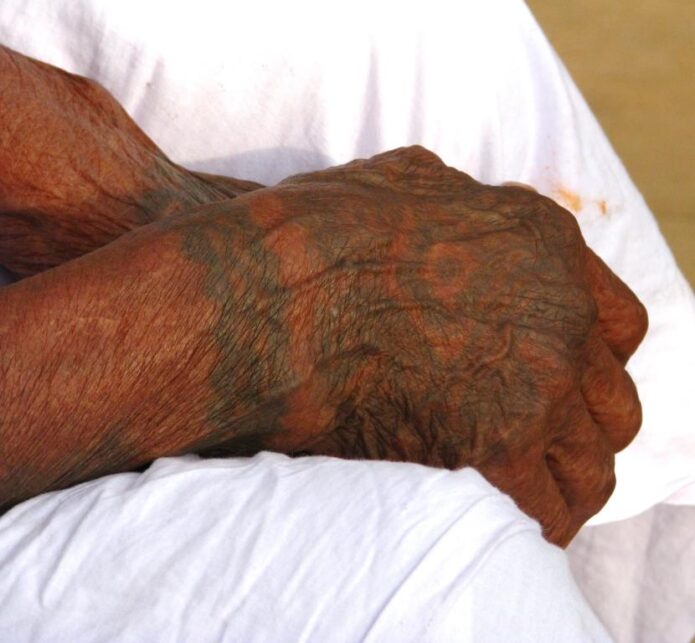
My great grandmother had them all over — arms, fingers. Elaborate patterns, symbols, swirls, and ornate kolam designs. I doubt she picked them from a design book. They probably carried meaning: community, rites of passage, family history.

How she endured them, I cannot imagine. No buzzing electric machines. No numbing cream. Just a steady hand, a homemade needle, and enough pain tolerance to make a dentist cry.

Today, it is far easier. You can walk into a climate-controlled studio, choose from a digital catalogue, sip a smoothie, and emerge with a pristine design in under an hour.

If my great grandmother walked into a modern tattoo studio, she would marvel at the air-conditioning, the choice of ink colours, and the playlists. Then she would quietly ask the tattooist why everyone looked so frightened of the needle.

That generation wore their tattoos with pride. In the photograph above, you see the hand of another grand old lady from our family — a picture I took years ago and dug out for this post. I remember how the wrinkles did nothing to hide the beauty of her ink; if anything, they made it richer.

Why Do People Tattoo?

Psychologists talk about identity, memory, belonging, rebellion, or beauty.
Anthropologists speak of culture, rites of passage, and spiritual protection.
Sociologists mention signalling — telling the world something about yourself before you even speak.

Sometimes, it’s profound: a reminder of survival, a memorial to someone loved.
Sometimes, it’s whimsical: “I was in Goa, the needle was cheap, and I liked dolphins.”

The common thread? Tattoos meaning something — even if that meaning is “I felt like it.”

Cool Again

Tattoos, once the mark of rebels and rockstars, now stroll into boardrooms without causing a stir. The same manager who once frowned at them might now roll up his sleeve to compare designs. The menu has expanded too: minimal line art, crisp geometrics, dotwork, photo-realism, tribal revivals.

If companies truly believe their people “bleed blue,” (or whatever colour) the next brand campaign should be a bulk booking at the local tattoo parlour. That would neatly separate the true believers from the LinkedIn enthusiasts. Wicked, isn’t it? 😉

Should You Get One?

Of course, your call. But in love, work, or belief — would you carry it on your skin for life? If the answer isn’t a loud, unapologetic yes, it probably doesn’t deserve permanent space.

And how would you ever know?
I wish my great grandmother was around for a conversation. One of my questions would be exactly that.

If you’re looking for inspiration, skip the dolphin-on-the-ankle Pinterest board. Check out that 50-year-old Pazyryk lady from Siberia here. Pretty cool I say.

Flyover: What Birds Can Teach Us About Teamwork

At Nudgee, I once saw something curious. Two birds — clearly different species — were standing a little apart, watching the water. One flapped its wings noisily, stirring up fish. The other swooped in and grabbed a snack. Then they did it again. And again. It looked rehearsed. It made me think about what birds can teach us about teamwork — not just within their own flocks, but even across species.

I didn’t know what they were at the time. I just stood there, amused. Impressed. A few clicks and a bit of help from the internet later, I figured them out — one was a white-faced heron, the other an eastern great egret. Different birds, different styles. But clearly in sync.

They didn’t speak. Didn’t exchange glances. But they worked together like seasoned professionals. It was quiet, effective teamwork. And it stayed with me.

We’ve been studying animals for years. Not in the wild, but in labs. Think of Skinner’s pigeons. Pavlov’s dogs. Harlow’s monkeys. Thorndike’s cats. All of them in cages, pressing levers, solving puzzles, or drooling on cue. From them, we learned about rewards, conditioning, learning curves, even motivation.

Great science. But very controlled. And very individual.

Push a button. Get a treat.
Climb a pyramid. Reach your potential.
Respond to a bell. Salivate on time.

Useful frameworks, no doubt. But they often missed something that birds in the wild seem to understand naturally — the power of doing things together.

Birds Of Different Feathers

A new study from the Smithsonian Conservation Biology Institute changes the frame. Researchers analysed more than 20 years of data from five bird banding stations in the Americas. What they found was remarkable. Certain migratory songbirds — like the American redstart and magnolia warbler — regularly travel together, across species lines.

Not by accident. On purpose.

These birds form what the researchers call “cross-species communities.” They migrate together, stop at the same places, forage in the same areas. Not because they’re best friends. But because it works. More eyes to spot predators. More beaks to find food. Less energy wasted. Better odds of survival.

Emily Cohen, co-author of the study, put it well: “We found support for communities on the move — considering migrating birds as part of interacting communities rather than random gatherings.”

It’s a lovely phrase: communities on the move.

Not networks. Not teams. No. Not even flocks. Communities.

It makes you pause and ask again: what birds can teach us about teamwork may be deeper than we assumed.

Together Is Smarter

We humans still cling to the idea of the lone genius. The hero’s journey. The self-made success story. But the truth is usually more tangled. Behind every solo act is a hidden chorus. A parent. A mentor. A partner. A team. A silent helper who made the win possible.

Flying solo might get you a headline. But it rarely gets you very far.

Those birds at Nudgee reminded me of that. Different feathers. Different instincts. But a shared goal. They weren’t doing a trust fall exercise. They were trying to eat. And they knew they could do it better together.

Nature doesn’t do TED Talks. It does what works.
And what seems to work — even across species — is collaboration.

So next time someone says, “I built this myself,” you might want to ask:
Really?
Or did someone help stir the fish?

The Scoop on Happiness: Ice Cream is Science

Ice Cream Happiness is not just a feeling—it’s science. Researchers—real ones—put people in an MRI machine and fed them vanilla ice cream. The results? Their brains lit up like Deepavali lamps. A study conducted by the Institute of Psychiatry in London found that eating ice cream activated the orbitofrontal cortex, the part of the brain associated with pleasure and reward.

Our ancestors weren’t spoiled for choice. Before supermarkets and food delivery apps, food was hard to find. Fat and sugar meant survival. So, the brain rewarded every bite with a dose of joy. Thousands of years later, we don’t need to hoard calories, but the brain still thinks we do. Which is why ice cream makes us happy.

Some say joy can be found in other things. These people are wrong. The MRI scans don’t lie. The next time someone judges my double scoop, I am going to point them to science.

Interestingly, the research also found that different flavours trigger different responses. Vanilla, the classic choice, brings a sense of comfort and nostalgia. Chocolate lights up more intense pleasure centers. But whatever your preference, the effect is undeniable—ice cream is a shortcut to happiness.

This might explain why ice cream parlours have been cultural landmarks for generations. From old-school softy vendors to artisanal gelato shops, they’ve always been places of joy. Whether celebrating a victory or nursing heartbreak, the cure is often found in a cone or a cup.

Speaking of nostalgia, there was an Arun Ice Cream shop at Simmakkal, Madurai. An odd place for an ice cream shop. In the middle of a busy road with no parking. But that never mattered. Arun Ice Cream was the first big name in mass retail ice cream in my life! Before Arun, ice cream was a fleeting treat, not a destination. Arun changed that. It gave ice cream a home. A shop. A menu.

The pushcart was replaced by the thrill of stepping into a store, choosing from a board full of flavours, and watching the shopkeeper handover happiness in a cup.

Or better still, a slice of Cassatta. A rainbow of flavours with a soft cake surprise at one end. The ultimate jackpot. The store in Simmakkal is long gone, but I look at the place fondly. Arun Ice Cream remains special. Their playful ads, delightful products, and bold entrepreneurship have kept them a favourite.

But back then? Well, those were the days. Sparse traffic. Slow afternoons. Ice cream melting slightly before the first bite.

Me, my brother, and dad would drive there on his good old Hero Honda. The wind in our faces, the thrill of the ride, and the promise of ice cream at the end of it—it was an adventure of its own. I can’t imagine how that would be possible now, with the traffic and chaos. But back then, it was simple. And sweet. Ice cream happiness was worth living for!

And by the way, this is not the first time I write about ice creams here.

Check out my ‘paal’ ice post here from 2008.

Or from 2014. Looks like I have been accessing ice cream happiness for a long time.

Now, if you’ll excuse me, I have important research to do. With a tub of filter coffee ice cream. Science, you see.