Madurai

Colours, Coin, and a Question

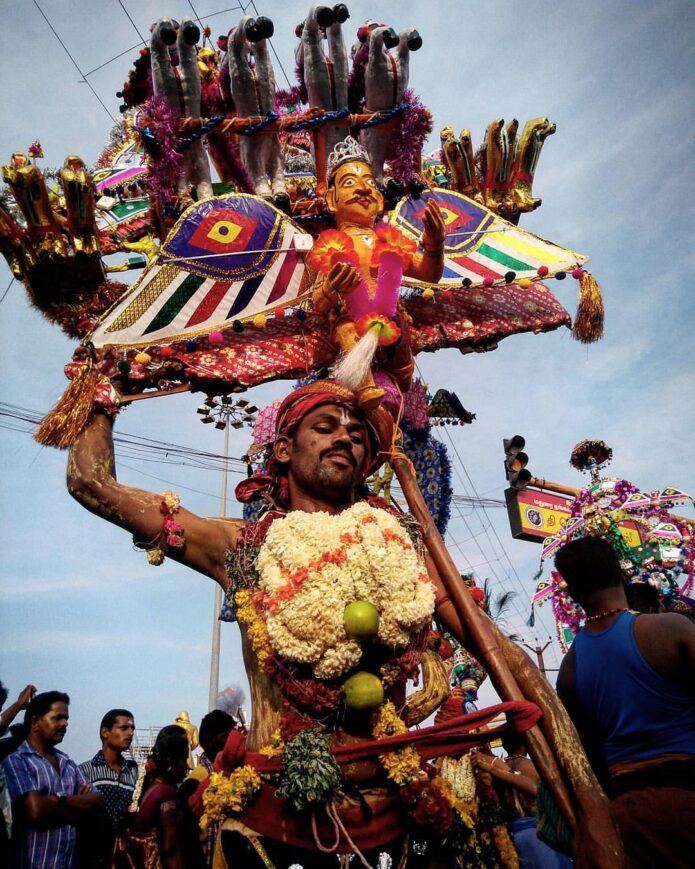
He appeared with a tap on my shoulder, cutting through the jostling crowd at Madurai’s Chithirai Festival. While chaos swirled around us, he stood calm, his face a riot of colour—deep devilish pink, adorned with glinting trinkets.

He smiled and held out a vessel. Ah, money, I thought. It paints the town red. Or, in this case, a shade of pink that refused to be ignored.

Carefully, I wrestled my wallet free, handed him a few notes. His eyes widened.

Was it the amount?
The act of giving itself?
Or my awkward attempt at wallet gymnastics in a jostling sea of people?

Surprise gave way to a grin, and suddenly—out of nowhere—he blessed me with a peacock feather.

I asked for a picture. He stood, smiled, then vanished into the festival, dancing to a new tune, swallowed by the crowd.

But his azure blue eyes lingered long after.

And a question stayed with me—Do we all wear paint to earn a living?

(at Madurai, India)

The Beat of Tradition, The Dance of Renewal

You can’t miss the beats—they travel miles, weaving through memory and the moment.

Folklore spills onto the streets of Madurai, as rural dancers take center stage—bare-chested, bells jingling, raw energy flowing. Nothing polished, nothing rehearsed. Just movement, music, and meaning.

This is Chithirai Festival.

There’s no perfect synchrony, no scripted spectacle for the screen. Yet, there’s joy. A gay abandon of culture, faith, and spontaneous rhythm. A festival that isn’t just performed—it’s felt.

A new warp and weft to an old tradition.

A treat to the senses. A soothing of the soul. A renewal—of memories, of roots, of fresh dreams taking flight.

How Travel Changes You: The Places We Carry Within

“Wherever you go becomes a part of you somehow.”

Anita Desai

Travel isn’t just about seeing new places. It’s about letting those places shape you. The streets you walk, the faces you meet, the air you breathe—it all settles into your being, often without you realizing it.

Some places leave an imprint instantly—a breathtaking view, a conversation with a stranger, a meal that lingers in memory long after the taste has faded. Others work quietly, weaving themselves into your thoughts over time, surfacing in moments of nostalgia.

And then there are places that shift something within—they change how you see the world, how you respond to life, how you define home.

A mountain trek might teach you patience. A bustling city may reveal resilience. A quiet village could remind you of simplicity. Wherever you go, something stays with you.

You don’t just visit places—you carry them forward. In memories, in perspective, in the way you tell your stories.

And in the end, perhaps the real journey is realizing that you never return as the same person who left.

It’s early in the morning. The Sun is unleashing a fresh crimson on an early sky which still seems besotted with the night gone by.

The Sun is there. Persistent yet silent. The only loud statement coming from it action : a constant rising.

People warm up to the Sun. But before people do, the birds set off a note of welcome. Loud. Joyful. Synchronous in their randomness. And as they announce their presence the giant temple gopuram of several centuries seems to nod and smile.

A new day is here. The Sun is out. It’s time to flap your wings and fly.

Fly.

(at Meenakshi Amman Temple)

The Pongal Magic


The birth of the Tamil month of ‘Thai’ occupies a special significance in my heart. For a farmer, ‘Thai’ is the tenth month in the Tamil calendar.  The arrival of ‘Thai’ is celebrated with colour, splendour, nature, gratitude and of course, good food : Pongal, we call it.  For a long while now, Pongal festivities in urban areas have been relegated to a fun bonfire, a fancy ghee dripping Pongal (the dish) and a lazy time in front of the TV.

The festival, though, has a lineage of several thousand years and the least every succeeding generation did was to mark it on the calendar. Which is fantastic. Needless to say, they celebrated in accordance of the times they lived in and added a layer of flavour.

As a kid, I recall running with a carefree energy, in farmlands of a distant dusty village cluster near Madurai in Tamil Nadu on the day of Pongal. Careful not to trample on the colourful ‘Kolams’ that dotted every doorway. Running to see garlanded cows and goats with a fresh coat of paint donning their horns.  Jostling to get a better glimpse of events at the village centre, atop the shoulders of uncles and cousins.  A uniquely rural Indian moment, if you will. Replete with painted horns matched in their colour by glaring ribbons, and blaring megaphones.  Shy women stood at the doorway of quaint houses and watched drunken men, cows, and kids like us traipse by.  The world seemed to have a spring in its step.

That is my memory of Pongal. There was magic in the air. The Pongal magic.

For long, I believed that it was ‘Thai’ that did it. For it heralded new beginnings. It meant that there was a shift in the seasons. The seeds that were sown months ago and nurtured over several months had morphed into something else. Grain. Food. It was time for a harvest. It was time for abundance.

To date, on Pongal day, a traditional Tamil rural household converges outside of their homes under the benign grandeur of the Sun God and cook. Boiling the milk and adding freshly harvested rice, even as it overflows, to signify gratitude and abundance. Or at least, that’s the story I have experienced.

‘Thai Piranthaal Vazhi Pirakkum’ they say. ‘When the month of Thai arrives, opportunities arrive’ is a loose translation.

The urbanisation of our lifestyles has drifted away from the rhythms of its rural origins. Retaining the ritual and missing the flavour. Yet, the spirit of the festival permeates the mid-January air.

Sometimes, that’s all that matter.

Here’s to a super Pongal. May there be new vistas for health, happiness and fulfilment in all our lives.  And even as they knock on our doors, may we have the prescience to hear the knock and open the doors of our soul.

May we live!

IMG_5413


A King and his kingdom

From as long as I can remember, I have wanted to stop here and stare. A long hard look, if you will. During this trip to Tirunelveli, I did it.

On the outskirts of Tirunelveli, just by the highway, within the precincts of a small town called Kayatharu, stands a lonely memorial. Lonely, because I haven’t seen many people stop here. Further and lip sealing evidence of no one stopping here : there is zilch commercial activity in the vicinity. No aerated drinks. No cigarettes. No parking area. Not even the cursory entry fee.

That doesn’t take away anything from the simple yet elegant majestic bearing of the pedestal, carrying a couple of drawn swords, a shield and a man standing atop, who seems ready to jump at you. I almost missed the ‘fish’, which is the emblem of the Pandyas, sitting pretty between the swords.

This is the memorial of a King who lived from from 1760 to 1799. Katabomman. Or rather, Veerapandiya Kattabomman. His life and heroics, like several others, would have continued to be confined to the dark ravines of apathy, fueled by a concoction of ignorance, a surfeit of history and the monochrome schema of day to day existence.

Thank God for the eponymous Tamil movie, starring Sivaji Ganesan that was released in 1959. For those that don’t know, Sivaji Ganesan was an actor who could get his molars to twitch and incisors to dance, just to bring alive a situation on screen. Well, almost. The film won a slew of awards and contains some searing screenplay delivered by a belligerent Sivaji. Some of those dialogues were part of the paraphernalia for any elocution competition in school. The film world brought a king, his kingdom and his time alive. A couple of centuries after his death. Sometimes, one act can condone many ills. This was one such.

His memorial stood right beside the highway and I wonder why I didn’t stop for all these years.   It is overcast today and the weather pleasant. So, under the aegis of a Sun who is playing truant, like a king who ceded his throne to the clouds, I enter tentatively.

IMG_20140904_100937

Within seconds, I become aware there is no one else there. Its just me. Never in my life I have had a memorial all to myself.  I walk, conjuring solemn memories of watching the movie along with dad and my brother. The majestic single pedestal, an array of plants and even a small children’s play area, all stand silent. Wonderfully maintained. Which of course, was a surprise considering the absence of commerce.

In the next few minutes, I discover that the statue has been sponsored by Sivaji himself and opened by the Congress leader and former chief minister, K.Kamaraj. Sivaji sponsoring a statue of the hero of the film, who he played in the film, would sound like the height of astute self propagation, in modern day marketing terms. But, I doubt if that era had already seen the devious depths that we have sunk to now. Who knows!

I spot a line which states clearly that this after all the place where Kattabomman was hanged by the British. So, it wasn’t just a convenient location for a statue, but a place of importance after all.

The story went, as far as I could remember, Kattabomman was a valiant king, who refused to pay taxes to the British and fought them. He had initial wins but was later done in by fellow clan, was captured and naturally, executed in front of his subjects.

A king and his kingdom. It perhaps was something to become King then. I walk around, imagining how it would have been in 1799, to be a bristling 39 year old fighting the British army, in his own backyard. My faculties that normally facilitate imagination stay unresponsive and I let them be, content with the quiet. For some reason a lump forms in my throat, as the silence grows on me. Vaguely disrupted by passing vehicles on the highway and their blaring horns.

In a bit, I spot an inscription. I read it first with some awe and then with mild amusement. I reproduce it here. It was all in bold letters. That’s one change. And the only one at that.

“Katta Bomman, a great tamizh kind had power and it was visible, tangible and real for ever. A courageous king never bowed before autocracy. A dazzling hero and dashing warrior dissipated hypocrisy.

Among perfidious traitors, Katta Bomman had moving faith, miracle generating faith, situation changing faith, displayed patriotism, pacifism, pragmatism and humanism whipped off the the then calculative, crafty cruel kingdom.

Friends, no, dastardly Ettappans only betrayed him to English royalty, never Katta Bomman deviated from fairness, justness probity and nobility. The lower he fell, the higher he bounced back with vitality, had reverberating, resilient and unshakable, devotion to Lord Muruga only.

Sowed the seed of freedom and earned the eternal fame. Sowed the seed of fortitude and hushed the needless shame. Shimmered as a radiant light and roared as a lion before the then collectors, shone martyr, alas, Katta Bomman was hanged because of the traitors. – D. Chandrasekaran. I.A.S. Chennai. “

I pulled out my white handkerchief, rubbed my eyes and started reading again. To carefully craft in stone stuff of this order, would require inordinate courage of the order that Kattabomman possessed. That was clear. But to go ahead, sign it and tag the Indian Administrative Service, took this to a different plane altogether.

I stood for ten minutes speculating how such words would have sprouted. Perhaps this was literal translation from a speech. Maybe he was high. Or was promoted. Or was going to retire. Whatever.

Right next to the big stone inscription stood a smaller one. By the same D.Chandrasekaran, I.A.S, Chennai.

IMG_20140904_100436_edit_edit


It sure looked like ‘adjectives’ were on short supply for a long time and suddenly, they went on a sale!  The granite plaque provides some relief to the sombre mood. After all, it was the memorial that I came for. I train my eyes again on the statue that is majestic and seemed modeled on Sivaji the actor. Perhaps, there were very little of reference points.

I leave quietly. Without saying a word. There was no one to say anything to of course. But Kattabomman’s heroics and the stone inscription by D.Chandrasekaran I.A.S, Chennai, leave me tongue tied that I don’t want to pursue any conversation with anybody, even if someone was around. As I leave, I turn and take a long look. As Kattabomman stands tall, looking at the buzzing traffic almost with disdain. I tell myself he is entitled to that view. The disdain, that is.

Back home, I dig up some history. And read about how Kattabomman and others fought the Polygar wars much before the first War of Independence in 1857! Each page revealed a slice of history that I had abysmal clues about. I read about ancestors, descendants, tax structures and many elements that complete the richness of the picture.  I sit there, sipping my filter Kaapi, thinking of what it must have been like to be a 39 year old king to be hung from a tree, in front of his subjects.

And then I think of D.Chandrasekaran, I.A.S, Chennai. The coffee seeps in to shake my inaction.

In one reflex action, I open my calendar on the phone and on the 16th October, I mark the death anniversary of Kattabomman. Silly, you may think. Some actions cant be explained. So, lets leave it there.