Learning & Change

The Power of Facilitation

Every now and then, there are domains and disciplines that come to the forefront and shine. Sometimes for a flicker of a brief moment and at other times for a bit longer.  Before retreating to the back offices of quiet practice or the ignominy of obsolescence and death. Facilitation, however, has been around for ages morphing with societal changes, demands and evolving constantly. There are moments in time, that are inflection points that provide opportunities never seen before. Right now, is one such. We are in the throes of life-altering changes in society that tugs at the power of facilitation to help create pathways for the future.

The future of work and life stand at a crossroad of sorts. We could go in many directions. A cursory examination of the world that we live in brings us face to face with a number of realities. Of course, there are many more. The following strikes me as dominant. (Please feel free to add and debate).

Reality # 1: Fractured and frayed

Switch on the television or flip open any newspaper. The fault lines show. Between countries, cultures, age groups. So much so, that that new fault lines appear citing the existence of a fault line in history and thus get perpetuated into the future. The consequent problem: mankind has been losing its humanity in such crevices. When we can’t have a civil conversation with one other, society has tripped on progress and fallen face down into the sand.

Reality # 2: Multiplier Effect

With the proliferation of social media and social tools, everybody has an equivalent of a global megaphone. Every minor fault line commands its own space, followers and likes. Over time, this shapes beliefs and positions that make possibilities for inclusive dialogue recede.  The tyranny of echo chambers wreck havoc.  The space and platforms for a neutral coming together disappear and walls (sometimes physical ones too) take their place.

Reality # 3: The technology conundrum

The rapid progress of technology has fundamentally altered how we went about our lives. We have ceded spaces in our lives that we treasured to technology. As the world sees more wearables, artificial intelligence, blockchain and a zillion other technologies, it takes a cursory glance to understand that the world is precariously poised. Add the possibility of singularity to that list, and we don’t know how the world will be in the not so distant future! Will we continue to be driven by the lure of profit or will we get to rise up to lift the world with technology? We don’t know.

Reality # 4: New world order

All of the above have churned the world order that we once knew. Countries that lead the charge in showing the way are now under the weather, having lost much sheen. The ‘order’ that they promoted lies amidst new questions and fresh doubts. For sure, a new world order brings with it new undertones of strife and conflict. With young populations armed with technologies that can well see beyond nations and boundaries, yet wrapped tightly in think ideologies, the future seems like a looming dark cloud.

If all of that seems far removed from the everyday rhythms of work and home, we have to remind ourselves that our lives, our homes, our places of work function within the context of these shifts. These have an indelible impact on us. What the future of work and living can be, needs fresh discussion.

The power of facilitation

Given the scenario, facilitation, as a body of work is well poised to act as a lever. There are a number of factors that will augment that argument. As a practitioner, my top three factors to bat for the power of facilitation, given where the world is, are the following.

a. The centrality of conversation and engagement

Facilitation is about the conversation, dialogue, engagement and an opportunity to shape a future that is different from the present.  Entrenched positions and echo chambers make strong walls but facilitation is best poised to be the bridge. It is not without example. The Singapore Conversations were a fantastic start. There are several other examples of public participatory decision-making processes. These need to make their move to citizen groups and communities. Without dialogue and conversation, we are broken. That is a substantive reason for facilitation.

b. The belief in the collective:

Facilitation’s working with (and on) the ‘group’ places emphasis on the ‘collective’. At best, there are solutions that emerge with everybody doing their bit to shape it. At worst, there is a recognition of the other’s position. Solutions are rooted in reality and draw strength from its foundations. It is not easy work by any stretch of imagination, but it is a platform for a beginning to be made. With effort and imagination, it evokes hope and promise.

c. A voice to all:

The belief in the collective leads to an important aspect: an opportunity to hear all voices. Sometimes just having a safe space to voice opinion is enough for a problem to sort itself out. As the gap between the haves and have-nots increases exponentially, we have a large marginalised population.  The haves and have-nots have its foundations on privilege. Privilege goes beyond economics.  It includes privileges that stem from age, technology, country of birth, the colour of skin, education, and others. Giving a voice and a safe space for every segment to share (and take responsibility for) their views is straight up the facilitation alley.

So, what must facilitators do?

The invitation for facilitation to play a crucial role emerges in both subtle and not so subtle ways.  Even as it does, there is much work for the community of practitioners from around the world to ponder, posit and practice.  Last week, I was at the Asia Conference of the International Association of Facilitators at Osaka, Japan. Conversations with fellow practitioners from around the world have had me reflecting on what must the community do. Here are some initial ideas. Let’s keep the conversation going. I remain confident that we will get somewhere.

a. Embracing technology:

The relentless march of technology has altered us as human beings and is busy working on our DNA! Amongst other things.  It has shrunk geography and tested our notions of who we are. Every profession from doctors to lawyers to taxi drivers have got to re-imagine their lives and their work. Facilitation and facilitators are no different.

To survey technologies that are emerging on the horizon and re-imagine what we could do with it for the profession is a good place to start.  This conference provided a teasing glimpse of what it can offer with hybrid sessions and a concurrent session on digital technologies that shape our world. Plus of course, an entire series on topics ranging from AI to the future of facilitation in a tech-enabled world.

We need to do more of this. We need more active experiments than the ones that shrink geography and time. Although, they are a great start. We need to get uncomfortable and weave our work around the technology that is becoming available.

b. Inclusive expansion:

As the profession expands and holds increasing allure, people from different walks of life are attracted to it. I have had conversations with a wide array of people over the last few weeks. People who have embraced facilitation with gusto. From chefs to chief executives, trainers to authors to social workers. All bringing in their own backgrounds and spice to the space. This perhaps is a good time to stay inclusive without getting lost in ‘definitions’ of what is (and isn’t) facilitation! We have a job to do. So what if facilitation goes by a different name or wears different overalls.

c. The work within:

As the profession advances, every facilitator needs to do deep work on self. That goes beyond facilitation tools. Facilitation, as a way of life, implies that it is a way of thinking and living. To elevate the profession requires facilitators to go deeper within. Becoming more aware of ‘the shadow’ self and its consequences are important. Here is a piece I had written earlier written whilst engaging with a similar thought stream.

Every time we reduce the profession to a bagful of tricks and tools, we rip a part of potential and toss it into a vacuous space.

The power of facilitation is more rooted in the outcomes that it can produce.  One way to advance the cause is to help larger groups of people experience facilitation in the context of the real world challenges. That implies work that goes beyond organisational domains. The work at the level of community, smaller cohorts working on challenges that confront everyday life can be challenging. To say the least. From traffic to pollution to plastic to even fostering peace in the building you live in. These are opportunities to hold space for a bunch of people to discuss and debate.

However, harnessing the power of facilitation that resides in everyone requires one crucial step.  Which is as simple as stepping forward with courage and stay open to all that emerges in the group.  There is raw power in quiet courage. Try.


Weaving culture through stories

Inanimate objects have a way of jumping to life when a story is woven around them. It is simple, isn’t it? Context determines the attention that we give to an object. When we get to know more about the context, the object jumps to life. There is much power in stories. In fact, paying attention to stories and culture will help us live rich lives.

Sample this.

The other day, my mom bought a saree and gave it an affectionate caress and whilst marveling its intricate pattern said, “that’s 41 years of experience that’s got this out”.  Intrigue got the better of me and I soon found this card with her.  This card came with the saree, she said. Whoever had thought about it, has a brilliant mind.

Truth be told, my appreciation of sarees is next to zero and the role often is limited to being the man in tow, when a saree is being bought. The card helps me view the saree as a product of human effort now. An object that I can relate to much better.

The power in stories.

That there is power in stories is a given. In the above instance, the saree, an inanimate object, came alive to me because of the added context. A human being with all life experiences is a carrier of stories. A power-packed repository, if you will. So power packed that tapping into them can completely alter the perception about the person. Often times, bringing alive our own biases and themes in our mind.

Lincoln, once famously said, “I don’t like that man. I must get to know him better”.

Stories and conversation.

If stories are at the heart of it all, it is conversations that bring them alive. In whichever form or shape, it is conversations that are active carriers of stories. In the ‘everything-needs-to-be-measured-binary-digital-transactional-world’, conversations have been reduced to transactions. The richness that lies nestled within us evaporates like the hope expecting parents had for a stillborn child.

Edgar Schein, who I have written about earlier, through Humble Inquiry and Humble Consulting espouse practical ways of empathy and connection.  A connect that has curiosity, discovery, and conversation as basic tenets to build on.

As I interact and work with leaders across the board and around the world, there is one thing that emerges ever so clear to me. The ability to create the climate for conversations to thrive is a competence modern day leaders must work on. There is much work that needs to be done in this space. Therein lies the space for us, our stories and our conversations.

Is there anything that we can do in our daily lives to be able to foster this. A bunch of things stand out for me. Here are two. These need to be expanded on.

1. Take on less: Keeping empty spaces in the calendar is, in the modern times, seen as inefficient planning. For all those who run a “return on investment” calculation on conversations: Returns that come from deep conversations are non-linear, long lasting and disproportionate in the long term. To go deep is necessary to expand.

2. Deep conversations have a lot more to do with questions, deep listening, and curiosity than sharing. Not that sharing is not important. Just that it becomes a natural part of evolving conversation.

Here is a fantastic blogpost that I discovered. Titled 52 Questions to Bring You Closer Together it is a keeper. I love the methodology behind the questions as much as the questions themselves, for it has lead me to work on and add on to the list.

Here is another story

Come September, along with my friend Stephen Berkeley,  I am running a one day workshop titled “Building Bridges Breaking Walls, One Story at a time” in Osaka.  At the Asia Conference of the International Association of Facilitators, we hope to stir some conversation.  Just as we did last year in Seoul, South Korea.  The workshop last year got us some feedback that flattered us beyond our imagination. Sitting at the lobby of the hotel in Seoul, still chuffed by the kind words that participants had for us, we promised ourselves last year that we would think through and prompted us to think and offer a more holistic offering.  That’s exactly what we have put together for this time.

For starters, we have gotten a lot more committed to the idea of encouraging a greater coming together. We intend continuing this conversation well into the future.  Through portals, platforms and one conversation at a time. We are aware that the role of leaders in creating a space for genuine deep conversation is something that we seek to explore even more.

That this conversation must develop is something that we are convinced of.  In organisations, communities, civil society and every other place, people have to be able to sit down and talk to each other. And hear each other out. The times we live in has seen building walls of all kinds catching the fancy of the world. But if we were to fancy our chance of passing the planet on to generations that come, we have to invest in our each other. Through our stories!

We look forward to your support.  We will keep try and aggregate our thoughts under the #story2story hashtag. Please dive into the conversation. In the meanwhile, listen to someone’s story. You never know what it can do to you. Or to them.

Features Dont Sell

It was in an animated conversation with a dear friend a quote came up. He said, quoting the Marathi playwright Mahesh Elkunchwar, as he spoke of writing, “the experience is always bigger than the writing”. His words have stayed with me ever since. Especially so, when I sit down to write and wanted to describe an experience. Last week, in the middle of a conversation on Digital change, I was so reminded of this again. As a fine bunch of tech colleagues focused much on the technology that they were getting deployed. I call it ‘Feature Focus’. And features don’t sell!

Helping organisations navigate digital change processes brings me front and centre of how much ‘feature focus’ dominates conversations. The top three conversation dominators in my experience have been like the following

  1. This product can do ‘X’ and then it can do ‘y’.
  2. If users face a problem then they can click button Q and hit enter and they will get a view of the help centre and raise a ticket..
  3. It runs on ‘XYZ platform with ABC technology that has been adopted by 85% of Fortune 500 firms.

You get the drift.

Products rarely succeed (or fail) solely by virtue of the features within. What a product can do, in this case, a technology, is also dependent on the context of the environment in question.  To have passionate conversations without the end user’s context in the room often proves to be the digital change efforts undoing. Falling in love with our areas of expertise ( geeks falling in love with technology, facilitators obsessed with their ‘performance’ etc). So much so that focus remains trained on the features within, forgetting that the technology is just a means to a larger business goal.

Reflections on my experience and conversations with fellow change practitioners lead me to three thought trails. To many, am restating the obvious. But I have been through serial surprises over the last few weeks on how blinding the obvious is, that it is completely missed.

1. Features are contextual

Features are not absolutes. They are always a function of the context in which they are deployed in. A 5G phone may be fantastic by itself. In a geography where technology is limited to 3G phones, 5G has no relevance! While this may occur to you as a rather inane example, it illustrates the point. Imagine sitting in meetings where the virtues of such ‘5G technology’ are extolled.

Business rhythms, organisational cycles, tendencies for change and the need for change all matter much. When these are drowned in the noise of features, the change effort goes nowhere. It, in fact, is a giveaway for how the change effort will unravel!

2. Tech adoption is not a function of features

Features are important. So is context. Yes. There are more elements that determine adoption. To me, a key aspect is demystifying the technology element and weaving it into daily work.  The time lag between the start of the change effort and when change hits every individual is a big factor too. The essence, however, is to focus on ‘work’ and how work shifts for every employee. Features and glory of the technology in itself have to be experienced on the ground, more because of the shift in work. There is no glory in them being on Powerpoint slides.

3. Communication is not the fancy poster in the hallway

There is a communication 101 lesson that I recall. Communication is always a function of how it is received. Numerous change efforts have fancy posters, screensavers, games, and contests. To my mind, communication is a ‘moment of truth’ thing. It happens at places closest where work gets done. It often happens between people on the ground. At least the communication that determines the sustenance and success of the change happens there. That’s why keeping the ear to the ground trumps hanging from the nail in a hallway in the ivory tower.

Designing effective change requires courage. It seeks a huge degree of going beyond the immediate and seeing the larger picture. It requires a raw courage to thrive in the ambiguous gray of change.  Above all, it mandates going beyond a feature focus. That often means going past a stated requirement and find a new plane.  For a change practitioner, that requires comfort in crowing heroes of change and staying in the shadows. Borrowing from my friend’s quote of Mahesh Elkunchwar, the change that is sought is more important than the skills it takes to orchestrate it!


Seven Characteristics of Awesome Facilitators

Any domain attracts attention, interest and following in its ascendency. Facilitation or ‘process facilitation’ is entering that phase now. This interest fueled by some reflection prompts me to write about the characteristics that I have observed in facilitators from around the world who continue to inspire me. It was a random reflective scrawl that morphed into “Seven Characteristics of Awesome Facilitators”.

As the world continues to get fragmented by narrow walls and as existing modes of engineering change creak more than normal, facilitation is more than merely ‘sought after’. Over the last few years, I have seen this in action in the first person. Conferences and events like the International Association of Facilitators‘ recently concluded Asia and India conferences are freshly minted in memory. Both conferences were well crafted with meticulous care and depth. Both organising teams deserved the heaps of praise and applause they got. What couldn’t be missed, was the enormous interest and attention that facilitation as a domain is drawing. I met people from diverse industries, geographies, professions, interest groups etc, all seeking to know and learn more.

Even as I experienced top quality facilitation, I recalled some of the best facilitators in action. When I was amongst those being facilitated. Post the conferences, I was scribbling some notes about what stood out in the best of my experience. ( I continue to hear first-person accounts of great facilitation from the world over. Facilitators whose mastery I hope to experience someday). This post holds together seven aspects that are common in facilitators who I have experienced and admire.  Of course, this is my list filled with my biases and notions of what construes to be the best.  If you are a facilitator, I would encourage you to reflect, have a conversation and evolve your own list as well. For now, this is my list: Seven Characteristics of Awesome Facilitators.

1. Self Awareness:

Top notch facilitators realise that the journey within them is the real journey. They are well aware of their own mental models, preferences. and biases. They are keenly aware of where their true self-worth comes from. Often times, it comes from who they are and not from being a recipient of an award, certification, the position they hold in a hierarchy or even the kind of work they do. They are in the perpetual beta mode!

This is invaluable in my opinion, for they approach the position of a ‘facilitator’  with a degree of respect and an inclusive embrace. They are simple people with no airs. Not for them any ‘super manesque’ infallibility and Midas touches that sprinkle magic solutions.  They don’t hanker for power and have any need to holler into a microphone. Wearing their vulnerability on their sleeve, they walk amongst the rest of us. Like the rest of us! This makes them endearing. There is something in them that draws people seeking out a conversation.


2. It is never about themselves:

That is a straight one, isn’t it? To be able to keep the light shining on the group that entrusts itself with a facilitator is an important ask. Great facilitators do this with effortless ease. An important distinction that I became aware of is the temptation to take the stage, in the garb of ‘shining the light on others’!  Great facilitators ensure that the whole space belongs to the group and the community. They are part of the milieu.

‘Holding the space’ is a phrase that permeates several facilitator conversations. This piece has some good insights and it lists eight important tips to hold space for others. Amongst them, are “Don’t take their power away”, “Keep your own ego out of it”, “Give guidance and help with humility and thoughtfulness”.

Those are potholes that I catch myself falling often into. These jarred edges have sticky spikes.

3. Here and Now:

Presence and complete immersion with the group in front of them get great facilitators in a flow. Close your eyes and imagine an ‘ego-less’ state, where it’s not about showcasing oneself or the tools or the competence. A state where the sole focus of the group moving forward. It is a powerful idea that escapes capturing in its full essence here.

Just being present to the stated and unstated needs of the people in front can mean on the spot improvisation of well laid out plans. Sometimes, junking plans and taking different routes.  It didn’t matter if hours of preparation went into the design of a process. I have seen great facilitators drop it as though they had never thought about it because the ‘group has a different need’. To hold oneself at the service of the group is a mindset that switches on presence, in my opinion.

4. Tools are tools:

This is amongst my favourites. The best amongst us treat tools as mere tools. There is a respect for what the tools can help accomplish and a consequent need to be acquainted with these. But true mastery is not in replicating tools and processes. True mastery is in combining, shaping, mixing, axing of tools, processes, and ideas with imagination. Tools must always bow at the altar of outcomes that a group needs.

Heres a tip that I learned some time ago: Learning up a tool is good.  But true learning is when you have learned to go beyond the tool or the process. The quest for the new and shiny tools have sent several of us scurrying to far corners & writing down every word that an expert says. My experience of having practiced it in my early years gets me to wish I had realised how pointless an exercise it is. Unless accompanied by adaptation and reflection lead practice, it is a big house with no residents.

5. Curiosity:

The benefits that curiosity laden inquiry brings are often missed. Genuine curiosity and a spirit of exploration can lead to results that alter horizons.  It is in the nature of what Edgar Shein describes in Humble Inquiry. It helps unravel what groups are confronted with and the issues beneath the surface.

I have been in groups where some ace facilitators tease groups with a curious inquiry. To go beyond what is stated, to ask how to seek why to question if a broader ‘what’ is possible all means to challenge status quo. It is in such challenges that groups move forward beyond their immediate stated needs. Curiosity is a superb lubricant to move a conversation into areas that it hasn’t been to.

6. Working on themselves:

Perhaps the biggest learning that I have had from expert facilitators is their investment in themselves.  It is this aspect that gives them renewal. Investment in areas of skills and processes is eclipsed often by a conscious commitment to discover and work on the self.

The meticulous commitment to reflect, dialogue, debate and learn as a collective is a not so secret weapon in the arsenal of true champions. But it is something that can so easily missed in the quest for business or in the comfort of easy ‘success’. Lasting long term comes from the commitment a facilitator makes to the craft of facilitation.

7. Givers:

I kept this for the last because it is special.  It is when you truly give, that you are worth receiving.  I have approached members of the community with so much ease that it has made my inhibitions melt. Irrespective of their schedules and stature, people who inspire have gone beyond their brief to help.

People give their time to bounce off ideas, talk,  debate, often times for little or no consideration at all. This lack of seeking ‘whats in it for me’, sets them apart. To them, ‘to give’ is consideration enough.

So those are my seven from a long list I drew up thinking of the people who I have experienced first-hand several times. 

The Song Of A Neo-Generalist

When you have been humming a favourite tune for a while and then to have it sung to you by the singer who sung it in the first place, is rare. To put it mildly. “The Neo-Generalist” has several tunes that have stayed with me.  And then, Kenneth Mikkelsen one of its authors came to Mumbai.  We have exchanged notes and followed each other’s work for a while now. So to catch up with an original neo-generalist and hear the context behind the points of views, was fascinating.

I read “The Neo-Generalist” co-written by Kenneth Mikkelsen and Richard Martin months ago. I was then in the eye of a personal change storm myself. Busy trading cartons of corporate experience for a flimsy backpack-wielding walk across the big wide world. The first tentative steps towards discovering what it meant to be ‘boundaryless’ were fulfilling and occasionally overwhelming.

‘The Neo-Generalist’ had held me together as I read stories of several others who had gone on this path before. Clutching a bunch of interests, sharing a worldview that was broad and most importantly, acting on their beliefs. The book fascinated me and has served as ready reckoner many times since. ( Richard and Kenneth and share their thoughts and work and do take a moment or two to follow their work).

The book tangibalised my meandering ways. Wrapped in the assurance that emerged from stories of different people, curated with care and laid out with brilliance, my ways found my feet. It taught me the importance of ‘serial mastery’. The importance of hybridisation in a world that favours labels and specialists. To specialise multiple times and to see the vastness of potential that resides within every person was energising beyond liberating.

Several aspects of the book have kept me unwavering company.  Am going to state two here. One, an image. Another, a phrase that morphed into a couplet. The image is that of an ‘infinite loop’. 

Pic from Hackernoon.com

An infinite loop of seamless movement through life that made the pathways credible. The seamless movement offering much energy and life to careers and life, that have become limited by labels, functions and designations. Through a rich array of examples, powerful metaphors, and flow, the richness of what it means to be a ‘neo-generalist’ emerged.

Now for the couplet.  “Jack of all trades and master of none” is pretty well known. Often spoken with an undertone of negativitiy and dismissal.  This morphing into a couple was unknown to me. The couple was “Jack of all trades, master of none, though oftentimes better than master of one”. Pretty neat. I thought. 

As much it was personal, there were other aspects too.  After reading and debating with friends, mentors, colleagues and other experts across the board, it was becoming clear that the ‘Future of Work and learning’ was going to be quite different than our present ways.  It was obvious that broad perspectives coupled with possibilities of dialogue and convergence were important. Linear thinking and limited ways has brought frayed success and deep residual issues.  Polymathic ways of thinking and living needed a shot in the arm and the book was precisely the remedy the doctor ordered.

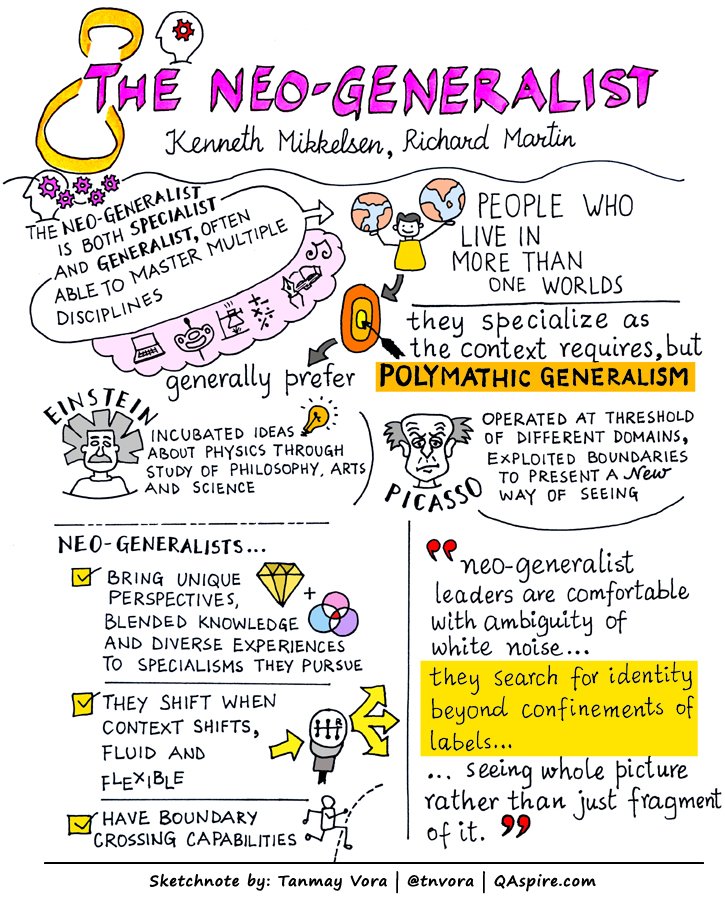
That’s about the book. My good friend Tanmay’s sketch note in should give you a drone’s eye-view of the book. ( Read his blogpost here).


Neo-Generalist Sketch Note

It is one thing to read a book and it is another to spend a few hours with the author. It is quite something else to do both! We shot the breeze, exchanging ideas and experiences from the roads that we have trodden. Similar roads and different pathways and here we were, talking to each other.  Exploring the neo-generalist in each other and relishing the intensity of our current multi-disciplinarian pursuits.

Cut to Tata Institute of Social Sciences ( TISS ). Heres some context.

Amongst the things I do, I am a visiting faculty at TISS and teach Advanced Learning & Development to a bunch of enthusiastic students who are pursuing their masters in Human Resources.  We are trying our hand at mirroring the modern world with its tools and tackles in the classroom. It has challenged our collective imagination but the class is doing good.

The class has its own slack channel where there is a continuous conversation that’s on. A fledgling hashtag ( #Tisslabs ) on twitter, the class is often punctuated by bursts of hard reflection and active conversation online. Much of it is under the hood. We recognise that we are just about warming up and have all the excitement to go a long distance. If you have a point or two about what we should be doing in class, or if you are interested to participate,  please do give us a shout.

So, when I proposed the idea of interacting with Kenneth and learning from conversations with him, the class took it to the next level. They proposed that the stage must be that of the Centre of Social and Organisational Leadership ( C SOL ). A body that is working to advance global and local thinking and practice of Organisation Development, Change and Leadership. Working with Prof. Vijayakumar, Chair and Professor at C SOL, the class made an interaction possible.

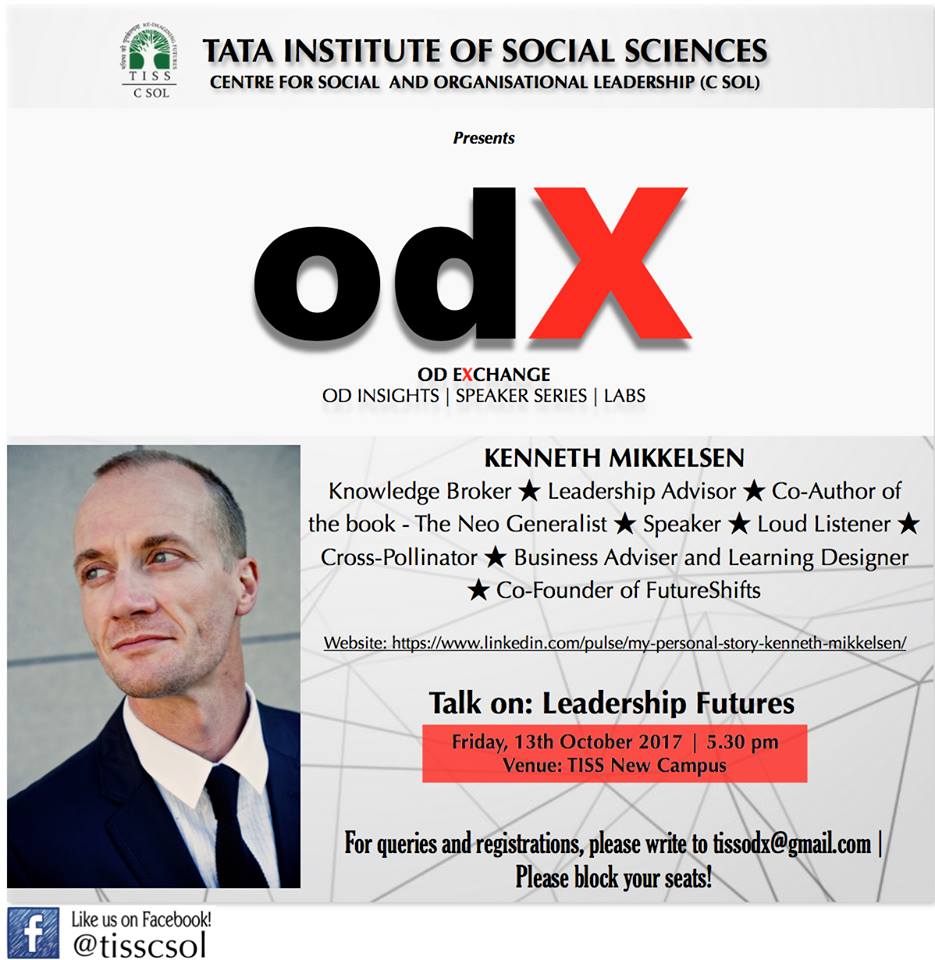
odX invite - TISS - Leadership futures

The evening was special. Kenneth drew from the book, his experiences, his India story, research, anecdotes from around the world and such else. Students, professors, practitioners, research scholars were in the audience. The thoughts elicited discussions, questions, and dialogue. Much to the curiosity and surprise of the chai vendor for people forgot about a chai break!

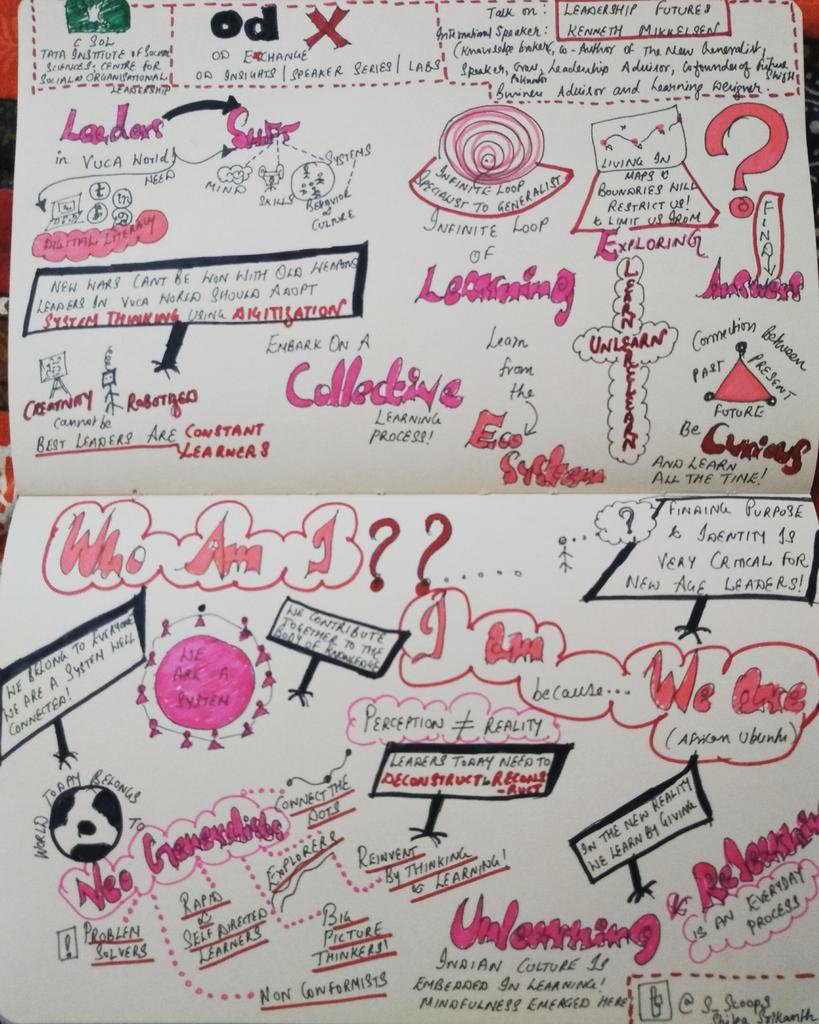
Heres a sketch note by Shilpa Srikanth, that captures the conversation.

Sketch Note by Shilpa Srkanth

The neo-generalist is perhaps ahead of its time said Kenneth in his talk. I think the neo-generalists have always been there. They are the ones who didn’t take the beaten paths but had it in them to weave a different warp and weft.  As the sounds of predictability, precision, clarity and definitiveness grows in the modern world, the music that a neo-generalist can create is of a different order. As we discovered with Kenneth.

Hearing him speak took me back to the book. The book is interlaced with some awesome quotes. One of them that I seek to mention here is this: “Nothing changed, except the point of view – which changed everything” – Nick Sousanis, Unflattering.  A new-generalist view of the world will change the way we approach ourselves. And our work too. That is precisely what the future needs.

Building Bridges & Breaking Walls. One Story at a time.

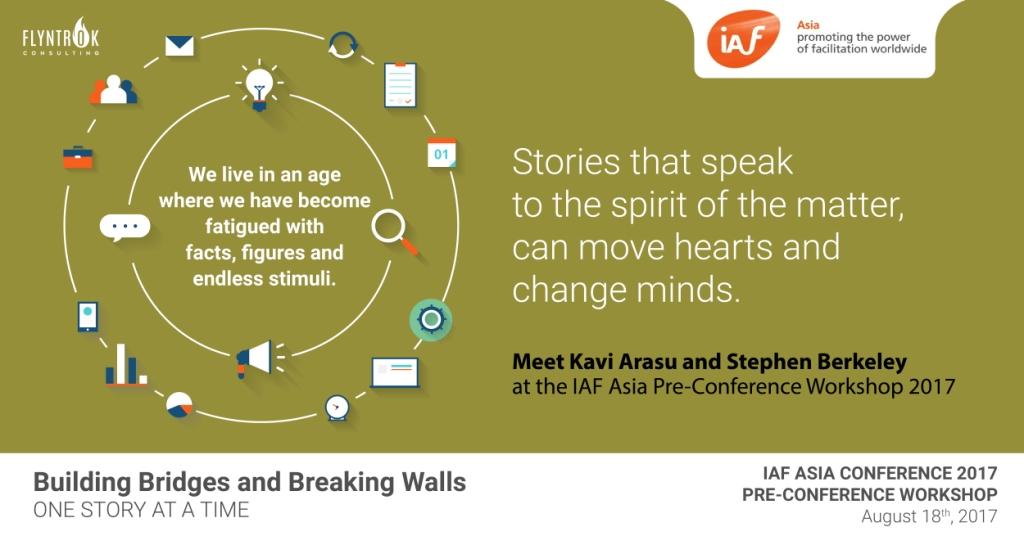
August will be the curtain raiser month of sorts for me. I along with Stephen Berkeley will be working with interested and interesting participants at a one day Pre-Conference Workshop at the International Association of Facilitators‘ Asia Conference and exploring the power of stories in bridging the world.  The IAF Asia Conference 2017 is happening in Seoul in August 2017.   What better of a setting for a topic like  “Building Bridges and Breaking Walls. One Story at a time”! I think it fit to build context the IAF Asia Conference 2017 Seoul Pre Conference Workshop titled: “Building Bridges and Breaking Walls, One Story at a time” through a series of posts here.  This then becomes a space for conversation and dialogue on the power of stories.

IAF Asia Conference 2017 Seoul Pre Conference Workshop

IAF Asia Conference 2017 Seoul Pre Conference Workshop “Building Bridges and Breaking Walls, One Story at a time”

Stephen and I have been bouncing ideas off each other for a while now on a variety of topics. From Systems Thinking to organisational structures. The power of local communities.  Change processes in organisations. Process facilitation. And a variety of other topics. Even as the conversation evolved, we realised that we were very different individuals with a different take on most topics that we discussed. United only by a strong idea of staying engaged with pursuits that are meaningful.

Even as we discovered more of our worlds we saw how similar they were, despite having completely different contexts. Set in different times, time zones. As much as we had our differences, we were united in our openness to share and exchange stories from our respective worlds. Over time this became to be the fulcrum of our friendship. It was but obvious that the willingness to listen to and share each other’s stories bridged gaps.

One day as we sat on a rock after a small hike, a little idea came upon us.  We perhaps could work with larger groups to explore the power of telling and listening to each other’s stories too. Perhaps, we thought, that would bridge larger gaps in the world that surfaced in our conversations many times over. We ran a few experiments, ran the idea past friends and colleagues.  The idea seemed to have currency. It kept growing. We wondered why and came up with our own set of hypotheses.  The set is only growing.  Here are the five that I connect to the most.

a. There are too many wedges in the world we live in. Cultural. Political. Generational. Economic. The trouble is that those wedges are seeming to appear like irrevocable divides. Walls of steel, so to speak!

b. The world has newer tools and additional power to communicate in the modern times. Sadly these tools find increasing use in amplification of these divides.

c. Listening to each other’s stories helps understand points of views and helps explore our world views.  Examining these with an open mind brings greater awareness and possible shifts. Stories are integral to these shifts.

d. Shaping and shifting of the narratives and stories, both inside our minds and in the world around us will determine the shape of the world our kids will inherit

e. When whole systems engage in deep listening to each other new realities emerge for the whole system that can be infectious. Systemic change will bring about lasting impact for the system and its constituents.

For now :

Armed with the first-hand experience of leading change initiatives in large organisations and communities, we seek to further the conversation to see what more is possible. Would it be a new set of skills and abilities? Perhaps a deeper understanding of the process of change? Maybe a clearer way to harness what emerges from a story? We don’t know for sure what else the questions are. And thus begins this journey.

While it is a personal journey to take the ‘story of the story’ to newer areas, new bridges will perhaps get built. In the telling and retelling of the stories, new ways and connections have greater chances of emerging. All of us who jump into participate are going to be better off depending on how much we are willing to give and take.  Seoul in August ’17 will be the first pit stop. And we intend continuing the conversation, armed with whatever comes from the previous pit stops. This space will curate the journey and will continue to evolve.

This is work in progress. And this is far from complete. Wonder if we will all ever be. So, do jump into the conversation. Spread the word. Let’s see what stories emerge.

Of Curiosity and exploration

A few weeks ago, I was tasked with curating Founding Fuel’s newsletter. I wrote there, “As new walls are coming up the world over, history points in the direction of bringing in diverse ideas and people to collaborate for new frontiers to get established.”

Diversity of thought, opinion and domains have been factors that I have been exposed on a regular basis over the last year. If there was one element that is central to this exposure, that would be curiosity. It is curiosity that has been central to all conversations that I have immensely enjoyed.  More on curiosity, later.  For now, allow me to let you rest you with this Zulu phrase that I spotted in this brilliant piece.

To drift into another area now. What does depth in a subject mean? The last year or so has been a pointer to have my own answer to this question has evolved. ‘Depth’ in a topic/domain is no longer a lonely chair in a unitary pipe at the bottom of an ocean of knowledge, but rather is a noisy couch at the intersections of disciplines.  Depth in a domain has now come to signify a deep knowledge and understanding yet a sense of not being bound by that domain alone. You know it well enough to think of how it relates and connects to other aspects around.

Depth in a domain, therefore, has leaned more towards the ‘connection’ and in the ‘relating’ to other domains and disciplines. You need to go beyond a domain to see how it relates to other domains. Needless to say, to go beyond one’s core domain and see how it relates to other domains requires a depth that is greater and much-varied depth.

Where better to see the interplay of disciplines in an airport and airplanes. They bring alive some of the best and worst behaviour in people. Some of my best travels have been with total strangers as co-passengers. People who are innately curious about my domains of interest and have had no hesitation in sharing theirs. I have had some fantastic conversation with doctors, scientists, traders and even a football coach. These have been people who did not hesitate to share or ask pointed questions on my work.

By the time the plane touched down at a new airport, I knew a thing or two about what it meant to be a doctor or a football coach. But more importantly, I knew a thing or two that I had to look up, reflect and dive deep into my own areas of work, based on our conversation in air.  These explorations have lead me to something else, triggering an infinite loop of search and discovery.

The other thing that I have now concluded is this: people are nice. Generally speaking! If you share a perspective, expose a vulnerable sleeve and are prepared to lend a patient ear, people share. There are the odd ones that are exceptions. But they are really the odd ones and yes, they are exceptions!

One more thing. I have met some true masters. Their mastery of their own craft that was belied by a simple demeanour but superseded by an innate infinite curiosity to explore other areas. It is this curiosity that held our conversations together. It is this curiosity that I hope to have by my side. To me, it is this curiosity that will surface the depths of what’s possible and what needs to be explored.

That brings me back to curiosity.

There is a ton of research that points to how relevant and important curiosity is to learning and growth.  There are pointers to how you could build curiosity in kids as well. I find it very easy to just ask questions and stay fully present to answers. It is as simple as that! And it is the best way to find others and in their answers find more of yourself.


Lasting Impressions

There are facilitators and facilitators. Not just the ones that have gone on a podium and facilitated a workshop, but the numerous other bosses, leaders, colleagues, partners and such else. When I look back and think of people who have left a mark on me and the teams that I was a part of, a couple of their attributes becomes apparent. First, lasting impressions have nothing to do with ‘striving to impress’. In fact, it can be counter-productive.  The second is this : It is futile to think of ‘control’ of a group. Especially so, using a position of a ‘boss’ or even worse, as a ‘facilitator’.

It is International Facilitation Week and here are some reflections on lasting impressions that a few global facilitators have left. I view both of these, ‘striving to impress’ and ‘seeking to control’ as memes that can interfere with success.

IAF #FacWeek

To try and engage in flamboyant (and ‘new’ ) action catches attention. The clamour for new ‘processes’ explains it well. But facilitation is more than ‘process’ and is very often diminished by a striving to impress. Some facilitators are natural on the stage. Others wear a new jacket. Dropping their voice, playing with intonation etc, cracking jokes to fill the silence, throwing in new tools etc. These by themselves aren’t bad. Just that, they stand out when someone who is not a natural at all these, attempts to weave it as part of a routine! The routine of trying to impress. Groups easily spot the incongruity between who the person is and the act the person is putting on.

To be comfortable with who I am as a person, with my biases and predispositions, is important for a facilitator. It makes a huge difference. Self-awareness and constant working on the self is perhaps one of the most underrated aspects of building a practice around facilitation. When we are comfortable with who we are, we don’t strive to ‘impress’! Inauthenticity is transparent.

The other meme that I frequently encounter is that of ‘control’.

Control for a facilitator has many inviting dimensions. Control over the participants is a non-starter in most cases. Unless you are talking of kids of yesteryears! With adults in the room, the best that can be done is to invite and create opportunities for them to voluntarily co-create and stay engaged.  Right from framing collective norms that help the group set the rules to working on arriving at cogent solutions.

Control over every minute of what will happen in a facilitated session is stuff that I have attempted early in my career. To disastrous results.   As a facilitator of a meeting or a program, of course, a facilitator needs to have a broad plan of action of how the day will flow. But it is just a broad plan. To be present to the needs of the group, and to stay flexible and ready in the moment to change course is important. Taking into account the energy of the group and its participants.

Facilitation at its very core transcends both of these memes. At its very core facilitation is less about the facilitator and more about the group. Less about the process that is ‘done to’ the group and more about what the group does with whatever that comes their way.

For a facilitator, there is great merit in standing away from the limelight and holding the space for the group to figure out a few solutions.  Some facilitators view that as an abdication. To me, that is hardly the case. In fact, that reinforces belief in the full potential of the group. In any case,a facilitative leader doesn’t see his position as a ‘throne’ to abdicate from. He or she sees his/her role as just another constituent member of a community., shifts the onus to the group, while the facilitator is also present. More channelising the conversation and ‘holding the space’ for it to emerge from the dark ridges of random argument to the possibilities the meaningful dialogue present.

Going past these two memes helps a facilitator to shift the onus to the group. The facilitator takes on another role. A higher order one. The one for channelising the conversation and ‘holding the space’ for new insights to emerge from the dark ridges of random conversation.  The possibilities that meaningful dialogue presents are tremendous.

The most effective facilitators that I have worked with blend into the group, yet stand apart. They listen to the conversations in the group and have little of solutions to offer to the topic of discussion. Yet, at the end of the conversation, people walk out with far more that mere solutions. They have new energy, meaning and purpose. For the energies from each one of them stands well woven into the solution.

Facilitation is a lot like sailing. The ace sailor navigates by the stars but adjusts the sails to catch the wind.  To act decisively and engage in reflecting on all the action.  To stay curious yet quiet. To seek people and conversation by listening with active intent. All these creates the space for success showing up at opportune moments.

The next time you are called in to facilitate, relax. Look at the field and catch the wind. The answers are blowing in the wind. Catch it. Its in fashion these days. Besides, it leaves lasting impressions!


Strategy. Alive and real!

The topic of building strategy that is alive and real, that is not an indulgent document that is a result of an annual ritual is a topic that stays on the minds of many. Be they entrepreneurs, social leaders, corporate executives and anyone with a set of objectives to move forward with. More on that in just a bit.

First, introducing Kimberly.

How do you introduce someone who has been making a difference to a growing community in a rather quiet, matter-of-fact manner? In a world where the decibel levels of raw marketing are perpetually set to ‘maximum’ examples of people who let their work do the talking is becoming rarer, Kimberly Bain and her work stand out. So when the opportunity of working closely with Kimberly Bain came up, we at the India Chapter of the International Association of Facilitators, we were delighted. To put it mildly!

Kimberly is an expert facilitator and works with both small and large groups ( 5 to 500) to help them reach consensus and achieve a common purpose amongst other things. She has a vast portfolio of experience, facilitating community groups, professional, volunteers, academics, hospitals, medical professionals, government departments and stakeholder groups. Her style is inclusive and works on building consensus. Something that our fractured times so need. Her innovative approach to strategic planning, expert conflict resolution techniques combined with her varied facilitation toolkit get her to work with varied groups across the world.

Her recent book the “The Reflective Practitioner : becoming a reflective ethical facilitator” made it to to the Amazon best sellers list is fast becoming a seminal resource for facilitators all around the world.

My conversations with her have been diverse, as she gets to do a bit of exploration of India.  Her thinking on strategy and her approach to conflict resolution perked my ear.  Read on. Am sure you will learn a thing or two.

Me : What are the components of strategy making and where do you see organisations / leaders struggle with?
Kimberly : Strategic planning is about focusing for success, this requires careful and insightful planning on how to develop the Strategy, who to involve, the processes to ensure best thinking is included and all options and opportunities are considered. Many thought leaders know that the Strategic Planning Process is almost more important that the resulting Plan itself. While most leaders understand this, they do not always have the background and information needed to design a planning process that meets their needs, the needs of the organization and the needs of the people who will be executing the Strategy. Utilizing the art and science of facilitation can provide the guidance needed to custom design a Strategic Plan that is based on collaboration to produce sustainable outcomes, therefore building the buy-in needed within the organization to move employees from thinking to action and from paper to implementation.

Me : How does facilitative style of leading people augment a business leader’s skillset? What must a leader do to bolster that?
Kimberly : In order to develop and utilize an effective facilitative leadership style, leaders need to understand behavioural analysis, group decision-making processes, individual communications styles and conflict handling styles. In order to bolster individual facilitative leadership we need to learn how to make the job of those who we lead “easier”, by facilitating their work, their relationships and expand their ability to innovate.

Strategy - Alive and RealMe :  A degree of conflict is inherently needed for progress and growth. Now is this true, from your experience? How do leaders get to foster this?
Kimberly : That depends how you define “conflict”. Creating an environment where individuals can voice and explore different opinions, alternative points of view and unconventional thinking does help groups and organizations grow and progress. But “conflict” often is a result of poor communication, negative assumptions of intent and lack of trust.

Me:  Inclusion (or the lack of it) can break the best of strategy. In a world where young people across the world want to participate in the decision making process and want to have their voice heard, what is the next frontier of strategy making?
Kimberly : Absolutely, engagement and inclusion are a central theme for effective strategic planning exercises. Not only is this necessary for social enterprises and community-based strategic planning, but it is just as important for profit-based organizations to include staff, shareholders, stakeholders, partners and customers in their Strategic Planning. This ensures all views are considered, all options are explored, and most importantly, champions and cheerleaders are created throughout the organization, making implementation smoother and more effective. When people feel like they have been involved in the decision, they will not only support it, but they will advocate for it!

Me :  Could you share an experience in helping a team with making of a strategy that has stayed with you.
Kimberly : I worked with a Government Agency in Canada. This was a new Agency that was created to help coordinate Cancer Control efforts across Canada. The Agency had no actual authority over health departments across the country, so they needed to develop a Strategy that would position them as the hosting agency convening crucial conversations to help coordinate effort and increase impact. Canada has 13 different provincial health departments and I assisted the Agency to design a Strategic Planning process that brought together each province, the various national and provincial cancer advocacy groups, agencies and thought-leading clinicians. The process took 9 months and was extremely successful. The 5 year resulting Strategic Plan was so effective that the Agency received a second 5 year mandate and is considered the main reason that cancer mortality rates have decreased across the country!

Kimberly is leading a two day session on Strategy Alive in Mumbai on the 26th, 27th of August. An opportunity for business leaders and facilitators to come together and explore. More details and FAQs are there on the Facebook events page as well. Dive in folks. It will be a fantastic investment of your time.

For those readers in Bengaluru, Kimberly will be leading a half day session on the Tao of Facilitation. The event page is here.

Future gazing

The few days spent in Washington DC attending the annual conference of the World Future Society was quite an experience. ( Detailed agenda and such else is here ).  I had curated a collection of tweets from the conference and was published by team Founding Fuel earlier.

The future has been a topic of interest for a long while and the new ideas and conversations with several other futurists has only deepened it even further. Our future emerges at a faster clip that we dont often get to see the resultant changes that envelope us. How will our lives change with all the technology around? Will we live longer? Will we be happier? What would we drive around in? How will we learn? What will be life like in the age of our kids? How do we prepare them for that future? And of course, how will the future of work shape up? These and more questions abounded when I went in.

I intend publishing a few more blogposts over the next few weeks and share some ideas, learning and experiences. As always, I seek your responses, comments and ideas.

For now, here is what got published at Founding Fuel earlier.