

I once turned down a tattoo at a party.
It was temporary, would fade in a week, and involved no pain. Still, I said no.
My daughter was horrified. Her face said, “Who in the world would miss such an opportunity?” As if I had refused free chocolate.
I shrugged and reached for a fried snack destined to sit on my hips forever.
I didn’t realise that moment would sit in my memory for years, waiting to be triggered by something I read last week.
An Inked Lady in Ice
A research report took me to Siberia. Archaeologists had found a woman from 500–200 BC, preserved in the ice. She was about 50 when she died — and she had tattoos everywhere.
Using near-infrared imaging, scientists created a 3D model of her skin. Mythical beasts curled around her shoulders. Animals fought for survival across her arms. There were extraordinary hand-poked designs of tigers, griffins and tiny roosters.
It was an art gallery — only the canvas was human.
She was from the Pazyryk people — nomadic herders in what is now Russia, Mongolia, China, and Kazakhstan. Her tattoos were not casual decoration. They signalled identity, status, and protection. They were her résumé, her business card, and perhaps her social media feed — all rolled into one.
Ink Runs in the Family
This felt oddly familiar. I grew up around tattoos.
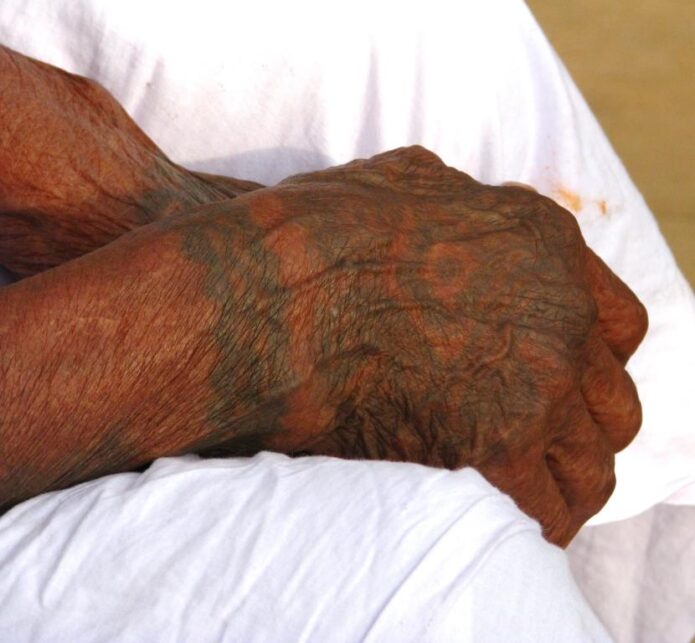
My great grandmother had them all over — arms, fingers. Elaborate patterns, symbols, swirls, and ornate kolam designs. I doubt she picked them from a design book. They probably carried meaning: community, rites of passage, family history.
How she endured them, I cannot imagine. No buzzing electric machines. No numbing cream. Just a steady hand, a homemade needle, and enough pain tolerance to make a dentist cry.
Today, it is far easier. You can walk into a climate-controlled studio, choose from a digital catalogue, sip a smoothie, and emerge with a pristine design in under an hour.
If my great grandmother walked into a modern tattoo studio, she would marvel at the air-conditioning, the choice of ink colours, and the playlists. Then she would quietly ask the tattooist why everyone looked so frightened of the needle.
That generation wore their tattoos with pride. In the photograph above, you see the hand of another grand old lady from our family — a picture I took years ago and dug out for this post. I remember how the wrinkles did nothing to hide the beauty of her ink; if anything, they made it richer.
Why Do People Tattoo?
Psychologists talk about identity, memory, belonging, rebellion, or beauty.
Anthropologists speak of culture, rites of passage, and spiritual protection.
Sociologists mention signalling — telling the world something about yourself before you even speak.
Sometimes, it’s profound: a reminder of survival, a memorial to someone loved.
Sometimes, it’s whimsical: “I was in Goa, the needle was cheap, and I liked dolphins.”
The common thread? Tattoos meaning something — even if that meaning is “I felt like it.”
Cool Again
Tattoos, once the mark of rebels and rockstars, now stroll into boardrooms without causing a stir. The same manager who once frowned at them might now roll up his sleeve to compare designs. The menu has expanded too: minimal line art, crisp geometrics, dotwork, photo-realism, tribal revivals.
If companies truly believe their people “bleed blue,” (or whatever colour) the next brand campaign should be a bulk booking at the local tattoo parlour. That would neatly separate the true believers from the LinkedIn enthusiasts. Wicked, isn’t it? 😉
Should You Get One?
Of course, your call. But in love, work, or belief — would you carry it on your skin for life? If the answer isn’t a loud, unapologetic yes, it probably doesn’t deserve permanent space.
And how would you ever know?
I wish my great grandmother was around for a conversation. One of my questions would be exactly that.
If you’re looking for inspiration, skip the dolphin-on-the-ankle Pinterest board. Check out that 50-year-old Pazyryk lady from Siberia here. Pretty cool I say.