

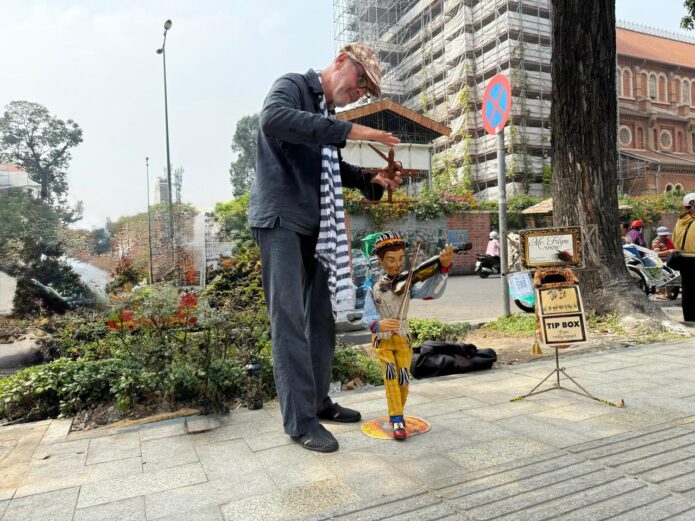
I stopped because something caught my eye. A small crowd. A man in a flat cap. And what appeared to be a very well-dressed child playing the violin on a Saigon pavement.
It was not a child. It was a marionette, a puppet controlled from above by strings attached to its limbs, its head, its bow arm. The puppeteer holds a wooden bar and works the strings to create movement. The word comes from French, apparently. Another French word. This one, a diminutive of Marie. Originally used for small religious figures, now used for this: a fellow in yellow trousers and zebra-print socks, playing violin outside the Saigon central Post Office ( aka the French Post Office) in Ho Chi Minh City, drawing a crowd on a regular morning.
I did not know any of this before I stopped. Travel is an education. Sometimes it arrives in a textbook. Sometimes it arrives in yellow trousers.
Mr. Filipo, Violin Virtuoso (Sort Of)
The marionette’s name is Mr. Filipo. His puppeteer is Filip, a Polish man with a flat cap and a striped scarf, working the strings with the ease of someone who has made his peace with the world, or at least with this particular corner of it.
What struck me first was the smoothness. No visible effort. No performance of performance. Filip moved with the unhurried confidence of a man entirely at home in what he was doing, which is rarer than it sounds. Mr. Filipo responded in kind. The fingers moved. The arm swung. He leaned into a phrase with his whole body, the way serious musicians do, as if the music was pulling him forward and he was happy to go.
A crowd gathered. Nobody checked their phone.
In Ho Chi Minh City traffic. There was joy in it. Genuine, uncomplicated joy. The kind that makes you wonder when you last felt that easy inside something you were doing.
I don’t know what Mr. Filipo is paid. But he earns it.
The Conversation That Came Free
After the show, I went over. Filip was packing up the strings with the careful attention you give to things that are irreplaceable, or expensive, or both.
The ease was still there in his hands. But not in what he said.
He is warm, direct, personable and quietly upset about the state of world. Europe especially, he said. Peace, he said, is becoming harder to find. He said it the way you say something you’ve been carrying for a while. Not to alarm, just to put it somewhere outside yourself for a moment.
He loves Asia because people here still stop. They still look up. A puppet plays violin on a street corner and they actually watch. Elsewhere, he told me, people are moving faster every year, as if standing still has become something to apologise for.
The man who had been all lightness and fluency a few minutes earlier was now speaking about a world running out of both. Same hands. Same flat cap. Completely different weather inside.
No ticket required for any of this. No QR code. Just a man, a marionette, and a taxi honking somewhere behind us.
No strings attached, you might say. Though Filip would probably find that funny.
One Thought Before We Go
Mr. Filipo is beautiful to watch because he holds nothing back. No hedging. No half-commitment. He is entirely inside the moment, and the moment gives back accordingly.
We mostly perform with conditions attached. I’ll be present once this is done. I’ll enjoy this after that is sorted. The strings that tie us to outcomes and ambitions are not wrong. Without any strings, Mr. Filipo is just painted wood. The question is simply which strings you’re holding, and which ones are holding you.
Filip was already packing when he said it. Folding the gilded frame. Coiling the strings. I work on my terms, he said, not breaking his rhythm. Somewhere behind us, two children were crying about something. He kept going.
He wished me well. Then he packed Mr. Filipo carefully into his box, picked up his bag, and walked.
The street outside the old French Post Office carried on as streets do. Taxis. Motorbikes. People with somewhere to be and tourists with something to see.
But something had left with him. The joy and the grief together, packed into the same box. A point of view, perhaps. The kind that arrives unannounced on a pavement, plays violin for a while, doesn’t ask permission. And walks away.