Habits

The Things That Worked. And the Ones That Quietly Didn’t.

Yesterday, I completed an audit of the year. I counted things. Books finished. Posts written. Work delivered. It felt good. Numbers tend to behave themselves, which is more than can be said for most of life.

But numbers are polite. They tell you what happened. They rarely tell you what it cost.

This piece stays with what the numbers were quietly pointing to, while I was busy admiring them.

What Seemed to Work

Quite a few things worked this year, and it would be churlish not to acknowledge them.

I read nine books, properly and without hurry. I have not done that in years. In a world that rewards skimming, scrolling, and nodding along to things one has not actually read, this felt like a small act of resistance. Or stubbornness. Possibly age.

More than sixty blog posts also escaped my head and entered the world. That has not happened in a long time either. Writing returned as a habit, not as an occasional ceremony involving coffee, good intentions, and eventual disappointment. If 2025 had a quiet win, this was it.

Ten pieces appeared in Founding Fuel. That mattered far more than the number suggests. The editing was demanding in the best way. Soft ideas did not survive. Better ones came back leaner and sharper. The conversations that followed were longer, deeper, and occasionally uncomfortable, which is usually how you know something worked.

I enrolled in three courses. I completed two. One remains, politely reminding me of its existence every few weeks. Each asked for time, money, and attention. All of them gave something back, which already puts them ahead of many commitments that quietly take all three and return very little.

At work, there were fresh experiments. New formats. New ways of framing familiar problems. These required courage and a fair amount of gumption, or at least the ability to sound as if I had both. Some ideas surprised me by working better than expected. A few even behaved sensibly.

I also stayed away from the news more than usual, and this time it was deliberate. It had been charging rent in my head without doing much useful work. The daily cycle is loud, repetitive, and faintly theatrical. It feels urgent while you are inside it, and oddly empty once you step out. I realised I was spending more time being informed than being wiser.

So I changed how I paid attention. I watched actions, not announcements. What actually moved once the cameras left. With the help of some outstanding friends, I stayed loosely connected to what mattered. Less churn. More patterns. It felt healthier, and oddly more informed. Not indifferent. Just clearer. This is special.

I travelled to new places this year. I will write about them in a separate post. I also worked on some relationships. They get a paragraph here. The difference between a full post and a paragraph probably says more about the distance covered in each than any honest accounting ever could.

If I stopped here, the year would look solid.

Which is exactly where trouble usually begins.

What Stayed Standing

Other things never quite worked, but they also refused to fail properly.

A few projects quietly became something else. They did not collapse. They simply declined to become what I had imagined. They stayed alive in an awkward middle state. These are worse than failures. A failure ends the story. A half-working project keeps clearing its throat and asking for attention.

Some habits looked productive while slowly draining energy. Days filled themselves effortlessly. Messages were answered. Meetings multiplied, as meetings always do, regardless of whether anyone invited them. Everything appeared under control. Over time, it became harder to tell whether effort was producing momentum or merely the appearance of it.

Health did not collapse. It was fitness slipped badly.

Family time did not disappear. It thinned. There is a suitcase that spent more time with me than my family did, which is not an achievement I intend to repeat.

No alarms went off. No urgent intervention was required. This is how deeper problems usually arrive. Quietly. Gradually. With excellent manners.

Relationships followed a similar pattern. Some were cared for properly. Conversations deepened. Trust grew. Others survived mainly because people were generous. Kindness covered many small absences. Kindness is wonderful like that. It also postpones reckoning.

I renewed connections with classmates from school, which was special. At the same time, there were many friends I meant to meet for coffee. These intentions remained noble, heartfelt, and entirely stationary.

The Questions That Wouldn’t Go Away

Even the things that worked left questions behind.

Did writing become my refuge as much as my craft? Did reading stretch my thinking, or did it soften the edges a little too comfortably? And whatever happened to the plays, performances, and long evenings of soaking in other people’s art that I was so confident I would make room for?

The fact that these questions have come up is data enough.

I am often told I am a hard marker. I usually disagree. But sitting with this year, I can see why the reputation exists.

It is easy to manage appearances. Outputs help. Stories help too. But it is much harder to mislead oneself for long. Somewhere beneath the busyness, I know what is alive and what is running on habit. I know which efforts deserve energy and which ones continue mainly because stopping would require explanation. I also know which win I wanted but did not get. No amount of other credit quite fills that gap. And that is that.

Carrying the Right Questions Forward

As the year closes, a familiar set of questions stops being polite and starts lingering.

What should I start? What should I stop? What should I do more of? What should I do less of?

Most years, these are treated like planning prompts. Lists are made with enthusiasm. Intentions are declared confidently. The calendar listens, nods, and then carries on exactly as before.

This year, the questions feel urgent. Not only because time is sprinting away, but because attention leaks are more than frustrating. These are not productivity questions. They are system questions. They ask where life actually goes once motivation gets bored and habit takes over the controls.

One question, in particular, refuses to leave.

What would I stop doing next year, even if it still sort of works?

This matters because what still works is rarely challenged. It is functional, defensible, and comfortably respectable. It quietly sets the ceiling on change. Most decline does not arrive loudly. It arrives wearing slippers and saying, “This will do.”

Wanting change turns out to be mostly decorative. Deciding helps, but not much. Without changing the system around attention, behaviour stays put. This is the point James Clear makes plainly. You do not rise to your goals. You sink to your systems.

Which makes the work ahead refreshingly practical.

What the calendar protects.
What friction gets added.
What gets removed without ceremony.
What is designed so the better choice stops requiring willpower.

This is where reflection stops being writing and starts becoming proof. Defaults win when left alone. Comfort compounds faster than effort. “Later” has a remarkable way of becoming “never.”

So the aim is not a dramatic reset. It is a structural one. Fewer defaults. Clearer constraints. Lighter suitcases. More room for what actually deserves to stay. Once the system shifts, behaviour usually follows. Quietly. Reliably. Without heroics.

That is the urgency. And that, inconveniently, is the work.

Somewhere between cheer and caution, a bell does its job. It doesn’t explain itself. It simply rings. Paying attention is left to the listener.

Merry Christmas. May your defaults behave themselves for a few days.

The Stuff No One Claps For

“I work physically very hard every day of my life. It’s got nothing to do with cricket anymore. It’s the way I live. So as long as my fitness levels are up and my mental enjoyment and sharpness is there, when you can visualise the game and see yourself running as hard, reacting fast on the ball, you know it’s fine.”

That is Virat Kohli. And thank God he scored runs before saying that.

Because if he had nicked one to slip for a duck, this philosophy would not have been printed anywhere. It would have been dismissed as a post-match consolation line. Success brings applause. Failure brings silence.

But the message matters, because it points to the stuff no one claps for.

The hours before the match.
The recovery routines.
The quiet mornings.
The invisible discipline.
None of it is dramatic, yet all of it is essential.

James Clear speaks the same language. Systems. Habits. Tiny steps.
MS Dhoni did the same thing without saying anything. One process at a time.
The Bhagavad Gita said it centuries ago. Act without attachment. Let the fruit take its time.

Outcomes get the spotlight.
Process sits backstage and holds up the ceiling.

Virat Kohli’s words are not a motivational poster. They are a reminder of how performance is built. Not on inspiration, but on daily structure. Not on hype, but on small habits. The world celebrates the big shot. The body remembers the small drills.

Sport keeps offering examples. Look at Roger Federer.

Roger made tennis look like silk.
People saw the elegance, not the repetition.
They admired the one-handed backhand, not the endless balance and footwork drills that came before it. They talked about grace, not the maintenance that kept him injury-free for two decades.

Federer’s genius was simple. He took care of the stuff no one claps for. Strength work. Recovery. Rehearsal. The glamorous “effortlessness” was built on ordinary routines repeated thousands of times.

This is the part we often forget.
Outcomes depend on timing, luck, conditions, moods, even the bounce of a ball.
Process depends only on you.

People imagine confidence comes from results.
But most confidence comes from doing the work when no one is watching.
You trust yourself because yesterday’s effort is still in your bones.

That is why the stuff no one claps for ends up shaping the very things people cheer for.
The unseen half carries the seen half.
The quiet routines make the loud moments possible.

So here is the simple truth in all this.
Stop staring at the scoreboard. Stop refreshing the result. Build the routines you can control.

Do the boring work. Do it when it is raining. Do it when you are not in the mood. Do it because it steadies you.

The applause will find its own time.
The work must find yours.

Sweating the small stuff


Its the small stuff. Big change is in there. People, organisations and communities want giant changes. The big stuff is sexy. It is visible and in a giant throne that cant be missed.

The company that’s lasted centuries..

The tennis player who invented a new shot

The Olympian who made a different cut.

And so on.

The brightest star captures attention. The bright star in the night sky provides direction to many others. In its twinkle and presence it illuminates the way ahead.

Everybody likes the outcomes the champions produce. But how many would sign up to become one if they know what it takes is a different question altogether.

Whether it is the outcome or the means to the outcome, seeing them as a whole is impossible to comprehend. The nucleus of change is the small stuff. Moment of truth is in fleeting seconds.

That’s what makes it both tough and easy. The small stuff is simple to start but can be a far cry for someone who jumped into the ring for the glory of the big achievement.

Yet, the small stuff offers hope. It is one small thing that you can do to stay the course. Small steps must be complemented with a structure to continue the effort.

Small stuff is good stuff when you build a system to back it up well with. To quote James Clear, ” “You do not rise to the level of your goals. You fall to the level of your systems.” My view of systems is a small set of processes, support folks, measures, observations etc, that are best made routine.

That’s small stuff.

Be it succeeding in a business venture, running a marathon, losing weight, building wealth, the small stuff is what gets the big stuff. Heck, the small stuff is the only stuff you can sweat on! Submit to them. Make them meaningful and part of a coordinated weave.

I check if I have stuck to my simple routines. Everday. I can tell you, it’s not as easy as it sounds. Nor is it as boring as it can seem. It keeps me tethered to the ground as mind is frequently infatuated by the bright beings and their ways.

The habits of champions

Michael Phelps helps me arrive at three monikers to treasure

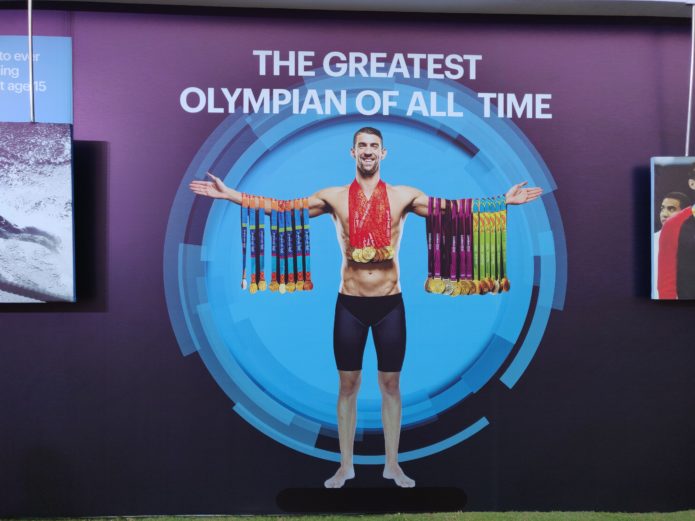
All that separate him and me is about 50 meters.  The 23 Golds, 3 silvers and 2 Bronze medals and achievements that befit the tag of the greatest Olympian ever’, are beside the point.  His achievements give a new meaning to what ‘Olympian heights’ or ‘champion’ could mean. Reading about or listening to habits of champions always leave me with ideas and energy. This one is no different.

When an Olympian with the stature of Michael Phelps is in front of you talking about his past, present and future, you shut up and listen. He speaks on his hydrophobia as a kid. He speaks of his coach. His mom. His team. How he trained, how he ate and much more.  Disbelief and gasps escape my lips as I soak in his story. Even as I do so, I become clearer of what it takes to scale the heights he has. Like a swimmer whose head bobs out for a brief moment before the body slices through the water with grace,  things crystalise in the mind.

These ideas stay on. Long after the event, put together to celebrate 20 years of the founding of True North, is done. Michael Phelps is perhaps back home minding the Instagram account of his son Boomer(With 726K followers that must be one tough job! 🙂 )

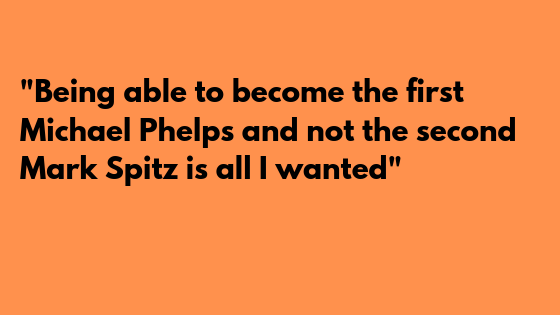
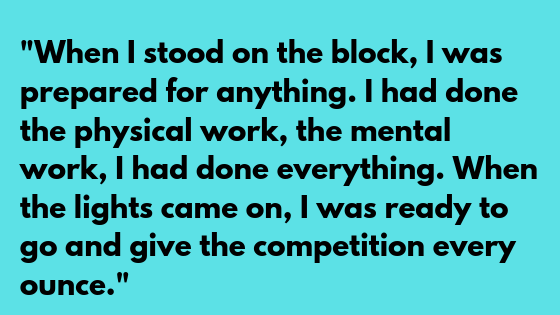
It’s a Sunday.  My mind keeps darting back to his statements. Elements of his life and his story that refuse to fade.  To unearth what’s within me, as has been a practice, I grab a pen and paper and write. It seems easy as they tumble out. I write them with care. Some of them are here (Please click on any of the tiles below to scroll through the quote gallery).


An hour passes by like a starter’s gun in a big race.  All his statements and ideas. A quick blast and its all over! Ideas that seemed to have competed for a share of the mind are all out there to see. They lend themselves to a ‘sit and ponder’ after the words are well digested.  How would I remember this, I ask myself? How would I share it with others? And wonder if I can put it into three themes? Monikers if you will.

Just three.

With a tentativeness of a sore muscle after a big race, I begin. I know what I am saying will not be new to many.  At least it isn’t to me. I realise that the gap between knowing and doing kills at many levels. The mind lulls us to think we have cracked it because we ‘know it’.  Sometimes, refusing to let us dig further. That has been my battle. I wonder if it is yours too. Anyway, here are my three monikers that hold a bunch of ideas in them.

1. Hard work beyond talent. 

It’s been stated several times before: Talent is an entry criterion.  Talent is far more common than success. Success comes from hard work. Putting in the hard yards makes a difference at every level. Every single qualifier, forget a medal winner, at the Olympics, has the talent and the hard work. There is no argument that at all.

But success at Phelps’s scale requires a maniacal devotion to the task at hand. And that makes all the difference! There isn’t much more!

The maniacal devotion requires hard work, when the arc lights, the podium and fame arent in the frame.  Labouring in obscurity and enduring relentless pain. Several years ago, I came across a piece titled “The Common Denominators of Success” by A.N.Gray. It tugged at me differently.  

 “..the secret of success of every man who has ever been successful — lies in the fact that he formed the habit of doing things that failures don’t like to do”

“…The things that failures don’t like to do are the very things that you and I and other human beings, including successful men, naturally don’t like to do. In other words, we’ve got to realize right from the start that success is something which is achieved by the minority of men, and is therefore unnatural and not to be achieved by following our natural likes and dislikes nor by being guided by our natural preferences and prejudices. ” 

A.N.Gray spoke in the context of insurance sales. But those passages leapt in, even while Phelps was speaking. All of us love champions and aspire to imbibe their thinking into our lives. But we forget to remember that Phelps (and champions like him) dont like several parts of their routines, yet do them with great discipline. It is not about likes and dislikes.  Doing every inch of what it takes is what will bring success is key.  Deserving success is as important as getting success. 

Michaealangelo famously said, “If you knew how much hard work went into it, you wont call it genius”. Thats that. 

2. Focus beyond boredom.

The world that we live in is ripe with distractions. Every sensory organ is invitingly propositioned with a promise for gratification. ‘Deep work’ is much needed.  But Deep work is demanding. And many times plain boring. Imagine showing up in the pool every day for six years straight.  Ever single day of six years in the peak of youth. That sets up an exploration of another level of boredom and drive. 

There is another aspect to the boredom. The relentless toil in complete complete obscurity, away from the arclights, the podiums and people. Chipping away at yourself one second here and another there. Adding strength to a calf muscle or a forearm! Stuff that will go completely unacknowledged but will all contribute to the goal! To do this for days on end, will need relentless motivation. For it can get plain boring. 

Champions bring a level of focus that lies beyond the first shore of boredom. It means, they show up even when they don’t feel like showing up and produce champion stuff. “Embrace boredom” says Cal Newport.  The high perches of success comes after many hours of languishing company of boredom. 

That would apply to everyone of us. People out to excel in the corporate world. Aspiring writer. A fashion designer. Lawyers. Coaches. Every one of us! If we want success at the scale of Phelps, there is no escaping the regimen that brought it. 

So, how about embracing some boredom,  and sticking to what you promised yourself? 

3. Team beyond Individual.

The narrative of the individual champion who changed the way of the world, is lovely story. From Michael Phelps to a Steve Jobs. From Sachin Tendulkar to Elon Musk. But that story of the individual is an incomplete story. 

For every individual champion that we see and celebrate there is a team behind the scene, that has given a hand. Well, more than a mere hand.  That is obvious.  Michael Phelps had his coach an entire troupe. A troupe that included his mom, sister, wife and now, his kids. He spoke of his special relationship with his coach Bob Beamon who deserves a part of every single of the 28 Olympic medals and more! 

Sudeep Banerjee said it very well on twitter.

An Olympic athlete can afford such a team and must do so too. On more personal terms, we have our own Olympic equivalents every day. And the responsibility of building our own support team rests with each one of us too. Of course, whilst speaking of teams I am not speaking of the teams that we end up with at our workplaces.

For instance, have you considered co-opting mentors onto your journey? Whatever the journey. Or maybe a coach? Perhaps members of the family? A classmate? A colleague from another team? Someone who will be able to look at things dispassionately and tell you as they see it. Someone who is interested in you and brings a strength that makes a difference to you. Infact, the part about hard work is rather incomplete without a smart agenda to work hard on. That is something a rich coalition of a co-opted team can bring.   

That sums it up for me.  With talent, hard work and discipline a good distance gets covered. But success at the height at which champions like Phelps have succeeded can’t happen without a team.   Speaking of teams,  here is a take on the same event by my good friend and colleague at Founding Fuel, Charles Assisi.  His take is very inspiring.

In a world that reveres champions and celebrates their success, not enough is said about what it took for them to get there. That applies to each one of us in our respective fields. Unless we are prepared to give it what it takes, our aspirations stay as well intentioned wishes. Before we realise someday that each day chipped away at what we might have become! 

The opportunity is omnipresent. The choices are ours to make.