Leidy Klotz wrote a book called Subtract. The argument, roughly, is that we are bad at removing things. Give a person a problem and they will add. Another feature, another step, another meeting. Taking something away needs a kind of nerve that most of us do not have.
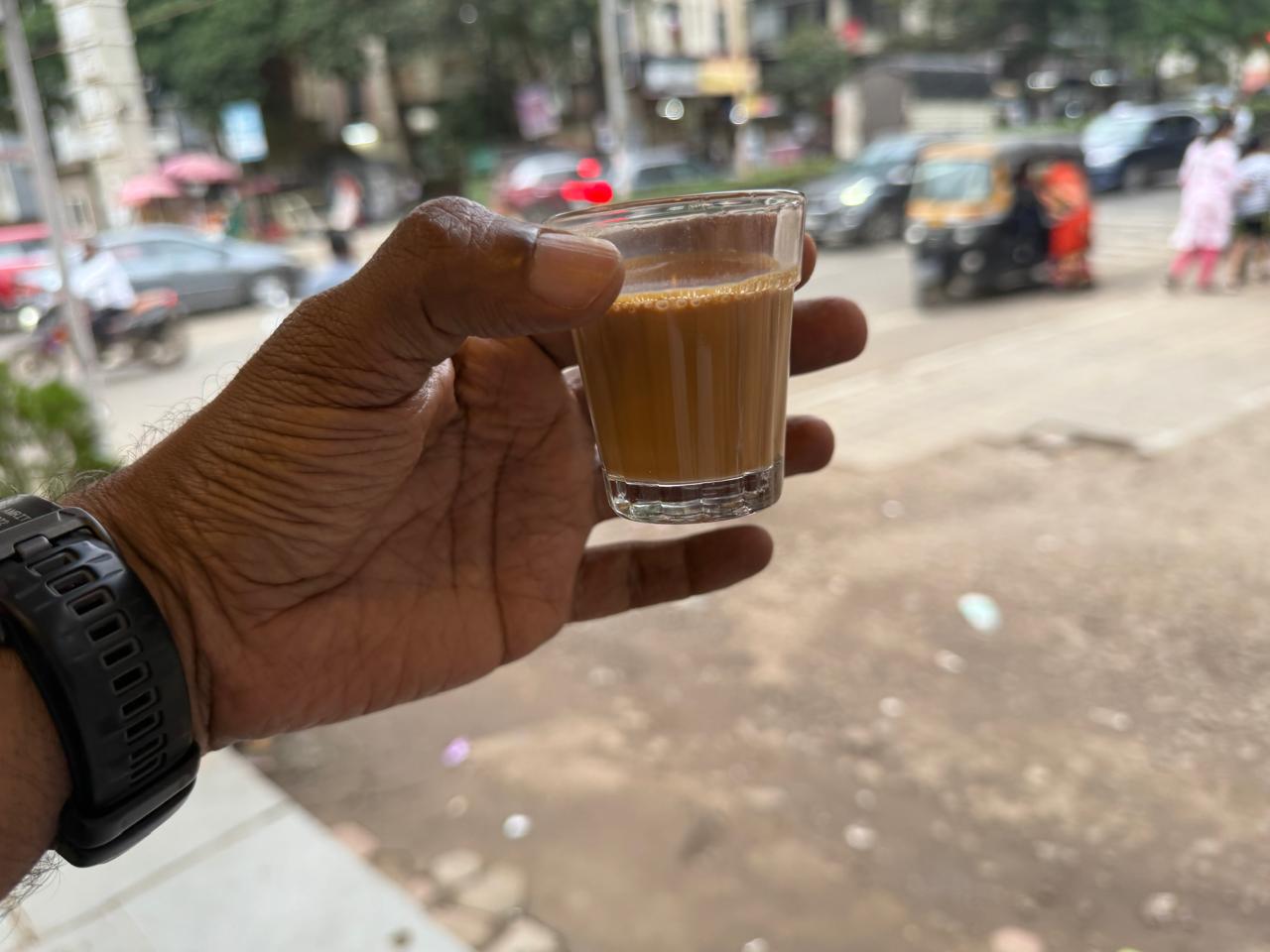
Mumbai sorted this out long ago and built a small glass around it. The glass is called cutting chai.
The First Cutting Chai
Decades back, new to the city and knowing nothing, I stood at a roadside stall while the man I was with asked for a cutting. I had no idea what was coming. A brand of tea, possibly. Something involving a machine. Out came half a glass, and that was that.
Cutting chai is a measure that quietly became the product. You can ask for tea. You can ask for a cutting. They are not the same order. The measure ate the thing it was measuring, which is a rare career for a word.
Why ‘Cutting’ and not ‘Cut’
I have wondered for years why it is ‘cutting’ and not ‘cut’. The tea has already been fractioned. The word insists on carrying on.
There is a plain commercial reason available. Cut chai would sound like the tea had been reduced in some suspicious way. Cutting sounds like a category. Mumbai is good at this.
The languages had options too. Marathi could have used ardha for half. Hindi the same, aadhi chai. Neither took hold, and aadhi chai would have been the obvious winner if half were the idea being sold. Half a dozen languages meet at that counter and none of them owns this word, which may be why it survived.
The same coast, further south, does the opposite. A Kerala toddy shop calls its food ‘touchings’. Fish curry, beef fry, tapioca, an entire meal, and the word claims only that something has been brushed against.
Back in Mumbai, the tense may simply be right. The tea is cut once at the pour, and then the cutting keeps happening. To your time, your appetite, the length of the conversation. The present continuous is accidentally correct.
What Stays
What is taken away is the tea. What is kept is everything else.
You still get the boiling. The ginger going in. The strainer. The pouring from a height that serves no purpose. You still get the hot glass handed over to someone whose fingers already know where to hold it. Half the volume, and not one part of the ceremony lost. Most people spend a full working life failing to manage that trick.
Four sips and it is finished. You are left holding an empty glass and a small sense of grievance, and this is on purpose. A full cup ends in satisfaction, and satisfaction ends conversations. A cutting chai ends in wanting a bit more. That bit is what makes you say the next sentence. It is also what makes you order another at four o’clock, which is where the economics comes back to collect.
The same subtraction runs through the company you keep while drinking it. Two men share one glass. Four people share two. The word sharing is never said out loud, because saying it would spoil it. The talk goes as far as the tea goes. A brother-in-law and his loan. A landlord. The road, which is always in the same condition. Then the glass is empty and everyone finds it natural to stop.
You are not asked to leave. The tea leaves for you.
So Much for the Spirit
The taxi drivers and mill workers who are said to have started this were not designing anything. One glass between two men, because that was what the money allowed. The city kept the habit long after the shortage went, and then put a price on it.
Which brings me to that much romanticised phrase, the spirit of Mumbai, usually produced after a flood or a bad day. If it began anywhere, it began here. In a glass cut in half so two people could stand together for four minutes.
The glass goes back on the counter. Someone rinses it in grey water. Nine seconds and it is ready for the next cutting chai.
Subtraction, done often enough, stops looking like loss.
5 responses
“The pouring from a height that serves no purpose.”
I disagree.
What if you were the tea?
Boiling and spices ,
a tea stained piece of rich cloth,
the sharp flame doing its thing,
catching memories,
and a descent from a height,
with the united molecules of milk,
supremely thrilled, straight into a glass,
“cutting” sharp.
The sheer delight in falling
and being caught just so,
the sipping by folks,
and the fogging of their specs.
Sharing, slurping.
The rough and tough cousin
of bamboo curtains, low tables,
kimono folks, gently pouring,
smiling, nodding, gently sipping
fragrant tea.
Namaste to that.
But.
Very clearly, rough and tumble,
this is our tea ceremony.
Such a big truth of life and living said in such simple cutting chai
Yes when done often enough does stop looking like loss and you learn to expect the same ‘cutting’ again!!
Wisdom encapsulated in the glass of cutting chai!
Kavi, I am not entirely convinced that subtraction always stops looking like loss.
In cricket, a defensive shot is not automatically wisdom. Sometimes it is simply fear of taking a risk. A team that keeps protecting its wicket may preserve what it has, but still lose the match.
Cutting chai works because the subtraction is deliberate. The flavour, ritual and conversation remain intact. In life and leadership, however, the real skill is knowing what to remove and what must be protected.
Not everything smaller is better. Sometimes the full cup is exactly what the moment requires.
Probably, the corporates learnt from the spirit of Mumbai….. cutting costs, cutting waste, cutting layers., cutting delays,cutting complexity, cutting downtime and overtime.
But never cutting promises and commitment.
That’s the Spirit of Mumbai…never cutting promises and commitments