
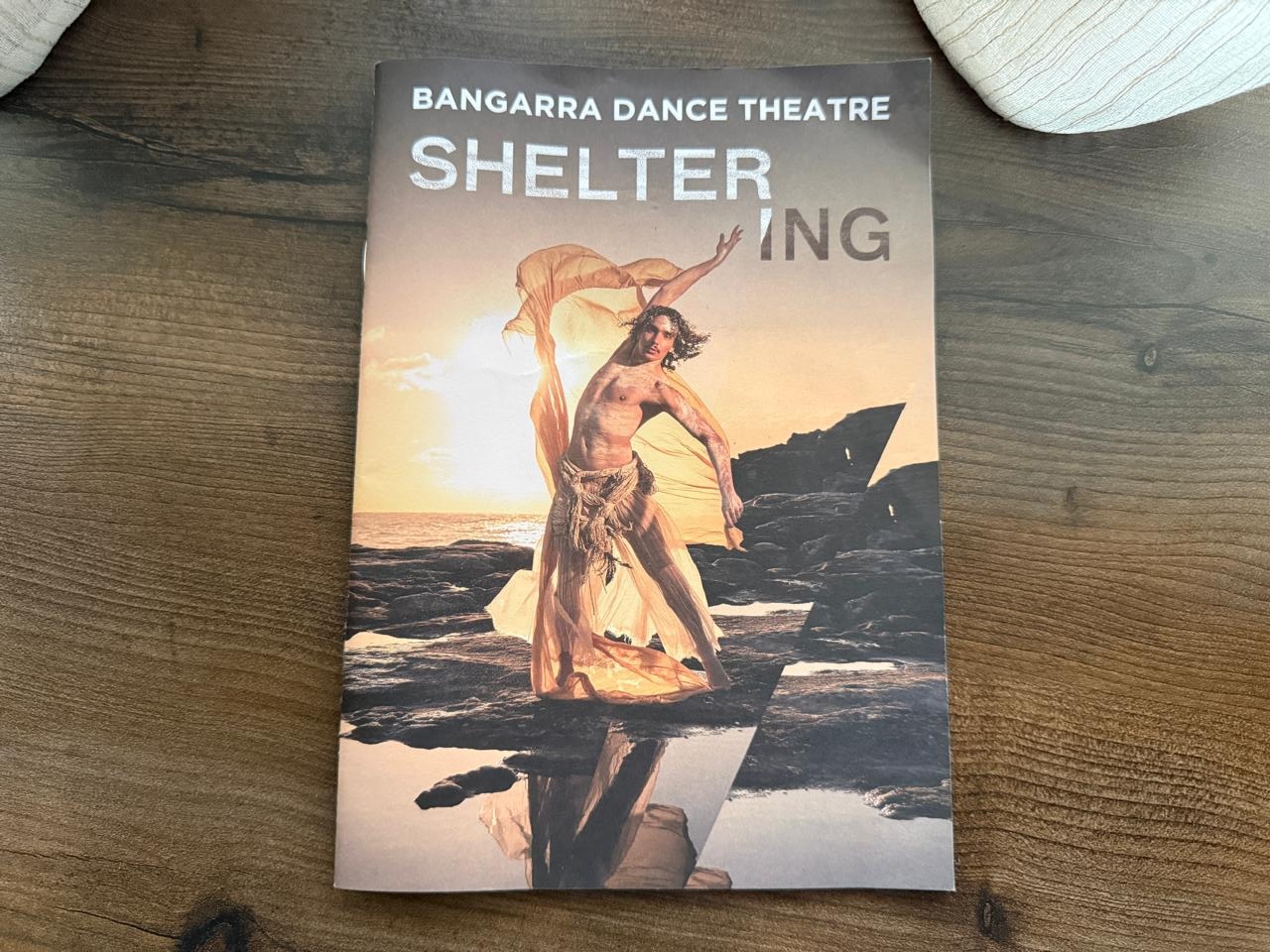
Bangarra is Australia’s leading First Nations dance company. In Brisbane I watched their show, Sheltering. It is made of three separate works, by different hands, in different years, telling different stories. On the night, they flow into one evening. After a while you stop noticing the joins.
I liked that before I understood it. Three streams, poured together, moving as one river.
No seams
I put my phone away, as you are asked to here, and sat with empty hands. Just as well. I would have missed all of it. I still have the small handout from that night, the only memory I let myself keep.
The dancing left no room for distraction. Graceful and strong at once. Sublime and telling in the same breath. Free in the moment, and perfectly orchestrated. These are meant to be opposites. On that stage they did not sit side by side. They fused into one thing.
We are one
The First Nations way of seeing does not draw hard lines. Not between a person and the land. Not between the living and the ones who came before. Not between you and the stranger in the next seat.
One work, Keeping Grounded, began with nets, dancers held in them as if the earth itself were holding them. Long ago, rubber soles slipped between our feet and the soil, and a small daily touch was lost. I did not need the note to feel it. In Madurai you take off your shoes to enter a temple, because the ground there is family. You meet family barefoot. My grandmother would have understood the nets with no English at all.
Then something happened that I keep returning to. Partway through, the show stopped. Someone in the audience needed medical help. The lights came up. The dancers waited. A room full of strangers held its breath together for one person none of them knew. A show about shelter paused, so the room could become one. Nobody planned it. It simply happened, the way true things do.
We shall overcome
The last work, Sheoak, cut the deepest. A sheoak is a tree. Here it stands as an ancestor and a guard, watching over the generations. It got raw. Bodies pushed to their edge. And then a quiet grace arrived and made the rawness bearable.
Underneath it was a stubborn strength. So much was taken from these people. And still the hurt did not turn into revenge. Maybe what was done to them helped make them. They carry it, and they refuse to pass the harm on. They pass on kindness instead. That is a rare and difficult thing, and it humbled me.
Brisbane and Madurai
None of this felt foreign. Land that holds memory. Ancestors standing somewhere in the same room. Story kept in the body long before it reaches any book. Walk into an old temple near Madurai and you meet the very same belief, worn smooth by a few thousand years of feet.
One last small wonder.
The new theatre, the Glasshouse, wears a skin of rippling glass, engineered in Austria and curved in China, shaped after Kurilpa Country, a poem by the Murri Elder and artist Lilla Watson, about the river below it. The poem watches fish move through the ripples of the water.
The architects thought of people in the foyer seen the same way, clear and blurred, through the curved glass. A poem, turned into a wall. Brisbane stands on a bend of that river, which the Turrbal people call Maiwar, on land they named Meanjin.
I have sat with this river before, the one they also call the Brown Snake, and each time it carries me home to the Vaigai in Madurai. Madurai is said to be among the oldest cities people have never stopped living in, one long settlement across thousands of years. Two river towns, far apart, both old, both still holding on to the ones who came before.
I flew home with empty hands and a full heart. Meanjin and Madurai, it turns out, have been saying the same thing for a very long time.