Leadership

Building an “attitude of interest” – Humble Inquiry


My dad used to always tell me that the virtues in keeping things simple, easy and small was so huge, that it gets often missed. His knack for keeping things real simple and constantly seek beyond what seemed obvious or what were ‘mainstream voices’, got him untold riches. Relationships. Ideas. Discoveries. And a wide spectrum of people who wanted to work with him. The essence of it was all about having an abundance of curiosity and an attitude of discovery. More of dad later.

Now about Humble Inquiry.
HI

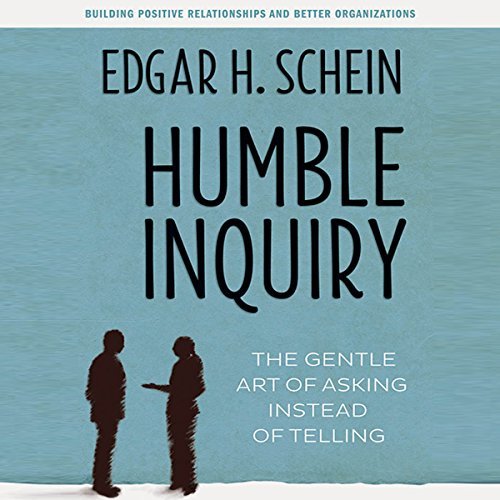
When Vivek Patwardhan recommends a book, I close my eyes and buy it.  Thats that. When he recommended “Humble Inquiry” by Edgar Schein, it was no different. Having consumed several of Edgar Schein‘s work in the past (and occasionally foisting it on MBA students who I taught), I was mildly surprised that I hadn’t come across this work before.  That it was dated June 2013, was some consolation!

Schein writes at the end of the book, “This book represents a culmination and distillation of my 50 years of work as a social and organisational psychologist“.  That one comment should be suffice to get anyone get started. But there is more. Here is another quote. “The current book Humble Inquiry brings together all of these trends in showing how culture and individual behaviour interact, and what it will take in the way of counterculture behaviour to deal with the changes that are happening in the world“.

In more than one way, the last few posts of mine have been about changes that are occurring in the world and our ways of dealing with them. Be it facilitation, Working Out Loud or even ‘Social’ for that matter.  This book settles that theme remarkably well for me. My own stumbling across such themes is either a fortuitous consequence or perhaps I am viewing everything that I am stumbling across with my current lens.

From very early on, Schein anchors his argument as an alternative to the popular mainstream culture of ‘tell’. “We also live in a structured society in which building relationships is not as important as task accomplishment in which it is appropriate and expected that the subordinate does more asking that telling, while the boss does more telling that asking. Having to ask is a sign of weakness or ignorance, so we avoid it as much as possible”. 

He drops anchor on curiosity, to explore and a willingness to ask questions to which we do not already know the answer.

The book is insightful in more ways than one. It is a read that I would recommend to any leader aspiring to lead large organisations now. And more importantly, in the future. The examples are lucid and pointed. Before you assume that the book is a set of skills about asking questions, let me hasten to add, that it is far from that. In fact, Schein himself states explicitly at several places. “The kind of inquiry I am talking about derives from an attitude of interest and curiosity“.

The book has several parts to it, stretching from building a case for it, articulating what it is and what could be possible inhibitors and ideas about developing this attitude. The weaving in of Humble Inquiry through the windows of simple frameworks like Johari Window and the ORJI (Observation – Reaction – Judgement – Intervention ) model helps in making it contextual and practical.

Its an easy, simple read. Devoid of jargon. Its the best Rs.123/- that I have spent in a long time!

This book is a superlative, if you are in the talent development, culture change arena. If you are an executive coach or are in pursuit of perfecting your skills, this could well be the centrepiece of your practice. Of course, this book holds a bundle of benefits for anyone serious about leading teams in our current times!

The scepter of uncertainty envelopes every leader’s ornamental bauble. Knowledge and expertise are far too distributed within and outside the precincts of the firewall.  The ‘attitude’ of ‘Humlbe Inquiry”, when coated with ‘social skills’ adds another rather potent dimension to the modern day leader’s quiver.

And, dad. It was while reading this book that realisation dawned that what endeared him to many was his consummate practicing of ‘Humble Inquiry’. His innate ability to ask a question with warmth, genuine interest and wait for answers used to have many wanting to talk to him. This book reminded me of him. Thats one more reason that this book stays on my mind.


Tell Well!

The word ‘story’ means different things to people. Am sure an image pops up in your head as well, as soon as you hear ‘story’. In a kid’s world, no other word can bring a wide eyed stare of possibility as much as the word ‘story’ can!

Stories excite children, widens their eyes and brings about a smile, every time they hear the word. Sometimes, they are ready to be lulled into sleep, exchange their favourite toys and have the food that they detest, all in exchange for a good story. The power that stories carry in them, is massive.

Let me pause here and add, that stories have a rather telling effect in the business world too. The same, if not better, than the effect that it has on kids.

Good stories, craftily told, carry with them tenor of playfulness yet manage to stoke imagination and possibly see a future in the mind that isn’t ordinarily visible. Stories help see parallels. Extrapolate the present into the future. Visualise scenarios. Connect a set of disparate events on a timeline. Sometimes, they are wonderful capsules where bitter pills are packaged as interesting accounts.

If they are peeled one more layer and understood better, stories help in translating abstract numbers, concepts and even contexts into more digestible chunks. In that they have a very unique and powerful role.

If stories have such a place of pre-eminence in the business world, imagine the importance of the ability to tell a good story. I could go out on a limb and proclaim that amidst several aspects, the ability to tell a good story is perhaps the most underrated and valued amongst leaders.

IMG_1184

Good leaders instinctively understand this and cultivate great story-telling capabilities. Capabilities that inspire large teams and more many times are successful in engineering hard action today, based on the image a story of the future that the leader is able to paint.

All of us tell stories. To ourselves. To others. We may not see them as ‘stories’ per se. But all of us do! To be able to tell it well for a predefined effect and intended result gives it a very different dimension.

If you are an entrepreneur out there, your power to weave the future, emanates from your story! The Elevator pitch is a story. The pitch to investors, customers, potential employees, employees..well, the list is long indeed. That list can be a story in itself. Joseph Levitt told it like none else, when he said, “The universe is not made of atoms. Its made of tiny stories”

Anyone with an internet connection and a device can find thousands of websites reeling out a zillion ways to tell good stories. Here are three top elements that come to my mind, in all my ears of telling and listening to great stories and working with some of the coolest leaders who were giant story tellers.

1. Preparation is key! As simple as it sounds, sans preparation, even the greatest of stories flounder without good storytelling. Getting the story aligned to intended outcomes is key. Most importantly, constantly staying on the lookout for good stories is what will add to the stock that can be deployed at will.

2. Great story tellers always leave their audience curious to know more. They leave them energized, thoughtful or sometimes very reflective. To keep the stories short, simple and contextual works. A dose of humour, as and when appropriate, works.

3. The stories that go a far longer distance are those that are REAL, told in first person and told with a degree of ‘authenticity.

Story telling is not an optional extras. It sits the very centre of good leadership skills. Besides if you want to build a great cohesive team with a defining sustained culture, stories look no further than the story that’s currently playing loudly and the ones that you would like to hear. That’s a very different topic and a giant story by itself!

Polish your story! Yet again. It helps.

This was my contribution to Sheroes.in a while ago.

The power in conversations

Imagine you have a four year old daughter. All sprightly, playful and extremely fun to be with. Assume that you have been away on work. Making full use of your absence and in her constant quest for exploration, she touches a hot tea pot.

The hot tea pot gets her to pull her hand back in a quick reflex action. Chances that she would go anywhere close to the tea pot reduce dramatically. Some learning has taken place there.

Meaning Making

You get home from work and ask her, ‘what did you learn today baby?’, chances of her saying ‘I learnt that the tea-pot in the corner of the kitchen is hot and can be very dangerous’ is remote. Remote is a mild word there!

In all probability, you will hear a ‘nothing’ or something or about the latest game that she picked up from her best friend or whatever. And getting on to the next game.

This scene is something that keeps repeating all over our lives. We are all learning. All the time. Or rather, continuously making meaning  of things that happen to us or around us. Constructivism holds meaning making right at the centreBut that’s as far we’ll go into that aspect.

In an organisational setup, the meaning making can take a collective hue as well. Most often, leaders abdicate a responsibility to help team members REALISE their meaning making and helping assimilate / moderate / augment the ‘learning’ that occurs all the time.

One key skill that is seeing more and more remote practice of, is the ability to hold reflective conversations with team members. In a high tech, connected world where email and the keyboard become THE interface, having good old conversations is becoming a rarer ‘event’! Yet, it is a such a vital tool in a leader’s arsenal.

If it is so vital, why isn’t it practiced as much as it should be?

For one, it is difficult. It is seemingly easy, but it is difficult. There cant be anything more easy than sitting down and having a good chat, it would seem. For one, it goes beyond ‘small talk’ and exchanging sounds about the weather or seeking basic information about each other!

A good quality conversation which can enthuse team members has a few aspects to it. It means, listening exceeds the speaking not with an intent to convince, but with a desire to bring complete ‘PRESENCE’ to the conversation. And listening happens both with the eyes and ears!

A good conversation means indulging in the lost art of curiosity and staying with asking questions to help the team member discover answers for himself or herself. It means patience. And it also means, living with the possibility that it perhaps will not head the way it was desired in the leader’s mind! Candour and sharing help establish trust from both sides and are great catalysts!

And no, a good quality conversation cannot be had over mail. Yes, ‘conversations’ sounds simple. And ‘simple’ is not always, ‘easy’! Or effective.

Some of the best leaders I have worked with have been great at conversations. Not necessarily, the funny-slap-on-your-back-laughter kind of conversations over a few drinks. But ones where they were fully present. Not for a moment looking into their mobile phones or into their watches. They listened intently, with curiosity ruling the day. And always, always, asking searching questions the answers of which I was in search of, sometimes, long after the conversation was over.

Many a time, these chats didn’t give me straight answers or ‘to-do’ lists but helped me formulate a thought and create my own ‘to-do’ list!

Even as the ultra fast world gets comfortable with clicking on the ‘like’ button, putting down a two line comment and drafting mails as a means for communication, they are just a patch on the power of a simple conversation!

It is a vital skill in a connected world to connect deeply!

Meaning From Within

Please do take a moment read the post by clicking here.

It was two years ago. But the memory of it all is evergreen. I was particularly pleased with the way the entire activity galvanised the neighbourhood into action. We were like any other neighbourhood in modern day India. Ok, most other neighbourhoods. Middle class with aspirations, new money, apathy and focussed on self.

On this day, it all changed. Even if it were for a brief while, it changed. We found support from every quarter. And today, what was once a mound of garbage is a clean place with no problems. Most of the people who were involved arent there any more to enjoy the fruits of ‘labour’ !

That doesnt seem to be important at all ! We were part of a moment. An important important. An important moment where there was disticnt movment. Both for the world and for us. That activity showed us what was possible. And that it was possible to go beyond illusory borders in our own minds.

All this, a tribute to a man, who showed it is possible to go beyond ! Yourself !

Even as i write this, there is new found energy to do something. Far more deep, distinct and ‘making a difference’. There is a plan. And watch this space ! More on that, is on the drawing board !