

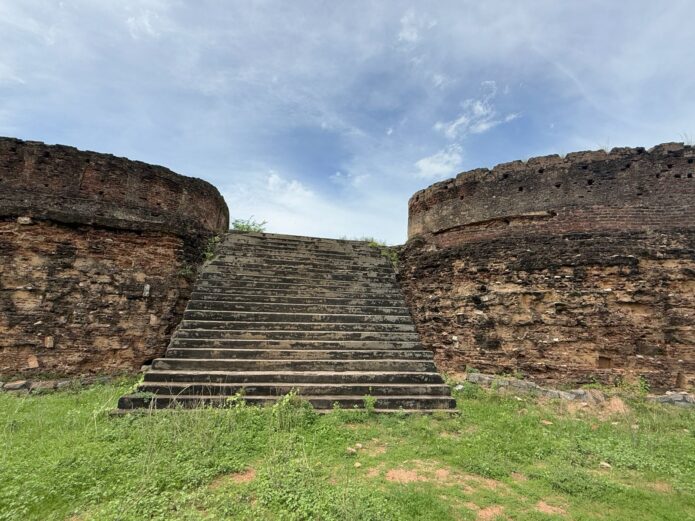
Google knows me a little too well. Somewhere between scanning my photos of weathered temples and long-abandoned wells, it popped up a notification. “You might be interested in Kamuthi Fort.” Oh sweet thing, of course I was.
Kamuthi Fort sits in one of those small Tamil towns that lived in my mind as a nameboard on buses leaving Mattuthavani bus stand years ago. You see the sign, nod at its existence, and move on to the next one. But as with all such towns, there are stories waiting if you only pause.
So, pause I did.
A sixteenth century fort, said Google. Nine ramparts, said the web. I was sold.
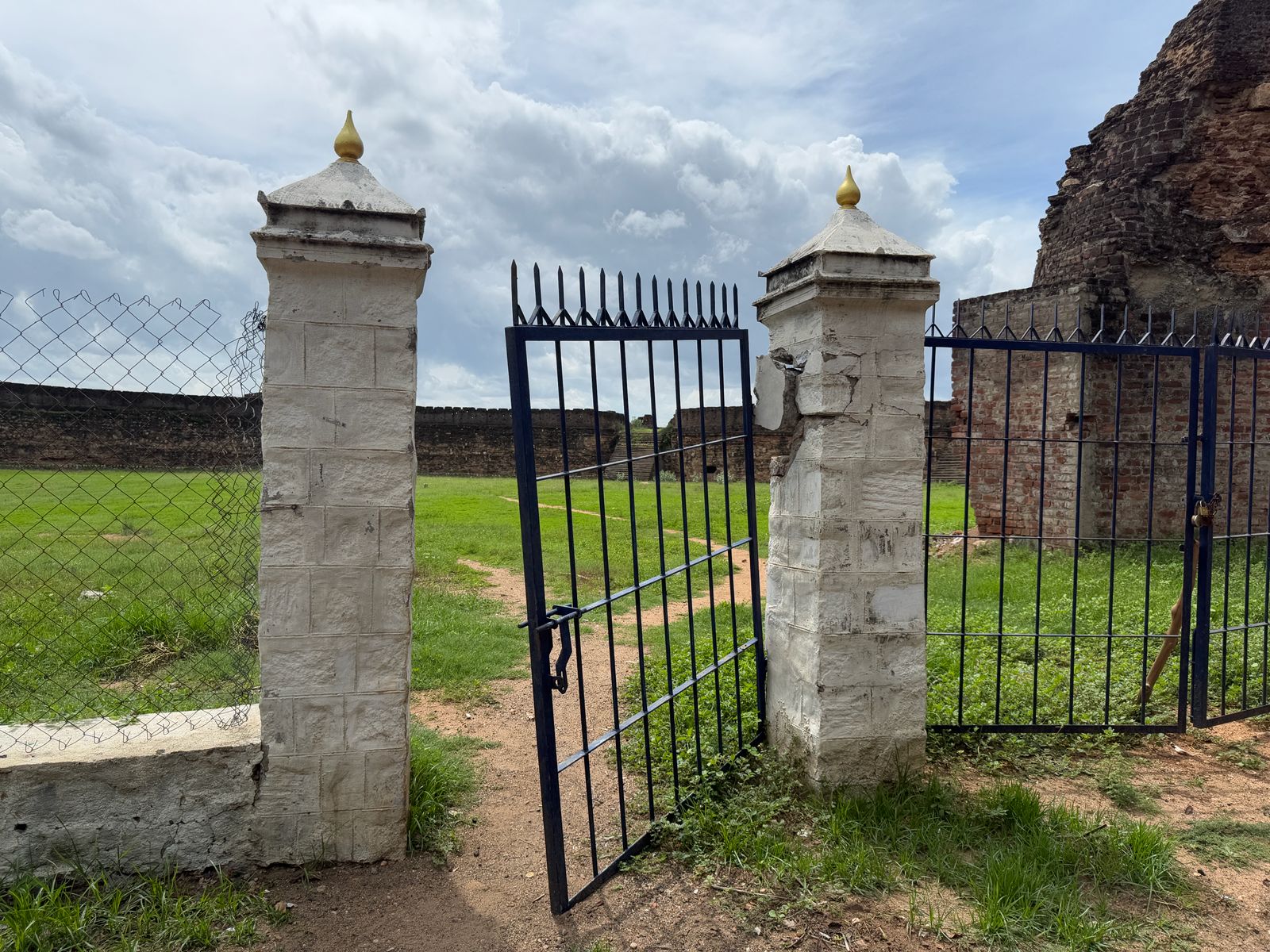
The drive from Sayalgudi was short and easy. The kind of road where fields stretch to the horizon and herons perform slow-motion flypasts. When the map finally announced, “You have arrived”, I looked around for a dramatic gateway, maybe a guard with a spear. Instead, a half-open steel gate squeaked in the wind. Silence did the welcoming.
My daughter and I stepped out to find a way to enter. A half-open steel gate guarding a three hundred year old fort was unmissable irony.
Inside, the Archaeological Survey of India had left a plaque, Tamil on one side and English on the other, as if to say, “You wanted history, here, have some.” It read:
“This stone fort was constructed 300 years ago by Sethupathy King Udayathevar alias Vijaya Raghunatha Sethupathy. It is believed that this was built with the assistance of a French Engineer. After the downfall of Panchalankurichi, this fort fell into the hands of the East India Company. It was also under the control of the Marudhu brothers for some time. It is reported that Veerapandya Kattabomman stayed at this fort on his way to Ramanathapuram.”
Department of Archaeology, Government of Tamil Nadu.
A Large Swathe Of Time
Three hundred years ago. Or maybe three fifty. Hard to say. The plaque offered no date, and the stone looked as if it had been sunbathing there for at least fifty years itself. Perhaps that was the idea, a quiet puzzle for every visitor to solve, century after century. A lump of cold data with no life, sitting there like an exam answer from a student who had memorised the facts but forgotten the story.
Large swathes of time like “three hundred years” hide more than they reveal. We revisited our memories and tried patching together a timeline of world events back then.
We bantered about how it might have been built when the Mughals were beginning to wobble.
Before the United States became a country, when it was still mostly wild land and brave people trying to survive winter. Before the French Revolution, when Marie Antoinette was still years away from allegedly offering people cake. Before Beethoven wrote a single note, before railways linked cities, before the first vaccine, and even before coffee became a global habit that half the world now depends on just to get through the morning.
The sun shone through the clouds. It was a splendid conversation to have in that setting. To talk about a quiet, crumbling place by stitching it into the larger story of the world. To look at these stones in desolate isolation, and then suddenly see them in full, noisy context.
The other line on the plaque that caught our attention was about the French engineer. What was a Frenchman doing in the sweltering plains of Ramanathapuram, drawing blueprints for a Tamil king? I pictured him, moustache damp, measuring walls under a merciless sun, wondering which Parisian sin had earned him this posting.
And then there were the Marudhu brothers, Kattabomman, the Sethupathis, all names that echoed rebellion and royalty. I could almost imagine them striding through this space with pride, purpose and possibly a few swords.
All these conversations were possible only because of past dalliances with history, and my occasional attempts to teach her some. In front of us, though, was an NCERT style summary carved into granite, looking surprised to get as much attention as we were to see it.
When you have too much history, you sometimes stop tending to it. It felt like a reasonable hypothesis to accept, nod at, and move on.
Steps, Stories, and Silence at Kamuthi Fort
The fort is circular, its thick walls still stoic even though time and rain have bitten chunks out of them. Wide stone steps climb up the ramparts. Strong. Straight. Stubborn. The kind you do not see in modern buildings.
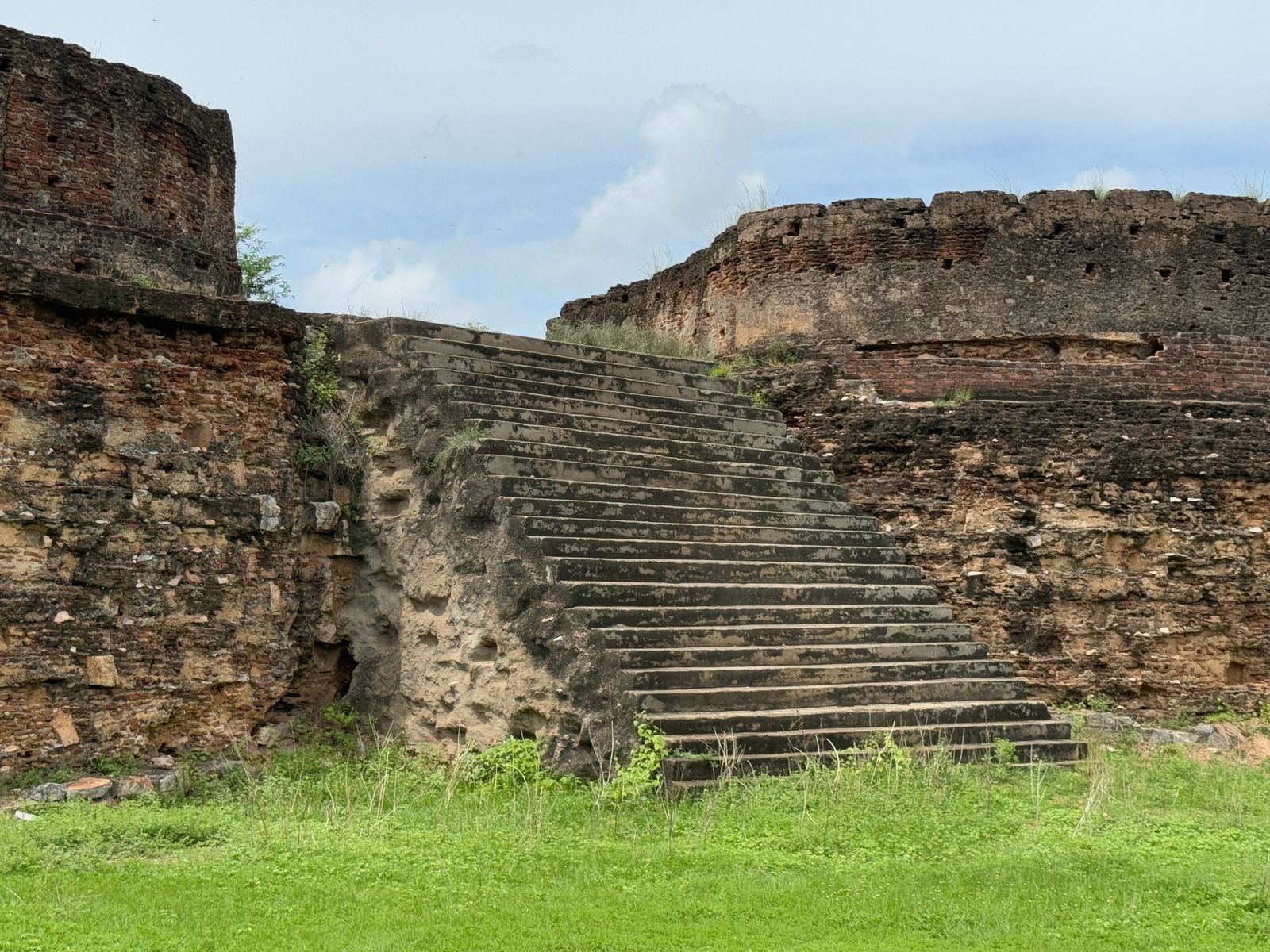
I climbed one and reached the top, expecting a grand view. Instead, I found empty beer bottles glinting in the sunlight. Every era has its warriors, I suppose. Then I climbed another flight of steps, and another view waited. Each staircase led to a different story.
From up there, the view stretched across contradictions. A colourful temple tower rose from one side, loud with freshly painted gods. On the other side, the Armed Reserve Ground stood silent.
I later found a YouTube video claiming that the cops once used the fort for target practice, until residents protested. Not out of love for history, but because of the noise. Small mercies, I thought. I have no idea how true that story is, but the fort clearly has had many lives. And its latest round of survival did not seem to be due to grand conservation plans, but to something far more ordinary, everyday irritation.
At the centre of the fort, a wide green patch stretched like an empty parade ground. Perhaps soldiers once trained there. Perhaps kings reviewed troops. Now, weeds stood in quiet attendance.
The walls of Kamuthi Fort are astonishingly thick, the kind that were built not just to stop enemies but to outlast them and ten generations that followed. Up close, you can see layers of old brick, lime mortar, sand, crushed shell, and the occasional glint of stone all holding together like a long, patient handshake.
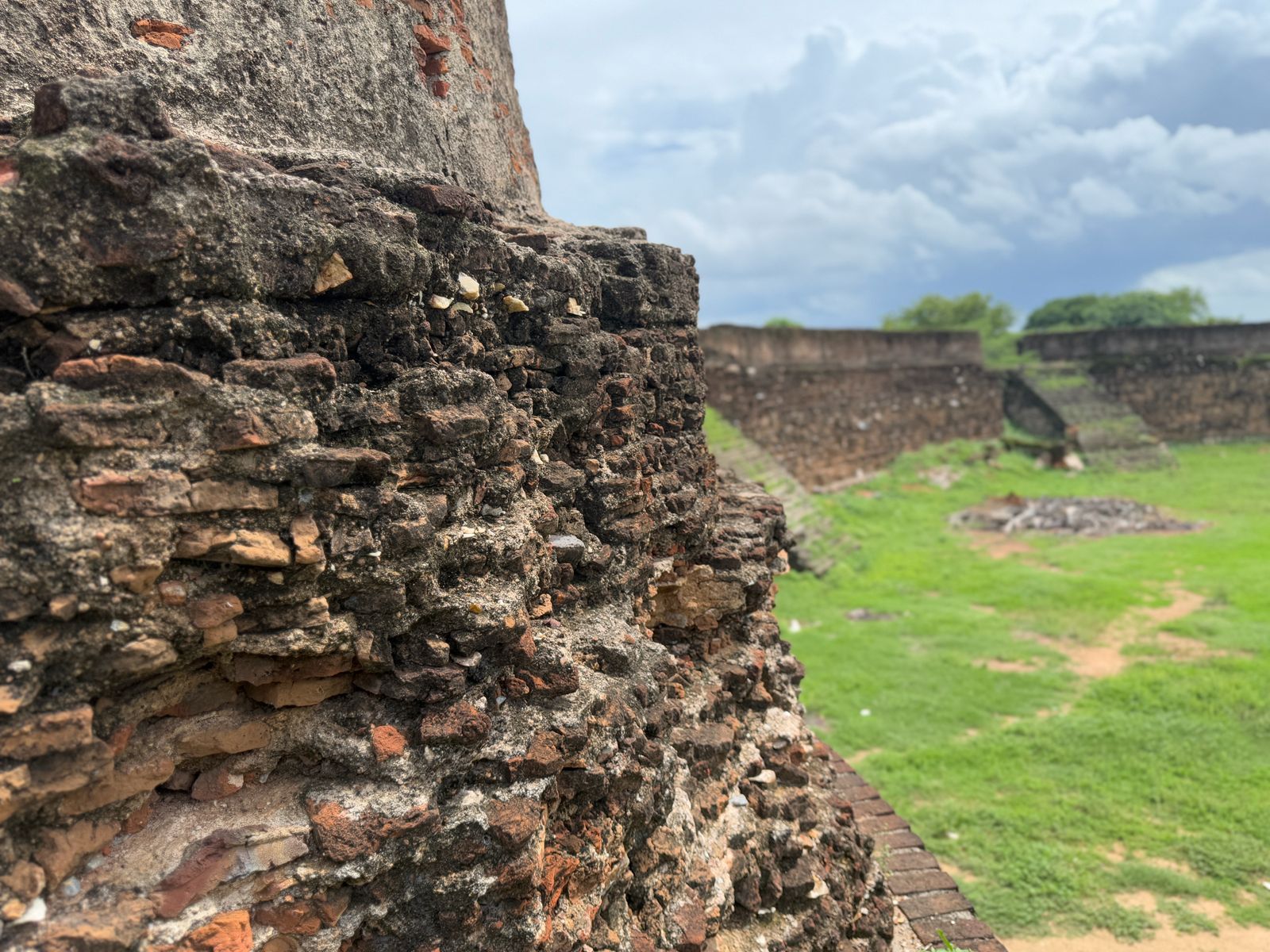
Later that evening we pored over the internet, trying to understand what gave the construction its strength. We found that builders in those days mixed the mortar with whatever helped it endure, including jaggery water, powdered limestone, and kadukkai, a small wrinkled fruit whose natural tannins helped the walls resist cracking and moisture.
Some recipes even mention raw eggs for a smoother set. Whatever they used, it clearly worked. Three centuries later, these walls still stand in stubborn defiance, quietly proving that things built with care and a few eccentric ingredients tend to last.
On my way out, I noticed a bold red 1993 painted on the wall of the temple wedding hall. Its proud year of inception. It stood directly opposite the steel gate, a mere thirty two years old. The contrast was almost comic. Like a fresher showing off a car he mostly owes the bank, before a billionaire who has lost his fortune.
What Kamuthi Fort Teaches Without Trying
Kamuthi Fort may never make it to glossy travel brochures. It does not charge tickets, sell souvenirs, or feature in drone videos with cinematic background music. But it has something many others do not. Presence. A stubbornness to remain. You walk through the broken walls and feel centuries of sun and storm still trapped in the bricks. You hear whispers of battles and see echoes of neglect.
If this were in Europe, there would have been tour guides with microphones, an entry ticket priced just right to fix half the state budget, and a tidy little museum shop selling magnets of the fort looking ten times grander than real life. There would have been plaques with footnotes, audio guides in eight languages, and a cheerful volunteer reminding you to stay on the marked path.
And if this were in the United States, the place would have been turned into “Fort Kamuthi National Heritage Park.” There would have been a café called “Kattabomman’s Brew”, a massive fort shaped bouncy castle for children, actors from Colonial Williamsburg doing hourly re-enactments, a twelve dollar bottle of water, burgers the size of dinner plates, and a forty nine dollar premium early access pass. Of course, the small town of Kamuthi would have been flattened to make way for a giant colour coded parking lot.
All this for a place that, in Kamuthi, lives perfectly happily with a steel gate and the afternoon sun.
It struck me then how wildly the world varies in the way it wraps itself around history. Some places polish their past to make it look like something else. Others leave it lying around like old furniture. Kamuthi Fort simply sits and waits, holding on with quiet strength while we hurry past. It deserves far more care than it gets. The slow drift into disrepair feels like a small discourtesy to everything it has survived.
Perhaps it will get more attention if someone like Lokesh Kanagaraj decides to shoot a fight sequence or a moody montage here. But we do not have to wait for that. We can start with something simpler, attention and respect.
We owe these places that. A few moments of silence. A pause to think of the countless hands that built, fought, prayed, or repaired these stones.
If you are ever near Kamuthi, please go. Not only for your children to climb its steps, but for yourself, to stand still for a while. To feel how time stretches, how pride turns to dust, and yet how beauty lingers in silence. You will come back lighter, and oddly grateful.
Because even in its decay, Kamuthi Fort is doing something quietly spectacular.
It is enduring.
Other blogposts from this trip
1. Kaapi Kadai wisdom
2. Notes from Sayalgudi