

I never met Ramki Sreenivasan. Yet I’ve heard his name often enough from friends and colleagues for him to feel familiar in the background. Like someone whose work you recognise before you recognise the face. I’ve read his writing, followed his work from a distance, and mourned his passing quietly.
Reading NS Ramnath’s piece on Founding Fuel, and seeing the images from the award instituted in his name, made me pause. Not as much in sorrow as much in meaning and celebration. A life like his leaves a long trail. For people, for places, and for everything that flies, swims, crawls, or blooms.
The award created in his name is not just a reminder of his work. It is a quiet act of love from his family and friends, who continue to keep his spirit alive in the field he cared about.
Ramki treated conservation as serious work. It needed persuasion, evidence, and courage. He didn’t photograph wild places as a hobby. He helped protect them. The tools were cameras and lenses, but the work was closer to activism.
A reminder of that impact came from an unexpected place: a tribute from Neiphiu Rio, the Chief Minister of Nagaland.
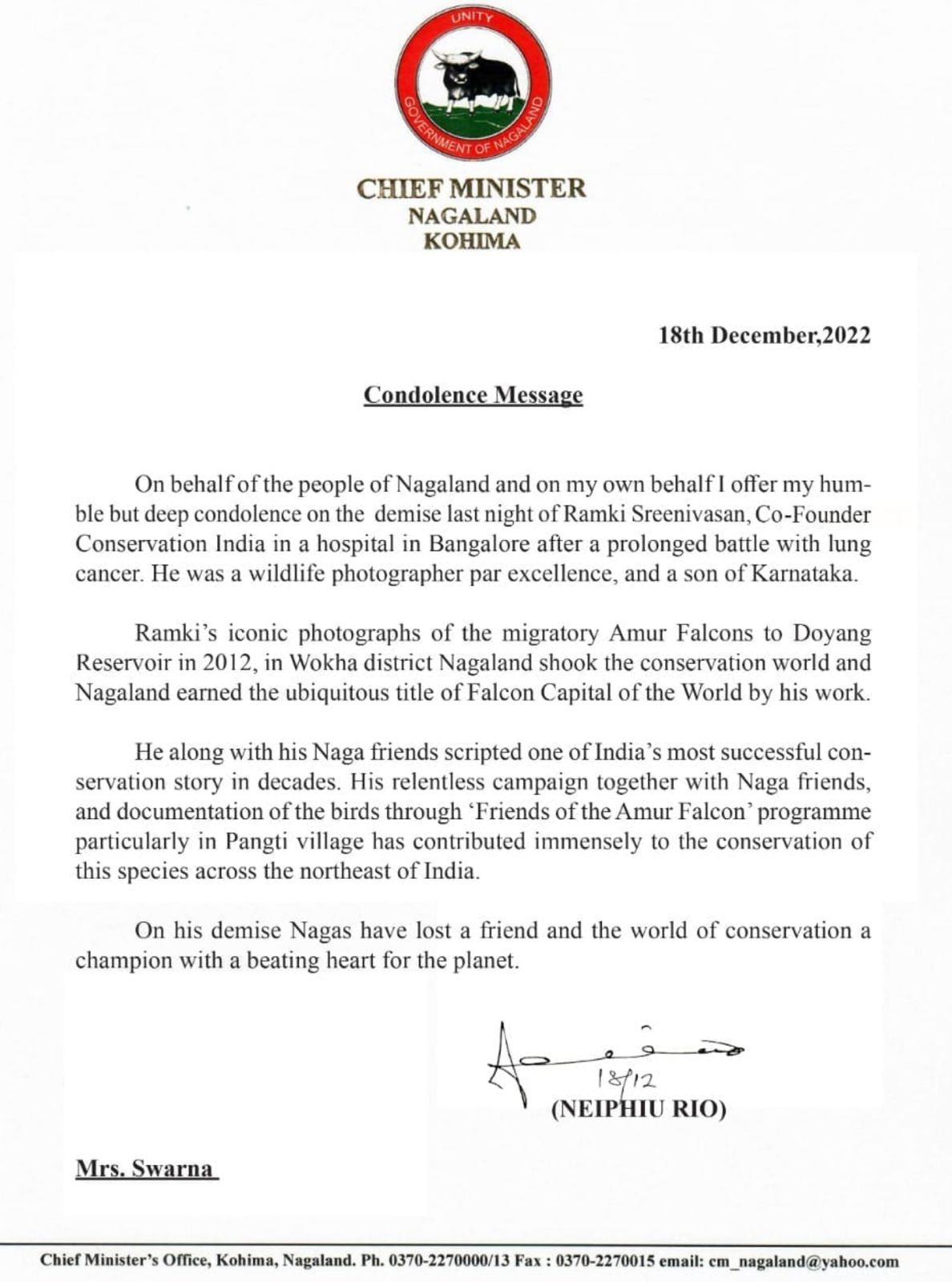
Political leaders rarely stop their day to acknowledge conservationists. Nature seldom makes it to the official list of people politics thanks. So when a state leader publicly honours a man who helped protect migratory birds, it says something about the work. And the scale of it.
The Cost We Forgot to Count
The damage we do to the environment is often invisible to us. We track inflation, GDP, stock indices, petrol prices. We complain about shrinkflation in our biscuit packets. But we don’t notice the shrinkflation of habitats. Forests thinning. Rivers narrowing. Skies losing their travellers. There is no mainstream index that measures the cost of losing forests, wetlands, or birds. It is a bill we are already paying. We have just settled for not seeing the invoice.
We don’t see ecological loss because it rarely comes as one dramatic event. It shows up quietly: fewer bird calls in the morning, a river that smells different, a fruit that no longer grows where it once did. These changes arrive disguised as “development” or “progress.” And because they don’t show up in quarterly earnings or political slogans, we treat them as background noise. By the time we notice, the damage is already permanent.
That’s where lives like Ramki’s shift perspective. They remind us that conservation is not fringe activism. It’s maintenance. It keeps the world in working order so that both people and wildlife can live with dignity. If the forests fall silent, we lose an entire vocabulary of life.
Small choices matter too. The plastic bag we refuse. The holiday we plan differently. A school project about migratory birds instead of zoo favourites. Culture changes through small, repeated acts of responsibility. And through teaching our children to relate to the planet as a neighbour they share life with.
Ramki’s life and work set a benchmark. This is a call to match his stance, not his scale. Most of us will not save a neighbourhood, let alone a species. But we can choose not to help erase one. That is a modest place to start, and perhaps the most honest one.
Some lives add noise.
Some add followers.
A few quietly make the world better.
Those are the ones worth paying attention to.
Here is the Founding Fuel essay by NS Ramnath for more context and links to Ramki’s work