Learning & Change

What does a coach really do?

The Indian cricket team’s dressing room sports a new head coach: Anil Kumble. The Indian head coach’s job is a prized one. Evidenced, if not by the frenetic minute-by-minute media attention, then by the sheer number of applicants for the top job: 57!

The Kumble coaching appointment saga took me back 10 years. It was 2006-07. John Buchanan was the coach of the Australian cricket team. The undisputed champions then, the team had earned a fearful reputation of clinically decimating opponents. Buchanan was a poster boy of sorts and I followed all what he spoke and wrote, and read all I could about his unconventional methods and the routines that he put the Australian cricket team through. It was another matter though that the team itself was star-studded: Shane Warne, the Waugh brothers, Ricky Ponting, Glenn McGrath, Matthew Hayden among others.

It was a random search fuelled by a liking for cricket, a passion for (and a job in) the people development domain and being a complete sucker for stories of “transformation” and success.  Buchanan and his boys kept reinforcing the stories that the media played out with success stamps from the cricket field. It was fascinating enough for me to decide that it was a success story that I had to get to the bottom of.

I remember reading and talking to other enthusiasts about his unconventional methodologies from pilates to public speaking. From prescribing Duncan Fletcher’s Ashes Regained as a mandatory read to dipping into Sun Tzu’s The Art of War for evolving the strategy he called “Everest”. And of course, the incisive deployment of data and analytics for team strategy. It was fascinating to say the least.

This is an extract from a piece that I wrote for Founding Fuel. Read the full piece here. 

The piece was published on 04 th July, 2016 and appeared in the Mint on the 5th July 16 and sported the above image along with the piece. 


Singularity University India Summit – Feb 2016

There is one aspect of Singularity University that has been on my mind for a while now. The very idea of it!

It is an idea that perhaps is ahead of its time. Maybe not, some would argue. For it is right here indeed. Perhaps it is an idea that is knocking on the high gates of the future, helping reimagine what lies ahead. Treating what we know with respect but not deference, in the quest for the seeking out a future that is beyond the grasp of linear minds.

So when Singularity University’s India Summit was happening here, and an opportunity to attend it presented thanks to Blogadda.com, I made it there. The India Summit happened in partnership with INK Talks and Deloitte.

Here is a summary of tweets. You will get to understand the summit, and hopefully will dig in a bit more about the idea of it all. In any case, I will write in more. I promise.

Mumbai, 26th/27th Feb 2016

Mumbai, 26th/27th Feb 2016

https://storify.com/kavismail/getting-started


One of a kind

Facilitation. Now, that’s a much abused word. There was a time when anybody with a PowerPoint deck, platform and a set of participants came to think of themselves as great trainers. Gradually, as ‘training’ in itself became less ‘cool’ and perhaps as a need to distinguish themselves from others who had gotten on to the ‘training’ bandwagon, it became fashionable to call oneself as a ‘Facilitator’. So much so, in several circles, ‘training’ and ‘facilitation’ are interchangeably, and without the slightest of pauses!

That topic for another day.


meaning


It was in 2011 that I got to experience deeper insights into what facilitation is. Or can be. I recall, very vividly, how a bunch of committed people from Japan demonstrated their response in mobilising public support and action, after the Fukashima nuclear disaster. It was mind blowing, to say the least. At one level, it was facilitation skills at play. But at another level, it helped me see a coming together of people with passion, with a singular objective of wanting to make a difference to a population. There was no commerce. No forking of brands in the name of CSR. It was just a committed bunch of people wanting to make a difference and do their bit. It was deeply humbling.

Since then, I have listened to stories and understood designs about how Facilitation helped brokered peace between countries or between warring factions of an apartment complex to bringing change within corporate contexts.

‘Facilitation’, I realised, was more dynamic and had potency to affect larger communities and conversations. Far beyond corporate walls and narrow problems. It was action. Inclusion. Participation. Mutuality. And a respect for one another. The feeling that we are all in this together. There was no pedestal to stand on and ‘address’ the group. I was hooked to the International Association of Facilitators. It occurred to me that to be able to stand before a group of people (sometimes in the 100s) and getting them to do their work, helping them work through their dilemmas is as raw as it can get. And more importantly having fun in the process.

After playing with facilitation in different settings since then (here is a post from last year), I am more than convinced that if it is one skill that community leaders, entrepreneurs, development workers, business leaders, leave alone HR practitioners, need to learn really well, it is facilitation. There is a ton of material available about what it is and what more you could do with this.. The International Association of Facilitators is leading the charge worldwide.

This week, I am looking forward to hearing many more stories of facilitation and sharing a few of mine too. The Asia Conference of the IAF is happening in Mumbai on the 21st and 22nd of August. Check out the website. With facilitators from around the world coming in, this will be one heck of a carnival of learning and process design. If you havent registered yet, I am told there are a few seats left. Do come in. Would be an experience to remember. Do follow the hashtag #IAFAsia15

IAF Conferences are quite unlike any other conference. They are intimate participative experiences that draw the best out of people in a fun filled effortless way. Riding on a feeling of togetherness and community. Plus there is a committed bunch of people working relentlessly to help the community move forward.

I am really looking forward to this.

‘U’ turns

“The boss isn’t competent”.

“The job isn’t meaningful”.

“Colleagues / partnerships are insensitive”.

“My health is going downhill and I don’t have the time to work on it”.

“People resort to unfair means to get ahead and I don’t want to do the same”.

“I cant get to work on my passions. The turkdom of daily work is killing my soul”

One of these is bound to come up in conversations beyond that go beyond a brief while. Once the pleasantries are done and the weather is beaten to death so much, that anything said beyond that would get the weatherman come after with an employment letter.

I don the hat of a coach, at times.  Most other times, just being a friend and listening to people, which in any case is a key aspect of being a coach.

The ‘sadness’ that engulfs the conversation is only eclipsed by the seeming helplessness of the situation. “But what can I do? I have a home loan and kids need to go to school” are refrains. Many speak of wanting to throw it all away and pursue their passions. The room lights up by their frissons when they describe these. Darkness returns as they talk of their immediate circumstances.

Sitting there, I don’t do much. For there is nothing for me to do except listen. Only pausing to ask a question here or one there. Hoping it can be a flare in a new moon night. Perhaps showing us a patch that can become a pathway. A clearing that can lead to a path. Whatever.

I have never ceased to be amazed at the depth of what resides in each conversation and in every person. Every time I come back convinced that the world will be a better place if we can sit down and talk to each other. Listening without an agenda.

The other thing that I have learnt to trust in, and am always proven right is this : people have it in them to be better off with their lives. Sometimes all I have to do is to help them become present to the fact that their choices make the difference. Choices that they become aware of when they speak their hearts out. When they are in the flow.

The moment, choices and consequences are very clear to people, new possibilities emerge.  People begin taking the You Turn. First in their minds and then if you help them stick with it, in reality as well.

You don’t need to do much.  Ask a few questions. Listen with all you have got. Perhaps am making it sound a tad easier than it is.

Here is an invitation. Perhaps its a challenge. Can you sit back and listen to one person this week?  It could be your driver. Perhaps the boss. Maybe its a peer in another organisation. Or even your kids. Listening without agenda. Just one person.

It may seem like an exercise in waste. You have no idea what it does to the other person. I didn’t too, for a long while. And then, I experienced an ace coach help people take ‘U’ turns. It gave me a new lens and I have been working on my ears.

Try.

Small problems with big data!

Conversations on Twitter have a unique ability to set off reflection and propel further conversation and thought. This invariably builds and shapes our collective ecosystem of sorts.  Especially so, when the conversation is between people who you watched from a distance, making a difference! 🙂

This post is a thought assortment, after spotting a conversation thread on Twitter.

It went like this.

(more…)

Wheels of Change!

Its a bright, brilliant Sunday. My nephew, who is all of seven years, is up and about. As I slip on the running shoes, he wants to smell the outdoors with me. ‘Lets walk’. He says. It isn’t often that such privileges nudge me. I agree in a flash

His seven year old legs are growing stronger. I notice. His limbs are slim. His hair in one irreverent lock that is bouncy and chirpy. Just like him. ‘How long are we going to walk?’, he asks, a few steps into our walk. As our incessant chatter steals a march over the energy expended on the walk.

Soon, I realise, like all of us he too has several windows to the world. His school. His friends and of course, his dad’s tablet.

Today, he paints a ‘I am a super hero’ picture to me. As you can imagine, I am remarkably pleased. Its been ages since anyone has tried to impress me. I let him know how impressed I was. We walk another fifty meters and I think he is slowing down.

‘Are you tired?’, I ask.

‘No’. He says. With the same singular chirpiness. ‘It is now 99’ he adds. My brain scrambles to assemble some sleepy resources to figure what the ’99’ is all about. After a bit of silence, I ask him, ‘err..but what is this 99?’

There are points in time, when kids lose all their respect in an adult’s prowess. The taller the pedestal they put the adult on, the harder the adult falls. When that moment comes, its not a pleasant feeling. This was that moment, when the push from the pedestal happened. He stopped walking. Put his hands on his hips. An expression that left something like ‘You didn’t know this….?’, largely unnecessary. He merely says, ‘My battery’. (Pronounced BAH-TTERY. With suitable emphasis for effect). “My body battery, when we started out from home it was 100. Now it is 99′.

Of course the ‘battery draining’ and ‘recharging’ have established themselves as common everyday living and lingua that are well woven into modern day language. But this quantified expression from this 7 year old, hands me a knock out punch.

We carry on with our walk. Speaking of other things. He with some of his questions and me with mine. The words he uses reveal the depth of his questions and the rich texture of his worlds . We speak of his sports day and the medals that his track running got him. The super hero in him emerges. Again. ‘I beat them all’. ‘By a lot of distance’. He says.

‘A lot of distance?’ I ask. Sensing an opportunity for a lesson in English grammar.

‘Yes. yes.’ He says. Vehemently. With a flourish, he adds, ‘They haven’t upgraded their bodies’, he says. I smile. Now that is profound, I think. I drop the idea of English grammar. I pursue this ‘upgrade’ line of thought. Having lost all of my respect on the battery front, I can afford to play dumb.

‘What does that mean?’, I ask. ‘Upgraded their bodies’?

In a seamless flow, he begins. “They are not becoming stronger, faster. And they don’t come upto me and say, ‘ I will beat you in the race’ ” That is what is ‘updgrade‘ is” he says. This is getting profound!

Our talk meanders on a straight road. Gradually the topic drifts to ‘what is the one most interesting thing that you can spend hours on end doing?’

‘I like cars’. He says. Almost impatient to allow me to complete my sentence. I too was greatly fascinated by cars in days of carefree boyhood. Perhaps it runs in the family, I think. I tentatively ask him, ‘Which cars?’ thinking that I would hear the the likes of BMW or an Audi!

He takes off.

“There are 183 different types”. He then rattles of a names that to me sound like random assemblages of vowels and consonants. Finally, resting on, “and sometimes, the ‘Dodge Viper.’ “
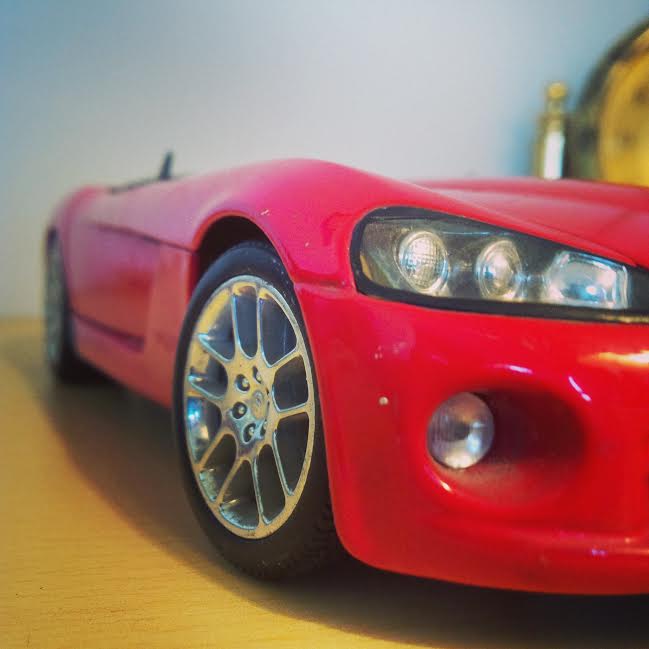
Dodge Viper

Thats the only car I am familiar with from his list. His dad had gifted a scaled down model to me many years ago. A model that sits on my desk to date. It was my dream car for a long while, until someone educated me on how many arms and legs I would have to give up to turn the wheels of something like that!

Today, I hold onto the Dodge Viper. And ask him, ‘Dodge Viper? But where have you seen the Dodge Viper?’

In ‘Asphalt 8’. He says. With a shrug of his shoulder. With a ‘I hope you know where that is’, look on his face. Hesitatingly adding, ‘I am sure you have seen it there’.

I am lost. I say, ‘Hmm’. Like an amateur boxer who is recuperating in his corner bleeding from three cuts that a friendly jab of a professional boxer caused.

Of course, ‘Asphalt 8’, ‘Need for speed Most Wanted’, are all video games. I am blissfully unaware of an entire ecosystem that is powering the world of my own nephew! He is unstoppable now. ‘There is Henessey Venom GT’ he says. And speaks about how fast it can go, how good looking that is and how expensive it is too. The prices he quotes are the prices of the video games. He seems confident.

Here is a guy who doesn’t like to sit in a real car, yet someone who prefers to play with them via a window. Me and brother were very different. We had to see them. I used to go to friends houses, because their neighbour had bought a new car. Touching the new car, just lying down and checking out the undersides and rushing to scarce books to read up more seemed so worth every passing second.

We have covered significant distance. 3-4 kilometers. I ask him, ‘Are you tired?’ It takes a while before he answers, ‘NOooo’.

The obvious and most common narrative that emerges from the previous generation talking to a younger generation, is often about how glorious the past was! And as a natural extension, how broken the present is. To see the present as a lament would be to view it through the lens of a time that is gone by.

The greater chance of living a fulfilled, productive, joyous life is to embrace the change and start off by speaking a different language. The onus is not on the newer generation to change. It is for the older generation to reach out and embrace the new. To make sense of the what is coming and to help the new flow well, learning from the mistakes of the old!

The world will belong to the new. In a short while! The first change perhaps is in how I think. Maybe language is a good point of synthesis. I ask my nephew, ‘Is the battery about 48?’ I ask.

Hmm. ‘Noooo. Its about 30′ He says. Ah. Thats a lesson learnt well. The next time, I wont ask him ‘Are you tired?’

The wheels of change. They keep spinning. If we need to get somewhere, we need to keep steering! We walk for a bit in silence. He drifting, perhaps, into his world of cars. I drifting into the world of change and how much more I have to! Bringing about substantial change within, is after all no walk in the park!

The lost art of fine conversations

Conversations after all the binding paste for several things. For a relationship to blossom. For a transaction to take place. History to be passed on. For societies to mature. For lessons to be learnt. Developing people and building a cultures Not to speak of building cultures in an organisation.Of course, The Cluetrain Manifesto took it to a different height altogether stating “Markets are conversations”. ( Incidentally, have you read the New Clues?)If we just hover around the topic of having good conversations, one on one, or even amongst a group of involved friends, how would it be? Think of a good chat you had with someone. Where you spoke and he or she spoke your hearts out?

Flowers

Wouldn’t it be nice? When did you last have such a conversation? How many times in the recent past have you had such involved conversations?If you have had such a conversation in the recent past and are prone to having such conversations often, then you can count yourself amongst a lucky minority in the world. For the world in itself is increasingly bereft of good conversations!It is a travesty isn’t it, when what makes societies and communities accorded lesser importance, in a world where everything is getting ‘smarter’? I have a premise : The power and the need for having deep conversations is seriously underrated.

Oftentimes we feel a vague sense of not connecting to family members, to teams we work in or organisations we converge at, there is a vague feeling of loss. A feeling that something is amiss. Not often, however, is this question pondered over : When was the last time I SPOKE to someone? I write ‘SPOKE’ in capitals, for it is not the same as having a dead ‘how is the weather’ or ‘we should strive for world peace’ conversation.

It could be five minutes or fifty minutes. Maybe five hours, where not much is spoken, and the presence speaks. What counts is how genuine is the interest shown in knowing more about the situation and the person. Its about revealing parts of oneself. Its being in the moment, with the other person.

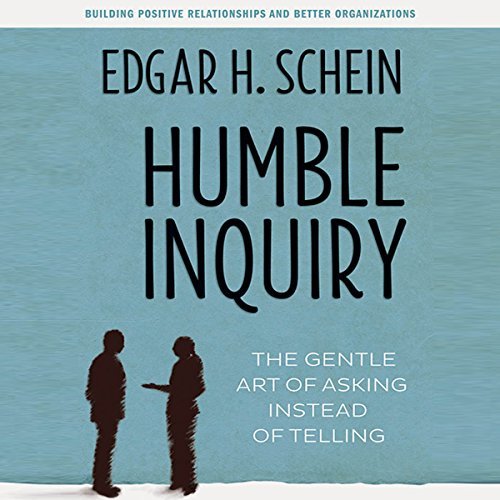
a reciprocal dance of self-exposure through alternately questioning and telling based on curiosity and interest writes Edgar Schein in the Humble Inquiry. My post on the book is here. That is an eloquent call out for good conversations.

The trouble with an aspect like ‘conversation’ is that it appears very simple! It is indeed simple. So simple, that its importance is missed. Given the distractions that our everyday world offers and the preoccupation that several of us have with ourselves, it is not easy to have good conversations.

Yet, it is at the centre of our modern day existence! Where ‘inter-dependency’ is a necessity that doesn’t require any reinforcement. Good conversations provide us with the opportunity to move from being mechanistic to being truly alive. To deal with ‘colleagues’, ‘family’ or ‘team members’ or ‘boss’ much beyond the shallowness proffered by the literal meaning of the word. It means interacting with another live human being.

 Organisations offer multiple formal opportunities for good conversations. Yes, they carry different labels like ‘appraisals’ or ‘development’ or ‘coaching’. In essence they are conversations!I chanced upon this wonderful Harvard Business Review piece titled “Leadership is a conversation” . If you haven’t read it before, do take the time to read it. If you already have, do give it a read again. . (The same authors have another piece titled “Conversations can save companies“. The aspect making talk happen is a leadership responsibility. That stood out.). The piece by the authors is fantastic on many counts. Putting together a need for a communication model that is ‘intimate, interactive, inclusive and intentional’ is powerful. Those are in any case tenets that make a good conversation between two people. When you imagine conversation as the basic thread that makes the weave of a community, a society or an organisation, you realise that it needs to be accorded far more importance than what is accorded now.

I hope this reaches you. In case it does, we sure must talk about it!

Building an “attitude of interest” – Humble Inquiry


My dad used to always tell me that the virtues in keeping things simple, easy and small was so huge, that it gets often missed. His knack for keeping things real simple and constantly seek beyond what seemed obvious or what were ‘mainstream voices’, got him untold riches. Relationships. Ideas. Discoveries. And a wide spectrum of people who wanted to work with him. The essence of it was all about having an abundance of curiosity and an attitude of discovery. More of dad later.

Now about Humble Inquiry.

HI

When Vivek Patwardhan recommends a book, I close my eyes and buy it.  Thats that. When he recommended “Humble Inquiry” by Edgar Schein, it was no different. Having consumed several of Edgar Schein‘s work in the past (and occasionally foisting it on MBA students who I taught), I was mildly surprised that I hadn’t come across this work before.  That it was dated June 2013, was some consolation!

Schein writes at the end of the book, “This book represents a culmination and distillation of my 50 years of work as a social and organisational psychologist“.  That one comment should be suffice to get anyone get started. But there is more. Here is another quote. “The current book Humble Inquiry brings together all of these trends in showing how culture and individual behaviour interact, and what it will take in the way of counterculture behaviour to deal with the changes that are happening in the world“.

In more than one way, the last few posts of mine have been about changes that are occurring in the world and our ways of dealing with them. Be it facilitation, Working Out Loud or even ‘Social’ for that matter.  This book settles that theme remarkably well for me. My own stumbling across such themes is either a fortuitous consequence or perhaps I am viewing everything that I am stumbling across with my current lens.

From very early on, Schein anchors his argument as an alternative to the popular mainstream culture of ‘tell’. “We also live in a structured society in which building relationships is not as important as task accomplishment in which it is appropriate and expected that the subordinate does more asking that telling, while the boss does more telling that asking. Having to ask is a sign of weakness or ignorance, so we avoid it as much as possible”. 

He drops anchor on curiosity, to explore and a willingness to ask questions to which we do not already know the answer.

The book is insightful in more ways than one. It is a read that I would recommend to any leader aspiring to lead large organisations now. And more importantly, in the future. The examples are lucid and pointed. Before you assume that the book is a set of skills about asking questions, let me hasten to add, that it is far from that. In fact, Schein himself states explicitly at several places. “The kind of inquiry I am talking about derives from an attitude of interest and curiosity“.

The book has several parts to it, stretching from building a case for it, articulating what it is and what could be possible inhibitors and ideas about developing this attitude. The weaving in of Humble Inquiry through the windows of simple frameworks like Johari Window and the ORJI (Observation – Reaction – Judgement – Intervention ) model helps in making it contextual and practical.

Its an easy, simple read. Devoid of jargon. Its the best Rs.123/- that I have spent in a long time!

This book is a superlative, if you are in the talent development, culture change arena. If you are an executive coach or are in pursuit of perfecting your skills, this could well be the centrepiece of your practice. Of course, this book holds a bundle of benefits for anyone serious about leading teams in our current times!

The scepter of uncertainty envelopes every leader’s ornamental bauble. Knowledge and expertise are far too distributed within and outside the precincts of the firewall.  The ‘attitude’ of ‘Humlbe Inquiry”, when coated with ‘social skills’ adds another rather potent dimension to the modern day leader’s quiver.

And, dad. It was while reading this book that realisation dawned that what endeared him to many was his consummate practicing of ‘Humble Inquiry’. His innate ability to ask a question with warmth, genuine interest and wait for answers used to have many wanting to talk to him. This book reminded me of him. Thats one more reason that this book stays on my mind.

Facilitating a conference on facilitation!

There is one conference that I make it a point to be around, it is the India conference of the International Association of Facilitators. For a variety of reasons. For one, it is a brilliant community with loads of equanimity. For another, there is no question of sitting back, staring at a deck of PowerPoint slides, slickly produced corporate videos and listen to suave speeches or a panel discussion, which is the staple fare of most other conferences. Nothing wrong with that.

Just that, the IAF conferences require active co-creation, reflection, and meaning making as an integral part of every minute. IAF events are truly immersive experience for everyone in the room. Never a dull moment. Perpetually inclusive and trusts the wisdom of the community to keep it moving along. That is a rich wisdom and I have always been enriched after each meeting!

leadership

IMG_20141115_131940

To share, learn and grow with the community is a narrative that is dear. We (Me and the L&D team from Asian Paints) were there this time around too, to share our experiences with facilitation, but more importantly to co-evolve along with all participants, a ideas and thoughts alongside our experience.

We ran a concurrent session and here are some highlights and reflections that we shared and helped co-create

a. The detachment that is necessary from labels & tools and in order to attach ourselves to outcomes seemed to resonate with many. The ‘lightly-tightly’ way of working. There were several models that got built atop that vector.

b. Every tool has a place and needs to be respected for that. Overuse can undermine, and under use can be a travesty of what is possible if that tool too had been used. Training, Facilitation, Coaching etc are different tools. ( Tools that carry different meanings in the minds of many). Attachment to outcomes, can bring about a focus on interplay and ownership.

c. Questioning of assumptions can alter the dynamics of how the future (and organisational processes like ‘reviews’)  can be differently built. To begin working on a problem as its stated, but to enable reframing of the ‘problem’ by all stakeholders, with imagination, can cause considerable shifts. We shared a couple of examples, the group constructed a few that were neat.

d. Of course, there were multiple rounds of discussions on ‘dismantling the hierarchy’ and the imaginative ways of co-creation that can be enabled by simple sharing and ‘letting go’. I would reckon the ‘letting go’ bit is a difficult but necessary pill (if it were to be one), for outcome effectiveness to reign.

e. We had begun by getting the group to imagine ‘all interactions’ within an organisation. The choices made by random diverse groups reiterated to me, how common organisational dilemmas are. And more importantly, for how long they have been around. We need new ways of working with and resolving these dilemmas. The old ways don’t work, for they were meant for an old time. And of course, we ourselves are new.

unnamed

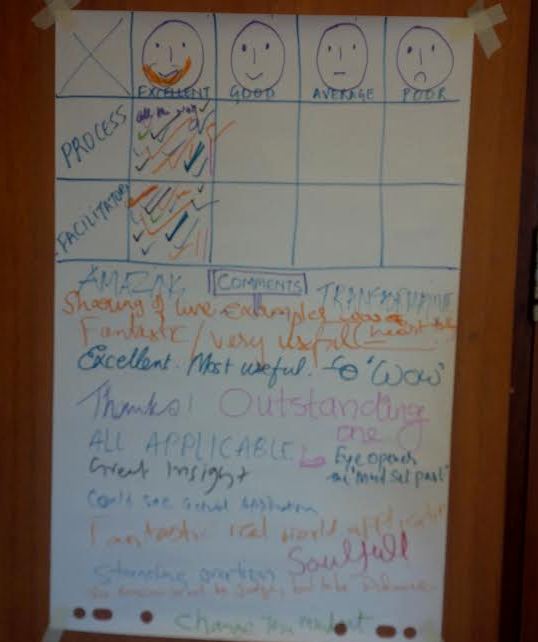
Another feature of IAF Conferences is the open, transparent way of gathering and collating feedback. What you see above was feedback sheet of participants from our session. It left me smiling, while serving as a pointed reminder of the work to be done.

The world and the #FutureOfWork, need an inclusive approach to life, living and work. The foundations of ‘facilitation’ stretch far beyond a clutch of skills. It presupposes an inclusive, generous, mindset that is not bound by ‘control’ but lead by ‘a letting go mindset’ and get everybody to take responsibility. It is a key skill to imbibe and get proficient with, for now and the times to come. With an emphasis on community, common ground and development. Skills to stitch together the future in the face of ever widening differences, are critical. Now, more than ever before.

It was in 2011 that I first attended the Asia Conference of the IAF in Bangalore. There were delegates from many parts of the world and every corner of Asia. It was 2011, the world was still reeling from the shock of the earthquake and Tsuanami that hit Japan. That conference had a number of facilitators from Japan, who detailed and demonstrated how ‘facilitation’ was getting deployed to rebuild the community in Fukashima. It was a deeply moving and a very thorough experience.

The conference provided perspectives, a clutch of skills and a sea of global friendships. I remember leaving that conference thinking if facilitation could aid complex community building work (like the Fukashima example) from the ground up, adapting it to the precincts of organisational  realities required a dash of courage and oodles of imagination. Nothing more. In more ways than one, it sparked a fresh bouquet of thoughts and has kept us busy for a long while.

Heres some news : The Asia Conference of the IAF is coming back to India ( It went to Schenzen in 2012, Tokyo in 2013, and Singapore in 2014).  Sometime in August 2015, Mumbai will play host to the IAF, Asia Conference. Thats the best news I have heard in a long time.  Watch this space for more.

In the meanwhile, here is Brig.Sushil Bhasin’s generous take on our session. Do read and give him a shout! 🙂 His energy is infectious.

Connecting dots

There are several riches the internet has offered me. One such is the opportunity for coffee and conversations with a multi hued spectrum of people that makes the mind soak colour from a rich palette. The limitless pleasure of conversations with a ton of interesting people is quite something. A fascinating array of stories have been exchanged.  Stories that bring alive our coruscating lives of arresting colours, often glazed over by the sad tint of the daily humdrum of existence. Needless to say, much coffee has been drunk, with this as an excuse. But that’s a story for another time.

For now, here is a story about stories.

Filter Coffee

Last week, work took me to Bangalore. Meeting Jaya (@nohrgyan on twitter) was forever on the cards and circumstances lent themselves rather well. Soon a filter kaapi flowed down the alimentary canal as the stories that we told each other filled the air and hogged her tastefully done up home. In the flicker of a few lamps with many wicks, characters, instances, incidents all seemed to flutter to come alive with a spontaneous flutter.

Her story. Her mom’s story. My story. Our dilemmas. Our hopes for the future. Our origins. Speaking of origins, I spoke, like I usually do, of Madurai. ‘Madurai’ adorned prima donna status, in the conversation for  a bit. In some time, a gentleman that Jaya and her mother knew, drifted into the chat. The man they knew was from Madurai.

This gentleman, called Krishnan, had beaten the odds before the odds got even with him. Many accounts of the awesome man he was, flowed, while I listed in awe. Like his dogged determination to learn. Of how he would assemble kids to spread the word about the environment. His doing his PhD and his quest to learn in rather trying circumstances, to put it mildly. His cycling to work and his innate grasp of what it was to learn and to be of value to any and everyone around.

One particular story of how he guided Jaya’s mom to watch birds fly in formation at 5.45 AM from a particular angle at the terrace was narrated with such energy, that what was left was hearing birds flap their wings, in the warmth of the home. He seemed to have created so much difference not only to his body of work, but to an entire community.

“And then, one fine day, he went home to Madurai, had food, watched a movie and went to bed”. In a matter of fact undertone she said, “He didnt get up the next day morning”. A gasp broke free. He was all of 35. The memorial service had people from around the world pour in their messages. Jaya said she too went to the memorial and spoke about his helping her mom to spot birds fly in a formation. As I got more and more curious about the man, she fiddled with her phone and pulled out this page. A tribute of sorts.

My heart beat faster and beads of sweat congregated from nowhere. I went still, when I read on. For the Kannan she was talking about, I knew as Ramesh. I knew him pretty well. He was in the class I used to teach more than a decade ago. Memories of him came flooding back. A tall handsome bloke, with sincerity as a middle name and a bright outlook to life and living. Twelve years ago, I taught a class of awesome students pursuing a Master of Science in NGO Management, from Madurai Kamaraj University. I went blank for a bit.

He and the conversation stayed with me long after we said our goodbyes and moved on. Many cobwebs in the mind got cleared as I had a dull dinner at the airport.  As the plane took off that night, the pilot announced a thunderstorm had hit Bangalore. He could have well spoken of what was happening within me.

The next day, Jaya called me. She said she had bumped into Ramesh’s wife and told her about me and my visit. ( She was a student in the same class as well). Apparently Ramesh’s wife had some very kind words for me and my work and went on to say Ramesh had great regard for me, citing incidents. And as Jaya narrated the incidents she had heard over the phone, I noticed them emerge from piles of other memories that were stacked on top.

As we were hanging up, Jaya said, “I wanted to tell you this, for otherwise there is no way you would have known”. I couldn’t agree more. Since that rainy evening of Bangalore, my mind constantly darts to wonder how small yet how large, how simple yet how complex, how similar yet diverse, how cruel yet joyous, our world is!

The thrill of the success that Ramesh, a small town young man, had achieved, hasn’t died down. Not in a merely materialistic way, but in a much larger wholesome way, making a difference to an entire community of people around the world. Even as it stands tall, the fragility of life makes its silent presence felt.

I will never ever forget Ramesh now. Or how we met and later took different paths, only to emerge at an intersection caused by an interaction! The tapestry of our lives is often a fast moving assortment of people and moments. Every interface is a dot that we leave somewhere. Sometimes, the dots come back to connect and spark a fire of wonder. That fire is often lit by two flint stones called ‘Stories’ and ‘Conversations’. The insanity that surrounds our routines, can nibble our souls. The wounds that are laid bare by the nibbling, are often soothed by gestures like Jaya’s and in the power of sharing and listening to each others stories.

So people, heres something you could consider doing. Sit down and talk to people. After they have shared their story, go ahead and share yours. Talk to someone. You never know which dot will connect or what it will lead you to.

PS : You may want to give this a read sometime. I wrote it in a seamless flow a while back and realised that it tethered emotions together, more than thoughts.