


The Bangalore Literature Festival has been around since 2012, but I always managed to miss it. My first glimpse of it was through friends and colleagues at Founding Fuel, Charles Assisi and NS Ramnath, authors of The Aadhaar Effect, when they spoke at the festival years ago. Since then I have been meaning to attend. Something or the other kept coming in the way. Then I read the founder’s comment on Founding Fuel about moving the festival from the five-star comfort of The Lalit Ashok to the wide open public grounds of Freedom Park. I remember thinking, Freedom Park? Interesting. The irony and the possibilities jumped out at once.
And so I finally went. The first thing that greeted me was a tall mosaic figure holding a bright red surfboard-like object with the word Freedom splashed across it. Not exactly what the British officers had in mind when they built the place, but a cheerful indication of what the day held. A few steps further was the bright @blrlitfest sign in pinks and blues. If you ever needed proof that literature can trend, this was it.
If you want to experience the full irony of modern life, go to a place once built to keep people in and watch thousands walk in voluntarily, some even jogging, to attend a literature festival. Freedom Park, the former Central Jail of Bangalore, is now a pleasant expanse of trees, sunlight, ideas, and, for a day at least, more book-loving humans than you could shake a bookmark at.
The symbolism was impossible to miss. Once, Freedom Park held prisoners in barracks with concrete beds and narrow passageways where freedom was a rumour. Now those same spaces hosted sessions on Sanskrit, parenting, news, men’s rights, and All India Radio. Chairs and yoga mats were laid out neatly across old prison beds, and people sat on them happily, notebooks open, as if taking notes in jail was the most normal thing in the world.

The watchtower stood tall and white in the centre, looking gently puzzled by its new job of overseeing conversations instead of convicts. A sepoy cast in stone held his rifle and stared ahead, while festival banners fluttered around him. If he ever imagined he would spend eternity watching people queue for author signings and filter coffee, he revealed nothing.
Entry was through two long parallel walls once built to contain bodies. In the evening they glowed red and seemed delighted to welcome minds instead. I could almost hear Bill Bryson remarking how human beings are the only species that would turn a former prison into a venue for people who willingly sit for hours listening to strangers discuss how to live better, write better, and occasionally argue better.
Inside the Festival: Ideas, People, and a Whiff of Possibility
The crowd was a marvellous pot-pourri. Teenagers with tote bags. Elderly couples who looked like they had stepped straight out of a Sunday crossword. Children trotting towards the #CLF area, drawn to colourful cloth canopies and cheerful storytellers. And of course a smattering of stars from Day One. Banu Mushtaq. Vir Das. Santosh Desai. Vivek Shanbag. And Shashi Tharoor, freshly returned from shaking hands with Vladimir Putin, which is not a sentence I ever expected to write. Yet there he was, surrounded by admirers, looking as though world diplomacy was merely a warm-up act for a weekend lit fest in Bangalore.
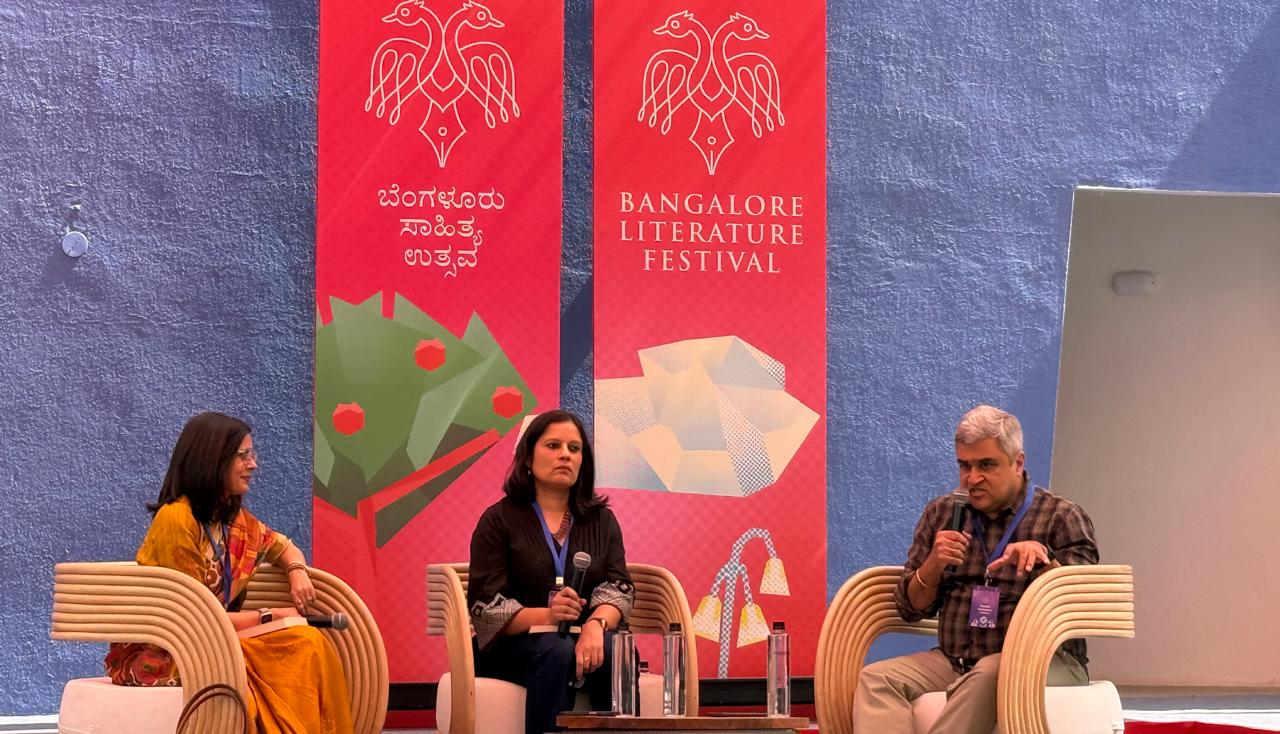
What I enjoyed most was how many remarkable authors simply wandered about. No entourage. No velvet ropes. You could walk up, say hello, and they would smile like old friends. In a world where even mid-tier influencers travel with ring lights, this felt wonderfully human. A free world, at least on that patch of reclaimed earth.

The children’s section was buzzing. Under a rainbow of cloth shades, kids sat on red chairs and listened wide-eyed to storytellers and wildlife experts. A far cry from my childhood, when literary glamour meant reading an author interview in The Hindu framed stiffly against a bookshelf. These children had open skies, soft grass, and sessions under trees. My younger self would not have known where to look.
There was also the small matter of the prison of devices. Everywhere I looked, people had put their phones away. Not in silent mode. Not in airplane mode. Properly away. Buried in bags. Forgotten. Occasionally taken out to check programme changes, especially after the Indigo fiasco caused some authors to miss their slots. It was as though the old walls had agreed to keep the devices inside and let the humans escape.
The fashion added its own subplot to the day. There were the formal types in suits. The linen types whose clothes took a moment to arrive after they did. The tight-fit types who seemed to have been sentenced to mild compression. Prints with camels, checks, stripes, feathers, hats, turbans. Greens, blues, greys, and salt-pepper combinations that could have been a paint chart. A riot, and a joyful one, united by a love for books.
I also met a few old friends, people I had worked with years ago. Some were authors now. We talked about books we were reading and books we were pretending to read. We shared recommendations. We spoke of manuscripts in progress and our quiet ambitions to one day contribute something that would sit on a table like the ones before us. These small reunions made the day feel less like an event and more like a homecoming.
Book buying was brisk. I picked up a few myself. At the end of it all, the young lady announced proudly that they accepted no credit cards. Instant debits from bank accounts are perhaps the truest measure of commitment. People paid anyway. I did too.
The organisers deserve every bit of credit. They created something warm, open, and quietly defiant at a time when reading is supposedly declining and AI, we are told, is sharpening its knives for books.
But at Freedom Park, of all places, there was a whiff of possibility. Under the watchtower that once surveyed prisoners, I watched hundreds of people sit under an open sky, listening, questioning, dreaming, and shaping answers they would take away.
Reading keeps us human. Writing keeps us honest. And festivals like these remind us that imagination is still, thankfully, unjailable.
Google says, ‘Dopamine is a crucial neurotransmitter (chemical messenger) and hormone in the brain and body, known as the “feel-good” chemical, vital for motivation, pleasure, reward, movement, mood, focus, and learning.’ Books as Dopamine is such a perfect analogy. There are people who keep religious books under their pillow in the hope something will get transferred thru osmosis. 😀
Marathi Sahitya Sammelan is a huge event. I once attended it and found that Dr Aruna Dhere, a renowned author and poet was sitting next to me. We engaged in conversation, I was mostly tongue tied, but she spoke freely. Memorable moment for me. At Marathi Sahitya Sammelan we learn how social developments, social issues in the society, history, culture, influence of politics and authors are so tightly knit. Art is essentially the work of rebels so we get to hear the other side of the story, which is so important to develop a comprehensive understanding. Thanks for writing on this subject.