

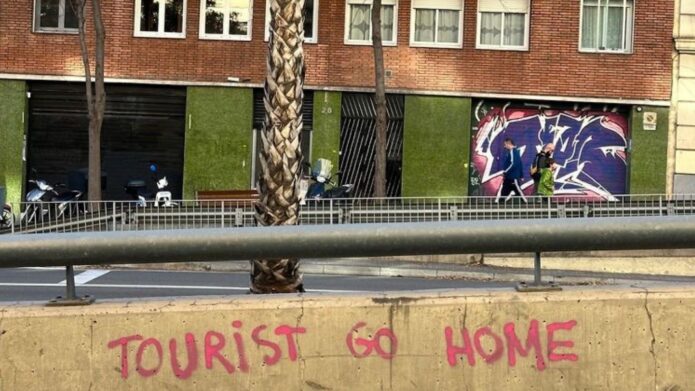
I was in Barcelona, wandering through a neighbourhood that smelled of olive oil and laundry, when I saw it. Painted in large, unapologetic letters on a wall: Tourist Go Home.
Not a suggestion. A verdict.
I stood there for a moment, passport metaphorically in hand, and felt the particular shame of someone who has just been told, with remarkable economy of language, that their presence is the problem. I took a photo, of course. Which, in retrospect, did nothing to help my case.
The Bus That Disappeared
Barcelona had been dealing with this for years. In the La Salut neighbourhood, a small 20-seat minibus called the 116 served locals going about their daily lives. Then Park Güell appeared on Google Maps, tourists discovered the route, and the bus stopped being useful to anyone who actually needed it. Luz López, 75, told a Spanish newspaper that people with walking sticks could no longer board.
The city council’s solution was quietly brilliant. They asked Google to delete the route from Maps entirely. No announcement. Just: gone.
“At first we laughed,” said a local activist. “It seemed absurd, like putting gates on the countryside.”
It worked. Cities are now erasing themselves from the internet, piece by piece, to get a moment’s peace.
Cherry Blossoms and the Limits of Instagram
In Fujiyoshida, a small Japanese city of under 50,000 people at the foot of Mount Fuji, the Arakurayama Sengen Park cherry blossom festival had run happily for ten years. Then social media found it. By last year, 10,000 people were arriving on a single peak day. Tourists trespassed on private property, dropped litter, opened doors to private homes to use the bathroom. Some defecated in residents’ gardens and, when challenged, became aggressive. Children walking to school were pushed off pavements by crowds that had no particular awareness that school existed.
In February this year, the mayor cancelled the festival. “Behind this beautiful scenery,” he said, “the quiet lives of our citizens are being threatened.”
The cherry blossoms will still bloom. The tourists will still come. Because the problem was never the festival. The problem is the assumption that beauty is a public resource, available to whoever can afford the flight.
We see the photograph. They live in the frame.
Documentarian and photographer Sej Saraiya, writing in the Hindustan Times on 22 February 2026, names this precisely: movement without humility, she argues, “trains us to confuse access with understanding, presence with permission, and visibility with care.” She goes further, suggesting that in an era of speed and viral exposure, humility may be the only thing that keeps travel honest at all.
The Thirty-Second Reminder
Before meetings, conferences, and school assemblies across Australia, someone will stand and say: I would like to acknowledge the Traditional Owners of the land on which we gather, and pay my respects to their Elders, past, present, and emerging.
Thirty seconds. It costs nothing. And it does something quietly radical: it reminds everyone in the room that the ground beneath them has a history, and that history belongs to someone who was here long before the meeting was scheduled.
Every time I have heard it said properly, by someone who means it, I have felt the same gentle, necessary deflation of my own self-importance.
You are a visitor here. You have been welcomed. Act accordingly.
Not a tourism lesson. A human one.
Somebody Lives Here
The simplest reframe is also the hardest to hold when you are three hours into a queue with your camera.
The place you are visiting is somebody’s home. The street you are photographing is where someone’s grandmother walks to the shop. The view that appeared on your feed at 2am last Tuesday has been somebody’s ordinary Tuesday for their entire life.
We have come to treat travel as a transaction. You pay, you arrive, you consume, you depart. What you owe the destination is not a conversation most of us are having.
When I stood in front of that wall in Barcelona, I did not feel attacked. I felt corrected. The city was telling me something accurate: your presence has a weight, and you may not have thought about that weight until now.
Barcelona had to paint it on a wall. Fujiyoshida had to cancel a festival it had spent ten years building. Luz López had to wait for a bus she had been riding for decades.
Travel remains one of the more reliable ways to discover that your assumptions are parochial. But done well requires arriving as a guest rather than a consumer. To leave a place at least as good as you found it. Which is, when you think about it, the oldest rule of hospitality, applied in reverse.
The cherry blossoms near Mount Fuji will bloom again this April. They are indifferent to us, which is part of what makes them beautiful.
The question is whether we will be worthy of them.
On the other side of tourism, there is travel done with presence. I found a small example of it on a river ferry in Brisbane. That story is here.
Have you had a moment that made you feel like an unwelcome guest? Or one that reminded you what good travel looks like? I’d love to hear it in the comments.