

Some travel experiences stop you mid-stride, send you into the nearest café, and make you look things up immediately. This was one of those. It has stayed with me ever since.
New York City has a presence that is hard to miss. Busy. Proud. Tall. When its mayoral elections attract international attention, it tells you something. The city also has a remarkable talent for organising queues. Queues for bagels. Queues for museums. Queues for coffee that costs more than lunch and tastes like it knows it.
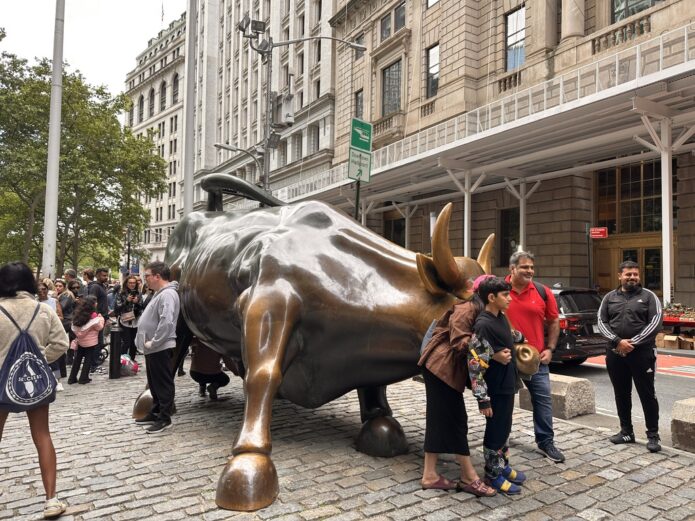
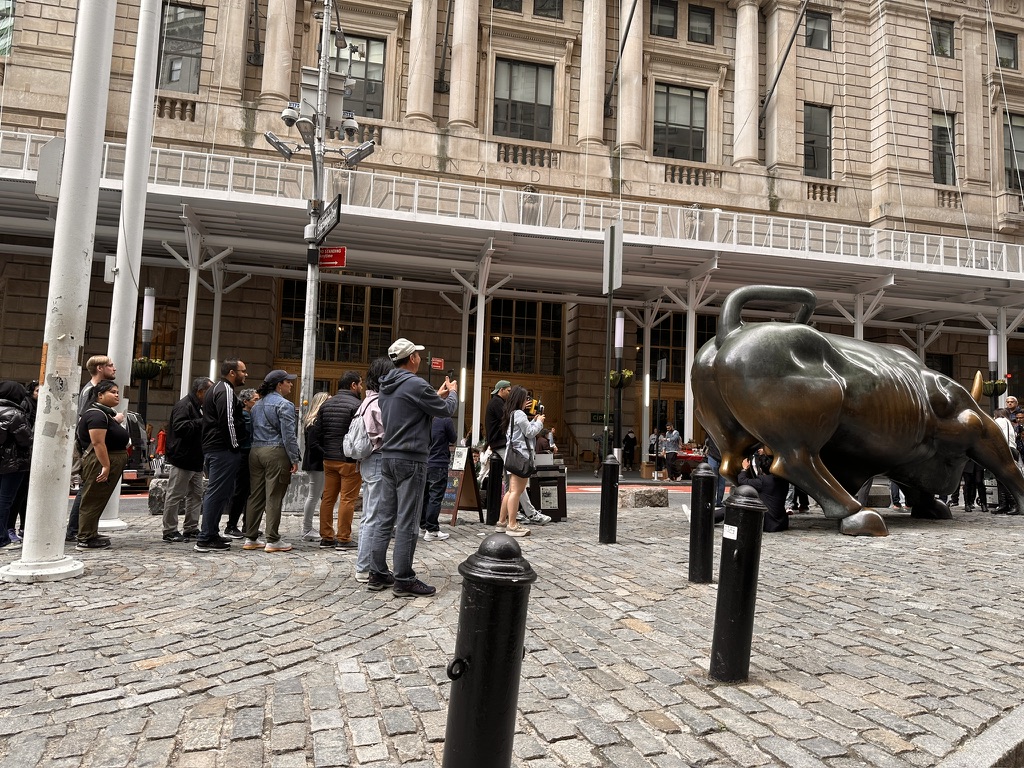
Near Wall Street, there are two queues around a bronze bull. Yes. The Charging Bull of Wall Street.
One forms in front. People pose, touch the horns, take photographs. It is literal, performative, and reassuringly obvious. Taking the bull by the horns, as it were.
The other queue is different. It gathers behind the bull.
This one does not announce itself. It does not move quickly. People shuffle forward with the seriousness usually reserved for immigration counters or new Apple launches. When their turn comes, they disappear briefly behind the animal and re-emerge wearing the faintly satisfied look of someone who has completed a small but meaningful civic duty.
That queue stopped me. I stood there for a while, trying to work out what exactly was being achieved.
A Ritual Revealed
It did not take long to find out.
The queue exists so that people can touch the bull’s testicles. Yes. You read that right. For luck, apparently.
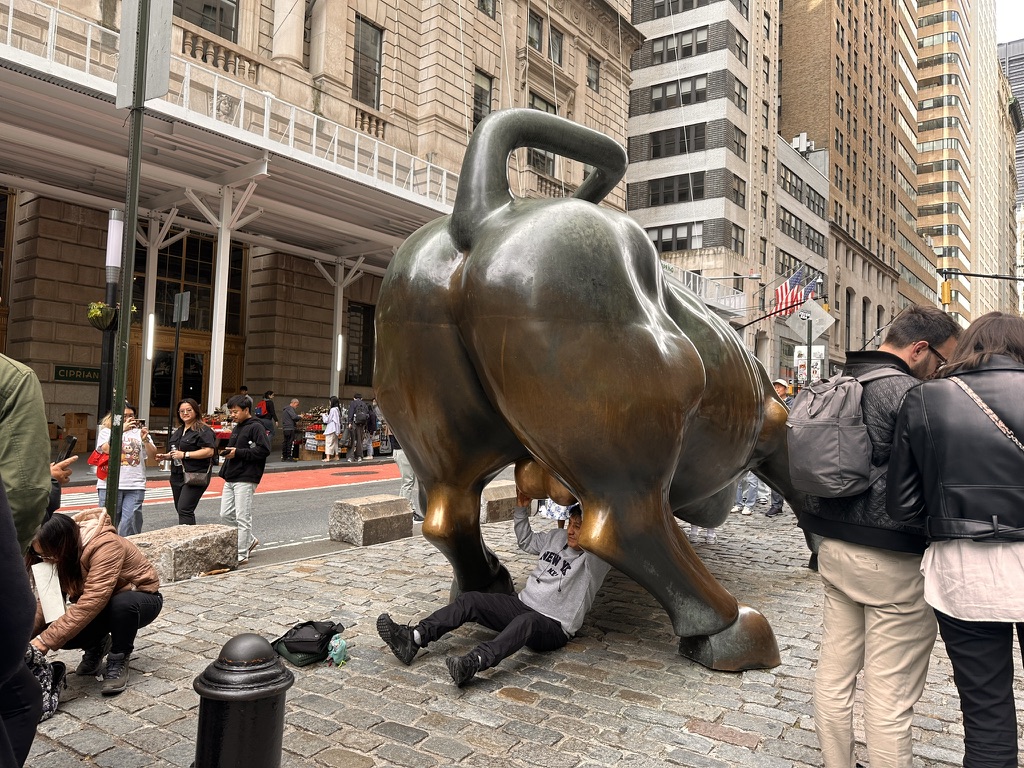
Not metaphorical luck. Actual luck. The sort associated with money, markets, careers, or at the very least, a good day. There was no embarrassment about it. No nervous laughter. People waited their turn, did what was required, and stepped aside for the next person.
Some things, I learned, are best understood by watching quietly.
How the Bull Got There
Absurd rituals deserve good origin stories, and this one has a particularly strong one.
The sculpture, officially called Charging Bull, was never commissioned. In 1989, after the stock market crash, an Italian sculptor named Arturo Di Modica was furious at what he saw as a collapse of courage and confidence.
So he did what any reasonable person might do.
He spent months working in his cellar, used his own money, cast a bronze bull weighing over three tonnes, and one night deposited it outside the New York Stock Exchange. No permission. No permits. No committee meetings. Then he vanished.
The city wanted it removed.
The public loved it.
The bull stayed.
The queue came later.
Bulls and bears, of course, existed long before bronze statues. The language of bull and bear markets has been around for centuries. Bulls charge forward. Bears retreat, swipe, and hibernate. One stands for confidence and momentum. The other for caution and decline.
After the Charging Bull appeared, optimism acquired a body. Confidence suddenly had muscle, shine, and something you could stand behind in a queue. Financial districts around the world followed the impulse, if not always the sculpture itself. Bulls appeared in good times, never bad ones. Built to be photographed, touched, and briefly believed in.
The bear, meanwhile, remained abstract. A chart. A warning. Something you were expected to read about later.
Understanding, it turns out, is much harder to rub for luck.
Touching Optimism
What fascinated me wasn’t the sculpture so much as the behaviour around it.
Touching the bull felt like experiential optimism. You don’t need to understand markets. You don’t need to read history. You just show up, queue, touch, and move on feeling marginally better. The bull promises movement. Momentum. Forward motion.
The bear, by contrast, asks for reading. Possibly thinking. It asks for a pause, for reconsideration, for the uncomfortable act of standing still. And pauses do not photograph well. People don’t fly halfway across the world to rethink their decisions. They come for symbols that look like they’re going somewhere.
Coffee, Naturally
I didn’t learn most of this from a plaque.
There is very little explanatory material near the bull. New York prefers you to work things out for yourself. I learned the story in a nearby coffee shop, sitting by the window, reading while watching the queue replenish itself with impressive reliability.
People arrived. People waited. People left slightly happier.
It felt appropriate that coffee was involved. Most observations worth keeping seem to require caffeine and a place to sit.
What Stayed With Me
Long after I left Wall Street, what stayed with me was not the bull’s size or shine, but the seriousness of the queue. The lack of irony. The shared understanding that this was a harmless thing to want.
Travel often sells spectacle.
This offered behaviour.
A line of people from all over the world, waiting patiently behind a bull, hoping for a little extra fortune. It was absurd. It was oddly touching. And it made perfect sense.
Some queues, it turns out, are worth standing in.
I asked a café regular if anyone ever took issue with it. “This is New York,” he said. “As long as it doesn’t block traffic, it’s fine.”
Which, I realised, is probably the operating principle in most parts of the world now.