Kavi Arasu

Between A Million And A Billion

A few weeks ago, I was in a coffee shop, catching up with an old friend. It was one of those moments when life feels paused. The aroma of coffee and the low hum of conversations hung in the air.

My friend, ever buoyant, declared with dramatic flair, “I’m so happy you’ve embraced entrepreneurship!”

I said nothing. Not because I disagreed, but because I didn’t know what to say. She wasn’t done, though. With a sly smile, she added, “At least you’ve jumped off the corporate salary bandwagon.”

I stirred my black coffee. It didn’t need stirring. In my head, I weighed her words. Should I tell her the truth? That entrepreneurship isn’t all glamour. It’s fulfilling, yes, but relentless.

Before I could decide, she dropped the next bombshell. “Someday, you’ll be a millionaire. Or even a billionaire!”

I almost choked. “Excuse me?”

The table next to us went silent. Two young men, mid-presentation, froze. Their audience, a man who looked like he made important decisions daily, turned to look at me too. The room suddenly felt charged.

I shuffled in my seat and mumbled something about the weather.

The moment passed. The other table wrapped up. The young men collected their notes. The polished man stood, slipping into his jacket.

He turned to the presenters. His voice was calm but sharp. “A million seconds is about 11 days. A billion seconds is roughly 32 years. There’s a big difference between a million and a billion.”

He glanced at them, then at my friend, and finally at me.

And then he walked away.

I turned to my friend. “There’s a lesson there,” I said.

Her eyebrows rose. “And what’s that?”

I smiled. “A million and a billion are one letter apart—with a lifetime in between.”

When The Sky Falls

Three or four Fridays ago, I was taking a stroll. It had been a tough day, and the retreating monsoon had left its mark in the morning. As usual, I was out unwinding, trying to move on from the dreadful day’s leftover froth. That’s when a styrofoam cup, freshly emptied of its coffee, but not fully of its froth, landed an inch from my feet. I looked up, but amidst the maze of dull and dead windows in the apartment building, it seemed ghosts had just had their strong coffee. There wasn’t a soul in sight. The only thing moving was up in the sky: a big plane, its underside letting go of a bold golden scream: ‘Emirates’.

For a moment, I wondered—could the cup have come from the plane? My mind quickly jumped to The Gods Must Be Crazy, a film I watched as a kid. A film that left its mark. In the film, a simple Coca-Cola bottle thrown from a plane brings chaos to a peaceful tribe. It was funny, absurd, and deeply thought-provoking.

But as I stared at that cup and thought about the plane above, another question popped into my head—the kind of question that drags me down a rabbit hole, as though my brain were a carrot offered to a waiting rabbit.

What if the cup didn’t come from the plane? What if it came from space?

Falling Debris—Not Just a Styrofoam Cup

Once home, I found myself reading about Alejandro Otero in Florida. Something had crashed into his home—not a styrofoam cup, but a chunk of metal alloy weighing 1.6 pounds, falling from space. No, it wasn’t an alien invasion—it was space debris. Till recently, it was part of the International Space Station.

NASA’s response? “The hardware was expected to fully burn up during entry through Earth’s atmosphere on March 8, 2024. However, a piece of hardware survived and impacted a home in Naples, Florida.” Roughly translated: Oops.

In the next hour of scrolling, I found that NASA isn’t the only space cowboy littering stuff up there. SpaceX debris once flattened an animal enclosure in Indonesia. Fortunately, no animals were present. Or take the case of the 20-tonne Chinese Long March 5B rocket, which hurtled from Los Angeles to New York in under nine minutes. Eventually, it broke apart, and pieces fell into a village in the Ivory Coast. Well, God is kind.

The Sky Is (Literally) Falling

As I jumped from one URL to another, it became clear that these incidents aren’t isolated. Space debris is piling up. The European Space Agency estimates there are 36,500 pieces of debris larger than 10 cm orbiting Earth, with a total mass exceeding 11,500 metric tons. We’re talking about everything from paint flecks to dead satellites. The more we launch, the more junk we leave behind.

Then I read something that made me pause. Moriba Jah, an aerospace engineer, warned that falling debris will eventually kill someone. A 2022 study predicts a 10% chance of casualties by 2032. Jah might not be Nostradamus, but the data suggests that his concern isn’t far-fetched.

What If It Hits an Aircraft?

And just when I thought it couldn’t get worse, another thought struck me: What if this random debris hit an aircraft? As is the way with the internet, it didn’t take long to find new material in that direction.

In 1996, a Boeing 757’s windscreen was cracked by an unidentified object at 31,500 feet. In 2013, another Boeing 757 had its nose-cone punctured by something unknown at 26,000 feet. Bird strikes were ruled out. Between voodoo and space debris, what do you think is the likelier cause?

As both air traffic and space junk increase, so do the risks. In November 2022, Spain and France even closed parts of their airspace because of a Chinese rocket body re-entering the atmosphere. Over 300 flights were disrupted.

What’s the Solution?

By now, I’d brewed some extra-strong espresso as there seemed to be no light at the end of this rabbit hole. What could be done?

One suggestion was to stop treating satellites as single-use. There’s precedent for this thinking. In the 1970s, the risk of oil spills led to calls for double hulls on tankers. The shipping industry resisted, but after the Exxon Valdez disaster in 1989, the US mandated double hulls. The world followed.

Today, space launches could be similarly regulated, with mandated disposal plans for satellites and rocket bodies. Hopefully, we won’t have to wait for an airplane full of passengers to be struck by a rogue satellite’s unhinged door before these regulations take effect.

The European Space Agency has announced a Zero Debris Charter aimed at tackling the problem at its root. I read about it, yawning without realising.

Meanwhile, I’ve made a few decisions of my own.

Take my strolls with care—the folks in my apartment building haven’t signed any charters! If I’m the unlucky one on any given day, it’s my problem.

And live with gratitude. When I deal with dreary email and deadly calls, I’ve resolved to remind myself that at least it’s not as bad as a debilitating piece of alloy from outer space.

Horlicks Whirled Wide

Mind Your Language, the old British sitcom, was a personal favourite. Actually, it continues to be. In one scene, the teacher, Mr Brown, asks Juan Cervantes, the Spanish bartender, “What’s unique to Britain?”

Juan fires back with a quick, savage reply: “Speak English!” It’s funny and true.

English is a British export, but different parts of the world have made it their own. In some cases, the meanings change so much that it’s funny — until it’s not.

Then I read this piece in The Guardian, which made me smile — until I realised I’d been using words and phrases that meant something completely different to a group from the other side of the Atlantic. The British and American divide, in full swing!

Reading it made me realise how often I use words that mean something else depending on where you are in the world.

Take “run up,” for example. In the US, it means to prepare for something, like the run-up to an event. In the UK, it can mean racking up expenses, like running up a credit card bill. Both meanings seem familiar, probably because I’m talking to both sides of the Atlantic quite often. You might say that’s clever — but be careful, in the US, that might not be a compliment at all!

Then there’s “gutted.” In Britain, if you’re gutted, you’re absolutely devastated. In the US, it sounds more like someone’s preparing fish for dinner. Or take the word “cheeky.” In Britain, it describes someone who’s playful and bold. Tell that to an American, and they might think the person is being rude.

Even simple phrases like “in the future” and “in future” mean different things. Going forward, let’s make a note of that! 🙂

Two moments recently made me smile. First, in a meeting with Australian colleagues, I used the phrase “the cat’s whiskers.” I said something like, “They think they’re the cat’s whiskers, but they’re not quite there.” I got some amused and confused looks.

Then, in a meeting with British colleagues, a gentleman said, “He made a Horlicks of the proposal.” This time it was my turn to perk up. Growing up, I had to drink Horlicks to “grow strong”. It was also the go-to drink you bought when visiting someone in hospital. Just now, I learned that “to make a Horlicks” means to completely mess something up. (I quite liked this line. “There’s also a theory that the slang refers to the beverage’s fickle nature. A little too much powder, or an insufficient amount of stirring, and a glass of Horlicks can become a gritty, chunk-filled disaster.” For it triggered memories!)

English has shifted and changed — and keeps doing so. One of the joys of working with people from different cultures is encountering these quirks! Even when they leave me confused for a moment.

As for me, after learning what it means to “make a Horlicks” of something, I’m ready to see if I can get a Boost from moments like these!

Choices and Consequences: India’s Journey

After reading the post on Independence Day, a good friend wrote a long text listing everything that was wrong with the country. It was easy to agree with all that is wrong. We disagreed on what needed to be done. And when we got to listing the ‘why’ of the state of affairs, our gulf only widened. The gulf kept widening and threatened to never stop. Until I brought up one specific point from Karthik Muralidharan’s superb book which I have been relishing.

Everything must be understood within its proper context. I didn’t quite see it this way until I read this book. This book rearranged stacks of thoughts in my mind.

” …in assessing Indian democracy, it is important to note that India is historically unique, by being a country that adopted democracy based on universal adult franchise from the outset—at a much lower level of per capita income and state capacity than most other modern democracies. India’s choice of ‘democracy before development’ has in turn created a unique set of political incentives and constraints.

….reason is India’s decision to adopt democracy based on universal adult franchise. Most countries became more democratic as they grew richer. India, however, started highly democratic and has stayed that way throughout its post-Independence history. This is a unique historic exception, a phenomenon that Arvind Subramanian has referred to as India’s ‘precocious democracy’

India’s choice of universal adult franchise democracy at the very outset is a great moral triumph. Despite being ‘democracies’, countries like the US and the UK excluded large fractions of their population from voting in the eighteenth and nineteenth centuries, with voting rights essentially restricted to land-owning white men.

Further, the wealth of these nations was built at least in part on the back of extreme exploitation of either slaves (in the US) or the colonies (in the case of the UK). This is why India’s democracy, which empowers even the most marginalized groups in society, is a signature achievement that we should all be proud of. Consistent with the global patterns discussed above, this democratic empowerment of the poor has created political incentives for welfare spending in India as well. However, this has taken place at a much earlier point in our development trajectory.

For example, the US launched food stamps for the poor in the 1930s at a GDP per capita of ~$20,000 (in 2011 dollars). In contrast, India launched the public distribution system (PDS) for food security for the poor in the 1960s at a GDP per capita of ~$1250, which is less than a tenth of the analogous US figure. Similarly, India introduced free midday meals in government schools at lower levels of income than most other countries. These are again laudable moral achievements, which were facilitated by India’s universal-franchise democracy.

At the same time, ‘democracy before development’ in India has created political pressure to expand the scope of the Indian state before building its strength to meet this expanded scope.20 This pressure, in turn, has made it more difficult to invest in building the capacity of the state to deliver against these goals by creating two fundamental challenges… “

The choices that we make have downstream consequences and realities. We forget to shine enough light on the choices themselves and the context in which those choices were made. When we lament the lack of development—or its absence altogether—we must also remember the credit side of the balance sheet.

To have forged a forward-thinking base for democracy in the face of seemingly insurmountable odds is quite something. Whichever side of the aisle you sit on, you have to acknowledge that.

The Choices of Independence

The usual scene unfolds. The flag is unfurled. Rose petals fall. Haven’t seen that anywhere else in the world. Kurta pajamas, mostly white. Flags pinned on, fluttering in the breeze. A crisp speech. The same ‘Patriotic’ songs echo. Kids perform to them with moves adapted from Bollywood. Adolescents enveloped in a certain busyness that befits their age. And the adults, well, those not on the management committee or without performing kids, busy with their conversations about neighbouring plots and other ‘nuisances.’

When they pause Lata Mangeshkar & A.R. Rahman to switch on the microphone, it conks out like clockwork. Every single time. India might land on Mars, but the neighborhood sound system can’t make it past the fifth second of it being switched on.

It’s all the same. I turn up, every time. To revel in the sameness and to feel those goosebumps when the national anthem plays.

As I sip a strong, dark coffee post-ceremony, some strong thoughts dance on the keyboard. Here are five. Groucho Marx quipped, “These are my principles. If you don’t like them, I have others.” I am no Groucho Marx and if these five don’t sit well with you, sorry. Blame it on the coffee and read about the dosa.

So. Here are the five.

  1. Independence from foreign rule demands interdependence among us. It requires raising our standards and lowering the decibels of argument. Trading rudeness for understanding. It requires trading impoliteness for understanding and patience.
  2. “She’s becoming an independent kid,” said the teacher recently. A nudge for everyone in the room to step back and let the child step up. Independence requires taking responsibility. Making better choices becomes possible every single moment.
  3. Choices come with consequences. Independence goes sour when we cherish the freedom to choose but dodge the fallout. A big heart, broad shoulders, and tough skin—essential gear for the truly independent.
  4. Indifference is the decay of independence. As Elie Wiesel wisely noted, “The opposite of love is not hate. It is apathy.” The heart of freedom shrivels when we stop caring.
  5. Freedom is precious, but what is it to be truly free? Naval Ravikant nails it: “People who live far below their means enjoy a freedom that people busy upgrading their lifestyles can’t fathom.” Choose upgrades wisely. That can be a motto for life.

And here’s a bonus point. Point number 6. Outside the list. Freedom is the chance to get better every day. To help one another and become the best version of ourselves, without the weight of dogma or the sting of diatribe. To grow old with dignity and poise.

Choices!

Thank God For Dosa

Kerala paratha? A flashback to my early professional life—years I could have spent differently. Filter coffee? That’s Mum. The smell of bread? Raja Barley, a bakery in Madurai. Crabs? Pier 39, San Francisco. Churros? San Gines in Madrid. Crisp dosa? Aiyappas in Matunga. Black coffee? I’m in Brisbane. Toast? Singapore. Kulcha? Amritsar. Pomfret? Calicut. Salads? Tokyo.

Not all of these meals were the best I’ve had. Some were far from it. Yet, they cling to my memory like stubborn guests who refuse to leave.

Indian Coffee House is one such guest. It’s not about the aroma or the taste; it’s the memories from decades ago that distort my senses. But there’s something magical about this place, something that keeps me coming back.

On countless walks down MG Road in Bangalore, decades ago, Indian Coffee House buzzed with life. Back then, I’d sit with a butter dosa, sipping coffee, watching the world pass by. People of all kinds. Old, young, rich, poor, men, women—everyone had a story. And in their eyes, in the conversations that filled those walls, I saw my own future unfold. Dreams!

Last month, I found myself in another Indian Coffee House. In another city.

As soon as I sat down and read the menu, it was clear: it wasn’t the food that drew me in. It was the pull of youth. A time when dreams were fresh, the road ahead sunlit, and time was something I could waste. Like in that Pink Floyd song…

“…And you are young and life is long, and there is time to kill today…”

As I sipped the rather unremarkable coffee, pretending it was gourmet, I became acutely aware of how my dreams and opportunities have evolved. They’ve changed colour. But I’m grateful for the dreams that once kept me company. They’ve shaped me, made me who I am today.

I’ve grown, I tell myself. Maybe that’s why I could enjoy that lacklustre coffee. “Thank God for dreams,” I wrote in my journal that night. At least, that’s what I thought I wrote. For when I looked again, it read, “Thank God for Dosa.”

Someday Soon

Starting something new feels like stepping into a rain-soaked muddy puddle. I jump in and notice the mess. Tasks turn into Herculean labours. Cleaning the cardboard boxes in the cupboard above? Easy, until I find old report cards and spend hours reminiscing.

Beginnings are intimidating. Like the first day at a new school, the first word of this blog post, or that first step of a run when your last run is but a distant memory. Unknowns paralyse me. I cling to my cluttered garage and unread books.

“Someday Soon” whispers that tomorrow is better. It lures me with some immediate thing that must be done. Call the plumber. Check in on the US Election. But tomorrow is a myth. It’s where productivity goes to die. Meanwhile, today slips away, and my grand plans remain just that—plans.

I’m too good at imagining obstacles. Writing a book? The blank page mocks me. “What if it’s terrible?” I think. And so, it remains unwritten.

Beginnings are messy, awkward, and imperfect. But they’re also where great things start. I need to embrace the mess. Dive into the muddy puddle. It does not have as much muck as I make it out to be.

Starting is about momentum. Newton’s First Law: an object at rest stays at rest; an object in motion stays in motion. This applies to me, a “Someday Soon” adherent. I write in my journal, ‘Take that first step, and the next ones come easier.’

So, I plan to break tasks into bite-sized pieces. Clean one shelf. Write one page. Small victories build momentum. Soon, I’m not just starting—I’m continuing.

I need to be kind to myself. Fear of failure is powerful. But failure is part of the process. Every great achievement had false starts and mistakes. I must allow myself to fail, be imperfect, and learn as I go.

The hardest part is often the first step. Lao Tzu said, “The journey of a thousand miles begins with a single step.” So, I take that step. Write that sentence. Clean that shelf. Drink that health mix, even if it tastes like bad client feedback.

Starting isn’t as daunting as it seems. Silence “Someday Soon.” Embrace the mess. Some wise human quipped, “The best way to get something done is to begin.”

Ok, we are rolling. At least until the next station.

Embracing Grey

When it rains, it pours. Especially so if you are in the Western Ghats during the monsoon season. The rain brings alive many emotions.

I nurse a hot coffee—dark brown with a sting that somehow never fails to awaken my senses and keep me attentive to everything around me: the falling rain, passing clouds, and winds that seem eager to howl but end up whimpering as the rain pelts down.

Arundhati Roy once said, “The rain was beautiful to watch. The way it slanted across the road, forming fine curtains through which everything looked different.” Some writers and their words latch onto seasons. For me, the monsoon season calls for Arundhati Roy. Roy equals the monsoons.

Blinding sheets slip into to faltering drips and then offer a mirage-like pause, only to be followed by blinding sheets again. Meanwhile, my coffee is disappearing from my cup.

Bob Marley said something to the effect that some people feel the rain while others just get wet. I can’t stay in either camp for long. Sometimes, I want to soak it all in. Other times, I’m happy just to watch.

You see, life is never black and white. It’s a whole lot of grey. The rain reminds me of that. It’s never just this or that.

A whole lot of black and white is just grey masquerading as one of them. That thought gives me comfort. It helps me lay the quest to find and settle into one of those black or white territories to rest and find a small space on the margins.

Margins.

The rain pelts there as well. Perhaps it’s not about the margins, as much as it’s about the rain. “There is no place more comforting than being in the embrace of a rain-washed landscape,” said Kamala Das. And I couldn’t agree more.

It’s all grey. And it’s nice.

Fake Facebook Profile: Have I Finally Arrived?

Someone has created a fake profile of me on Facebook. Good friends have let me know about it. So please, do not accept any friend requests from “me.” And for God’s sake, do not send money. Or photographs. Or whatever. I assure you, I’m not in dire straits on some exotic island with no access to funds.

Living with a touch of imposter syndrome, discovering there’s an actual imposter out there is quite something. I’ve always wondered if I’ve truly made it, and now it seems I have, in the most dubious way possible. Only the noteworthy have their profiles duplicated, right? Atleast, one friend thinks so. Thats the first one who alerted me!

Now, for the burning question: Why would anyone choose to create a fake profile of me? I mean, really, have they seen my posts? My life, filled with incoherent rants about all and sundry, unflattering essays, and the occasional (intended) wisecrack that didn’t go anywhere, hardly seems worth the trouble. But if you get a friend request from “me,” please, don’t accept it. The real me is too busy navigating the existential crisis of finding matching socks to befriend you twice.

Then there’s the money aspect. These imposters often ask for it. Here’s the truth: if you ever receive a message from “me” asking for money because I’m stuck in a remote location with no cash and no support, do not send anything. Normally, I’m never far from a local ATM or my trusty phone. Besides, If I needed help, I’d call you directly, not via a sketchy Facebook message. Plus, the real me would probably call you crying, promising to never book a non-refundable ticket again.

In reality, my daily struggles include keeping track of the numerous OTPs I’m compelled to key in for grocery thats getting delivered at different times of the day. And trust me, if I was really in dire straits, I’d find a way to let you know that didn’t involve a social media plea. Maybe a skywriting message, or an interpretive dance, but not Facebook.

This whole incident is a timely reminder to make real friends and reconnect with ones I haven’t in a long while. Of course, be cautious about accepting friend requests from people you think you already know. The best way to do that is to stay connected in real life! Enjoy life – meet real friends, have real conversations, do real things. Like figuring out how to remove dark coffee stains from your favourite shirt or having a debate about the best way to run a country.

Next time you see a friend request from “me,” remember this post. Enjoy the irony that someone thought my life interesting enough to fake. It’s no small matter. I need to take adequate precautions like changing my passwords, letting my friends know, letting Facebook know and such else. Besides all this, I found myself shaking my head and smiling. Because in this age of digital absurdity, sometimes all you can do is chuckle at the ridiculousness of it all.

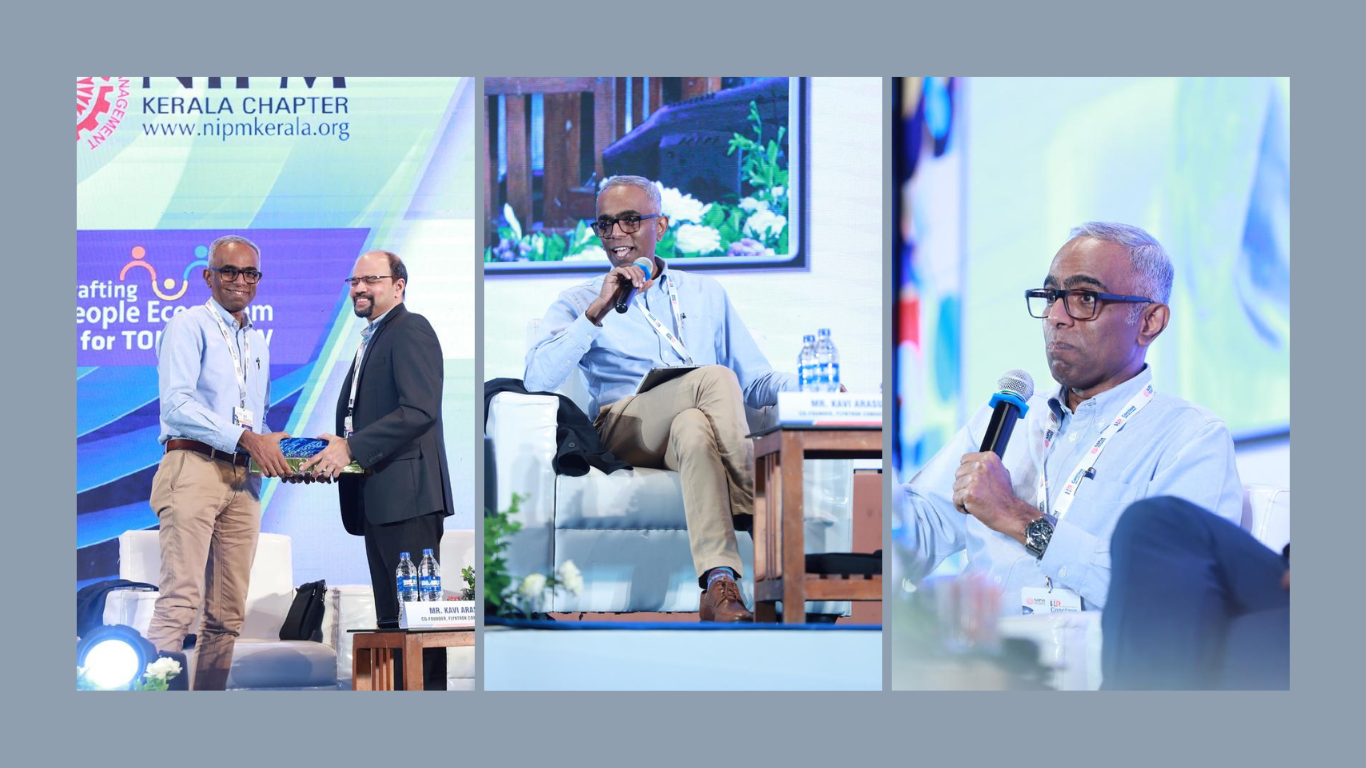
A Long-Awaited Presence at NIPM Kerala. HR Conclave 2024

The Kerala Chapter of NIPM hosted its Biennial Conclave and Exposition-24 on the 16th and 17th of May. Anish Aravind and I had been in conversation for a long time about making this happen. This year, it finally did. And I was glad I could be there.

After the event, the Flyntrok team shared a post on LinkedIn. I think they did a fantastic job. So, leaving it here.

“The Kerala Chapter of NIPM hosted their Biennial Conclave and Exposition-24 on the 16th and 17th of May. It was an event that featured an impressive lineup of speakers and well curated topics. The event has left an impression on people who have participated going by first hand accounts and commentary online.

Flyntrok’s Kavi Arasu attended the event—or at least, most of it. He shared his key insights from his experience with the Flyntrok team. Heres what stood out from his engaging recount.

Kavi began with Madhu Nair, the CMD of Cochin Shipyard, who delivered an inaugural address that caught everyone’s attention. Nair compared carrying his 20-odd kg daughter on his shoulders during the Guruvayoor temple festivities to lugging around a bag of cement of equal weight. The difference between the two is pronounced, although the physical effort is just the same.

This simple analogy seemed to have set the stage for a recurring conversation throughout the conference, taking on different names: Work-Life Balance, Work-Life Integration, Work-Leisure Balance.

We had a quick internal discussion about how a large part of the workforce doesn’t have identities boundaried by work or profession, while for many others, work defines their identity. We are sure that we haven’t seen the last of this ’20Kg sack of cement’ metaphor!

Kavi found Satish Pradhan’s keynote particularly thought-provoking. Pradhan scattered dots of data and wisdom across his talk and asking the audience to do the work of connecting them and drawing context to anchor their learnings on. Thats precious! From Star Trek to Fuzzy Logic, and from murmuration to Augmentation. It was a rich mix of ideas that left plenty to ponder and act upon. “Delectable fare”, Kavi remarked.

Kavi noted that Biju Dominic‘s insights into neuroscience and decision-making are legendary and it held the audience in rapt attention. Prof Arvind Sahay offered persuasive research from the academic and marketing worlds. Dr Saundarya Rajesh , who has helped over 200,000 women return to work, struck a chord with her emphasis on the ecosystem and not just the individual. “That’s our tune too,” Kavi remarked. “Just when things couldn’t get more interesting, Sangeeta Kalyan stood upside down to get everybody interested in yoga! Talk about going the distance.”

Session moderation by Prof. Anandakuttan Unnithan, Prof. Biju Varkkey, and V.K. Madhav Mohan, who provided space for conversations and presentations in good measure, got some good airtime in the briefing.

Kavi himself was part of a panel on “Technology with a Human Touch,” moderated by the erudite Prashanth Nair, co-panellists Jonas Prasanna and Vaishali Gambhir who have provided personal examples and points of views. Given Flyntrok’s focus on change work at the intersection of technology and humanity, this was right up our alley. The conversation seemed to resonate with quite a few people.

From all the sharing, Kavi emphasised two specific aspects that made a difference to the audience. One, the sessions offered practical takeaways, not just limiting themselves to cerebral ideas, theoretical constructs, and frameworks. He cited the thought leadership session with Rajesh NairAtul Singh, and Vijayshankar Ananthanarayanan as a prime example.

The second was the subtle (and effective) presence of sponsors in this conference. “They seamlessly blended in without overwhelming the event, allowing the focus to remain on the content”, said Kavi.

And as a delightful bonus, a DEI fashion show on the 16th evening is reported to have lit up the evening.Yes, a fashion show! Kavi, who usually skips and rarely mentions anything outside the core agenda of a conference, gave this fashion show a special nod. “Very thoughtful,” he said. Must have been something!

A good conference goes beyond a mere event. The conversations it sparks and the ideas that linger long after the conference is over are a testament to how well it has served its audience and the topics discussed. Kudos to the folks at NIPM Kerala Chapter for stringing together a super show that continues to stay alive.”