The vegetables came home first.
My father had done the Sunday market round. My mother was laying everything out on the dining table after a wash so thorough that the vegetables seemed to be under suspicion. Every ladies finger held up to the light. Every tomato turned over. I could not see what they had done wrong. I said nothing, because there are arguments you learn early not to start.
I had finished the newspaper. All of it, including the classified pages, which is what boredom looks like when I was young, in a small town on a Sunday morning.
My father asked what I was reading.
Nothing specific, I said. Which was not an answer. It was a complaint wearing the clothes of one. My daughter does the same thing now, and I know exactly what it means, because I invented it.
There was a reason he had something ready. I read at speed, and I read everything, and in a small town with one channel on the television and no screen in anyone’s pocket, a boy who has finished the newspaper is a problem a parent has to solve before lunch. Feeding my reading was a running task.
He went to his cupboard at the pace of a man who has all day and knows it. It was a professor’s cupboard, and it had the density of one. He came back and handed me a book with his left hand. It was pink. Not a proud pink. The pink of a paperback that has been sitting somewhere warm for years.
Try this, he said.
I took it with mild interest and mega dismissal. Then I did nothing about it for several days.
It was a Honda
What made me finally open it was not curiosity. It was that my father owned a Hero Honda CD 100. Jet black. And shiny.
He had bought one of the first that came into the country. Imported and all that. The talk around it was all about the engine, which said “Made in Japan”. And that settled the question of whether it was any good. I did not care about the engine. I liked the ride.
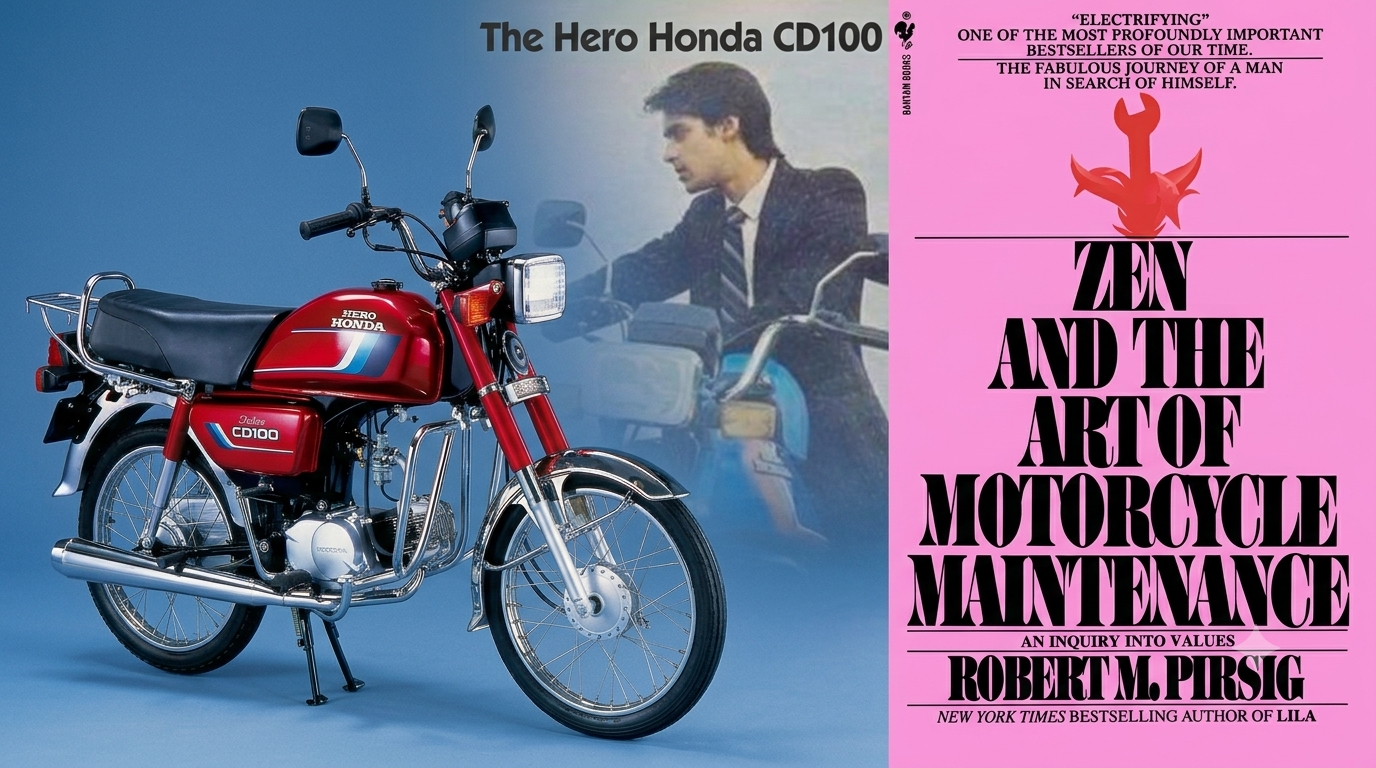
The advertisements agreed with me, in a way. “Fill it, shut it, forget it”, they said, selling the bike on never thinking about it again. Peace of mind, from not looking. Pirsig’s book is about peace of mind too, and he means the opposite kind. The bike was sold on forgetting it. The book was about the cost of that.
My father read the engine. I wanted the ride. The book would eventually have names for both of us, and I would not enjoy mine. For now, it was a Honda. And it was a bike. That was enough of a bridge.
The road, and the ghost
So I read Zen and the Art of Motorcycle Maintenance in instalments. Sometimes I sat on the parked CD 100 to read it, going nowhere at all, reading about a man crossing a country.
My father had a friend who was a mechanic, and I was often left to pass the hours in his shed. All sorts came in to be repaired, two-wheelers and cars and things that defied category, and I would watch them opened up and coaxed back to life. So I was reading a book about a man taking care of a machine while sitting a few feet from someone actually doing it. I connected the two not at all.
The book was in my hands and the thing itself was in front of me, and I looked straight past it, which is a fair summary of being in your teens.
I did not understand it.
Not the way I understand things now, where I can hold an idea and turn it around and see how it is joined together. I just kept going. There is a father and a son on a motorcycle, and behind them a third person called Phaedrus, the man the father used to be, before something in him broke and was put back together in a different shape.
That was the one thing that reached me whole. A man haunted by an earlier version of himself. I could not have told you why it disturbed me. It simply moved in and stayed.
The long stretches of philosophy went past me completely. I read every one of them. I kept the road.
Two things he said
I complained to my father more than once. I did not follow the book, I told him.
He grunted. Then he said the thing. I didn’t give it to you to understand it today.
He taught at the university. Explaining things to people who did not follow them was his working life. He could have taken the book apart for me in twenty minutes. He chose the grunt. He had handed me permission to not understand something and stay with it anyway, a strange gift for a young man raised to be graded on understanding things by the end of term. Stranger still from a man who set the papers for a living.
He said one more thing, handing it over. When you understand this, you will be a man.
I did not take that vaguely, the way he probably meant it. I took it as a specification. Somewhere in those pages was the border between boy and man, the book was the test, and understanding it was the pass mark.
So I read it every year. I failed the first time, and the next, and again the year after that, all through my college years. Each time I closed the book more certain the fault was mine, because the book was clearly a masterpiece and I was clearly not yet a man.
It took me years to suspect he had not meant comprehension at all. He may have meant the Kipling kind of man, the one at the end of If who fills the unforgiving minute and never gets told he has passed. Character, not understanding. No exam at all.
The joke is that his sentence worked exactly as a father could hope, and not at all as he said. It did not make me a man. It made me a boy who read one book to pieces, once a year, checking.
The report card
Decades later I was at an airport with a colleague. He was a serious reader. He was a serious reader, the kind who has opinions about which translation you should use. He mentioned he had just bought Zen and the Art of Motorcycle Maintenance. For the first time.
I was surprised. A man who had read so much had walked past this book for so long. I told him that the book had made a huge difference to me. I said I had feelings about it, which is as close as I get to a recommendation.
He rang me a month later. What crap of a book, he said.
Of course, I thought. And then I went out and bought myself another copy.
I still do not know whether the book is any good, or whether I am only defending a Sunday morning. My colleague came to it on time, as a grown man, with his mind fully built, and it had nothing for him. I came to it far too early, understood perhaps a fifth of it, and it went in and stayed.
The book may need you to be unqualified.
What it left in me
The book never fully left. It goes quiet for years, and then I am in a meeting and it is back, holding up the thing that none in the room can name. Pirsig called it Quality. Note the capital Q. You cannot define it, you know the moment it is missing, and every second organisation has an entire department to put a number next to it instead.
When a room goes silent and stuck, the instinct is to fill the silence fast. He taught me to sit in it. That stuckness is usually the only honest thing that has happened all morning.
And when a leadership team or board of directors cannot find the answer, it is rarely short of intelligence. It has decided in advance what the answer should look like, and walked straight past it. Pirsig had a word for the will to keep going when that happens. Gumption, and the traps that drain it.
None of this was in the book the way I have just put it. It was in the book the way my father was. Stay with it.
A day late
The book came back most recently, when I bought DiSanto and Steele’s guidebook to the original. A companion, written with Pirsig’s blessing, notes for the parts a first reading walks past. There I was, grey now and with a bulging middle, buying the map to a road my father had sent me down before I could read it.

Which is how I came to be looking at the calendar. Robert Pirsig was born on the sixth of September, 1928. That was yesterday. He would have been ninety-eight.
My father has been gone more than a decade. He never knew the book stayed with me. I never told him, because you do not tell your father that the thing he handed you with his left hand, somewhere between the tomatoes and the newspaper, turned out to be load bearing.
He knew something, though. He knew I was onto something that would make me happy, and he was happy with that. He never once asked for the report card.