Years ago I walked into a hall where a training programme was underway and asked a participant what had brought him there. I was hoping for a gap he had spotted in his own work, or a topic he could not leave alone. He was an honest man. The menu ran to seven programmes. He had worked through the others over three years, and this was the one left. A short break from work. No burning desire to change anything.
That answer has followed me around ever since. It came back last week, on a panel about why so much investment in people produces so little engagement.
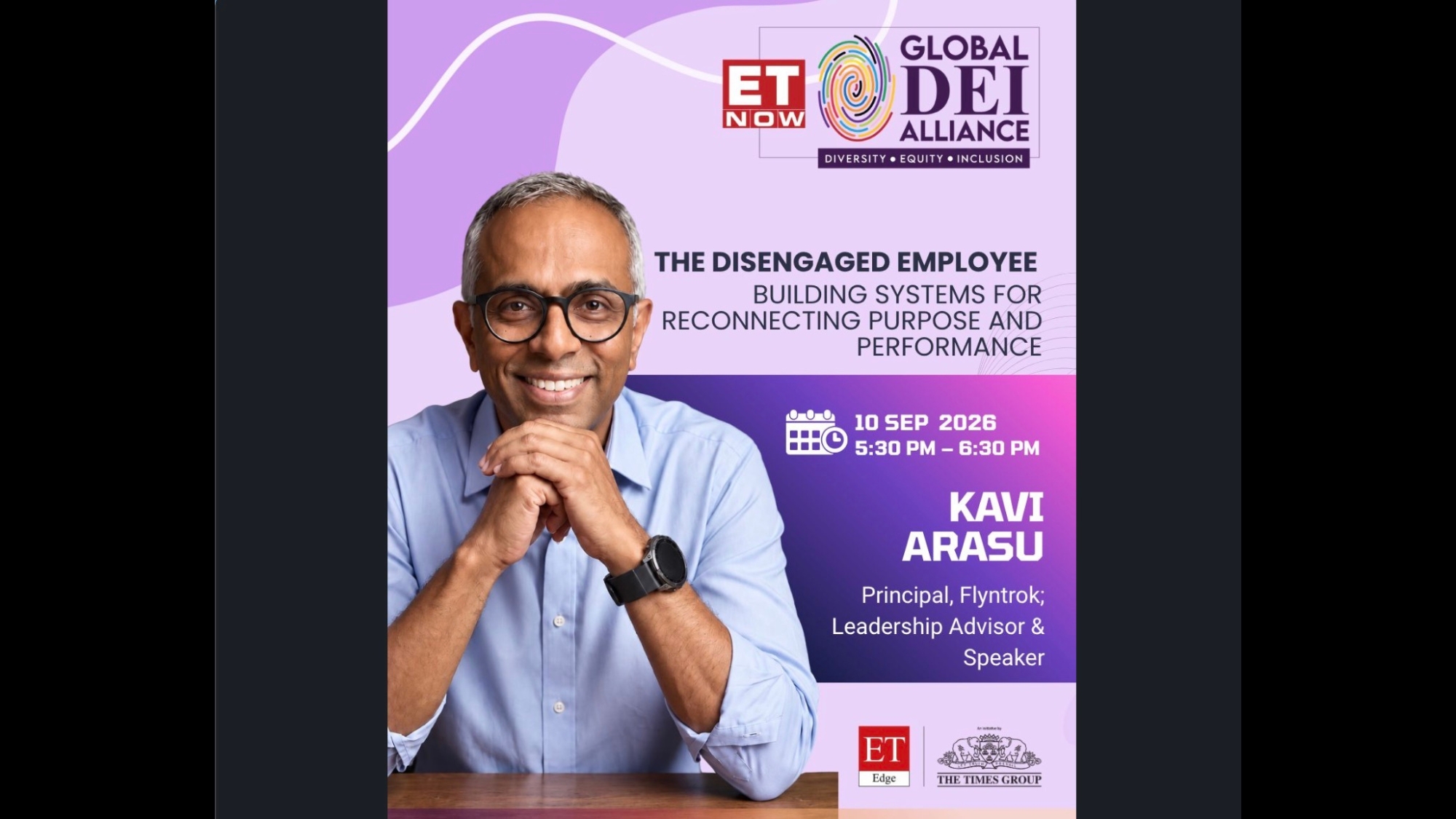
The session was the ET Now Global DEI Alliance conversation on 10 September 2026, an ET Edge initiative, titled The Disengaged Employee: Building Systems for Reconnecting Purpose and Performance. Anjali Mittal, who curates content for the business community, set it up and framed it. Anamika Singh, AGM of Capability and Talent Acceleration at Mahindra Susten, moderated, which meant she was asking questions about systems while building them at her day job.
Who was in the room
Professor Ernesto Noronha teaches Organisational Behaviour at IIM Ahmedabad, and he took the conversation where most engagement panels do not go. The quality of the jobs themselves. Bullying that is interpersonal, and bullying that sits inside the labour process. Grievance mechanisms that exist without being effective. He described an organisation in the south that met a serious workplace problem by recognising a union, which is not the first move anyone expects in 2026, and by his account the relationship there is now a good one.
Aditi Surana, founder of APT, a high-performance leadership coach and behavioural expert who also makes her ideas travel to a wide audience online, made the point that people do not burn out from doing more work. They burn out from doing work they did not want to do. She added that we have all mastered the skill of pretending, which is worth sitting with before the next engagement survey goes out.
An academic studying labour from inside one of the country’s best institutions, a coach who works with senior leaders one at a time, and me, working on change across sectors. Three vantage points, one floor.
The bit I keep returning to
Someone in the chat asked how leaders tell healthy adaptability apart from exhaustion dressed up as resilience. I suspect that question came from lived experience.
My answer was about digestion. Organisations watch the world outside, decide something must change, and launch. Before the change is absorbed, the outside moves again, so another initiative lands on top of the first. We keep snacking on fast food for change. Long enough on that diet and you get indigestion, then ill health. Cohen and Levinthal gave this a name in 1990, and I have written about absorptive capacity at greater length elsewhere.
The skill this asks of a leader is unglamorous. It is the ability to say no to a real change happening in the real world, not for want of money or nerve, and because the last one is still going down.
Ryan and Deci settled the engagement question decades ago. Autonomy, competence, relatedness. Unless the work itself carries those, and the conversations at work are real ones, balloons and a cake in the afternoon will not move anything. The man with three programmes left on his menu was not disengaged. He was doing precisely what the system asked of him.
So the question I left the room with, and leave here. How do we help an organisation understand digestion when all it has to see with is a dashboard?