

Yesterday, I completed an audit of the year. I counted things. Books finished. Posts written. Work delivered. It felt good. Numbers tend to behave themselves, which is more than can be said for most of life.
But numbers are polite. They tell you what happened. They rarely tell you what it cost.
This piece stays with what the numbers were quietly pointing to, while I was busy admiring them.
What Seemed to Work
Quite a few things worked this year, and it would be churlish not to acknowledge them.
I read nine books, properly and without hurry. I have not done that in years. In a world that rewards skimming, scrolling, and nodding along to things one has not actually read, this felt like a small act of resistance. Or stubbornness. Possibly age.
More than sixty blog posts also escaped my head and entered the world. That has not happened in a long time either. Writing returned as a habit, not as an occasional ceremony involving coffee, good intentions, and eventual disappointment. If 2025 had a quiet win, this was it.
Ten pieces appeared in Founding Fuel. That mattered far more than the number suggests. The editing was demanding in the best way. Soft ideas did not survive. Better ones came back leaner and sharper. The conversations that followed were longer, deeper, and occasionally uncomfortable, which is usually how you know something worked.
I enrolled in three courses. I completed two. One remains, politely reminding me of its existence every few weeks. Each asked for time, money, and attention. All of them gave something back, which already puts them ahead of many commitments that quietly take all three and return very little.
At work, there were fresh experiments. New formats. New ways of framing familiar problems. These required courage and a fair amount of gumption, or at least the ability to sound as if I had both. Some ideas surprised me by working better than expected. A few even behaved sensibly.
I also stayed away from the news more than usual, and this time it was deliberate. It had been charging rent in my head without doing much useful work. The daily cycle is loud, repetitive, and faintly theatrical. It feels urgent while you are inside it, and oddly empty once you step out. I realised I was spending more time being informed than being wiser.
So I changed how I paid attention. I watched actions, not announcements. What actually moved once the cameras left. With the help of some outstanding friends, I stayed loosely connected to what mattered. Less churn. More patterns. It felt healthier, and oddly more informed. Not indifferent. Just clearer. This is special.
I travelled to new places this year. I will write about them in a separate post. I also worked on some relationships. They get a paragraph here. The difference between a full post and a paragraph probably says more about the distance covered in each than any honest accounting ever could.
If I stopped here, the year would look solid.
Which is exactly where trouble usually begins.
What Stayed Standing
Other things never quite worked, but they also refused to fail properly.
A few projects quietly became something else. They did not collapse. They simply declined to become what I had imagined. They stayed alive in an awkward middle state. These are worse than failures. A failure ends the story. A half-working project keeps clearing its throat and asking for attention.
Some habits looked productive while slowly draining energy. Days filled themselves effortlessly. Messages were answered. Meetings multiplied, as meetings always do, regardless of whether anyone invited them. Everything appeared under control. Over time, it became harder to tell whether effort was producing momentum or merely the appearance of it.
Health did not collapse. It was fitness slipped badly.
Family time did not disappear. It thinned. There is a suitcase that spent more time with me than my family did, which is not an achievement I intend to repeat.
No alarms went off. No urgent intervention was required. This is how deeper problems usually arrive. Quietly. Gradually. With excellent manners.
Relationships followed a similar pattern. Some were cared for properly. Conversations deepened. Trust grew. Others survived mainly because people were generous. Kindness covered many small absences. Kindness is wonderful like that. It also postpones reckoning.
I renewed connections with classmates from school, which was special. At the same time, there were many friends I meant to meet for coffee. These intentions remained noble, heartfelt, and entirely stationary.
The Questions That Wouldn’t Go Away
Even the things that worked left questions behind.
Did writing become my refuge as much as my craft? Did reading stretch my thinking, or did it soften the edges a little too comfortably? And whatever happened to the plays, performances, and long evenings of soaking in other people’s art that I was so confident I would make room for?
The fact that these questions have come up is data enough.
I am often told I am a hard marker. I usually disagree. But sitting with this year, I can see why the reputation exists.
It is easy to manage appearances. Outputs help. Stories help too. But it is much harder to mislead oneself for long. Somewhere beneath the busyness, I know what is alive and what is running on habit. I know which efforts deserve energy and which ones continue mainly because stopping would require explanation. I also know which win I wanted but did not get. No amount of other credit quite fills that gap. And that is that.
Carrying the Right Questions Forward
As the year closes, a familiar set of questions stops being polite and starts lingering.
What should I start? What should I stop? What should I do more of? What should I do less of?
Most years, these are treated like planning prompts. Lists are made with enthusiasm. Intentions are declared confidently. The calendar listens, nods, and then carries on exactly as before.
This year, the questions feel urgent. Not only because time is sprinting away, but because attention leaks are more than frustrating. These are not productivity questions. They are system questions. They ask where life actually goes once motivation gets bored and habit takes over the controls.
One question, in particular, refuses to leave.
What would I stop doing next year, even if it still sort of works?
This matters because what still works is rarely challenged. It is functional, defensible, and comfortably respectable. It quietly sets the ceiling on change. Most decline does not arrive loudly. It arrives wearing slippers and saying, “This will do.”
Wanting change turns out to be mostly decorative. Deciding helps, but not much. Without changing the system around attention, behaviour stays put. This is the point James Clear makes plainly. You do not rise to your goals. You sink to your systems.
Which makes the work ahead refreshingly practical.
What the calendar protects.
What friction gets added.
What gets removed without ceremony.
What is designed so the better choice stops requiring willpower.
This is where reflection stops being writing and starts becoming proof. Defaults win when left alone. Comfort compounds faster than effort. “Later” has a remarkable way of becoming “never.”
So the aim is not a dramatic reset. It is a structural one. Fewer defaults. Clearer constraints. Lighter suitcases. More room for what actually deserves to stay. Once the system shifts, behaviour usually follows. Quietly. Reliably. Without heroics.
That is the urgency. And that, inconveniently, is the work.
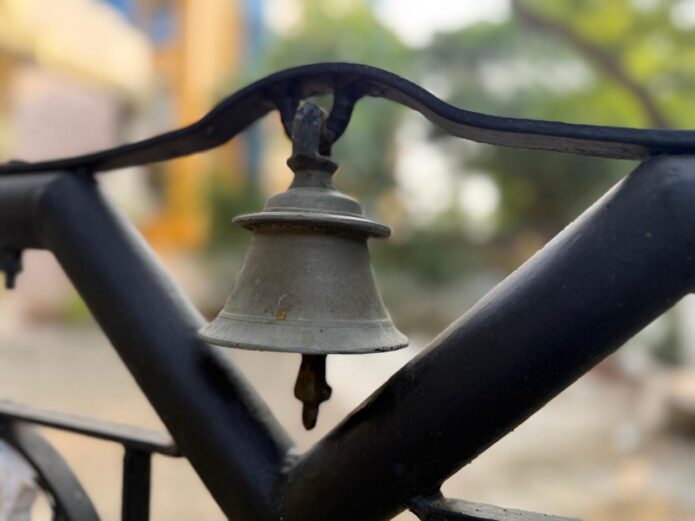
Somewhere between cheer and caution, a bell does its job. It doesn’t explain itself. It simply rings. Paying attention is left to the listener.
Merry Christmas. May your defaults behave themselves for a few days.
Thanks for sharing – it is in a way, everyone’s story.
The final question is “Am I on the right path of ‘becoming myself’ as Warren Bennis puts it.”
The answer in your case is obviously a big yes, and that makes this post so inspiring.
Thanks again for sharing,
Hi Kavi. Thankyou for sharing . Your level of self awareness and intentionality is inspiring. I respect you for living a meaningful life. Thankyou for sharing
Thanks for sharing this, Kavi. You write often in what Instagram has named a filter Nostalgia…your words always read sepia-toned to me. Every time I read you, I’m reminded of things that routine makes us forget. When you write, “But it is much harder to mislead oneself for long…,” I can’t help but smile. Writing, as you say, is a refuge to stop getting misled and get on track. Happy holidays, and thank you for being a bright part of my year Kavi! 🙂
Thank you Kavi for sharing in all honesty
Enjoyed reading your thoughts and my two bits worth is just create two SMART goals for 2026 of which family quality time is a suggestion to consider
Have a splendid 2026 and yes we will have that long pending coffee someday!
Thank you Kavi! Blurting out the truth is so you! Makes me wonder where I am headed…Merry Christmas and a Happy New year!
( Fewer defaults. Clearer constraints. Lighter suitcases. More room for what actually deserves to stay. Once the system shifts, behaviour usually follows. Quietly. Reliably.)
Terrific insight . Poignant one. A big take away for me as a reader is that , ‘ Systems Thinking ‘ works, not only for organizations , Start up s and MSMB s but also at individual level . And that, our daily behavior is just a function or an off shoot of our System .
( I enrolled in three courses. I completed two. One remains . Each asked for time, money, and attention. All of them gave something back )
This is a terrific achievement too . You seem to have made wise and right professional decisions in choosing those courses . That all of them ‘ gave something back ‘ , not many people can say this with satisfaction ! All the best in 2026 !
Thanks for this quiet reflection Kavi. I needed a reminder of the slow declines that arrive politely wearing slippers, looking back, this year feels filled with them, the trick would be to identify them honestly.
Saying no to things that still sort of work had been a theme for me for a while, as I discover things that used to work really well in 2015, no longer work quite that well, but feels comfortable like the pair of shoes that are long out of style. I need to get better at letting them go. Without drama, without aggression, quietly telling them – Marie Kondo style – Thank you for your service.
Wanting to stop doing things that work..? That’s deep Kavi… May be another roost on that some time …I am sure that would open many more questions than answers …
As usual, your writings are a soup to the soul
Kavi what you have done here is truly remarkable.You have done a gentle,and yet ,candid analysis of 2025 and with yourself at the centre.You have stripped off the layer of comforting delusions and cosy half truths which is our thinking process throughout the year and particularly the year end.I entirely endorse many of the lessons and conclusions that you have unravelled before the reader and helped everybody (at least me)to polish my lenses to see where I wish to be this time in 2026.
My personal Felicita toons to you for your candour and courage.Might I be permitted to say that you’ll “never walk alone”
Tomorrow, I’ll write too!
Brave reflections. Gentle nudges. Kind reminders.
What stood out to me was the reference from James Clear. Maybe it is because a lot of what I think about is how people tend to get the attention, when systems should.
Everyone sinks to the level of the system they work in, yet we keep urging them to rise above it. Most systems are forgiving; they quietly absorb and conceal our weaknesses. But when a system turns unforgiving, it is the people it exposes who are denied forgiveness.
Tomorrow never comes.
Ah, tomorrow. That ever so reliable organiser of intentions!
Fairness is a human construct. Forgiveness even more so. Systems rarely bother with either. They just do what they’re designed to do, quietly amplifying strengths and politely exposing weaknesses when the weather changes.
Perhaps the real work is simpler. Pay attention sooner. Adjust earlier. And be a little kinder to people caught inside systems that were never built with kindness in mind.
As for tomorrow, does it not have an impressive track record!
Thank you Kavi for sharing this link with me. I highlighted several points that stood out for me because they touched something inside myself:
• A half-working project keeps clearing its throat and asking for attention.
• (relationships) Others survived mainly because people were generous. Kindness covered many small absences
• What should I start? What should I stop? What should I do more of? What should I do less of?
• “Later” has a remarkable way of becoming “never.”
• Once the system shifts, behaviour usually follows. Quietly. Reliably. Without heroics.
Your own comments above hit hard: As for tomorrow, does it not have an impressive track record!
I’m currently working on an article based on my past 20 years of research and AI. I’d love to share it with you (privately) before I submit it for publication.
It has to do with system shifts and impact on behavior, or should I say how behaviors make systems shift.
Let’s stay in better touch in 2026. As you said about relationships: “Others survived mainly because people were generous. Kindness covered many small absences.”
warm regards,
Jane
Thanks much for this Jane. I would love to read the article. I look forward to to stay in touch better in 2026 for sure.