Twenty-five years ago I rang an ISABS office before my first human process lab. I had one urgent question. Was there a dress code? Should I wear a tie?
The lady on the phone laughed. She said, just show up.
I have attended several process labs since. And have recommended it even more.
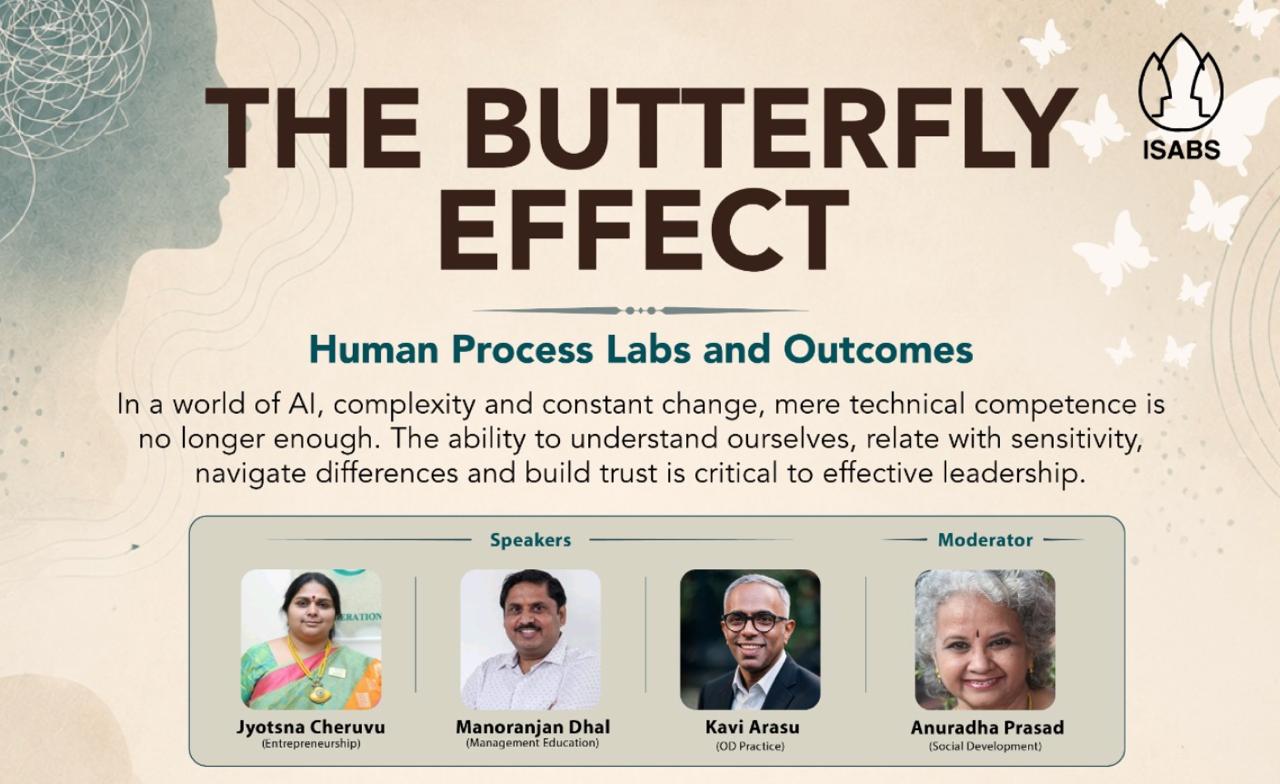
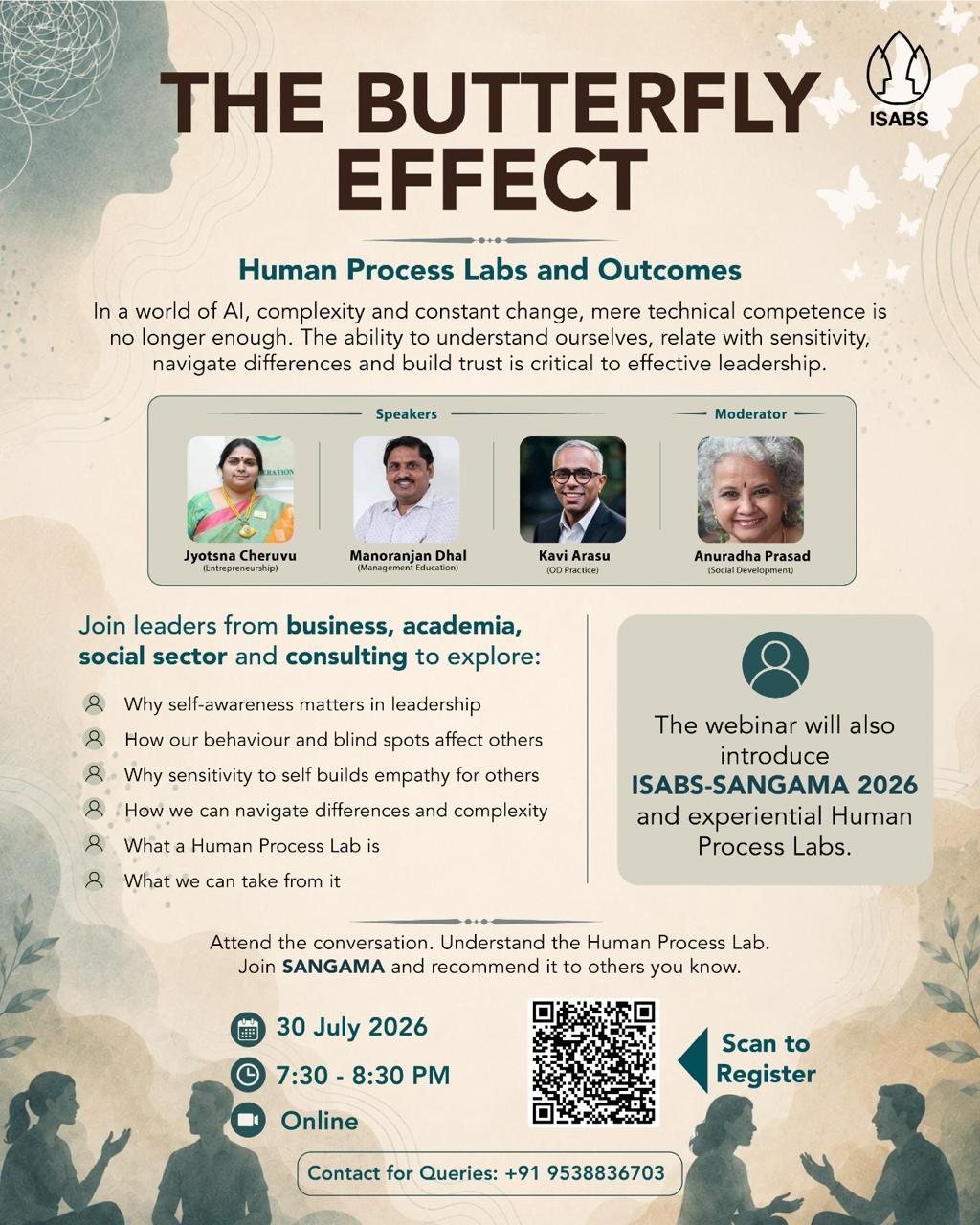
Recently, I was on an ISABS panel called The Butterfly Effect. Someone asked about my early days. Three things came back to me. None of them are complicated. That is rather the point.
The panel was a good spread, which is rather the point. Manoranjan Dhal teaches organisational behaviour at IIM Kozhikode and heads its labour studies centre. Jyotsna Cheruvu is a Hyderabad based entrepreneur, an engineer who runs a business and champions women in enterprise. Anuradha Prasad, who moderated, is a long-standing process facilitator. Four people who would not otherwise share a room.
That is where the mirror comes from.
What a human process lab actually teaches
The first thing happened in an opening plenary. We sat in a circle and each offered a single word. Mine was struggle. I wore it with some pride. We struggled, we came through, we earned our place. That was the story I told myself.
Someone across the circle said joy. Just that. The lightness of it.
I still think about how small that moment was. A stranger, a word, a circle of chairs. And yet it was the first time I let myself believe there might be another way to be. A lighter way. Possibly a better one. I started to laugh at myself a little. That was new.
The second thing was about other people. The groups were always mixed. Backgrounds I would never have sat with for so long, at such depth. I got a mirror from them. Parts of myself I could not have seen on my own.
You stop sorting people into right and wrong. You take them as they arrive, in the here and now. That has held up in work and in life. It is one of the few things I trust completely.
The third thing is the hardest to explain. The method is simple. You sit down. You talk. Then you sit down and talk some more.
People ask me what happens in a lab. I say, you talk to each other. Then what? You keep talking. The simplicity makes it almost impossible to describe. It also makes it real.
It has become my standard for change work. Can people sit in a room and work it out between themselves? If the answer needs a toolkit, I get suspicious.
Why simple matters now
We have grown allergic to not knowing. I book a cab and watch the screen. If it is a minute late I refresh three times. Where is it now? Where is it now?
People come to work wanting the same thing. Guarantee me where I will be in three years. And the world outside cannot guarantee anything.
A human process lab is one of the few places I know where you sit inside the not knowing. You watch the discomfort in a small group. You watch it churn. And then, slowly, you watch it change. People do change.
Change asks something of us though. It asks us to loosen our grip on who we already are. That can feel like a small death. Really it is just room being made.
I remember my first facilitator, Rusi Engineer. We stayed in touch long after the lab. He is gone now. He showed me how much can happen when nothing dramatic is happening at all.
So I keep going back, because I have not arrived. After my first lab I was not ready to run into the next one immediately. I needed time to digest. Then one morning it was simply, right, again.
Maybe that is the whole thing. You show up. You get a mirror. You let go of a little. You come back. Do you have a place that does that for you?